Henry Singleton
Founder and CEO of Teledyne
Where to hear and read about Henry Singleton1 episode or test
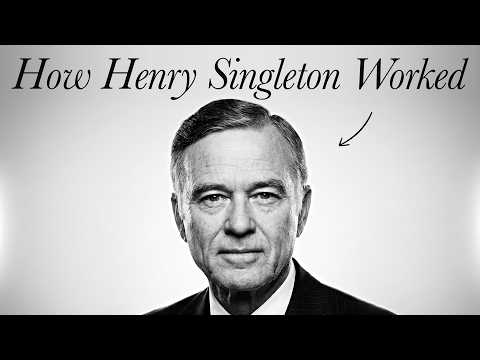
Henry Singleton was a mathematician and engineer who founded Teledyne at 43 and, as CEO until 1990, returned 20.4% a year for almost 30 years, turning $1 invested in 1963 into about $180. The lesson most worth taking from him is that a CEO's central job is allocating capital, and that doing it well means changing tactics as prices change and ignoring what the crowd is doing.
If everyone's doing them, there must be something wrong with them.
How Henry Singleton Worked
Henry Singleton: the story and the lessons
1Henry Singleton's path from scientist to founder
Singleton was a gifted scientist long before he ran a company. Born in 1916 in a tiny Texas town, he took three MIT degrees, won the Putnam Medal in 1939 and programmed MIT's first computer for his doctorate.
In World War II he built technology that let Allied ships avoid radar detection, and in the 1950s he created an aircraft guidance system still used in most military and commercial planes. He never earned an MBA.
He played chess blindfolded and studied how markets value growth. He once caught a wrong move reported three moves earlier, and in the 1940s and 50s he watched brokerage tickers to learn how markets priced growth.
He also studied the growth of Ford and General Motors and how firms grew by acquisition. His friend Claude Shannon, creator of information theory, later sat on Teledyne's board for about 26 years.
He left Litton when his boss rejected his semiconductor bet. Singleton believed digital technology would take over control systems, but Litton's leadership said semiconductors were too crowded. Once it was clear he would not succeed Tex Thornton, he left in 1960.
At 43, with no prior startup, he co-founded Teledyne with $450,000. He entered semiconductors "because of our conviction that it was necessary for our long-term future growth," even during a business crisis.
2How Singleton built Teledyne by acquisition in the 1960s
He used Teledyne's high-priced stock to buy cheaper companies. From 1961 to 1969 he bought about 130 companies, nearly all paid for with Teledyne stock that traded at a higher multiple than the targets.
Teledyne began with three small electronics firms, won a large naval contract and went public in 1961. There was no private equity competing for deals then, so targets often sold at lower multiples than Teledyne's own.
He bought profitable niche leaders and avoided turnarounds. Unlike peers who bought indiscriminately, he targeted growing companies with leading positions in narrow markets, and bought 90 of them from 1966 through 1969 alone.
Jack Hamilton, who ran specialty metals, described them as "high margin products that were sold by the ounce, not the ton."
He grew Teledyne like a plant so no business mattered too much. He wanted to build "another GE, not another Litton," so each business opened the way to related ones, and acquired managers often proposed the next purchase.
Seismic products led into oceanography, then offshore oil exploration, then wider petroleum work. He described Teledyne as "like a living plant with our companies as the different branches."
He cut losses fast when a business turned bad. Teledyne bought Packard Bell for $16.5 million in stock plus $5 million of assumed debt, and Singleton closed its television operation once Japanese competition became too severe.
A colleague said "Henry was never shy about cutting his losses."
3Why Singleton stopped acquiring and started buying back stock
He quit acquiring the moment his stock stopped being cheap currency. In mid 1969, as Teledyne's multiple fell, acquisition prices rose and rival conglomerates bid for the same companies, he dismissed his acquisition team.
Teledyne never made another material purchase or issued another share. His reasoning: "I won't pay 15 times earnings. That would mean I'd only be making a return of 6 or 7%," which T-bills already paid.
Once his stock was cheap, he bought it back harder than anyone. Eight tender offers from 1972 to 1984 retired about 90% of Teledyne's shares and returned 42% a year to shareholders.
Wall Street then read buybacks as weakness. He said, "I think we can earn a better return buying our shares at these levels than by doing almost anything else," and compared it to coiling a spring. Munger said no one had ever bought his shares as aggressively.
He bought pieces of public companies instead of whole ones. A stock at 6 or 7 times earnings cost 12 to 14 times in an acquisition, so his insurers bought minority stakes instead, with over 70% in five companies and 25% in Litton.
He moved during the severe mid 1970s bear market, buying businesses he knew well at near-record-low P/E ratios. "There are tremendous values in the stock market, but in buying stocks, not entire companies."
He held large stakes without ever seeking control. By 1977 Teledyne was the largest shareholder in nine Fortune 500 companies and could have controlled six, yet he never sought a board seat.
A Curtiss-Wright spokesman said "He's been absolutely scrupulous in staying out of our affairs." Singleton's own line: "Buying and selling companies is not our bag."
4Henry Singleton on capital allocation as the CEO's real job
Singleton saw two CEO jobs and favored the one others neglect. The jobs are running operations and deploying the cash they generate. He gave most of his attention to the second and stepped back from operations after George Roberts became president in 1967.
Buffett notes most CEOs rise through marketing, production, engineering or politics, so allocating capital is a job they have never done, like a musician made chairman of the Federal Reserve.
He measured success by per-share value, not size. His beliefs all pointed at per-share value and independence, and he saw his own stock as potentially the best investment available.
He had no single powerful idea, only a pragmatic focus on cash. Buffett said he had the best operating and capital deployment record in American business.
He kept his own job undefined to stay flexible. He reserved no routine duties and defined the job as freedom "to do whatever seems to be in the best interest of the company at any time."
That let him switch from acquirer in the 1960s to repurchaser and stock investor in the 1970s as conditions changed.
5How Singleton ran 40,000 people with under 50 at headquarters
He broke Teledyne into the smallest possible units. Teledyne had over 40,000 employees but fewer than 50 at headquarters, with no human resources or investor relations departments.
He rejected the fashionable ideas of integration and synergy, believing small units gave better control and made each local manager fully responsible for results.
He paid managers on a metric that averaged cash and profit. The Teledyne return was net income plus cash flow divided by two, and set every unit manager's bonus. A unit with $1 million profit but $500,000 cash scored $750,000.
It exposed managers who padded earnings with inventory or generous credit and gave headquarters one number per unit. He told managers to "tell us about the rest of the profit when you get it."
He kept acquired founders in place and left them alone. Most owners stayed on, and a monthly reporting system flagged trouble before it became serious. In 1979 only one of about 130 profit centers lost money.
Those managers "knew more about their specific businesses than we did." On people: "Why bother them if they are doing their job?" and "we work our heads off to increase our own capability at collecting and promoting the right people."
He prized managers who knew their numbers cold. He praised a group executive, Russ, for giving last month's sales for any company he supervised without calling anyone.
Singleton sweated details himself, once lying on the floor debating the exact proportions of the Teledyne logo.
He pointed managers at outside rivals, not each other. He told every manager the real competitors were "all the other large corporations in the US," and treated beating their earnings growth as a game.
This kept independent units pulling in the same direction. He taught his philosophy one on one, over coffee, in his office and at cheap lunches.
6Henry Singleton's rules for thinking long term and alone
He ignored Wall Street conventions and still beat his peers. He paid no dividends, never split the stock, gave no quarterly guidance and refused to talk to analysts or journalists, which earned him the name the Sphinx.
In a rare 1979 interview he said his cash-flow approach "came out of our own thinking. It is not copied." One profile described him as someone who "watches the thundering herd then trots off in his own direction."
He distrusted popular ideas, even ones he pioneered. Two years before he died at 82, asked about new Fortune 500 buybacks, he answered that if everyone was doing them, something must be wrong with them.
He had been the buyback pioneer, so his suspicion was of the crowd, not the tool.
He accepted lumpy earnings to maximize cash. He warned that "our quarterly earnings will jiggle" because the accounting was set for cash flow, yet from 1970 the company was consistently profitable across very different markets.
He called boosting the stock by swapping divisions repulsive: "We'd rather get something permanent, and that takes time." Pressed on spin-offs: "You're thinking in the short term. I'm in the long term."
He refused long-range plans and steered day by day. He distrusted detailed strategic plans because most outside events cannot be predicted.
"My only plan is to keep coming to work. I like to steer the boat each day rather than plan ahead way into the future."
He stayed frugal and signed every check to learn the business. He took colleagues to a cheap poker parlor and had them pay, wanted Pintos as company cars, and in retirement signed every check for his ranch.
"Through doing the signing, it's amazing how much you learn about the business." He never sold a house, ranch or lot and was among the largest US landowners at his death.
7How Munger, Buffett and Shannon saw Henry Singleton
Munger called Singleton the smartest person he ever knew. He put Singleton's raw intelligence in the top 1,000th of 1% and called his returns "a mile higher than anyone else's."
Munger added that Buffett made up for it with time: "Henry was a lot smarter, but Warren had thought about investments a lot longer." Singleton invested Teledyne's cash for roughly 20 years, from about age 50 to 70.
Singleton ran Berkshire's playbook before Buffett did. Both ran decentralized firms with tiny staffs, gave no guidance, held concentrated stocks in industries they knew, and relied on insurance float as their largest business.
William Thorndike calls Singleton a "proto Buffett," and Buffett called it a crime that business schools did not study him.
Shannon saw his silence as a chess player's discretion. Shannon said Singleton always tried to work out the best moves, and in a game you don't tell anyone your strategy.
Singleton shrugged off his record: "Anyone can swing a club, but some of us do swing it better than others." A recruiter who met him at MIT saw warmth under the reserve.

How Henry Singleton Worked
Henry Singleton built Teledyne on the belief that a CEO's main job is allocating capital, while operations run through extreme decentralization. He bought back over 90% of Teledyne's shares and returned 20.4% a year for almost 30 years, turning $1 in 1963 into about $180 by 1990.
Singleton was a gifted scientist long before he ran a company. Born in 1916 in a tiny Texas town, he took three MIT degrees, won the Putnam Medal in 1939 and programmed MIT's first computer for his doctorate.
In World War II he built technology that let Allied ships avoid radar detection, and in the 1950s he created an aircraft guidance system still used in most military and commercial planes. He never earned an MBA.
He played chess blindfolded and studied how markets value growth. He once caught a wrong move reported three moves earlier, and in the 1940s and 50s he watched brokerage tickers to learn how markets priced growth.
He also studied the growth of Ford and General Motors and how firms grew by acquisition. His friend Claude Shannon, creator of information theory, later sat on Teledyne's board for about 26 years.
He left Litton when his boss rejected his semiconductor bet. Singleton believed digital technology would take over control systems, but Litton's leadership said semiconductors were too crowded. Once it was clear he would not succeed Tex Thornton, he left in 1960.
At 43, with no prior startup, he co-founded Teledyne with $450,000. He entered semiconductors "because of our conviction that it was necessary for our long-term future growth," even during a business crisis.
He used Teledyne's high-priced stock to buy cheaper companies. From 1961 to 1969 he bought about 130 companies, nearly all paid for with Teledyne stock that traded at a higher multiple than the targets.
Teledyne began with three small electronics firms, won a large naval contract and went public in 1961. There was no private equity competing for deals then, so targets often sold at lower multiples than Teledyne's own.
He bought profitable niche leaders and avoided turnarounds. Unlike peers who bought indiscriminately, he targeted growing companies with leading positions in narrow markets, and bought 90 of them from 1966 through 1969 alone.
Jack Hamilton, who ran specialty metals, described them as "high margin products that were sold by the ounce, not the ton."
He grew Teledyne like a plant so no business mattered too much. He wanted to build "another GE, not another Litton," so each business opened the way to related ones, and acquired managers often proposed the next purchase.
Seismic products led into oceanography, then offshore oil exploration, then wider petroleum work. He described Teledyne as "like a living plant with our companies as the different branches."
He cut losses fast when a business turned bad. Teledyne bought Packard Bell for $16.5 million in stock plus $5 million of assumed debt, and Singleton closed its television operation once Japanese competition became too severe.
A colleague said "Henry was never shy about cutting his losses."
He quit acquiring the moment his stock stopped being cheap currency. In mid 1969, as Teledyne's multiple fell, acquisition prices rose and rival conglomerates bid for the same companies, he dismissed his acquisition team.
Teledyne never made another material purchase or issued another share. His reasoning: "I won't pay 15 times earnings. That would mean I'd only be making a return of 6 or 7%," which T-bills already paid.
Once his stock was cheap, he bought it back harder than anyone. Eight tender offers from 1972 to 1984 retired about 90% of Teledyne's shares and returned 42% a year to shareholders.
Wall Street then read buybacks as weakness. He said, "I think we can earn a better return buying our shares at these levels than by doing almost anything else," and compared it to coiling a spring. Munger said no one had ever bought his shares as aggressively.
He bought pieces of public companies instead of whole ones. A stock at 6 or 7 times earnings cost 12 to 14 times in an acquisition, so his insurers bought minority stakes instead, with over 70% in five companies and 25% in Litton.
He moved during the severe mid 1970s bear market, buying businesses he knew well at near-record-low P/E ratios. "There are tremendous values in the stock market, but in buying stocks, not entire companies."
He held large stakes without ever seeking control. By 1977 Teledyne was the largest shareholder in nine Fortune 500 companies and could have controlled six, yet he never sought a board seat.
A Curtiss-Wright spokesman said "He's been absolutely scrupulous in staying out of our affairs." Singleton's own line: "Buying and selling companies is not our bag."
Singleton saw two CEO jobs and favored the one others neglect. The jobs are running operations and deploying the cash they generate. He gave most of his attention to the second and stepped back from operations after George Roberts became president in 1967.
Buffett notes most CEOs rise through marketing, production, engineering or politics, so allocating capital is a job they have never done, like a musician made chairman of the Federal Reserve.
He measured success by per-share value, not size. His beliefs all pointed at per-share value and independence, and he saw his own stock as potentially the best investment available.
He had no single powerful idea, only a pragmatic focus on cash. Buffett said he had the best operating and capital deployment record in American business.
He kept his own job undefined to stay flexible. He reserved no routine duties and defined the job as freedom "to do whatever seems to be in the best interest of the company at any time."
That let him switch from acquirer in the 1960s to repurchaser and stock investor in the 1970s as conditions changed.
He broke Teledyne into the smallest possible units. Teledyne had over 40,000 employees but fewer than 50 at headquarters, with no human resources or investor relations departments.
He rejected the fashionable ideas of integration and synergy, believing small units gave better control and made each local manager fully responsible for results.
He paid managers on a metric that averaged cash and profit. The Teledyne return was net income plus cash flow divided by two, and set every unit manager's bonus. A unit with $1 million profit but $500,000 cash scored $750,000.
It exposed managers who padded earnings with inventory or generous credit and gave headquarters one number per unit. He told managers to "tell us about the rest of the profit when you get it."
He kept acquired founders in place and left them alone. Most owners stayed on, and a monthly reporting system flagged trouble before it became serious. In 1979 only one of about 130 profit centers lost money.
Those managers "knew more about their specific businesses than we did." On people: "Why bother them if they are doing their job?" and "we work our heads off to increase our own capability at collecting and promoting the right people."
He prized managers who knew their numbers cold. He praised a group executive, Russ, for giving last month's sales for any company he supervised without calling anyone.
Singleton sweated details himself, once lying on the floor debating the exact proportions of the Teledyne logo.
He pointed managers at outside rivals, not each other. He told every manager the real competitors were "all the other large corporations in the US," and treated beating their earnings growth as a game.
This kept independent units pulling in the same direction. He taught his philosophy one on one, over coffee, in his office and at cheap lunches.
He ignored Wall Street conventions and still beat his peers. He paid no dividends, never split the stock, gave no quarterly guidance and refused to talk to analysts or journalists, which earned him the name the Sphinx.
In a rare 1979 interview he said his cash-flow approach "came out of our own thinking. It is not copied." One profile described him as someone who "watches the thundering herd then trots off in his own direction."
He distrusted popular ideas, even ones he pioneered. Two years before he died at 82, asked about new Fortune 500 buybacks, he answered that if everyone was doing them, something must be wrong with them.
He had been the buyback pioneer, so his suspicion was of the crowd, not the tool.
He accepted lumpy earnings to maximize cash. He warned that "our quarterly earnings will jiggle" because the accounting was set for cash flow, yet from 1970 the company was consistently profitable across very different markets.
He called boosting the stock by swapping divisions repulsive: "We'd rather get something permanent, and that takes time." Pressed on spin-offs: "You're thinking in the short term. I'm in the long term."
He refused long-range plans and steered day by day. He distrusted detailed strategic plans because most outside events cannot be predicted.
"My only plan is to keep coming to work. I like to steer the boat each day rather than plan ahead way into the future."
He stayed frugal and signed every check to learn the business. He took colleagues to a cheap poker parlor and had them pay, wanted Pintos as company cars, and in retirement signed every check for his ranch.
"Through doing the signing, it's amazing how much you learn about the business." He never sold a house, ranch or lot and was among the largest US landowners at his death.
Munger called Singleton the smartest person he ever knew. He put Singleton's raw intelligence in the top 1,000th of 1% and called his returns "a mile higher than anyone else's."
Munger added that Buffett made up for it with time: "Henry was a lot smarter, but Warren had thought about investments a lot longer." Singleton invested Teledyne's cash for roughly 20 years, from about age 50 to 70.
Singleton ran Berkshire's playbook before Buffett did. Both ran decentralized firms with tiny staffs, gave no guidance, held concentrated stocks in industries they knew, and relied on insurance float as their largest business.
William Thorndike calls Singleton a "proto Buffett," and Buffett called it a crime that business schools did not study him.
Shannon saw his silence as a chess player's discretion. Shannon said Singleton always tried to work out the best moves, and in a game you don't tell anyone your strategy.
Singleton shrugged off his record: "Anyone can swing a club, but some of us do swing it better than others." A recruiter who met him at MIT saw warmth under the reserve.