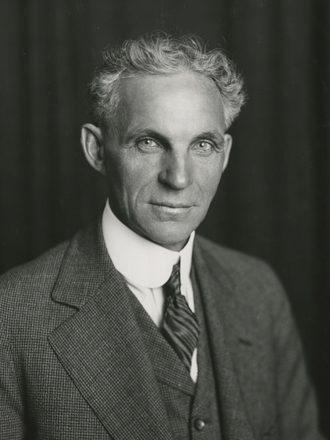
Henry Ford
Founder of Ford Motor Company and maker of the Model T
Where to hear and read about Henry Ford1 episode or test

Henry Ford founded Ford Motor Company and built the Model T, the first mass-produced car, after 12 years and eight earlier models spent chasing one idea: a good, simple car priced so almost anyone could own one. The lesson most worth taking from him is that relentless waste cutting, a price set before the cost, and patient focus on serving the customer can turn a single idea into a giant company.
It has been thought that business existed for profit. That is wrong. Business exists for service.
Henry Ford's Autobiography
Henry Ford: the story and the lessons
1Henry Ford's path from farm boy to car builder
Ford grew up on a farm wanting machines to replace hard labor. At 12 he saw a road engine, the first vehicle he had seen that was not horse drawn, and he never forgot it.
His father wanted him to farm, and he was all but given up for lost when he became a machine shop apprentice at 17. "My toys were all tools and they still are."
He saw the car as freeing farmers and replacing the horse. Farmers rarely went to town more than once a week, and Ford judged that horses, with their care and feed, did not earn their keep.
He wanted to make cars in quantity: not five a day, but five every 2 minutes.
He built his first car on nights and Sundays. While working at the Detroit Electric Company, Ford worked on his gas engine every night and all of Sunday, finishing his first motorcar in 1892.
It was the only automobile in Detroit, and he needed a special permit from the mayor to drive it. "No work with interest is ever hard."
Ford bet on the gas engine while experts backed steam and electric. The wise people had shown the gas engine could not compete with steam, but Ford thought steam could explode and electric cars could not travel far.
Few thought the internal combustion engine would have more than limited use.
He quit a secure job with no money to build cars. Earning $125 a month as chief engineer, he was offered the general superintendency if he dropped the gas engine, and he left on August 15, 1899.
His wife agreed they had to make or break. "I had to choose between my job and my automobile and I chose my automobile."
Ford expected no demand for a new product at first. The horseless carriage was seen as a freak notion and a toy, and no man of money saw it as a commercial possibility.
The most optimistic hoped it might grow into something like the bicycle.
2How Ford used racing and control to found Ford Motor Company
Ford left his first company because it wanted luxury cars. As chief engineer with a small stake, he spent three years there selling very few cars, and the company wanted expensive cars made to order at the highest price.
He found the luxury car repulsive, rented a one-story shed, and kept experimenting to learn what the automobile business really was.
Racing gave him advertising the public would actually read. The public thought nothing of a car unless it beat other cars, so Ford built race cars and won his first race at the Grosse Pointe track.
He would not drive his scariest car, the 999, so a fearless driver took it. "This 999 advertised the fact that I could build a fast motor car."
He formed Ford Motor Company a week after the 999 race. Short of funds, he started with a minority share, and the early company only assembled bought-in parts.
It was more warehouse than factory at the start.
Ford bought control so no partner could dilute his one idea. In 1906 he used his earnings to raise his stake to 51%, and by 1919 he had bought out all investors and owned 100%.
His associates did not believe he could hold the company to a single model. "I have to have control."
3How Henry Ford built the Model T around one idea
Ford held one idea for decades: a quality car everyone could afford. He promised a family-sized car built of the best materials and simplest design, priced so no man on a good salary could be unable to own one.
Mass production did not exist yet, so he had to invent it.
He refused real production until he had a real product. He designed eight models and spent 12 years before he had a Model T that suited him.
He argued the factory, organization, selling and financial plans will shape themselves to the product.
Cutting prices proved the one-model approach before the Model T. Models at $2,000 and $1,000 sold only 1,500 cars, while models at $750 and $600 sold almost 8,500.
His partners had pushed three models, which he said scattered the company's energy.
Ford treated 100 cars a day as a start, not a finish. Alarmed stockholders wanted to stop him from ruining the company, and he told them he hoped to make a thousand a day.
"I regarded our progress merely as an invitation to do more."
He sold the car as a utility, never as a pleasure. Ford's first ads made no pleasure appeal and showed the car as a useful tool.
The same belief drove him to remove parts rather than add them: "the most beautiful things are those from which all excess weight has been eliminated."
Ford perfected one idea rather than chasing new ones. His five millionth car kept almost every point of his first gasoline buggy from about 30 years earlier, only simpler.
He said one idea at a time is about as much as anyone can handle.
The result was a car rivals could not match on speed or volume. Ford could build a car in 12 minutes that took a competitor two days, and the Model T alone sold 15 million.
4Henry Ford's method: cut waste and set the price first
Ford asked the same waste question of every part, for years. Noticing the wood in a car held 30 lbs of water, he looked for the same strength without hauling dead weight.
He had used this thinking for about 20 years before the first Model T came off the line. It is simple but slow, because it is repeated a thousand times in different places.
He counted savings to the thousandth of a cent. One cent saved on each part meant millions a year, and saving 10 steps a day for 12,000 employees cut 50 miles of wasted motion daily.
His rule: not a single operation is ever considered as being done in the best or cheapest way.
Ford set the price first and made the cost follow. He cut the price to where more sales would result, then worked out how to build at it, such as a Model T costing $490 that must sell at $300.
"We have never considered any cost as fixed."
He aimed for minimum profit per car and profit from volume. Ford sought minimum waste in materials and effort and a small margin on each car.
He said being greedy for money is the shortest way to not get it.
In slumps Ford lowered price, never quality. He said there is always a price people can and will pay for a necessity, and waste cutting let him meet it.
"It cannot be met by lowering quality it has to be met by lowering price."
5Why Henry Ford put service before profit
Ford saw profit as the result of service, never its basis. He used the word service 129 times in his 1922 book My Life and Work, and serve or serves another 55.
He saw nothing wrong with profit, since without it business cannot extend. "Money comes naturally as a result of service."
He thought business had finance and service backwards. Makers of $5,000 and $6,000 cars saw no reason to improve, since a sale was enough whether or not the buyer was satisfied.
He warned that a producer serving himself lasts only until people wake up to the fact they are not being served.
Ford lowered prices where others held them as high as possible. Old-time business kept prices at the highest point people would pay, and Ford rejected that.
Manufacturing to him meant buying materials fairly, adding the least possible cost, and delivering a usable product.
He watched customers and disregarded competitors. His creed included no fear of the future, no veneration of the past, and disregard of competition.
"There is no disgrace in honest failure, there is disgrace in fearing to fail."
Ford paid high wages because wages are families. He said wages are numbers on a cost sheet but in the world are bread boxes and coal bins, cribs and children's education.
He was also ruthless: everything and everybody must produce or get out.
6How Henry Ford thought about work, experts and learning
Ford got rid of men as soon as they thought they were experts. He said anyone who really knows his job sees so much left to do that he never stops pressing forward.
"If I ever wanted to kill opposition by unfair means I would endow the opposition with experts."
He defined education as the ability to think and do. Ford called thinking the hardest work anyone can do, and said learning continues after school.
He rejected both contempt for education and the snobbery that a degree cures ignorance.
Ford saw life as a journey of growth, not a road to retirement. He could not understand businessmen working toward the day they could retire on an income.
He said one must wake up anew every morning and keep awake all day, and that business is healthiest when, like a chicken, it must scratch for what it gets.
He had no place for idleness. Ford wrote that there is no place in civilization for the idler, and called work our sanity, self-respect and salvation.
7How Ford fixed a railroad without new money
Ford bought a railroad because it blocked his River Rouge plans. He ran it on the same rule as his car business: maximum service at minimum cost.
The risk was small because he had been a customer and saw the obvious waste.
Cutting waste turned the railroad's loss into a profit. He closed the Detroit executive office, put one man in charge, and cut payroll from 2,700 to 1,650 while freight time fell by about two thirds.
The work was paid for out of the road's own earnings.
Ford held that money cannot cure a business broken inside. He said you might as well borrow 100,000 lathes as $100,000 if the trouble is inside the business.
Easy borrowing becomes an excuse not to look at the trouble, and a pinch can show a businessman his best capital is his own brains. His own company threw off so much cash he said it needed none from outside.
8Where Henry Ford's one idea fell short
The single-model strategy lost once buyers wanted variety. Ford held over 50% of the market with one Model T, while Billy Durant and Alfred Sloan built GM on cheap, medium and luxury cars.
When the Model T tapered off, GM rose to become one of the largest companies on the planet. The two opposite philosophies each won in a different era.

Henry Ford's Autobiography
Henry Ford's autobiography lays out a single idea he held for decades: make one simple, high quality car at a price almost everyone can pay, and let waste elimination and volume do the rest. It matters because he carried that idea through 12 years of development, down to a Model T that reshaped mass production.
Ford grew up on a farm wanting machines to replace hard labor. At 12 he saw a road engine, the first vehicle he had seen that was not horse drawn, and he never forgot it.
His father wanted him to farm, and he was all but given up for lost when he became a machine shop apprentice at 17. "My toys were all tools and they still are."
He saw the car as freeing farmers and replacing the horse. Farmers rarely went to town more than once a week, and Ford judged that horses, with their care and feed, did not earn their keep.
He wanted to make cars in quantity: not five a day, but five every 2 minutes.
He built his first car on nights and Sundays. While working at the Detroit Electric Company, Ford worked on his gas engine every night and all of Sunday, finishing his first motorcar in 1892.
It was the only automobile in Detroit, and he needed a special permit from the mayor to drive it. "No work with interest is ever hard."
Ford bet on the gas engine while experts backed steam and electric. The wise people had shown the gas engine could not compete with steam, but Ford thought steam could explode and electric cars could not travel far.
Few thought the internal combustion engine would have more than limited use.
He quit a secure job with no money to build cars. Earning $125 a month as chief engineer, he was offered the general superintendency if he dropped the gas engine, and he left on August 15, 1899.
His wife agreed they had to make or break. "I had to choose between my job and my automobile and I chose my automobile."
Ford expected no demand for a new product at first. The horseless carriage was seen as a freak notion and a toy, and no man of money saw it as a commercial possibility.
The most optimistic hoped it might grow into something like the bicycle.
Ford left his first company because it wanted luxury cars. As chief engineer with a small stake, he spent three years there selling very few cars, and the company wanted expensive cars made to order at the highest price.
He found the luxury car repulsive, rented a one-story shed, and kept experimenting to learn what the automobile business really was.
Racing gave him advertising the public would actually read. The public thought nothing of a car unless it beat other cars, so Ford built race cars and won his first race at the Grosse Pointe track.
He would not drive his scariest car, the 999, so a fearless driver took it. "This 999 advertised the fact that I could build a fast motor car."
He formed Ford Motor Company a week after the 999 race. Short of funds, he started with a minority share, and the early company only assembled bought-in parts.
It was more warehouse than factory at the start.
Ford bought control so no partner could dilute his one idea. In 1906 he used his earnings to raise his stake to 51%, and by 1919 he had bought out all investors and owned 100%.
His associates did not believe he could hold the company to a single model. "I have to have control."
Ford held one idea for decades: a quality car everyone could afford. He promised a family-sized car built of the best materials and simplest design, priced so no man on a good salary could be unable to own one.
Mass production did not exist yet, so he had to invent it.
He refused real production until he had a real product. He designed eight models and spent 12 years before he had a Model T that suited him.
He argued the factory, organization, selling and financial plans will shape themselves to the product.
Cutting prices proved the one-model approach before the Model T. Models at $2,000 and $1,000 sold only 1,500 cars, while models at $750 and $600 sold almost 8,500.
His partners had pushed three models, which he said scattered the company's energy.
Ford treated 100 cars a day as a start, not a finish. Alarmed stockholders wanted to stop him from ruining the company, and he told them he hoped to make a thousand a day.
"I regarded our progress merely as an invitation to do more."
He sold the car as a utility, never as a pleasure. Ford's first ads made no pleasure appeal and showed the car as a useful tool.
The same belief drove him to remove parts rather than add them: "the most beautiful things are those from which all excess weight has been eliminated."
Ford perfected one idea rather than chasing new ones. His five millionth car kept almost every point of his first gasoline buggy from about 30 years earlier, only simpler.
He said one idea at a time is about as much as anyone can handle.
The result was a car rivals could not match on speed or volume. Ford could build a car in 12 minutes that took a competitor two days, and the Model T alone sold 15 million.
Ford asked the same waste question of every part, for years. Noticing the wood in a car held 30 lbs of water, he looked for the same strength without hauling dead weight.
He had used this thinking for about 20 years before the first Model T came off the line. It is simple but slow, because it is repeated a thousand times in different places.
He counted savings to the thousandth of a cent. One cent saved on each part meant millions a year, and saving 10 steps a day for 12,000 employees cut 50 miles of wasted motion daily.
His rule: not a single operation is ever considered as being done in the best or cheapest way.
Ford set the price first and made the cost follow. He cut the price to where more sales would result, then worked out how to build at it, such as a Model T costing $490 that must sell at $300.
"We have never considered any cost as fixed."
He aimed for minimum profit per car and profit from volume. Ford sought minimum waste in materials and effort and a small margin on each car.
He said being greedy for money is the shortest way to not get it.
In slumps Ford lowered price, never quality. He said there is always a price people can and will pay for a necessity, and waste cutting let him meet it.
"It cannot be met by lowering quality it has to be met by lowering price."
Ford saw profit as the result of service, never its basis. He used the word service 129 times in his 1922 book My Life and Work, and serve or serves another 55.
He saw nothing wrong with profit, since without it business cannot extend. "Money comes naturally as a result of service."
He thought business had finance and service backwards. Makers of $5,000 and $6,000 cars saw no reason to improve, since a sale was enough whether or not the buyer was satisfied.
He warned that a producer serving himself lasts only until people wake up to the fact they are not being served.
Ford lowered prices where others held them as high as possible. Old-time business kept prices at the highest point people would pay, and Ford rejected that.
Manufacturing to him meant buying materials fairly, adding the least possible cost, and delivering a usable product.
He watched customers and disregarded competitors. His creed included no fear of the future, no veneration of the past, and disregard of competition.
"There is no disgrace in honest failure, there is disgrace in fearing to fail."
Ford paid high wages because wages are families. He said wages are numbers on a cost sheet but in the world are bread boxes and coal bins, cribs and children's education.
He was also ruthless: everything and everybody must produce or get out.
Ford got rid of men as soon as they thought they were experts. He said anyone who really knows his job sees so much left to do that he never stops pressing forward.
"If I ever wanted to kill opposition by unfair means I would endow the opposition with experts."
He defined education as the ability to think and do. Ford called thinking the hardest work anyone can do, and said learning continues after school.
He rejected both contempt for education and the snobbery that a degree cures ignorance.
Ford saw life as a journey of growth, not a road to retirement. He could not understand businessmen working toward the day they could retire on an income.
He said one must wake up anew every morning and keep awake all day, and that business is healthiest when, like a chicken, it must scratch for what it gets.
He had no place for idleness. Ford wrote that there is no place in civilization for the idler, and called work our sanity, self-respect and salvation.
Ford bought a railroad because it blocked his River Rouge plans. He ran it on the same rule as his car business: maximum service at minimum cost.
The risk was small because he had been a customer and saw the obvious waste.
Cutting waste turned the railroad's loss into a profit. He closed the Detroit executive office, put one man in charge, and cut payroll from 2,700 to 1,650 while freight time fell by about two thirds.
The work was paid for out of the road's own earnings.
Ford held that money cannot cure a business broken inside. He said you might as well borrow 100,000 lathes as $100,000 if the trouble is inside the business.
Easy borrowing becomes an excuse not to look at the trouble, and a pinch can show a businessman his best capital is his own brains. His own company threw off so much cash he said it needed none from outside.
The single-model strategy lost once buyers wanted variety. Ford held over 50% of the market with one Model T, while Billy Durant and Alfred Sloan built GM on cheap, medium and luxury cars.
When the Model T tapered off, GM rose to become one of the largest companies on the planet. The two opposite philosophies each won in a different era.