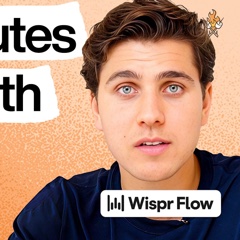
Hector Serrano
Head of Content at Wispr Flow
Where to hear and read about Hector Serrano1 episode or test

Hector Serrano is Head of Content at Wispr Flow, a 22-year-old who runs its paid UGC program and the founder's organic channels, and who got the job at 19 off a LinkedIn listing. The thing most worth learning from him is how to scale a product people already love by paying a small, hand-picked, varied group of creators a share of ad spend and letting them make the ads their own way.
Everyone looking for a marketer with the best resume is going to end up hiring a bot.
A UGC masterclass from the 22-year-old who built Wispr Flow’s growth machine | Hector Serrano
Hector Serrano: the story and the lessons
1Hector Serrano's path to Wispr Flow
Hector quit D1 soccer and landed Wispr Flow days later. He applied to about 200 creator jobs on LinkedIn, had one call with founder Tanay and joined three days after turning 19, before the product had found product-market fit.
He had never worked at a startup. On that first call he asked for equity, and Tanay laughed and said "I like you, man."
Nobody knew his job description for the first year. In one of his first weeks, Tanay messaged him during calculus class to re-edit the launch video in CapCut with more Gen Z vibes. It took a year before he felt comfortable.
He came in as a content creator and the role grew. Today he owns the creative side of paid UGC and manages the founder's YouTube and Instagram, but does not buy media.
A finance internship in New York showed him where he belonged. His immigrant parents wanted the traditional route and he doubted content was a real career, so he took the internship. Two weeks in he hated it and started sneaking out to Soho cafes to work on Wispr Flow and his own content.
He says that is when everything started to click.
He reads his own path as dots that only connect backward. He had bad ADHD, was never the smartest kid and lost soccer, his one thing. Picking up a camera at 16 and posting on YouTube only made sense in hindsight.
He quotes Steve Jobs on connecting the dots looking backward, and thanks Tanay, Daniel and the Wispr team for taking a shot on him.
2How Hector built Wispr Flow's paid UGC machine
Hector treats the product as the real growth lever. Wispr Flow had a few thousand users early and caught steam about six months in, and channels were layered on only after that. Revenue has since grown 30x in a year.
He says there is no hack besides a good product with more levers added. Creators who stay and do not churn are themselves a test of product-market fit.
Wispr killed its organic UGC program because it chased vanity metrics. Creators posted on alternate accounts for a CPM of about $2 per thousand views. It reached about 500 million views in 2.5 months but few conversions, since students did not become payers.
The program had started with an intern, Tobin. Hector later applied the same roster and performance-pay idea to paid ads that pitch the product directly.
He rebuilt UGC for Meta ads using Tribe. Tribe brings the TikTok Shop creator method to Meta ads, which SaaS companies cannot get from TikTok Shop. Wispr was one of its first customers.
Hector had made all the paid assets himself before this. Creators now earn a percent of ad spend instead of a CPM.
Hector turns paid on early to test messaging on cold traffic. Paid gives a cleaner signal than organic for most teams, who are weak at organic content. If cold traffic converts, the same messaging should work organically.
He calls fear of saturating the market overblown, since new messaging and new customer types keep opening up.
Hector ships 500 to 600 ads a month because ads die fast. An ad is usually dead around $100,000 in spend, which can take two or three weeks. Wispr Flow has about 5,000 lifetime ads and about 800 live.
Meta groups near-identical ads together, so constant volume and variety are required.
Organic presence makes his paid ads cheaper. A buyer needs about seven touches before purchasing. YouTube long form, founder reels and LinkedIn warm people up so the first ad converts.
Paid then gets the credit for the conversion, and costs fall across all platforms as more channels run.
3How Wispr Flow pays its creators
Hector pays creators a share of ad spend, not flat fees. SaaS attribution is slow, and freemium conversions can take a week or two to show, so a cut of ad spend avoids leaving creators unpaid for ads that worked. E-commerce brands use a percent of GMV instead.
The cut gives creators a piece of an ad's success without a flat fee capping them.
A smart retainer keeps new creators motivated. A creator who makes 25 videos gets a $1,500 retainer. If commission is $500 they are topped up by $1,000, and at $3,000 they keep commission only.
On pure commission a new creator could make $100 off 30 videos, which demoralizes. After three or four months creators break out into pure commission, which costs the brand nothing extra.
Earnings are uncapped, and small accounts can earn a lot. The best creators make over $13,000 a month, sometimes with only 1,000 to 2,000 followers.
"It's truly uncapped."
A stable group of creators gets better every month. The same power users work with Wispr each month, so videos improve. Some understand the product almost better than Hector and pitch ideas he would not have.
For a launch such as the note taker, he drops it in Discord and asks for videos.
4Hector Serrano's playbook for recruiting and onboarding creators
Hector recruited the first creators by hand on Instagram. A new brand with no payout history gets ignored on Tribe. He searched niche keywords such as tech, lawyer and doctor, browsed followers and following lists, and sent 150 to 250 targeted DMs.
That produced five or six really good creators, and he has not needed outreach since. He avoids mass-send software because it brings back low-quality creators. "Typically good creators know other good creators."
He opens soft and only later pitches the pay model. The first message is just that he loves their content and would love them in the creator group. Only after a reply does he send a simple PDF on structure, pay and typical earnings, then hop on a call.
He holds back the performance model at first because many creators are skeptical of it.
He closes creators on the onboarding call like a sales deal. The call opens with questions about them, then a slideshow on his background, media buyer Eric, the product, how Tribe works and example ads. They leave able to start a video right away.
Creators are paid every 7 days so early money keeps motivation high.
Each new creator should fill a gap in audience or message. He checks the ad library and product for gaps. Wispr's group includes moms, lawyers, engineers, sales reps and agency owners, and five distinct creators produce net-new concepts where a hundred similar ones make every ad look the same.
The group grew from 5 to 10 to 15 to 20 and now 50 by adding five or six every few weeks. "More isn't necessarily better."
Growth is slow and selective, with a cap of 50. Wispr Flow gets 1,000 to 1,500 applications a week and accepts one to three. Creators earn $100 for referring a good fit.
The cap makes referrals a thank-you, not a pyramid, though a LinkedIn post about it drew comments calling it an MLM scam. Hector calls the group a very tight-knit family.
He builds community because creators are remote and crave it. Wispr runs weekly meetings, creator coaches, giveaways and an in-person San Francisco retreat for top creators. The group has been paid about $300,000.
Word spreads fast about brands that pay late or badly, so he argues the companies with the best creator relationships win long term.
5Hector Serrano's rules for creative that wins
Hector gives creators no briefs and lets them experiment. Ten-page guidelines remove the creativity that makes creator ads work. One creator's ad of a keyboard on a rainy roof, raindrops typing random words, became a top performer.
He tells creators that copying top ads lands them beneath those ads with little spend. No two ads in the library look the same.
He keeps the quality bar low and lets odd ads run. Ads are weirder than organic content, and an ad he does not understand sometimes becomes the best performer.
"Sometimes I'll see an ad that comes in and I'm like, what the heck is this? And it ends up becoming the best performer."
For technical and older buyers, he runs ugly screen recordings. UGC means users, so a dev tool needs technical creators, not college kids. Screen recordings of someone using the product, 30 seconds to a minute long, perform best.
One of Wispr's best and ugliest ads is a year-old, long 9 by 16 screen recording with text on top. For an expensive niche product, use a creator who looks and sounds like the buyer.
Unknown creators can beat famous influencers, even in enterprise. Big faces are seen as sellouts, and partnership ads from an unknown person's account feel more genuine. Enterprise deals often start with one user who tells a colleague.
Only then does the team chase the enterprise contract.
He made every Wispr ad himself before directing creators. Hector made every ad for about a year and a half. He says a non-creator briefing creators is like a non-engineer telling engineers how to solve a problem.
Burnt out and limited in how many videos he could make, he built the creator group to multiply himself.
He splits the creative lead and the media buyer into two roles. The creative lead handles creator comms, concepts and video approvals. A media buyer structures the ad account and runs spend across Meta, LinkedIn and YouTube.
Hector says he is not a numbers person and glad not to stare at Meta Ads Manager. "It's pretty rare to find someone who's a creative and also media buyer."
6How Hector hires and builds a marketing team
Hector hires on character and a grown account, not the resume. He looks for a hard worker who fits the team and has grown an account to 10,000 to 15,000 followers, ideally on Instagram. That shows consistency, trend sense and editing skill.
Hector had a 2.5 GPA and Tobin a 4.0, and both became great marketers. Instagram is a higher signal than TikTok, where growing on brain rot content is easy.
Young hires get money, time and room to fail. Hector was all over the place for his first seven months and the team kept backing him. Tobin got money and time and found something that worked in about two months.
The test is whether the person keeps learning and improving.
He argues young marketers see new channels before older founders do. A 30 or 40-year-old founder does not see what an 18-year-old sees in Discord chats and daily Instagram and TikTok scrolling. Tanay still calls Hector in to ask what is working on Instagram.
He says you never get smart enough to stop learning, even from a random 19 or 22-year-old.
He wants startups to run hiring like a sports youth academy. Clubs scout young players, coach them for years, then promote or sell them. He says many companies have dropped internships even though they are cheap and not very time-consuming.
Young hires can become A players and stay loyal whether or not they stay, and later help bring in more young talent.
A high-salary job listing attracts the wrong people. A listing at $200k to $250k base plus equity draws the wrong crowd. He says the best person to run this is a hungry learner, not the priciest hire.
He cites his own tweet that the best founders and creators are delusionally confident, outwork everyone and love what they do.
He hires through his own Instagram stories. Hector hired his videographer, YouTube agency and every member of the UGC and founder content teams this way. His story for a San Francisco videographer drew about 80 replies.
The 24-year-old he picked, Alex, flew in on three days' notice. "Typically the best social people you also find on social platforms."
The marketing team stays small and flat. It started with the CMO, a head of growth and Hector making ads. It is now about 15 experts in design, film, PR, creator partnerships and talent management.
There are no middle managers, so the CMO has a pile of direct reports.
7Hector Serrano on founder-led content and YouTube
Hector ties every founder post to one company mission. Wispr's mission is 1 billion daily active users, and each piece builds toward it like episodes of a Netflix series. Formats include product launches, a week in the life and a whiteboard breakdown.
He advises giving value and oversharing for a year or more before a soft sell, since "people buy from people, people invest in people." The team is a head of content, a videographer, a YouTube team and a short-form editor.
He puts YouTube titles and thumbnails ahead of production quality. Packaging covers click-through rate, average view duration, pacing, the intro and a payoff that matches the thumbnail. A masterpiece with a bad thumbnail goes unseen.
"You could have a masterpiece of a video, but if you put a bad thumbnail and a bad title, no one's actually going to know how good your video is."
A strong long-form YouTube team makes short-form easier. Short-form editors juggle many clients, so sent 40 hours of raw footage they may not return the best clips. A well-cut YouTube video, sent clean with no titles or music, lets them pick the best moments.
Several of the short-form editors are overseas, in Germany, Romania and Australia.
He values YouTube for its long half-life. One video on his own channel went from about 40,000 views to 600,000 in a year, five years after posting. A Wispr Flow video posted three months ago still gets about 10,000 views in 48 hours.
Instagram posts, by contrast, are dead within 48 hours.
8Hector Serrano on AI and on starting as a creator
Hector uses AI behind the scenes but keeps final creative human. Wispr helps people sound like themselves, so AI influencers and AI statics would feel off and could backfire. The most automation-minded person he knows still keeps a human on the last 10%.
"If we go out and start making AI slop ads, it's probably not going to be received really well."
He bets on quality over volume to cut through the noise. Wispr's YouTube channel hit millions of views and about 21,000 subscribers within five videos, about three months after launch, with no three-videos-a-week schedule.
Each video had a real story, careful packaging and a team of humans touching it.
He tells would-be creators to stop seeking advice and start filming. Over about three years, friends got a two-hour call and guides from him, then did nothing with them.
Even famous creators stutter and refilm. His viral X video took a 15-minute cut after two earlier cuts of about 30 minutes each.
He sees media as permissionless leverage. His top book pick is Naval Ravikant's Almanac. Once content is online it works for you without asking permission.
It made little sense on the first read. Only later did he see the compounding effect of putting himself out there.

A UGC masterclass from the 22-year-old who built Wispr Flow’s growth machine | Hector Serrano
A tactical guide to building a paid UGC program for SaaS: pay creators a share of ad spend, recruit them by hand, and give them creative freedom. Hector's roster of 50 creators drives 500 to 600 ads a month, and Wispr Flow grew revenue 30x in a year.
Hector quit D1 soccer and landed Wispr Flow days later. He applied to about 200 creator jobs on LinkedIn, had one call with founder Tanay and joined three days after turning 19, before the product had found product-market fit.
He had never worked at a startup. On that first call he asked for equity, and Tanay laughed and said "I like you, man."
Nobody knew his job description for the first year. In one of his first weeks, Tanay messaged him during calculus class to re-edit the launch video in CapCut with more Gen Z vibes. It took a year before he felt comfortable.
He came in as a content creator and the role grew. Today he owns the creative side of paid UGC and manages the founder's YouTube and Instagram, but does not buy media.
A finance internship in New York showed him where he belonged. His immigrant parents wanted the traditional route and he doubted content was a real career, so he took the internship. Two weeks in he hated it and started sneaking out to Soho cafes to work on Wispr Flow and his own content.
He says that is when everything started to click.
He reads his own path as dots that only connect backward. He had bad ADHD, was never the smartest kid and lost soccer, his one thing. Picking up a camera at 16 and posting on YouTube only made sense in hindsight.
He quotes Steve Jobs on connecting the dots looking backward, and thanks Tanay, Daniel and the Wispr team for taking a shot on him.
Hector treats the product as the real growth lever. Wispr Flow had a few thousand users early and caught steam about six months in, and channels were layered on only after that. Revenue has since grown 30x in a year.
He says there is no hack besides a good product with more levers added. Creators who stay and do not churn are themselves a test of product-market fit.
Wispr killed its organic UGC program because it chased vanity metrics. Creators posted on alternate accounts for a CPM of about $2 per thousand views. It reached about 500 million views in 2.5 months but few conversions, since students did not become payers.
The program had started with an intern, Tobin. Hector later applied the same roster and performance-pay idea to paid ads that pitch the product directly.
He rebuilt UGC for Meta ads using Tribe. Tribe brings the TikTok Shop creator method to Meta ads, which SaaS companies cannot get from TikTok Shop. Wispr was one of its first customers.
Hector had made all the paid assets himself before this. Creators now earn a percent of ad spend instead of a CPM.
Hector turns paid on early to test messaging on cold traffic. Paid gives a cleaner signal than organic for most teams, who are weak at organic content. If cold traffic converts, the same messaging should work organically.
He calls fear of saturating the market overblown, since new messaging and new customer types keep opening up.
Hector ships 500 to 600 ads a month because ads die fast. An ad is usually dead around $100,000 in spend, which can take two or three weeks. Wispr Flow has about 5,000 lifetime ads and about 800 live.
Meta groups near-identical ads together, so constant volume and variety are required.
Organic presence makes his paid ads cheaper. A buyer needs about seven touches before purchasing. YouTube long form, founder reels and LinkedIn warm people up so the first ad converts.
Paid then gets the credit for the conversion, and costs fall across all platforms as more channels run.
Hector pays creators a share of ad spend, not flat fees. SaaS attribution is slow, and freemium conversions can take a week or two to show, so a cut of ad spend avoids leaving creators unpaid for ads that worked. E-commerce brands use a percent of GMV instead.
The cut gives creators a piece of an ad's success without a flat fee capping them.
A smart retainer keeps new creators motivated. A creator who makes 25 videos gets a $1,500 retainer. If commission is $500 they are topped up by $1,000, and at $3,000 they keep commission only.
On pure commission a new creator could make $100 off 30 videos, which demoralizes. After three or four months creators break out into pure commission, which costs the brand nothing extra.
Earnings are uncapped, and small accounts can earn a lot. The best creators make over $13,000 a month, sometimes with only 1,000 to 2,000 followers.
"It's truly uncapped."
A stable group of creators gets better every month. The same power users work with Wispr each month, so videos improve. Some understand the product almost better than Hector and pitch ideas he would not have.
For a launch such as the note taker, he drops it in Discord and asks for videos.
Hector recruited the first creators by hand on Instagram. A new brand with no payout history gets ignored on Tribe. He searched niche keywords such as tech, lawyer and doctor, browsed followers and following lists, and sent 150 to 250 targeted DMs.
That produced five or six really good creators, and he has not needed outreach since. He avoids mass-send software because it brings back low-quality creators. "Typically good creators know other good creators."
He opens soft and only later pitches the pay model. The first message is just that he loves their content and would love them in the creator group. Only after a reply does he send a simple PDF on structure, pay and typical earnings, then hop on a call.
He holds back the performance model at first because many creators are skeptical of it.
He closes creators on the onboarding call like a sales deal. The call opens with questions about them, then a slideshow on his background, media buyer Eric, the product, how Tribe works and example ads. They leave able to start a video right away.
Creators are paid every 7 days so early money keeps motivation high.
Each new creator should fill a gap in audience or message. He checks the ad library and product for gaps. Wispr's group includes moms, lawyers, engineers, sales reps and agency owners, and five distinct creators produce net-new concepts where a hundred similar ones make every ad look the same.
The group grew from 5 to 10 to 15 to 20 and now 50 by adding five or six every few weeks. "More isn't necessarily better."
Growth is slow and selective, with a cap of 50. Wispr Flow gets 1,000 to 1,500 applications a week and accepts one to three. Creators earn $100 for referring a good fit.
The cap makes referrals a thank-you, not a pyramid, though a LinkedIn post about it drew comments calling it an MLM scam. Hector calls the group a very tight-knit family.
He builds community because creators are remote and crave it. Wispr runs weekly meetings, creator coaches, giveaways and an in-person San Francisco retreat for top creators. The group has been paid about $300,000.
Word spreads fast about brands that pay late or badly, so he argues the companies with the best creator relationships win long term.
Hector gives creators no briefs and lets them experiment. Ten-page guidelines remove the creativity that makes creator ads work. One creator's ad of a keyboard on a rainy roof, raindrops typing random words, became a top performer.
He tells creators that copying top ads lands them beneath those ads with little spend. No two ads in the library look the same.
He keeps the quality bar low and lets odd ads run. Ads are weirder than organic content, and an ad he does not understand sometimes becomes the best performer.
"Sometimes I'll see an ad that comes in and I'm like, what the heck is this? And it ends up becoming the best performer."
For technical and older buyers, he runs ugly screen recordings. UGC means users, so a dev tool needs technical creators, not college kids. Screen recordings of someone using the product, 30 seconds to a minute long, perform best.
One of Wispr's best and ugliest ads is a year-old, long 9 by 16 screen recording with text on top. For an expensive niche product, use a creator who looks and sounds like the buyer.
Unknown creators can beat famous influencers, even in enterprise. Big faces are seen as sellouts, and partnership ads from an unknown person's account feel more genuine. Enterprise deals often start with one user who tells a colleague.
Only then does the team chase the enterprise contract.
He made every Wispr ad himself before directing creators. Hector made every ad for about a year and a half. He says a non-creator briefing creators is like a non-engineer telling engineers how to solve a problem.
Burnt out and limited in how many videos he could make, he built the creator group to multiply himself.
He splits the creative lead and the media buyer into two roles. The creative lead handles creator comms, concepts and video approvals. A media buyer structures the ad account and runs spend across Meta, LinkedIn and YouTube.
Hector says he is not a numbers person and glad not to stare at Meta Ads Manager. "It's pretty rare to find someone who's a creative and also media buyer."
Hector hires on character and a grown account, not the resume. He looks for a hard worker who fits the team and has grown an account to 10,000 to 15,000 followers, ideally on Instagram. That shows consistency, trend sense and editing skill.
Hector had a 2.5 GPA and Tobin a 4.0, and both became great marketers. Instagram is a higher signal than TikTok, where growing on brain rot content is easy.
Young hires get money, time and room to fail. Hector was all over the place for his first seven months and the team kept backing him. Tobin got money and time and found something that worked in about two months.
The test is whether the person keeps learning and improving.
He argues young marketers see new channels before older founders do. A 30 or 40-year-old founder does not see what an 18-year-old sees in Discord chats and daily Instagram and TikTok scrolling. Tanay still calls Hector in to ask what is working on Instagram.
He says you never get smart enough to stop learning, even from a random 19 or 22-year-old.
He wants startups to run hiring like a sports youth academy. Clubs scout young players, coach them for years, then promote or sell them. He says many companies have dropped internships even though they are cheap and not very time-consuming.
Young hires can become A players and stay loyal whether or not they stay, and later help bring in more young talent.
A high-salary job listing attracts the wrong people. A listing at $200k to $250k base plus equity draws the wrong crowd. He says the best person to run this is a hungry learner, not the priciest hire.
He cites his own tweet that the best founders and creators are delusionally confident, outwork everyone and love what they do.
He hires through his own Instagram stories. Hector hired his videographer, YouTube agency and every member of the UGC and founder content teams this way. His story for a San Francisco videographer drew about 80 replies.
The 24-year-old he picked, Alex, flew in on three days' notice. "Typically the best social people you also find on social platforms."
The marketing team stays small and flat. It started with the CMO, a head of growth and Hector making ads. It is now about 15 experts in design, film, PR, creator partnerships and talent management.
There are no middle managers, so the CMO has a pile of direct reports.
Hector ties every founder post to one company mission. Wispr's mission is 1 billion daily active users, and each piece builds toward it like episodes of a Netflix series. Formats include product launches, a week in the life and a whiteboard breakdown.
He advises giving value and oversharing for a year or more before a soft sell, since "people buy from people, people invest in people." The team is a head of content, a videographer, a YouTube team and a short-form editor.
He puts YouTube titles and thumbnails ahead of production quality. Packaging covers click-through rate, average view duration, pacing, the intro and a payoff that matches the thumbnail. A masterpiece with a bad thumbnail goes unseen.
"You could have a masterpiece of a video, but if you put a bad thumbnail and a bad title, no one's actually going to know how good your video is."
A strong long-form YouTube team makes short-form easier. Short-form editors juggle many clients, so sent 40 hours of raw footage they may not return the best clips. A well-cut YouTube video, sent clean with no titles or music, lets them pick the best moments.
Several of the short-form editors are overseas, in Germany, Romania and Australia.
He values YouTube for its long half-life. One video on his own channel went from about 40,000 views to 600,000 in a year, five years after posting. A Wispr Flow video posted three months ago still gets about 10,000 views in 48 hours.
Instagram posts, by contrast, are dead within 48 hours.
Hector uses AI behind the scenes but keeps final creative human. Wispr helps people sound like themselves, so AI influencers and AI statics would feel off and could backfire. The most automation-minded person he knows still keeps a human on the last 10%.
"If we go out and start making AI slop ads, it's probably not going to be received really well."
He bets on quality over volume to cut through the noise. Wispr's YouTube channel hit millions of views and about 21,000 subscribers within five videos, about three months after launch, with no three-videos-a-week schedule.
Each video had a real story, careful packaging and a team of humans touching it.
He tells would-be creators to stop seeking advice and start filming. Over about three years, friends got a two-hour call and guides from him, then did nothing with them.
Even famous creators stutter and refilm. His viral X video took a 15-minute cut after two earlier cuts of about 30 minutes each.
He sees media as permissionless leverage. His top book pick is Naval Ravikant's Almanac. Once content is online it works for you without asking permission.
It made little sense on the first read. Only later did he see the compounding effect of putting himself out there.
 Wispr Flow
