
Hamilton Helmer
Author of 7 Powers
Where to hear and read about Hamilton Helmer1 book · 1 episode or test
Hamilton Helmer is a strategy consultant and the author of 7 Powers, who has advised more than 200 companies over three decades. The most useful thing to learn from him is to test every claimed advantage for both a benefit and a barrier, and to be honest about which strengths a rival could copy.
you have to have a pretty good understanding of why it's a castle and not a shack.
Business strategy with Hamilton Helmer (author of 7 Powers)
Hamilton Helmer: the story and the lessons
1Who Hamilton Helmer is and how he defines strategy and power
Helmer has taught strategy to some of the best-known founders. He has more than three decades in strategy consulting and has advised over 200 companies, from startups to Fortune 100 firms. Patrick Collison, Peter Thiel, Reed Hastings and Daniel Ek credit 7 Powers.
Hastings had him run classes for Netflix's top 100 people before the book existed. A second book, about the path to power, is in progress.
Helmer defines strategy narrowly as what drives long-run business value. He treats strategy as the fundamental determinants of business value, the NPV of expected cash flow. That makes it long-term, while tactics are short-term.
Pearl Harbor was a huge tactical success for Japan and a strategic disaster, because it united Americans behind the war. He admits the narrow definition is an arbitrary choice but says decades of experience show it works.
Helmer says power is a benefit paired with a barrier. The benefit is a cost or price advantage over rivals. The barrier is what stops them from copying it, so margins stay high far into the future.
Netflix content is about 50% of its costs and is spread over more subscribers, so its cost per subscriber is lower than a smaller rival's. He calls this check the to be or not to be test.
Helmer sorts every value driver into power, market size or operational excellence. He argues these three categories are exhaustive and come out of the math of business value. Anyone who lists many drivers is right, but all of them fall into the three.
Founders can use the sort to separate what moves value from busywork.
2How Helmer matches powers to a company's stage
Helmer reversed his view that strategy waits for product-market fit. He now says to think about power from day one. Before fit, the question is which business propositions tilt toward power being available, not a full strategic plan.
Talks with early founders turned out richer and more relevant than he expected. He treats this as shifting odds, not guaranteeing anything.
Helmer says startups begin with counter positioning. Product-market fit is mostly a substitution, so competition is functional and a capable incumbent can extend its product and attack. Counter positioning is the refuge from that.
Amazon substituted for brick-and-mortar stores and Google for Yahoo. Scale economies, switching costs and network economies come later, depending on scale relative to rivals. "almost every startup that you want to deal with starts with counter positioning"
Helmer crosses brand and process power off the early list. Brand and process power only become available late in a business. Resource power needs rights to something valuable, such as a patent, which is a different class of business.
Brand recognition can be bought with a Super Bowl ad, so it is not power. He calls process power operational excellence on steroids, usually imitable.
Helmer splits a business into origination, takeoff and stability. In stability, know your power to defend it. In takeoff, the job is winning share by tracking technology offshoots, new features and new segments.
Product managers in the weeds often spot these first, and new businesses often bubble up from below. He dislikes a blanket goal of a strategic organization because it blurs the stages.
Helmer says knowing your power source prepares the next act. Iconic firms often get a second or third act, such as AWS, Intel moving into CPUs and Apple moving into iPhones. Each act restarts the process.
Knowing the original source of power is the foundation for those moves.
3Why Helmer says most claimed moats are not power
Helmer says a moat covers only the barrier half. A moat can sit around worthless property. He credits Buffett and Munger but sees 7 Powers as more systematic and comprehensive.
Spending on a capability does not prove a castle. Netflix's UI, A/B tests and recommendation engine were essential but largely mimicable, and Blockbuster's site looked identical to Netflix's once it copied the interface.
Helmer thinks data rarely gives real scale economies. Existing competitors usually operate at scales within shouting distance of each other, so cost per unit barely differs. The curve flattens as the fixed cost is spread over more volume.
The most common scale economy is a big fixed cost spread over more units, so its percentage advantage shrinks as scale grows.
Helmer judges network and flywheel claims by materiality. Almost any platform has modest network effects. He uses network economies only for effects large enough to support a price gap that moves margins far into the future.
He thinks Uber and Lyft likely have network effects but not network economies. "it's not an impact, it's a material impact."
Helmer reads Uber's win as attrition on modest local scale economies. Lyft's market cap is about 5% of Uber's. He guesses Uber's early misstep was defining its business as international transportation.
The business is geographically specific, so a strong Bay Area position does not help in London. Uber pulled back from forays like China and focused on its local scale economy. He offers this as an unformed guess, not a studied view.
Helmer calls operational excellence a treadmill, not a power. It wins the race in takeoff and keeps you alive in stability, but consultants and poached hires can copy it. He agrees with Porter that it is not strategy, though as a path strategy needs it.
Only complex, opaque operations such as TSMC's fab bring-up or Toyota's factories might count as process power. "if you stop running that treadmill, you get creamed"
Helmer tests process power by asking if a consultancy could sell it. If a practice is not written down or describable, it may be hard to imitate. If a consulting firm could bring a rival up to speed, it is not process power.
Claims of the best team or the fastest speed fail this test.
Helmer accepts that founders overclaim moats and says checking takes work. Founders must be optimistic and understate risk a little, so he tells critics not to be unkind about the wrong slide in the deck.
Confirming that a power exists can take weeks for one well-known company, because the hard part is the industry economics.
4Helmer on AI, strategic thinking and acting first
Helmer sees no eighth power from generative AI. He applies the existing seven. A model costing about a billion dollars is a fixed cost, so scale economies are possible. A model that learns from one user to help another would be a network economy.
A model that learns about you, like a psychiatrist, creates switching costs. He calls the seven an empirical seven and keeps looking for an eighth.
Helmer expects AI to matter most for businesses that already existed. He splits technology plays into three: the technology itself (Intel), companies that would not exist without it (Microsoft), and users of it in older products (automobiles with chips). He guesses AI lands mostly in the third.
Like electricity or 1990s business process re-engineering, it needs slow redesign and complements to pay off in functions such as accounting, HR and R&D.
Helmer builds strategic thinking through debate with colleagues. Read the book, then regularly ask whether you really have a given power, what is going on and what matters.
This is how he trained Netflix's top 100 people at Hastings's request.
Helmer tells founders to act first and use frameworks as guideposts. He calls action the first principle of business. The book offers guideposts and does not tell anyone what to do.
Many early teams polish a grand master plan or read about ideas without trying them. His advice is that thinking helps a little but it's mostly doing stuff. His optimism rests on Schumpeter's view that entrepreneurs keep an economy alive.

Business strategy with Hamilton Helmer (author of 7 Powers)
Hamilton Helmer explains how to find and test the sources of durable competitive advantage (his seven powers) at each stage of a company, from pre product-market fit to stability. The episode is worth hearing because it shows which claimed moats usually fail (brand, data scale, flywheels, speed, operational excellence) and which powers a startup can actually build early.
Helmer has taught strategy to some of the best-known founders. He has more than three decades in strategy consulting and has advised over 200 companies, from startups to Fortune 100 firms. Patrick Collison, Peter Thiel, Reed Hastings and Daniel Ek credit 7 Powers.
Hastings had him run classes for Netflix's top 100 people before the book existed. A second book, about the path to power, is in progress.
Helmer defines strategy narrowly as what drives long-run business value. He treats strategy as the fundamental determinants of business value, the NPV of expected cash flow. That makes it long-term, while tactics are short-term.
Pearl Harbor was a huge tactical success for Japan and a strategic disaster, because it united Americans behind the war. He admits the narrow definition is an arbitrary choice but says decades of experience show it works.
Helmer says power is a benefit paired with a barrier. The benefit is a cost or price advantage over rivals. The barrier is what stops them from copying it, so margins stay high far into the future.
Netflix content is about 50% of its costs and is spread over more subscribers, so its cost per subscriber is lower than a smaller rival's. He calls this check the to be or not to be test.
Helmer sorts every value driver into power, market size or operational excellence. He argues these three categories are exhaustive and come out of the math of business value. Anyone who lists many drivers is right, but all of them fall into the three.
Founders can use the sort to separate what moves value from busywork.
Helmer reversed his view that strategy waits for product-market fit. He now says to think about power from day one. Before fit, the question is which business propositions tilt toward power being available, not a full strategic plan.
Talks with early founders turned out richer and more relevant than he expected. He treats this as shifting odds, not guaranteeing anything.
Helmer says startups begin with counter positioning. Product-market fit is mostly a substitution, so competition is functional and a capable incumbent can extend its product and attack. Counter positioning is the refuge from that.
Amazon substituted for brick-and-mortar stores and Google for Yahoo. Scale economies, switching costs and network economies come later, depending on scale relative to rivals. "almost every startup that you want to deal with starts with counter positioning"
Helmer crosses brand and process power off the early list. Brand and process power only become available late in a business. Resource power needs rights to something valuable, such as a patent, which is a different class of business.
Brand recognition can be bought with a Super Bowl ad, so it is not power. He calls process power operational excellence on steroids, usually imitable.
Helmer splits a business into origination, takeoff and stability. In stability, know your power to defend it. In takeoff, the job is winning share by tracking technology offshoots, new features and new segments.
Product managers in the weeds often spot these first, and new businesses often bubble up from below. He dislikes a blanket goal of a strategic organization because it blurs the stages.
Helmer says knowing your power source prepares the next act. Iconic firms often get a second or third act, such as AWS, Intel moving into CPUs and Apple moving into iPhones. Each act restarts the process.
Knowing the original source of power is the foundation for those moves.
Helmer says a moat covers only the barrier half. A moat can sit around worthless property. He credits Buffett and Munger but sees 7 Powers as more systematic and comprehensive.
Spending on a capability does not prove a castle. Netflix's UI, A/B tests and recommendation engine were essential but largely mimicable, and Blockbuster's site looked identical to Netflix's once it copied the interface.
Helmer thinks data rarely gives real scale economies. Existing competitors usually operate at scales within shouting distance of each other, so cost per unit barely differs. The curve flattens as the fixed cost is spread over more volume.
The most common scale economy is a big fixed cost spread over more units, so its percentage advantage shrinks as scale grows.
Helmer judges network and flywheel claims by materiality. Almost any platform has modest network effects. He uses network economies only for effects large enough to support a price gap that moves margins far into the future.
He thinks Uber and Lyft likely have network effects but not network economies. "it's not an impact, it's a material impact."
Helmer reads Uber's win as attrition on modest local scale economies. Lyft's market cap is about 5% of Uber's. He guesses Uber's early misstep was defining its business as international transportation.
The business is geographically specific, so a strong Bay Area position does not help in London. Uber pulled back from forays like China and focused on its local scale economy. He offers this as an unformed guess, not a studied view.
Helmer calls operational excellence a treadmill, not a power. It wins the race in takeoff and keeps you alive in stability, but consultants and poached hires can copy it. He agrees with Porter that it is not strategy, though as a path strategy needs it.
Only complex, opaque operations such as TSMC's fab bring-up or Toyota's factories might count as process power. "if you stop running that treadmill, you get creamed"
Helmer tests process power by asking if a consultancy could sell it. If a practice is not written down or describable, it may be hard to imitate. If a consulting firm could bring a rival up to speed, it is not process power.
Claims of the best team or the fastest speed fail this test.
Helmer accepts that founders overclaim moats and says checking takes work. Founders must be optimistic and understate risk a little, so he tells critics not to be unkind about the wrong slide in the deck.
Confirming that a power exists can take weeks for one well-known company, because the hard part is the industry economics.
Helmer sees no eighth power from generative AI. He applies the existing seven. A model costing about a billion dollars is a fixed cost, so scale economies are possible. A model that learns from one user to help another would be a network economy.
A model that learns about you, like a psychiatrist, creates switching costs. He calls the seven an empirical seven and keeps looking for an eighth.
Helmer expects AI to matter most for businesses that already existed. He splits technology plays into three: the technology itself (Intel), companies that would not exist without it (Microsoft), and users of it in older products (automobiles with chips). He guesses AI lands mostly in the third.
Like electricity or 1990s business process re-engineering, it needs slow redesign and complements to pay off in functions such as accounting, HR and R&D.
Helmer builds strategic thinking through debate with colleagues. Read the book, then regularly ask whether you really have a given power, what is going on and what matters.
This is how he trained Netflix's top 100 people at Hastings's request.
Helmer tells founders to act first and use frameworks as guideposts. He calls action the first principle of business. The book offers guideposts and does not tell anyone what to do.
Many early teams polish a grand master plan or read about ideas without trying them. His advice is that thinking helps a little but it's mostly doing stuff. His optimism rests on Schumpeter's view that entrepreneurs keep an economy alive.
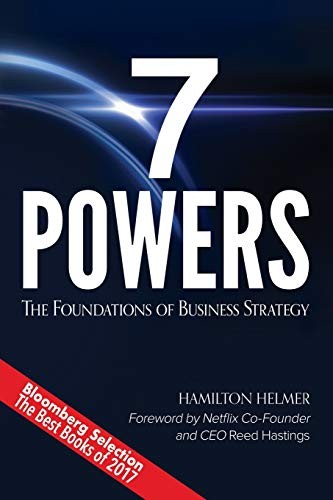
7 Powers: The Foundations of Business Strategy
Business value comes from market scale times Power, the conditions that let a firm earn lasting above-normal returns while capable rivals compete. There are seven types of Power, and each one can only be first built at a specific stage of a business's growth, which gives builders a simple, teachable map of which strategic battles matter now.