Georg Tacke
Author of Monetizing Innovation
Where to hear and read about Georg Tacke1 book
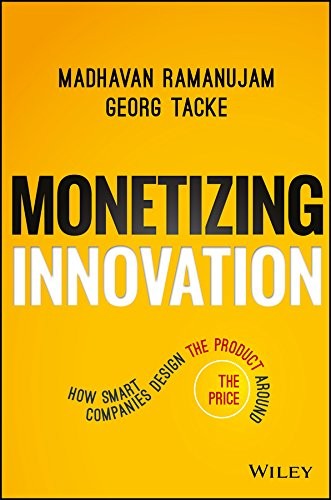
Georg Tacke wrote Monetizing Innovation (2016), a book arguing that new products fail to make money because companies set the price last. The lesson most worth taking is to learn what customers value and will pay before building, then design segments, features, bundles, revenue model and launch around that price.
How you charge trumps what you charge.
Monetizing Innovation: How Smart Companies Design the Product Around the Price
Georg Tacke: the story and the lessons
1Georg Tacke's case for designing the product around the price
Tacke says most new products miss their goals because price comes last. A Simon-Kucher study of 1,615 companies found 72 percent of new products from the prior five years missed revenue and profit goals or failed outright. Other studies match: the PDMA puts the failure rate at 65 percent.
Companies model costs line by line but only guess at revenue. Eddie Hartman of LegalZoom calls it a "wild asymmetry of precision." Tacke wants the usual order of design, build, market, price flipped to market and price first.
Porsche priced the Cayenne before it existed; Dodge priced the Dart after. Porsche surveyed buyers on appetite and price before any concept car, and leaders said they would drop the SUV if the price failed. Ten years after its 2003 launch the Cayenne sold about 100,000 a year and earned about half of Porsche's profit.
Fiat Chrysler engineered the Dart until it seemed ready, then attached a price. In 2012 it sold about 25,000 units, a quarter of analysts' forecast.
Tacke sorts failures into feature shocks, minivations, hidden gems and undeads. A feature shock is overstuffed and overpriced: Amazon's Fire Phone fell from $199 to 99 cents with contract in four months and took a $170 million write-down. A minivation is priced too low: Valeo sold Park Assist to VW for about €100 and VW charged buyers €670.
A hidden gem is a strong idea the company fails to launch: Kodak's Steven Sasson invented digital camera technology in 1974, and Kodak's first digital camera came in 1995. An undead gets released though few want it: Segway promised 50,000 sales in year one and sold about 30,000 in total by the end of 2007.
He blames a mindset that treats pricing as a threat to creativity. The innovator is cast as an artist and underdog, a picture fed by Apple's 1997 Think Different campaign. Underdog tales such as Harry Potter being rejected 12 times are loved as exceptions, while nobody mentions the 95 percent of cases that went the other way.
Five myths hold the mindset up: build it and they will pay, innovate in isolation, high failure is normal, customers must experience a product before pricing it, and you must know every cost before valuing it.
2Tacke's willingness-to-pay talk before design starts
Tacke has teams ask what customers will pay before any design work. An internet marketplace planned 25 buyer features. Several hundred prospects would pay $10 to $20 a month, but only for 10 of them, and the team's favorite feature ranked seventh.
Those 10 became the roadmap, which avoided a feature shock. The talk must yield a price range customers find reasonable and the value of each feature.
He sets a walk-away condition before any concept exists. Porsche tested every planned feature. It cut the six-speed racing transmission and kept the sportiness and powerful engine, and added large cup holders.
The range has to work for the company too. If no profitable product fits inside it, the opportunity may not be there.
Tacke asks acceptable, expensive and prohibitive prices, then always asks why. About 25 percent of the questions should be why questions. Open with pain points, pitch features, and turn to price last, with qualitative talks before any large survey.
Phrasing matters: "Would you buy this" is not "Would you buy this for $20." His line: "Make sure customers answer your real, underlying question."
He reads the spread of answers, never just the average. Groups willing to pay $20 and $100 do not make a $60 market. That price overcharges one group and undercharges the other.
A clear split can justify a separate version for each group.
Gillette's Guard razor shows the talk shaping a product from the price down. In 2009 Gillette held 22 percent of India's razor market. P&G spent thousands of hours interviewing and observing buyers, then set targets of 15 rupees for the razor and 5 rupees for blades.
The Guard went from the Mach 3's 25 components to four, and by 2012 held more than 60 percent of India's razor category.
Tacke favors charging for beta pilots instead of giving them away. LinkedIn validated packages and willingness to pay before writing code, then sold its betas. Its Talent Solutions reached $1.3 billion by 2014.
Testers with money at stake give better feedback and help tune the price. Sales reps get a gut check only after customers have validated the idea.
3How Tacke builds offers: segments, features and bundles
Tacke segments by needs and willingness to pay, not demographics. A packaging paper maker split customers into small, medium and large. A survey of about 200 customers found four needs-based segments mixing all sizes: want price only, want it now, want product only, want the best.
Some would pay for technical service the firm had treated as a cost. Prince Charles and Ozzy Osbourne match on paper yet want different things.
He starts with three or four segments and tests them on salespeople. Each extra segment adds complexity across product, marketing and sales. If reps cannot sort their own clients into the segments, they are not usable.
Drop segments you cannot win and keep at a viable price. His line: "Segmentation power, in turn, is what gives you monetization power."
Tacke sorts each feature into leaders, fillers and killers per segment. Flag a killer when fewer than 20 percent value a feature and more than 20 percent do not value it at all. Cut killers and sell them à la carte.
A European retail bank replaced 30 account offerings with three for Comfort, Direct and Classic segments, and personal banking profit grew 30 percent. "Product configuration requires the guts to take away features."
He strips the entry tier when over half of buyers pick it. Aim for about 30 percent in good, 70 percent in better and best, and at least 10 percent in best.
An overloaded entry tier lets a firm land customers but not expand them.
Tacke shows mixed bundling can beat separate prices and a single bundle. In a pizzeria puzzle, stand-alone prices earn $3,300 and a single $10.50 bundle earns $4,200. A $13 bundle plus items alone at $9 earns $4,400, 33 percent above stand-alone.
Fewer than 10 percent of executives find that answer. Stand-alone prices must sit above their unbundled optimum.
He also says sometimes the best bundling strategy is to unbundle. Travelers are about twice as sensitive to the base fare as to surcharges. Ryanair paired a £9.99 fare with fees for admin, seats and bags, so the average customer paid four times the fare.
Net profit rose from €15 million in 1995 to €522 million in 2014.
4Why Tacke says how you charge beats what you charge
Michelin tied revenue to customer value by charging per kilometer. Its new tire lasted about 20 percent longer, which would have cut replacement demand. In 2001 it began charging trucking fleets per kilometer, and by 2011 its EBIT was 25 percent above Bridgestone's.
Tacke says to check whether product improvements would cut demand under your current model, and change the model if so.
Tacke prices on the usage metric that tracks value, not per seat. Optimizely's founders rejected per-user pricing and charged Testing by monthly unique visitors in experiments. Personalization is priced on total site traffic because it runs for every visitor.
A lab software firm swapped a perpetual license for a fee per lab report and lifted revenue 20 percent.
He stress-tests per-unit contracts against shifting cost drivers. A European distributor signed a three-year deal at a fixed price per TV delivered. TVs grew larger, fewer fit per truck, costs rose and revenue stayed flat.
"Monetarily, a bad monetization model can be worse than a bad price."
Tacke warns freemium fails for 90 percent of companies. Free-to-paid conversion in software is usually below 10 percent, so free users must cost almost nothing. Evernote reached 150 million registered users but has been slow to earn revenue.
A fast-growing SaaS firm modeled its planned free tier, found heavy cannibalization of its paid entry products, and dropped the idea.
5Tacke on pricing strategy, elasticity and the business case
He has executives split 100 points across goals to expose misalignment. The CEO, CMO, head of sales, CFO and head of procurement of one client split their points very differently, though they thought they were aligned. They agreed to maximize share while raising overall profit at least 10 percent.
Goals must be ranked, since share and total profit push price in opposite directions. Firms with a clear pricing strategy are 40 percent more likely to reach their full earning potential.
Tacke calls penetration pricing the riskiest strategy. LivingSocial raised more than $900 million and by 2015 had four years of losses totaling more than $1 billion. Lexus entered the U.S. low and raised prices more than 40 percent five years later.
Penetration needs a concrete path to monetize later, such as network effects or planned price hikes. Otherwise choose maximization or skimming.
He builds each product's own elasticity curve to settle price debates. In his example, revenue peaks at $100 but profit peaks at $110, on 10 percent less volume. A $20 pricing error can easily cost 20 percent of total profit.
Never borrow an industry average, because elasticity varies widely by product. Build the curve from willingness-to-pay research and costs.
Tacke wants a living business case built on willingness-to-pay data. Only about 5 percent of business cases seen across thousands of companies contained willingness-to-pay data. Price, value, volume and cost must be modeled as linked.
Manheim researched dealers before launching DealShield in 2012 and priced returns within 21 days and 500 miles by transaction risk. "Without this information, your business case will only tell you what you want to hear."
6How Tacke sells the benefit and frames the price
He replaces feature lists with a few segment-specific benefit statements. SmugMug cut more than 100 feature statements across four plans to fewer than 10 benefit statements, one need per plan. Revenue and conversion rose by a double-digit percentage.
"A feature belongs to the product; a benefit belongs to the customer." Marketing and sales should join the innovation team from day one.
Tacke gives sales a spreadsheet that computes each customer's own return. A warehouse SaaS firm dropped per-user pricing, asked prospects about manual picking hours, inventory and error costs, and showed the savings in dollars. Its sales ended up many times higher than per-user pricing would have produced.
Peers charged about $50 per month per user, which Tacke sees as a minivation.
He adds a premium anchor tier and prices just under thresholds. An internet start-up moved from $49, $79 and $149 to $49, $99 and $199 with a slimmer Basic, and added a $299 Premium anchor. ARPU rose 36 percent and new-customer MRR rose 29 percent.
At an online subscription company, more than 20 percent of customers would refuse $71, but $69.99 kept them. Large companies should expect a 1 to 3 percent sales gain.
Tacke avoids low launch prices because price signals quality. In a 2008 placebo study, 85 percent felt relief from a $2.50 pill and only 61 percent at 10 cents. Apple launched the iPhone at $599 in 2007.
A price can be lowered later but hardly raised. He also says to quote monthly or hourly prices to avoid sticker shock, as Amazon EC2 does.
7Tacke on protecting price after launch
He requires three nonprice fixes before anyone approves a price cut. A Latin American telecom required managers to propose three nonprice actions before any cut, and a board member called it the highest-impact rule the company had seen.
If you do cut, get something back: volume, commitment or references. Weak sales usually come from features, awareness, communication or sales training, so a cross-functional task force should find the cause first.
Tacke treats sellouts and easy sales as signs of underpricing. Mercedes' 1970s SL was about 20 percent underpriced and could rise only 3 to 5 percent a year. Audi's Q7 at €58,000 instead of €55,000 would have earned €210 million more a year.
If you raise an underpriced price, do it in small steps paired with improvements.
He watches escalation rates to catch rubber-stamping. At most 20 to 30 percent of deals should be escalated, with price changed on at least 30 to 40 percent of those.
If approved prices always equal requested ones, the process is rubber-stamping. Too few escalations may mean the product is underpriced.
Tacke says the only winning move in a price war is not to play. In the 2014 Global Pricing Study, 58 percent of companies said they were in a price war, and 90 percent of those blamed competitors. Only 5 percent admitted starting one on purpose.
Never move first, and learn why rivals moved. Apple held the Apple Watch at $349 despite mixed reviews rather than cutting.
8Why Tacke says price-first innovation needs leaders to drive it
Tacke says executives must lead it themselves, not delegate. Firms where senior executives led the effort averaged 33 percent more profit than firms that delegated it.
If monetizing innovation is not a top-two priority with real C-level involvement, he says not to start at all.
He pilots on one product with a named monetization hero. Run one representative idea through all nine rules with a cross-functional team, give members license to say no, and fund willingness-to-pay research early. Optimizely did this, and it was a key factor in its success.
Then scale one product group at a time, never in a big bang.
Porsche flipped approval from yes, maybe, no to no, maybe, yes. Porsche executives, up to the CEO, rented and test-drove rival cars, and teams presented monetization plans to the full board. Each product must earn its way to market.
Dräger proved the process with pilots before making it mandatory. One alcohol breath tester sold 10 times its predecessor.
Tacke warns that following the steps mechanically misses the point. Culture changes when leaders model the behavior and approval rules flip. A pharma firm moved value analysis ahead of Phase III and killed several compounds for weak market prospects.
"You may get an A on your process but an F on your innovation."
Monetizing Innovation: How Smart Companies Design the Product Around the Price
New products miss their revenue and profit goals mostly because companies set the price last. They should learn what customers value and will pay before building, then design segments, features, bundles, the revenue model and the launch strategy around that price. The book gives nine concrete rules, plus cases from Porsche, LinkedIn, Uber, Optimizely and others, that move teams from hoping a product will sell to knowing it will.
Tacke says most new products miss their goals because price comes last. A Simon-Kucher study of 1,615 companies found 72 percent of new products from the prior five years missed revenue and profit goals or failed outright. Other studies match: the PDMA puts the failure rate at 65 percent.
Companies model costs line by line but only guess at revenue. Eddie Hartman of LegalZoom calls it a "wild asymmetry of precision." Tacke wants the usual order of design, build, market, price flipped to market and price first.
Porsche priced the Cayenne before it existed; Dodge priced the Dart after. Porsche surveyed buyers on appetite and price before any concept car, and leaders said they would drop the SUV if the price failed. Ten years after its 2003 launch the Cayenne sold about 100,000 a year and earned about half of Porsche's profit.
Fiat Chrysler engineered the Dart until it seemed ready, then attached a price. In 2012 it sold about 25,000 units, a quarter of analysts' forecast.
Tacke sorts failures into feature shocks, minivations, hidden gems and undeads. A feature shock is overstuffed and overpriced: Amazon's Fire Phone fell from $199 to 99 cents with contract in four months and took a $170 million write-down. A minivation is priced too low: Valeo sold Park Assist to VW for about €100 and VW charged buyers €670.
A hidden gem is a strong idea the company fails to launch: Kodak's Steven Sasson invented digital camera technology in 1974, and Kodak's first digital camera came in 1995. An undead gets released though few want it: Segway promised 50,000 sales in year one and sold about 30,000 in total by the end of 2007.
He blames a mindset that treats pricing as a threat to creativity. The innovator is cast as an artist and underdog, a picture fed by Apple's 1997 Think Different campaign. Underdog tales such as Harry Potter being rejected 12 times are loved as exceptions, while nobody mentions the 95 percent of cases that went the other way.
Five myths hold the mindset up: build it and they will pay, innovate in isolation, high failure is normal, customers must experience a product before pricing it, and you must know every cost before valuing it.
Tacke has teams ask what customers will pay before any design work. An internet marketplace planned 25 buyer features. Several hundred prospects would pay $10 to $20 a month, but only for 10 of them, and the team's favorite feature ranked seventh.
Those 10 became the roadmap, which avoided a feature shock. The talk must yield a price range customers find reasonable and the value of each feature.
He sets a walk-away condition before any concept exists. Porsche tested every planned feature. It cut the six-speed racing transmission and kept the sportiness and powerful engine, and added large cup holders.
The range has to work for the company too. If no profitable product fits inside it, the opportunity may not be there.
Tacke asks acceptable, expensive and prohibitive prices, then always asks why. About 25 percent of the questions should be why questions. Open with pain points, pitch features, and turn to price last, with qualitative talks before any large survey.
Phrasing matters: "Would you buy this" is not "Would you buy this for $20." His line: "Make sure customers answer your real, underlying question."
He reads the spread of answers, never just the average. Groups willing to pay $20 and $100 do not make a $60 market. That price overcharges one group and undercharges the other.
A clear split can justify a separate version for each group.
Gillette's Guard razor shows the talk shaping a product from the price down. In 2009 Gillette held 22 percent of India's razor market. P&G spent thousands of hours interviewing and observing buyers, then set targets of 15 rupees for the razor and 5 rupees for blades.
The Guard went from the Mach 3's 25 components to four, and by 2012 held more than 60 percent of India's razor category.
Tacke favors charging for beta pilots instead of giving them away. LinkedIn validated packages and willingness to pay before writing code, then sold its betas. Its Talent Solutions reached $1.3 billion by 2014.
Testers with money at stake give better feedback and help tune the price. Sales reps get a gut check only after customers have validated the idea.
Tacke segments by needs and willingness to pay, not demographics. A packaging paper maker split customers into small, medium and large. A survey of about 200 customers found four needs-based segments mixing all sizes: want price only, want it now, want product only, want the best.
Some would pay for technical service the firm had treated as a cost. Prince Charles and Ozzy Osbourne match on paper yet want different things.
He starts with three or four segments and tests them on salespeople. Each extra segment adds complexity across product, marketing and sales. If reps cannot sort their own clients into the segments, they are not usable.
Drop segments you cannot win and keep at a viable price. His line: "Segmentation power, in turn, is what gives you monetization power."
Tacke sorts each feature into leaders, fillers and killers per segment. Flag a killer when fewer than 20 percent value a feature and more than 20 percent do not value it at all. Cut killers and sell them à la carte.
A European retail bank replaced 30 account offerings with three for Comfort, Direct and Classic segments, and personal banking profit grew 30 percent. "Product configuration requires the guts to take away features."
He strips the entry tier when over half of buyers pick it. Aim for about 30 percent in good, 70 percent in better and best, and at least 10 percent in best.
An overloaded entry tier lets a firm land customers but not expand them.
Tacke shows mixed bundling can beat separate prices and a single bundle. In a pizzeria puzzle, stand-alone prices earn $3,300 and a single $10.50 bundle earns $4,200. A $13 bundle plus items alone at $9 earns $4,400, 33 percent above stand-alone.
Fewer than 10 percent of executives find that answer. Stand-alone prices must sit above their unbundled optimum.
He also says sometimes the best bundling strategy is to unbundle. Travelers are about twice as sensitive to the base fare as to surcharges. Ryanair paired a £9.99 fare with fees for admin, seats and bags, so the average customer paid four times the fare.
Net profit rose from €15 million in 1995 to €522 million in 2014.
Michelin tied revenue to customer value by charging per kilometer. Its new tire lasted about 20 percent longer, which would have cut replacement demand. In 2001 it began charging trucking fleets per kilometer, and by 2011 its EBIT was 25 percent above Bridgestone's.
Tacke says to check whether product improvements would cut demand under your current model, and change the model if so.
Tacke prices on the usage metric that tracks value, not per seat. Optimizely's founders rejected per-user pricing and charged Testing by monthly unique visitors in experiments. Personalization is priced on total site traffic because it runs for every visitor.
A lab software firm swapped a perpetual license for a fee per lab report and lifted revenue 20 percent.
He stress-tests per-unit contracts against shifting cost drivers. A European distributor signed a three-year deal at a fixed price per TV delivered. TVs grew larger, fewer fit per truck, costs rose and revenue stayed flat.
"Monetarily, a bad monetization model can be worse than a bad price."
Tacke warns freemium fails for 90 percent of companies. Free-to-paid conversion in software is usually below 10 percent, so free users must cost almost nothing. Evernote reached 150 million registered users but has been slow to earn revenue.
A fast-growing SaaS firm modeled its planned free tier, found heavy cannibalization of its paid entry products, and dropped the idea.
He has executives split 100 points across goals to expose misalignment. The CEO, CMO, head of sales, CFO and head of procurement of one client split their points very differently, though they thought they were aligned. They agreed to maximize share while raising overall profit at least 10 percent.
Goals must be ranked, since share and total profit push price in opposite directions. Firms with a clear pricing strategy are 40 percent more likely to reach their full earning potential.
Tacke calls penetration pricing the riskiest strategy. LivingSocial raised more than $900 million and by 2015 had four years of losses totaling more than $1 billion. Lexus entered the U.S. low and raised prices more than 40 percent five years later.
Penetration needs a concrete path to monetize later, such as network effects or planned price hikes. Otherwise choose maximization or skimming.
He builds each product's own elasticity curve to settle price debates. In his example, revenue peaks at $100 but profit peaks at $110, on 10 percent less volume. A $20 pricing error can easily cost 20 percent of total profit.
Never borrow an industry average, because elasticity varies widely by product. Build the curve from willingness-to-pay research and costs.
Tacke wants a living business case built on willingness-to-pay data. Only about 5 percent of business cases seen across thousands of companies contained willingness-to-pay data. Price, value, volume and cost must be modeled as linked.
Manheim researched dealers before launching DealShield in 2012 and priced returns within 21 days and 500 miles by transaction risk. "Without this information, your business case will only tell you what you want to hear."
He replaces feature lists with a few segment-specific benefit statements. SmugMug cut more than 100 feature statements across four plans to fewer than 10 benefit statements, one need per plan. Revenue and conversion rose by a double-digit percentage.
"A feature belongs to the product; a benefit belongs to the customer." Marketing and sales should join the innovation team from day one.
Tacke gives sales a spreadsheet that computes each customer's own return. A warehouse SaaS firm dropped per-user pricing, asked prospects about manual picking hours, inventory and error costs, and showed the savings in dollars. Its sales ended up many times higher than per-user pricing would have produced.
Peers charged about $50 per month per user, which Tacke sees as a minivation.
He adds a premium anchor tier and prices just under thresholds. An internet start-up moved from $49, $79 and $149 to $49, $99 and $199 with a slimmer Basic, and added a $299 Premium anchor. ARPU rose 36 percent and new-customer MRR rose 29 percent.
At an online subscription company, more than 20 percent of customers would refuse $71, but $69.99 kept them. Large companies should expect a 1 to 3 percent sales gain.
Tacke avoids low launch prices because price signals quality. In a 2008 placebo study, 85 percent felt relief from a $2.50 pill and only 61 percent at 10 cents. Apple launched the iPhone at $599 in 2007.
A price can be lowered later but hardly raised. He also says to quote monthly or hourly prices to avoid sticker shock, as Amazon EC2 does.
He requires three nonprice fixes before anyone approves a price cut. A Latin American telecom required managers to propose three nonprice actions before any cut, and a board member called it the highest-impact rule the company had seen.
If you do cut, get something back: volume, commitment or references. Weak sales usually come from features, awareness, communication or sales training, so a cross-functional task force should find the cause first.
Tacke treats sellouts and easy sales as signs of underpricing. Mercedes' 1970s SL was about 20 percent underpriced and could rise only 3 to 5 percent a year. Audi's Q7 at €58,000 instead of €55,000 would have earned €210 million more a year.
If you raise an underpriced price, do it in small steps paired with improvements.
He watches escalation rates to catch rubber-stamping. At most 20 to 30 percent of deals should be escalated, with price changed on at least 30 to 40 percent of those.
If approved prices always equal requested ones, the process is rubber-stamping. Too few escalations may mean the product is underpriced.
Tacke says the only winning move in a price war is not to play. In the 2014 Global Pricing Study, 58 percent of companies said they were in a price war, and 90 percent of those blamed competitors. Only 5 percent admitted starting one on purpose.
Never move first, and learn why rivals moved. Apple held the Apple Watch at $349 despite mixed reviews rather than cutting.
Tacke says executives must lead it themselves, not delegate. Firms where senior executives led the effort averaged 33 percent more profit than firms that delegated it.
If monetizing innovation is not a top-two priority with real C-level involvement, he says not to start at all.
He pilots on one product with a named monetization hero. Run one representative idea through all nine rules with a cross-functional team, give members license to say no, and fund willingness-to-pay research early. Optimizely did this, and it was a key factor in its success.
Then scale one product group at a time, never in a big bang.
Porsche flipped approval from yes, maybe, no to no, maybe, yes. Porsche executives, up to the CEO, rented and test-drove rival cars, and teams presented monetization plans to the full board. Each product must earn its way to market.
Dräger proved the process with pilots before making it mandatory. One alcohol breath tester sold 10 times its predecessor.
Tacke warns that following the steps mechanically misses the point. Culture changes when leaders model the behavior and approval rules flip. A pharma firm moved value analysis ahead of Phase III and killed several compounds for weak market prospects.
"You may get an A on your process but an F on your innovation."