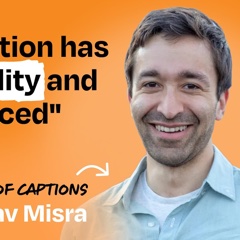
Gaurav Misra
Co-founder and CEO of Captions, former product leader at Snap
Where to hear and read about Gaurav Misra1 episode or test

Gaurav Misra is co-founder and CEO of Captions, an AI video app, and a former design engineering leader at Snap. The most useful thing to learn from him is his weekly rhythm: every engineer ships one small marketable feature, scope is cut instead of quality, and the biggest bets come from a roadmap rivals cannot see.
If a user's asking us for it, they're asking everybody for it.
How to win in the AI era: Ship weekly, embrace technical debt, ruthlessly cut scope, and more
Gaurav Misra: the story and the lessons
1Gaurav Misra's path from Snap to Captions
Misra led design engineering at Snap before founding Captions. He was an early Snap employee and built its design engineering team. He had also worked as an engineer at Microsoft and a couple of other companies.
Snap ran without PMs, and designers made product decisions. That model shaped how he runs product at Captions.
Captions lets people generate and edit talking videos with AI. The company has over 10 million users and has raised over $100 million.
He builds for people who could not make video before. Captions targets people who lacked the tools, skills or time to make video, such as business owners with no time who want results. The product lets them jump the skill gap or the time gap.
Misra reduces product building to three steps: find a user problem, apply technology to it, and find the people who have it. He says 'We're building for the person who could not have created video before.'
2How Captions ships a marketable feature every week
Misra wants every engineer to ship a marketable feature weekly. A marketable feature is one users would subscribe or download the app for, not table stakes like justify alignment. Many weekly bets fail, so the team doubles down on the ones that work and cuts the rest.
He says the goal is for 'every engineer' to 'ship a marketable product every week', and this keeps the product top of mind amid constant AI news.
Misra cuts scope and holds quality fixed. The team lists every element of a feature and removes parts until the product would be useless if anything else went. For an add-image feature, that meant a native camera-roll picker dropping straight into the video, with no background removal, hue controls or cloud import.
He says engineers, PMs and designers under time pressure often cut quality when they could cut scope. If someone uses a feature, it should work.
The loudest user complaint becomes next week's work. Users complain first about what bothers them most, such as hue, background removal or cloud import. The team ships those fixes the next week, so users see a team shipping like crazy.
Misra reads complaints as a sign of product-market fit. People who complain care enough to want the product better. Silence is the worrying sign.
In his words, 'If nobody complains, it's almost red flag.'
He uses virality as a cheap test of demand. The team watches what trends and gets shared on social media, since something real sits at the core of a viral idea. They find that core and mold it into the business.
A viral idea can be a one-time use case that cannot support a subscription. Merely talking about an idea shows how it might be received before anything is built.
Misra says hype earns a first look and only delivery keeps users. Saying an old product is rethought with AI makes people curious enough to try it. If the product does not deliver, they play around and leave.
He sees choosing what to ignore as now the key product skill, because there are more possible paths than people to build them.
3Why Misra takes on technical debt on purpose
Misra tells startups to borrow against the future. He compares technical debt to financial debt: it creates leverage, and a later engineer can fix what the company cannot afford to fix today. He says a startup takes on debt because that is how it operates faster than a bigger company.
He asks whether the 500th engineer can solve it instead. The test is whether a problem needs solving today or whether the 50th, 100th or 500th engineer can solve it. If the company fails, that engineer is never hired and it does not matter.
That future engineer may be an AI agent. He separates two-way doors, where you can do whatever you want, from one-way doors, which deserve care in proportion to how much they will matter later.
Misra prices each piece of debt by its daily interest. Each piece costs perhaps 1% or 2% of daily time in bugs, crashes and restarts. Too much debt pushes the interest to 80% or 90%, leaving no time for new work.
He frames it as a debt runway: deliver enough value to hire engineers before it runs out.
Captions spends Q4 paying down infrastructure debt. By Q4 the year's products are shipped and things wind down before the holidays. That quarter goes to infrastructure and technical debt.
He says bigger companies either pay debt right away or are still repaying debt from their startup days.
Misra pushes the team to adopt AI engineering tools fast. Everyone at Captions uses Cursor, which he calls a huge multiplier. The team also tried Devin, an AI engineer you chat with in Slack, for about $500 a month.
He says a big company would need 30 lawyers in the room before adopting Devin.
4Misra's secret roadmap and how Captions finds big ideas
He keeps a secret roadmap beside the public one. The public roadmap is what users ask for, which every competitor also sees and builds. The secret roadmap holds ideas nobody requested, drawn from his understanding of users and the technology, and the team never discusses them publicly.
He says the biggest wins usually come from the secret roadmap. These ideas aim to change behavior so that once users try them, they never go back.
Everyone at Captions pitches ideas in a quarterly brainstorm. Engineering, recruiting and marketing all submit ideas, then the company votes and ranks them. The product team then checks feasibility and technology.
This turns the noise from social media and new models into a shared internal roadmap.
The eye contact feature came out of that brainstorm. It shifts the eyes of someone reading a script so they look at the camera. Captions was the first to build it, together with Nvidia, and the demo ad ran in nearly every language and still gets millions of views.
Nvidia was unsure at first why anyone needed it but was open to a partnership. Almost every app has since copied the feature.
Some features start with design concepts instead of a spec. Designers make many concepts without a stated purpose, and PMs review them one by one until interesting ideas stand out. Other work starts PM first, with a problem and then specs.
The design-first route surfaces ideas the team would miss if it stared only at metrics and numbers.
Misra does not yet use an LLM to brainstorm products. The missing piece is context. He understands his users but cannot put that understanding into words.
He already struggles to pass it on to PMs and designers, so loading it into an LLM is harder still.
5What Misra took from Snap's way of building products
A small designer team ran Snap's product and Evan Spiegel approved every UI change. A design team of 10 to 12 people ran product and stayed that size even at 5,000 to 6,000 employees. There were no PMs until monetization arrived, so designers did the PM work.
Spiegel approved any user-facing change before it shipped. Misra thinks consumer breakthroughs need one mind holding the whole app, and links it to Brian Chesky at Airbnb and founder mode.
Misra saw only years later why camera-first mattered. Opening Snapchat to the camera meant people captured a funny moment in the app immediately. Instagram could not copy it because its metrics would drop.
He says this one small decision was holding the entire company against all competition. Spiegel pitched ideas the whole team disagreed with, and they kept becoming hits that nobody could explain.
Snap tested ideas in the live app before staffing a full build. At 500 to 3,000 engineers, every product became a six-month to one-year bet. A small design engineering team put early versions inside Snapchat and tested them in Australia and a couple of high schools.
Only after a test showed good dynamics did 500 engineers spend six months building it at scale.
He built alignment by sharing prototype builds instead of lobbying. A working build spread from engineers to managers, then VPs, then Spiegel, who asked why he was the last to hear about it. People then began asking when it would ship.
Misra says 'you can actually create virality inside a company.' It replaced the stakeholder-by-stakeholder alignment work of a PM.
Snap's mission decided what was out of scope. Private sharing in a safe way ruled out public sharing, which invites bullying, and ruled out resharing someone's story without their consent. Snap's Our Stories had strong engagement but needed a curation team that reviewed every post and could not scale.
Misra says this is one reason Snap was not the company to find short-form video.
Misra warns that strong growth hides whether your work helps. When growth is strong, you cannot tell if your changes drive it or if it happens despite them. That can teach wrong lessons, such as that a contrarian choice was right.
6How Misra thinks about PMs, marketing and user research
He wants PMs to own the path all the way to marketing. Marketing expands the product's surface area: a search ad or Facebook ad is a button to your product placed elsewhere. The PM should own the funnel from that tap through onboarding to use.
Captions hires PMs with marketing instinct, or the ability to learn it. He notes Chesky renamed PMs at Airbnb to product marketing managers for the same reason.
Misra says someone must own the PM work or nobody does. He thinks Snap may have succeeded despite not hiring PMs, since without enough people doing it nobody was responsible. He treats a designer or engineer with a PM mindset as the same idea as a PM with design and engineering skills.
Every function should know the others well enough to operate in them. Misra points to Stripe reportedly having hundreds of engineers before its first PM.
User research shapes the leader's picture of customer pain. Misra cites Patrick Olson's idea that research updates your picture of customer pains, and that picture decides what you build.
Snap had one user researcher until about 5,000 employees, after its IPO. Its decision makers and CEO were still steeped in how users behave.
7The year and a half Misra ignored his own hit app
The first Captions app hit the top of the App Store in two days. It took two days to build and reached the top of the App Store with about 600 videos a day, with no promotion.
The plan was a social network, with a creation tool first. Speech to text was a solved problem, so captions came first.
Misra distrusted the hit because it came too easily. The founders assumed it could not be the real product and went off to build social networks. The app sat on his personal account, so he rarely checked it.
He says 'we basically wasted about a year and a half.'
The neglected app kept growing without anyone working on it. After about a year and a half he found $500,000 in the account and a chart still rising. There were no employees, releases or support, and about 2,000 tickets sat unanswered, yet reviews stayed great.
Once the team shipped new features into it, growth became a new vertical line that made the old one look flat.
He learned social networks are hard to build and hard to kill. The team's old social app was pulled from the app store, yet thousands of people still use and post on it.
He compares it to X, where the brand, team and URL all changed and the network held.
8Misra on AI video, trust and marketing
Misra sees talking video as the unsolved frontier. Text-to-video today is mostly silent B-roll, yet most movies, shows and ads are dialogue and monologue. He says researchers see talking video as fully solvable with large generative models and nobody had yet taken the time.
He calls ByteDance's OmniHuman demo, a talking broccoli, the most striking recent AI video, and says it looks far more expressive than an avatar.
Captions designs products to make fake documentation hard. Misra splits video into documentation, such as personal memories or news, and storytelling, such as ads and entertainment. He sees no benefit of AI in documentation, so much of the product and design effort goes into making misuse hard and storytelling easy.
He thinks fully indistinguishable video is still a couple of years away, which is scary but opens an opportunity for someone to solve the trust problem.
AI video ads now beat the ones people record. Once quality improved, comments calling Captions' ads fake stopped. Generating 30 to 40 variants lets one win, which beats a single filmed creative.
Translating a winning ad with AI performed almost as well as the original in each language, versus rebuilding it for each market.
He thinks marketing is where most people will first meet AI video. Adoption lags the technology, and many people still do not know these advances exist.
His parents in India are the only ones in their neighborhood who know ChatGPT, and they quietly use it for their community notes.
Misra's rule is that the easiest way to be the best is to be first. He says he loves to compete and win, and that speed to market is the key. Captions is hiring early product and design people who want to ship weekly.
He calls shipping a marketable feature every week 'the PM's dream'. The pace works as a filter: people it excites fit, and people it stresses do not.

How to win in the AI era: Ship weekly, embrace technical debt, ruthlessly cut scope, and more
Gaurav Misra explains how Captions runs an AI consumer startup: every engineer ships a marketable feature each week, scope is cut instead of quality, technical debt is taken on on purpose, and a secret roadmap drives the big wins. It also covers how Snap built products with designers acting as PMs, and how Captions ignored its own hit app for 1.5 years while it kept growing to $500,000 in revenue.
Misra led design engineering at Snap before founding Captions. He was an early Snap employee and built its design engineering team. He had also worked as an engineer at Microsoft and a couple of other companies.
Snap ran without PMs, and designers made product decisions. That model shaped how he runs product at Captions.
Captions lets people generate and edit talking videos with AI. The company has over 10 million users and has raised over $100 million.
He builds for people who could not make video before. Captions targets people who lacked the tools, skills or time to make video, such as business owners with no time who want results. The product lets them jump the skill gap or the time gap.
Misra reduces product building to three steps: find a user problem, apply technology to it, and find the people who have it. He says 'We're building for the person who could not have created video before.'
Misra wants every engineer to ship a marketable feature weekly. A marketable feature is one users would subscribe or download the app for, not table stakes like justify alignment. Many weekly bets fail, so the team doubles down on the ones that work and cuts the rest.
He says the goal is for 'every engineer' to 'ship a marketable product every week', and this keeps the product top of mind amid constant AI news.
Misra cuts scope and holds quality fixed. The team lists every element of a feature and removes parts until the product would be useless if anything else went. For an add-image feature, that meant a native camera-roll picker dropping straight into the video, with no background removal, hue controls or cloud import.
He says engineers, PMs and designers under time pressure often cut quality when they could cut scope. If someone uses a feature, it should work.
The loudest user complaint becomes next week's work. Users complain first about what bothers them most, such as hue, background removal or cloud import. The team ships those fixes the next week, so users see a team shipping like crazy.
Misra reads complaints as a sign of product-market fit. People who complain care enough to want the product better. Silence is the worrying sign.
In his words, 'If nobody complains, it's almost red flag.'
He uses virality as a cheap test of demand. The team watches what trends and gets shared on social media, since something real sits at the core of a viral idea. They find that core and mold it into the business.
A viral idea can be a one-time use case that cannot support a subscription. Merely talking about an idea shows how it might be received before anything is built.
Misra says hype earns a first look and only delivery keeps users. Saying an old product is rethought with AI makes people curious enough to try it. If the product does not deliver, they play around and leave.
He sees choosing what to ignore as now the key product skill, because there are more possible paths than people to build them.
Misra tells startups to borrow against the future. He compares technical debt to financial debt: it creates leverage, and a later engineer can fix what the company cannot afford to fix today. He says a startup takes on debt because that is how it operates faster than a bigger company.
He asks whether the 500th engineer can solve it instead. The test is whether a problem needs solving today or whether the 50th, 100th or 500th engineer can solve it. If the company fails, that engineer is never hired and it does not matter.
That future engineer may be an AI agent. He separates two-way doors, where you can do whatever you want, from one-way doors, which deserve care in proportion to how much they will matter later.
Misra prices each piece of debt by its daily interest. Each piece costs perhaps 1% or 2% of daily time in bugs, crashes and restarts. Too much debt pushes the interest to 80% or 90%, leaving no time for new work.
He frames it as a debt runway: deliver enough value to hire engineers before it runs out.
Captions spends Q4 paying down infrastructure debt. By Q4 the year's products are shipped and things wind down before the holidays. That quarter goes to infrastructure and technical debt.
He says bigger companies either pay debt right away or are still repaying debt from their startup days.
Misra pushes the team to adopt AI engineering tools fast. Everyone at Captions uses Cursor, which he calls a huge multiplier. The team also tried Devin, an AI engineer you chat with in Slack, for about $500 a month.
He says a big company would need 30 lawyers in the room before adopting Devin.
He keeps a secret roadmap beside the public one. The public roadmap is what users ask for, which every competitor also sees and builds. The secret roadmap holds ideas nobody requested, drawn from his understanding of users and the technology, and the team never discusses them publicly.
He says the biggest wins usually come from the secret roadmap. These ideas aim to change behavior so that once users try them, they never go back.
Everyone at Captions pitches ideas in a quarterly brainstorm. Engineering, recruiting and marketing all submit ideas, then the company votes and ranks them. The product team then checks feasibility and technology.
This turns the noise from social media and new models into a shared internal roadmap.
The eye contact feature came out of that brainstorm. It shifts the eyes of someone reading a script so they look at the camera. Captions was the first to build it, together with Nvidia, and the demo ad ran in nearly every language and still gets millions of views.
Nvidia was unsure at first why anyone needed it but was open to a partnership. Almost every app has since copied the feature.
Some features start with design concepts instead of a spec. Designers make many concepts without a stated purpose, and PMs review them one by one until interesting ideas stand out. Other work starts PM first, with a problem and then specs.
The design-first route surfaces ideas the team would miss if it stared only at metrics and numbers.
Misra does not yet use an LLM to brainstorm products. The missing piece is context. He understands his users but cannot put that understanding into words.
He already struggles to pass it on to PMs and designers, so loading it into an LLM is harder still.
A small designer team ran Snap's product and Evan Spiegel approved every UI change. A design team of 10 to 12 people ran product and stayed that size even at 5,000 to 6,000 employees. There were no PMs until monetization arrived, so designers did the PM work.
Spiegel approved any user-facing change before it shipped. Misra thinks consumer breakthroughs need one mind holding the whole app, and links it to Brian Chesky at Airbnb and founder mode.
Misra saw only years later why camera-first mattered. Opening Snapchat to the camera meant people captured a funny moment in the app immediately. Instagram could not copy it because its metrics would drop.
He says this one small decision was holding the entire company against all competition. Spiegel pitched ideas the whole team disagreed with, and they kept becoming hits that nobody could explain.
Snap tested ideas in the live app before staffing a full build. At 500 to 3,000 engineers, every product became a six-month to one-year bet. A small design engineering team put early versions inside Snapchat and tested them in Australia and a couple of high schools.
Only after a test showed good dynamics did 500 engineers spend six months building it at scale.
He built alignment by sharing prototype builds instead of lobbying. A working build spread from engineers to managers, then VPs, then Spiegel, who asked why he was the last to hear about it. People then began asking when it would ship.
Misra says 'you can actually create virality inside a company.' It replaced the stakeholder-by-stakeholder alignment work of a PM.
Snap's mission decided what was out of scope. Private sharing in a safe way ruled out public sharing, which invites bullying, and ruled out resharing someone's story without their consent. Snap's Our Stories had strong engagement but needed a curation team that reviewed every post and could not scale.
Misra says this is one reason Snap was not the company to find short-form video.
Misra warns that strong growth hides whether your work helps. When growth is strong, you cannot tell if your changes drive it or if it happens despite them. That can teach wrong lessons, such as that a contrarian choice was right.
He wants PMs to own the path all the way to marketing. Marketing expands the product's surface area: a search ad or Facebook ad is a button to your product placed elsewhere. The PM should own the funnel from that tap through onboarding to use.
Captions hires PMs with marketing instinct, or the ability to learn it. He notes Chesky renamed PMs at Airbnb to product marketing managers for the same reason.
Misra says someone must own the PM work or nobody does. He thinks Snap may have succeeded despite not hiring PMs, since without enough people doing it nobody was responsible. He treats a designer or engineer with a PM mindset as the same idea as a PM with design and engineering skills.
Every function should know the others well enough to operate in them. Misra points to Stripe reportedly having hundreds of engineers before its first PM.
User research shapes the leader's picture of customer pain. Misra cites Patrick Olson's idea that research updates your picture of customer pains, and that picture decides what you build.
Snap had one user researcher until about 5,000 employees, after its IPO. Its decision makers and CEO were still steeped in how users behave.
The first Captions app hit the top of the App Store in two days. It took two days to build and reached the top of the App Store with about 600 videos a day, with no promotion.
The plan was a social network, with a creation tool first. Speech to text was a solved problem, so captions came first.
Misra distrusted the hit because it came too easily. The founders assumed it could not be the real product and went off to build social networks. The app sat on his personal account, so he rarely checked it.
He says 'we basically wasted about a year and a half.'
The neglected app kept growing without anyone working on it. After about a year and a half he found $500,000 in the account and a chart still rising. There were no employees, releases or support, and about 2,000 tickets sat unanswered, yet reviews stayed great.
Once the team shipped new features into it, growth became a new vertical line that made the old one look flat.
He learned social networks are hard to build and hard to kill. The team's old social app was pulled from the app store, yet thousands of people still use and post on it.
He compares it to X, where the brand, team and URL all changed and the network held.
Misra sees talking video as the unsolved frontier. Text-to-video today is mostly silent B-roll, yet most movies, shows and ads are dialogue and monologue. He says researchers see talking video as fully solvable with large generative models and nobody had yet taken the time.
He calls ByteDance's OmniHuman demo, a talking broccoli, the most striking recent AI video, and says it looks far more expressive than an avatar.
Captions designs products to make fake documentation hard. Misra splits video into documentation, such as personal memories or news, and storytelling, such as ads and entertainment. He sees no benefit of AI in documentation, so much of the product and design effort goes into making misuse hard and storytelling easy.
He thinks fully indistinguishable video is still a couple of years away, which is scary but opens an opportunity for someone to solve the trust problem.
AI video ads now beat the ones people record. Once quality improved, comments calling Captions' ads fake stopped. Generating 30 to 40 variants lets one win, which beats a single filmed creative.
Translating a winning ad with AI performed almost as well as the original in each language, versus rebuilding it for each market.
He thinks marketing is where most people will first meet AI video. Adoption lags the technology, and many people still do not know these advances exist.
His parents in India are the only ones in their neighborhood who know ChatGPT, and they quietly use it for their community notes.
Misra's rule is that the easiest way to be the best is to be first. He says he loves to compete and win, and that speed to market is the key. Captions is hiring early product and design people who want to ship weekly.
He calls shipping a marketable feature every week 'the PM's dream'. The pace works as a filter: people it excites fit, and people it stresses do not.