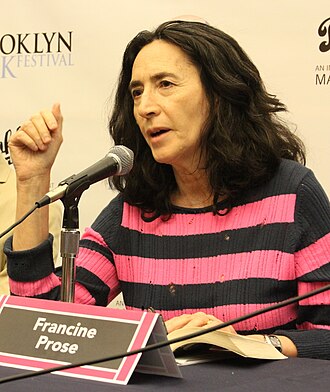
Francine Prose
Novelist and author of Reading Like a Writer, who has taught at Harvard and Bard
Where to hear and read about Francine Prose1 episode or test

Francine Prose is a novelist who has written more than 30 books, including Reading Like a Writer, and has taught at Harvard and Bard. The most useful thing to learn from her is to read slowly enough to see every word as a choice, then revise for plain clarity.
if you wouldn't say it and if you can't get it out of your mouth there's a good chance that it shouldn't be on the page
This Is What a Harvard Writing Masterclass Feels Like (Francine Prose Interview)
Francine Prose: the story and the lessons
1Francine Prose and how she teaches
Prose teaches writers to read like writers. She has written more than 30 books and taught at Harvard and Bard College. Her advice is to pick books that have lasted and look at their words, sentences, characters and details.
The question she puts to each book is why it has stayed popular for so long.
She keeps repeating one point to students: a human being wrote this. At Harvard she teaches literature, with a 300-word paper due every week. Readers talk about Madame Bovary, Heathcliff and Ahab as people they know.
She calls these characters holograms that we can turn around on the desk and examine from every side.
Her ghost stories class draws far more applicants than seats. The cap is 15 students. She usually gets 20 applications and this time got about 60.
The course covers ghost stories from many cultures, including Latin American ones, where people live closer to their dead. She believes in ghosts, reasoning that too many people have seen them for it to be imagination.
2How Prose reads like a writer
Prose reads slowly and asks why this word and not another. She treats every word and mark as a choice a person made, such as a semicolon instead of a period. Close reading is the basis of how she teaches.
She says the gap between a Van Gogh sunflower and a yard-sale sunflower print is the brushstroke, which she treats as the equivalent of language.
She studies masters for the scene she cannot write. Party scenes are hard because many people talk at once. She points students to the party in Joyce's The Dead and the ball in Anna Karenina.
Tolstoy follows jilted Kitty's view of Anna and Vronsky dancing, because Kitty is the one who would notice. Joyce's party is a babble of voices, yet you soon learn who everyone is.
Chekhov broke every rule she taught, so she distrusted rules. She had taught students not to give two characters one name and not to kill a close third-person narrator. Reading Chekhov on a bus to Sarah Lawrence, she found he had broken each one.
In Gusev the narration follows the dead sailor's coffin into the sea, past sharks and fish, then up into the sky. The one rule she kept is to write so the stupidest person in the room can understand.
Her paragraph breaks come from instinct that reading built. She has never worked out what a topic sentence is. She breaks a paragraph when a slightly new thought begins, and says that sense comes from reading and writing.
García Márquez's The Autumn of the Patriarch is one unbroken paragraph, and a friend hated it because he had nowhere to set down his beer. She says it doesn't get easier, but you get a clearer sense of what you need.
3Prose on clarity and revision
Prose reads her pages aloud and cuts what she could not say. If you can't get a sentence out of your mouth, or you would never say it in conversation, it probably doesn't belong on the page. She says writers reach for fancy words because they think they must write with a capital W.
She applies the test to fiction and nonfiction alike, since revision for both comes down to clarity.
She translates jargon into plain English and sees what survives. She used to assign students a bad passage of jargon, historical, art historical or literary, and have them translate it. The passages collapsed because there was little inside them.
A line at One Vanderbilt about its spire nodding to the Chrysler Building's spire meant nothing once questioned. Her method is to ask what you are trying to say and state it plainly.
Prose finds first drafts exhausting because she is fighting cliches. She can manage only two or three hours on a first draft before she is done for the day.
A friend told her a first draft is a constant barrage of cliches. The stupidest way of saying something arrives first, and the job is to notice it and look for another.
She numbers her drafts and keeps revising. Her 23rd novel has been through about 40 drafts. She numbers them now so she knows how many there are.
Revision is the same for novels and nonfiction, because it is about finding sentences that mean nothing.
Prose reads Anne Frank as a writer who revised her natural voice. Anne Frank heard a radio announcer say people would want war accounts afterward, then edited her diary several times. She was 12 to 15 while writing it.
Her father edited it again, cutting the sex and then putting it back in. Prose says the diary's natural voice was made in revision.
She cuts hard and says you will not miss the words. She can lose 2,000 words and miss none of them, which she compares to losing weight without dieting. In the 1970s Mademoiselle bought her 20,000-word story but could print only 3,000 to 5,000 words.
They paid $800, she took a trip to Mexico, and she never noticed a missing word.
She hunts for the one word that replaces ten. Finding a single word where she thought she needed ten is, in her phrase, insanely satisfying. She calls it a buzz and part of why she keeps writing.
When an ending feels flat, Prose asks what one more turn would add. She finds endings the hardest part of a book and loves open ones like Chekhov's Lady with the Pet Dog. Her editor, Noah Eker, said her new novel needed one more turn and suggested a letter from Catherine Dickens.
The last line has the youngest child saying he no longer wants to be called Baby, but Edward. She says she is happier with this ending than with almost any other.
4How Prose writes dialogue and chooses a narrator
Prose never lets dialogue be exposition dressed up as conversation. The worst dialogue has characters tell each other things they both know so the reader can learn them. Her example is a line asking whether it's true that you live in the West Village.
The best dialogue has someone say something unexpected, as people do in life. Dialogue should move the story or reveal character, and people speak out of who they are.
She lets characters answer sideways and lets subtext work. Speakers don't take turns like a ping pong game. B may answer A with something unrelated, then show five lines later that he heard A exactly.
Her advice is to listen for what people are not saying.
Prose eavesdrops to collect real talk. She calls eavesdropping the best way to learn dialogue, and says writing dialogue makes you listen to people. She misses subway rides most since moving to the country.
She once thought a man ahead of her was talking about ayahuasca, then passed him and found he wasn't. Overheard fragments are often more interesting than what was said.
She deletes any gesture or line she would not miss. Her test is to remove the line and see whether you notice it's gone. A character's cigarette or refilled coffee cup must mean something or it was a placeholder.
She uses the space break to skip walking characters around. She says the value of the space break is underrated. You can skip two pages of getting characters out the door.
She doubts the Hollywood rule of entering late and leaving early, since it depends on the scene and screenwriting assumes a different attention span.
Prose picks each narrator by the distance it puts between reader and story. Omniscience keeps you far from the action, close third sits in a head, and first person is closest. Her novel Five Weeks in the Country uses five kinds of narration, each for a reason.
Dickens's nine children speak in a collective voice because she couldn't pick one. Dickens is in third person, Andersen's isolated mind is reached only in first person, and letters add another form.
She suggests writing as if one person tells the story to another. Her exercise is a story told by one person to another, like strangers on a long train ride, as in Tolstoy's The Kreutzer Sonata. It settles who is talking and who is listening, and the listener can interrupt to ask for clarity.
She gave the exercise to a student, and her own first novel was built this way. Anne Frank's addressing her diary to Kitty worked the same way.
5Where Prose's stories come from
Prose starts a book from an image that makes her ask why nobody wrote it. A Brassaï photograph of a couple at Le Monocle, with wall text naming the butch woman as a race car driver, set off her novel. A quick search showed she was barred from competing in France for cross-dressing.
Hitler invited her to sit in his box at the 1939 Olympics, and she later spied for the Gestapo. Prose's first thought was what a great story, and why a million people hadn't already written it.
She builds from story and need, not from a chosen theme. Practical questions make a person on the page: family, neighbors, neighborhood, memories. Details gather around that person until the character becomes an arc she has to follow.
For her YA novel about a school turned into a prison camp, she Googled preventing school violence. The results, metal detectors and spy searches, became the structure.
Forgotten memories slip into her fiction, and the writing feels like dictation. Weeks after finishing her novel, she recalled that her son Leon's attention had once cured a child's trouble with his L's, an episode she had given to Andersen without remembering it. She credits deep bodily memory, not chance.
She says that when a novel is working it feels like taking dictation, and the characters start talking to you.

This Is What a Harvard Writing Masterclass Feels Like (Francine Prose Interview)
Francine Prose argues that good writing comes from slow, close reading of how other writers made their choices, and from a plain, clear voice you could say out loud. Her most useful habits are reading aloud, cutting anything you would not miss, and borrowing the moves of great books to solve your own problems.
Prose teaches writers to read like writers. She has written more than 30 books and taught at Harvard and Bard College. Her advice is to pick books that have lasted and look at their words, sentences, characters and details.
The question she puts to each book is why it has stayed popular for so long.
She keeps repeating one point to students: a human being wrote this. At Harvard she teaches literature, with a 300-word paper due every week. Readers talk about Madame Bovary, Heathcliff and Ahab as people they know.
She calls these characters holograms that we can turn around on the desk and examine from every side.
Her ghost stories class draws far more applicants than seats. The cap is 15 students. She usually gets 20 applications and this time got about 60.
The course covers ghost stories from many cultures, including Latin American ones, where people live closer to their dead. She believes in ghosts, reasoning that too many people have seen them for it to be imagination.
Prose reads slowly and asks why this word and not another. She treats every word and mark as a choice a person made, such as a semicolon instead of a period. Close reading is the basis of how she teaches.
She says the gap between a Van Gogh sunflower and a yard-sale sunflower print is the brushstroke, which she treats as the equivalent of language.
She studies masters for the scene she cannot write. Party scenes are hard because many people talk at once. She points students to the party in Joyce's The Dead and the ball in Anna Karenina.
Tolstoy follows jilted Kitty's view of Anna and Vronsky dancing, because Kitty is the one who would notice. Joyce's party is a babble of voices, yet you soon learn who everyone is.
Chekhov broke every rule she taught, so she distrusted rules. She had taught students not to give two characters one name and not to kill a close third-person narrator. Reading Chekhov on a bus to Sarah Lawrence, she found he had broken each one.
In Gusev the narration follows the dead sailor's coffin into the sea, past sharks and fish, then up into the sky. The one rule she kept is to write so the stupidest person in the room can understand.
Her paragraph breaks come from instinct that reading built. She has never worked out what a topic sentence is. She breaks a paragraph when a slightly new thought begins, and says that sense comes from reading and writing.
García Márquez's The Autumn of the Patriarch is one unbroken paragraph, and a friend hated it because he had nowhere to set down his beer. She says it doesn't get easier, but you get a clearer sense of what you need.
Prose reads her pages aloud and cuts what she could not say. If you can't get a sentence out of your mouth, or you would never say it in conversation, it probably doesn't belong on the page. She says writers reach for fancy words because they think they must write with a capital W.
She applies the test to fiction and nonfiction alike, since revision for both comes down to clarity.
She translates jargon into plain English and sees what survives. She used to assign students a bad passage of jargon, historical, art historical or literary, and have them translate it. The passages collapsed because there was little inside them.
A line at One Vanderbilt about its spire nodding to the Chrysler Building's spire meant nothing once questioned. Her method is to ask what you are trying to say and state it plainly.
Prose finds first drafts exhausting because she is fighting cliches. She can manage only two or three hours on a first draft before she is done for the day.
A friend told her a first draft is a constant barrage of cliches. The stupidest way of saying something arrives first, and the job is to notice it and look for another.
She numbers her drafts and keeps revising. Her 23rd novel has been through about 40 drafts. She numbers them now so she knows how many there are.
Revision is the same for novels and nonfiction, because it is about finding sentences that mean nothing.
Prose reads Anne Frank as a writer who revised her natural voice. Anne Frank heard a radio announcer say people would want war accounts afterward, then edited her diary several times. She was 12 to 15 while writing it.
Her father edited it again, cutting the sex and then putting it back in. Prose says the diary's natural voice was made in revision.
She cuts hard and says you will not miss the words. She can lose 2,000 words and miss none of them, which she compares to losing weight without dieting. In the 1970s Mademoiselle bought her 20,000-word story but could print only 3,000 to 5,000 words.
They paid $800, she took a trip to Mexico, and she never noticed a missing word.
She hunts for the one word that replaces ten. Finding a single word where she thought she needed ten is, in her phrase, insanely satisfying. She calls it a buzz and part of why she keeps writing.
When an ending feels flat, Prose asks what one more turn would add. She finds endings the hardest part of a book and loves open ones like Chekhov's Lady with the Pet Dog. Her editor, Noah Eker, said her new novel needed one more turn and suggested a letter from Catherine Dickens.
The last line has the youngest child saying he no longer wants to be called Baby, but Edward. She says she is happier with this ending than with almost any other.
Prose never lets dialogue be exposition dressed up as conversation. The worst dialogue has characters tell each other things they both know so the reader can learn them. Her example is a line asking whether it's true that you live in the West Village.
The best dialogue has someone say something unexpected, as people do in life. Dialogue should move the story or reveal character, and people speak out of who they are.
She lets characters answer sideways and lets subtext work. Speakers don't take turns like a ping pong game. B may answer A with something unrelated, then show five lines later that he heard A exactly.
Her advice is to listen for what people are not saying.
Prose eavesdrops to collect real talk. She calls eavesdropping the best way to learn dialogue, and says writing dialogue makes you listen to people. She misses subway rides most since moving to the country.
She once thought a man ahead of her was talking about ayahuasca, then passed him and found he wasn't. Overheard fragments are often more interesting than what was said.
She deletes any gesture or line she would not miss. Her test is to remove the line and see whether you notice it's gone. A character's cigarette or refilled coffee cup must mean something or it was a placeholder.
She uses the space break to skip walking characters around. She says the value of the space break is underrated. You can skip two pages of getting characters out the door.
She doubts the Hollywood rule of entering late and leaving early, since it depends on the scene and screenwriting assumes a different attention span.
Prose picks each narrator by the distance it puts between reader and story. Omniscience keeps you far from the action, close third sits in a head, and first person is closest. Her novel Five Weeks in the Country uses five kinds of narration, each for a reason.
Dickens's nine children speak in a collective voice because she couldn't pick one. Dickens is in third person, Andersen's isolated mind is reached only in first person, and letters add another form.
She suggests writing as if one person tells the story to another. Her exercise is a story told by one person to another, like strangers on a long train ride, as in Tolstoy's The Kreutzer Sonata. It settles who is talking and who is listening, and the listener can interrupt to ask for clarity.
She gave the exercise to a student, and her own first novel was built this way. Anne Frank's addressing her diary to Kitty worked the same way.
Prose starts a book from an image that makes her ask why nobody wrote it. A Brassaï photograph of a couple at Le Monocle, with wall text naming the butch woman as a race car driver, set off her novel. A quick search showed she was barred from competing in France for cross-dressing.
Hitler invited her to sit in his box at the 1939 Olympics, and she later spied for the Gestapo. Prose's first thought was what a great story, and why a million people hadn't already written it.
She builds from story and need, not from a chosen theme. Practical questions make a person on the page: family, neighbors, neighborhood, memories. Details gather around that person until the character becomes an arc she has to follow.
For her YA novel about a school turned into a prison camp, she Googled preventing school violence. The results, metal detectors and spy searches, became the structure.
Forgotten memories slip into her fiction, and the writing feels like dictation. Weeks after finishing her novel, she recalled that her son Leon's attention had once cured a child's trouble with his L's, an episode she had given to Andersen without remembering it. She credits deep bodily memory, not chance.
She says that when a novel is working it feels like taking dictation, and the characters start talking to you.