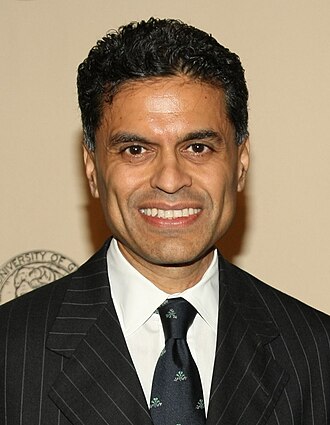
Fareed Zakaria
Journalist, CNN host and Washington Post columnist
Where to hear and read about Fareed Zakaria1 episode or test

Fareed Zakaria is a journalist, CNN host of Fareed Zakaria GPS and Washington Post columnist who has written a weekly column for about 25 years. The thing most worth learning from him is to build each piece around one idea that adds value, earned through deep reading, firsthand conversations and deadline-driven practice.
it's an exclamation point that makes people think differently about some important subject
Learn to Write Persuasively in 70 Minutes (Fareed Zakaria Interview)
Fareed Zakaria: the story and the lessons
1How Zakaria builds a column around one idea
Zakaria organizes every short column around a single idea. A 500 to 800 word column must carry one idea, not two or three, or the narrative falls apart. He has written his weekly column this way since about 2000.
He says an article that fails to do this is mostly failing. Essays of about 2,000 words can hold more and wander, but a column cannot.
He tells smart readers something they don't know. He assumes readers already know what happened, so recapping events wastes space. He supplies context, an analytic framework or history they haven't considered.
This is the first requirement he sets for a good take on his show and in his columns: "Tell me something I don't know."
He thinks in writing so his spoken version arrives polished. He cites Walter Lippmann's remark that he didn't know what he thought on a subject because he hadn't written about it yet. At a George Will talk at the LBJ Library he heard the clarity and economy that only come from prior writing.
He calls Will's delivery art.
For TV and talks, he leads with the main clause. On TV a subordinate clause up front loses listeners, and lists don't work. In print he can invert a sentence for effect.
For 90 minute speaker series before 3,000 paying people, he has no personal anecdotes to lean on, so he builds a chronological story with side detours.
He speaks as the person he really is. He avoids the clipped anchor voice and the brilliant debater style, even though he can do it. He aims to sound like one part of a conversation, because he thinks audiences now want a human being.
He never had TV coaching. He argues authenticity builds more trust than a one-liner.
2Zakaria's routines: deadlines, blank hours and self-review
Zakaria chose journalism because he lacked his mentor's self-discipline. He watched Samuel Huntington rise at 6am and write in his basement study until about 10am before teaching or attending meetings. Zakaria decided he could not do that unprompted and took the forced structure of deadlines instead.
Huntington held a chaired professorship at Harvard and had nothing to prove, yet he started the day with the real work.
A weekly deadline made his column fast. The column began around 2000 and once took half a week. It now takes about two hours of writing plus research.
He says "the greatest thing about journalism for me is the deadlines."
He schedules blank hours for reading and thinking. As you rise, calls, meetings and breakfast invitations pile up. He blocks hours of blank time each day to read, think and call expert contacts, and treats it as his greatest value add.
His team handles the cutting and producing of his show after a few notes from him.
He reviews every episode of his show for one thing to fix. For three years he could not watch himself because it hurt his confidence. He now watches every episode to catch slumping, verbal props like ums and better follow-up questions.
He borrows his brother's tennis method of picking one weakness, such as the backhand, and drilling it. "You have to have purposeful practicing."
He learns writing from great prose and from repeated mistakes. He would fill a seminar with excellent writing, not 20 rules. He gives nearly every employee Orwell's Politics and the English Language and prefers Zinsser's On Writing Well to Strunk and White.
He ran a school magazine in high school and wrote his first New York Times op-ed at about 24, in graduate school at Harvard. He says trial and error cannot be short-circuited.
3How Zakaria reads, researches and writes books
He skims most books for the argument and rereads the best. He reads the introduction, conclusion and key chapters to find where the fulcrum of the argument lies, which can crack a 600 page book in about two hours. The few great ones he rereads about three times with a pen.
He read Steve Pincus's 700 page 1688 twice and marked up every page.
Rereading shows him how a writer builds an argument. On later reads he stops following the plot and sees the mechanics. He says it gives "x-ray vision into how a body of work is crafted."
It took several readings of The Great Gatsby before he saw how beautifully Fitzgerald wrote it at 28.
He starts from today's news and reads back to the roots. He asks what the roots of an event are, then reads a book or calls a historian. Sometimes he reads a history of Iran just as events there intersect with it.
He calls this doing it backwards compared with studying the past first.
He travels and meets people to find what data hides. On a three-day trip he packs in breakfasts and coffees and can meet 100 people. He gathers 20 to 40 impressions, then checks them against data, and later texts contacts when news breaks in their country.
A London hotel bouncer's remark and a silent pub gave him a read on public mood. Economist Stan Fischer told him his assumptions about a country were wrong within 24 hours of arriving.
He checks anecdotes against data and data against anecdotes. He reminds himself that the plural of anecdote is not data. He also notes data can hide things: Edward Luce's trip around America found left-behind regions while national figures showed the US beating other rich countries.
He picks the altitude of his map by the question he asks. A map the size of the territory is useless, and so is one from 70,000 feet. He asks what he is trying to answer and which comparison fits.
That is why he judges America against other great powers such as Kaiser's Germany, Hitler's Germany and the Soviet Union, not against an ideal.
He plans books chapter by chapter and briefs a research assistant. He used to start at chapter one and fill gaps later. Now he decides each chapter's topic, key books and research needs, and only used research assistants in his last two books.
The French Revolution chapter took about 20 books plus academic articles and became a 40 to 50 page digest. He says most books fail by using every research note.
Guilt and learning drive him to write books. The guilt comes from his PhD and academic past, since without a book underway he feels he is wasting his life. A book also forces him to digest a subject so readers don't have to.
He sides with Bill Buckley's split between writers who like to write and those who like to have written, and says he is the second kind.
4Zakaria on AI and the judgment it can't supply
Zakaria uses AI as a researcher, not as the source of his argument. Gemini scans sources worldwide, and he fed it his blood tests to get three questions for his doctor. But he says an argument forms through reading and talking to smart people, which AI can't do for you.
"But the way you come to your argument is partly by reading by talking to smart people."
He finds AI thin on deep dives. It can't access most of the best books on the French Revolution, only reviews and excerpts, so its output can read like a sophomore's paper. He compares it to off-the-rack suits when he wants bespoke.
Asked to write, it hedges with "on the one hand, on the other".
He says choosing which argument to make is the scarce skill. AI can write six columns for six positions, possibly better than he can. A person must decide which is right for this moment and put their credibility and courage behind it.
An AI opinion means nothing unless a human advocates it and risks their reputation.

Learn to Write Persuasively in 70 Minutes (Fareed Zakaria Interview)
Fareed Zakaria explains how a weekly column for 25 years, deep rereading of a few great books and on-the-ground conversations produce arguments with a distinct point of view. The technique worth hearing is building each piece around one idea that adds value, then using deadlines and purposeful practice to get better at it.
Zakaria organizes every short column around a single idea. A 500 to 800 word column must carry one idea, not two or three, or the narrative falls apart. He has written his weekly column this way since about 2000.
He says an article that fails to do this is mostly failing. Essays of about 2,000 words can hold more and wander, but a column cannot.
He tells smart readers something they don't know. He assumes readers already know what happened, so recapping events wastes space. He supplies context, an analytic framework or history they haven't considered.
This is the first requirement he sets for a good take on his show and in his columns: "Tell me something I don't know."
He thinks in writing so his spoken version arrives polished. He cites Walter Lippmann's remark that he didn't know what he thought on a subject because he hadn't written about it yet. At a George Will talk at the LBJ Library he heard the clarity and economy that only come from prior writing.
He calls Will's delivery art.
For TV and talks, he leads with the main clause. On TV a subordinate clause up front loses listeners, and lists don't work. In print he can invert a sentence for effect.
For 90 minute speaker series before 3,000 paying people, he has no personal anecdotes to lean on, so he builds a chronological story with side detours.
He speaks as the person he really is. He avoids the clipped anchor voice and the brilliant debater style, even though he can do it. He aims to sound like one part of a conversation, because he thinks audiences now want a human being.
He never had TV coaching. He argues authenticity builds more trust than a one-liner.
Zakaria chose journalism because he lacked his mentor's self-discipline. He watched Samuel Huntington rise at 6am and write in his basement study until about 10am before teaching or attending meetings. Zakaria decided he could not do that unprompted and took the forced structure of deadlines instead.
Huntington held a chaired professorship at Harvard and had nothing to prove, yet he started the day with the real work.
A weekly deadline made his column fast. The column began around 2000 and once took half a week. It now takes about two hours of writing plus research.
He says "the greatest thing about journalism for me is the deadlines."
He schedules blank hours for reading and thinking. As you rise, calls, meetings and breakfast invitations pile up. He blocks hours of blank time each day to read, think and call expert contacts, and treats it as his greatest value add.
His team handles the cutting and producing of his show after a few notes from him.
He reviews every episode of his show for one thing to fix. For three years he could not watch himself because it hurt his confidence. He now watches every episode to catch slumping, verbal props like ums and better follow-up questions.
He borrows his brother's tennis method of picking one weakness, such as the backhand, and drilling it. "You have to have purposeful practicing."
He learns writing from great prose and from repeated mistakes. He would fill a seminar with excellent writing, not 20 rules. He gives nearly every employee Orwell's Politics and the English Language and prefers Zinsser's On Writing Well to Strunk and White.
He ran a school magazine in high school and wrote his first New York Times op-ed at about 24, in graduate school at Harvard. He says trial and error cannot be short-circuited.
He skims most books for the argument and rereads the best. He reads the introduction, conclusion and key chapters to find where the fulcrum of the argument lies, which can crack a 600 page book in about two hours. The few great ones he rereads about three times with a pen.
He read Steve Pincus's 700 page 1688 twice and marked up every page.
Rereading shows him how a writer builds an argument. On later reads he stops following the plot and sees the mechanics. He says it gives "x-ray vision into how a body of work is crafted."
It took several readings of The Great Gatsby before he saw how beautifully Fitzgerald wrote it at 28.
He starts from today's news and reads back to the roots. He asks what the roots of an event are, then reads a book or calls a historian. Sometimes he reads a history of Iran just as events there intersect with it.
He calls this doing it backwards compared with studying the past first.
He travels and meets people to find what data hides. On a three-day trip he packs in breakfasts and coffees and can meet 100 people. He gathers 20 to 40 impressions, then checks them against data, and later texts contacts when news breaks in their country.
A London hotel bouncer's remark and a silent pub gave him a read on public mood. Economist Stan Fischer told him his assumptions about a country were wrong within 24 hours of arriving.
He checks anecdotes against data and data against anecdotes. He reminds himself that the plural of anecdote is not data. He also notes data can hide things: Edward Luce's trip around America found left-behind regions while national figures showed the US beating other rich countries.
He picks the altitude of his map by the question he asks. A map the size of the territory is useless, and so is one from 70,000 feet. He asks what he is trying to answer and which comparison fits.
That is why he judges America against other great powers such as Kaiser's Germany, Hitler's Germany and the Soviet Union, not against an ideal.
He plans books chapter by chapter and briefs a research assistant. He used to start at chapter one and fill gaps later. Now he decides each chapter's topic, key books and research needs, and only used research assistants in his last two books.
The French Revolution chapter took about 20 books plus academic articles and became a 40 to 50 page digest. He says most books fail by using every research note.
Guilt and learning drive him to write books. The guilt comes from his PhD and academic past, since without a book underway he feels he is wasting his life. A book also forces him to digest a subject so readers don't have to.
He sides with Bill Buckley's split between writers who like to write and those who like to have written, and says he is the second kind.
Zakaria uses AI as a researcher, not as the source of his argument. Gemini scans sources worldwide, and he fed it his blood tests to get three questions for his doctor. But he says an argument forms through reading and talking to smart people, which AI can't do for you.
"But the way you come to your argument is partly by reading by talking to smart people."
He finds AI thin on deep dives. It can't access most of the best books on the French Revolution, only reviews and excerpts, so its output can read like a sophomore's paper. He compares it to off-the-rack suits when he wants bespoke.
Asked to write, it hedges with "on the one hand, on the other".
He says choosing which argument to make is the scarce skill. AI can write six columns for six positions, possibly better than he can. A person must decide which is right for this moment and put their credibility and courage behind it.
An AI opinion means nothing unless a human advocates it and risks their reputation.