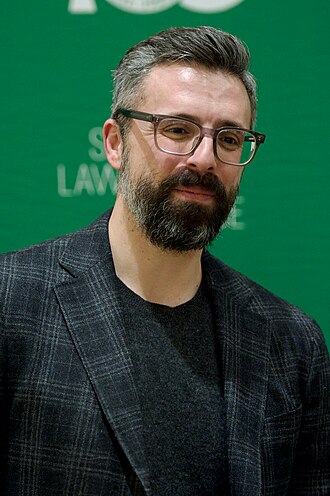
Ezra Klein
New York Times opinion columnist, podcaster and co-founder of Vox
Where to hear and read about Ezra Klein2 episodes and tests

 How I WriteIs AI Killing Writing? 12 Different Answers
 How I WriteEzra Klein Gives His Best Writing Advice
Ezra Klein is a New York Times opinion columnist and podcaster who co-founded Vox in 2014 and wrote the bestseller Abundance. The thing most worth learning from him is that good writing is the visible end of reading and reporting, so when a draft fails, the fix is more work behind the words, not better phrasing.
Writing, I think, is a technology of rigor.
Ezra Klein Gives His Best Writing Advice
Ezra Klein: the story and the lessons
1Ezra Klein's path from student blogger to Vox to the Times
Klein started blogging in his freshman year and took a $21,000 first job. He began blogging at UC Santa Cruz, then took a $21,000 fellowship at the American Prospect.
His dad compared the fellowship to grad school that pays a little.
His first editor told him his draft was not journalism. Michael Tomasky told him his first feature draft 'isn't even a piece of journalism. This is only you,' and told him to pick up the phone.
Even now most of his columns are filled with other people's voices, because he is 'just not that interested in what I think.'
Klein co-founded Vox in 2014 and helped start the online explainer era. He moved to the Washington Post around 2010 and later co-founded Vox. Its explainers were hugely popular and were copied by every other organization.
That copying gave Vox influence over the profession, though it did not protect the business.
He left the Post to build something, and sees the Times as the same project. He calls the Times irreplaceable and says he was never a Martin Gurri 'revolt' guy. He describes himself as an institutionalist who wants more institutions, not fewer.
His voice got more careful as his reach grew. A rival writer at the New Republic warned him that 'you don't realize you've gotten big' and his punches land hard. He now aims for construction over destruction and has gotten worse at writing short.
Podcasts let him shoot from the hip, which writing no longer does.
2How Klein wrote Abundance
Abundance joins big claims to granular reporting. Klein calls it joining the '30,000 feet and the 3 inches.' The reporting digs into details like the CHIPS Act funding notice and how LA developers stack tax credits.
His first book, Why We're Polarized, was descriptive and almost non-normative. Abundance is a manifesto. The book sat at number one on the New York Times bestseller list when the interview was recorded.
He threw out several introductions before the book found its cadence. He kept a sticker above his keyboard reading 'say what you're saying,' which pushed him to strip out rhetorical flash.
He credits it for the book's declarative style and calls it the best craft work he has done.
He wrote in five-day cabin stretches and expected nonlinear progress. He often made no headway for three or four days, or threw out what he wrote, then got a large amount done in the last two.
He says three hours of writing surprises you with how much you do, while 30 minutes shocks you with how little.
Book leave was cut short by October 7th. He got two months of leave against a plan of four, and said another book would need six to eight months.
He could sense Abundance would spark, 'plugging into a live socket,' after seeing it catch fire in columns and in Derek Thompson's original piece. He is not always right about this.
3What Klein learned from the Vox years
Klein did not trust his own editorial judgment at Vox. He sought outside validation, such as whether a story was popping or others were covering it. He says he should have said no more often.
'When you are not confident, others cannot tell what you want from them.' Today he believes that if he really feels something, it is likely right, even if weird.
Vox's business model could not keep its talent. Digital media was tied to advertising, and the platforms took the money, so print dollars became 'digital dimes.' Vox could not hire as fast as others poached its people.
He says Vox did not run out of ideas. 'If you can't keep paying the talent over time, you will degrade.'
Managing never felt like a day of work to him. At Vox he wrote two to three pieces a week while making The Weeds and The Ezra Klein Show. His wife told him it would not work unless he felt managing was a day of work.
A real workday for him is reporting, writing and podcasting, which is why he says he is not cut out to mainly manage.
At the Times he covers only what he can do best. At Vox he covered whatever the institution needed that day. Now he lets most stories pass and follows the news cycle only when a story connects to him emotionally.
His hit rate is higher as a result. 'Now the organization is supporting me, I don't have to support the organization.'
4Klein's rules for writing nonfiction
Klein treats a failing chapter as a missing-reading problem. When a book chapter failed, the cause was almost never style. He had not read enough books or done enough reporting, so he went back to gather something to put at the core.
'It's not that you've messed up stylistically, it's that you haven't actually done enough reporting.'
Writing carries the finding, it is not the finding. Pete Holmes compared him to a dog that keeps dropping a dead bird at the back door, and Klein agreed: he goes out, gets something and brings it back.
He calls hiding a thin idea behind embellishment 'a terrible habit' and has seen writers use 'jazz fingers' to distract from a hollow center.
He gives every stretch of text something to pass the baton to. Each section needs a real source or finding at its core: a book on homelessness and housing carries 1,600 words, a reporting trip on high-speed rail carries 3,000.
This keeps him from trying to solve a content problem with rhetoric.
Klein says not to write the way you talk. His spoken explanations of the book do not work on the page. Writing should be denser and less loose than conversation, and audio scripts are a different form again.
'For me, what works as writing is writing.'
5How Klein reads, reports and prepares
Reading is the source of everything else Klein does. He aims for two to three hours a day with printed pages and a pen. If he could keep only reading or reporting, he would keep reading.
Long, undistracted reading puts his mind in an associational mode that conversation does not. When book promotion squeezed his reading, he cleared June and July of travel and appearances.
He beat people early on by reading what they skipped. Many people read only the executive summaries of Congressional Budget Office reports, which are rarely over 30 pages. Reading the whole report was an easy edge.
His cancelled commencement address was titled 'just do the work,' or in this case 'do the reading.' 'You could just beat people by outworking them.'
About 80% of a good conversation happens before recording. That share is the choice of guest, the preparation and the team's thinking through the conversation.
He cites the conductor in Tár, who says almost no revelation happens in performance but a lot happens in practice. Klein says the same of taping.
He says lasting change comes from erosion, not a single wave. Repeated hours of a podcast change a listener the way erosion shapes a coast. After a searing reporting trip to Israel and the West Bank he had learned almost nothing new, yet he understood it differently.
6Klein on writing as rigor, and its traps
Writing exposes the gaps that conversation lets him glide past. In conversation he rarely stops for lack of anything to say, but in writing it happens all the time. Stretching ideas over a 300-page scaffold shows how much he only thought he knew.
'Conversation is exploratory and probing. Writing is a technology of rigor.'
He warns that the writer is the person most persuaded. Writing pushes him to chisel down to one best argument, and he sometimes leaves too little doubt and no room for the opposite view. On a podcast he can leave ideas in tension.
'You always believe your own [ __ ] first.' Thin work behind a piece makes it worse.
He tries a case for and a case against to keep uncertainty. Few writers can say 'I am not sure of the answer' without falsely resolving it. Klein names Ta-Nehisi Coates as doing it well at points.
It feels weird to audiences, but it stops you from talking yourself out of doubt too early.
7Klein on taste and editors
Klein judges an editor by taste and trust, not line edits. He can check clarity and grammar himself. Before a hot piece goes out, he needs someone with really good judgment to have seen it. With his Times editor Aaron Retica, the key ingredient is trust.
'The thing that is hard to find is taste.' Two editors can say very different things, and who is right about what is good is what separates them.
He says taste is intuitive, and part of developing it is trusting it. Podcasting taught him that people good at something are least able to explain how they do it. He cannot always say why one article sparks a conversation and a similar one does not.
Many artists do their best work early, when the first thing they make is the most theirs. Later the audience and the editors are in your head.
8How Ezra Klein uses AI, and why he keeps it away from the thinking
Klein uses AI for lookups and prep, not for his thinking. It replaces some Google searches, and deep research helps with preparatory work. In a crunch he lets it build a spreadsheet.
He says it helps with the work he needs least and replaces the work he needs most. Even with access to the labs and the best models, it has not become an honored partner in his workflow.
He rejects the download model of the mind. His essay 'Against the Matrix Theory of the Mind' says he once pictured a port in the brain, then read Rawls's Political Liberalism and changed his mind. Seven hours with a book is seven hours with your mind on the topic.
'What knowledge is supposed to do is change you. And it changes you because you make connections to it.'
He marked up a Rand report for over an hour rather than summarize it. An AI summary of the Rand housing construction cost report would have given useful factoids, but it would not know what he wanted to know or make his connections.
'It's more dangerous to think you've read something that you haven't than to not read it at all.'
He says AI sees what everybody else would see. He wants to write what he will notice that others would not. Perell likened AI to a kaleidoscope that prompts can aim differently, and Klein replied that no prompt would have told him to go read more books.
He says ChatGPT will not tell you the whole approach is wrong. It helps you tweak what you think you should be doing. A good editor, or the 'not right' voice in your own head, keeps saying no until it is right.
'It doesn't know that you're just wrong.'
Klein says compression loses fidelity, so he doubts shortcuts. Sam Bankman-Fried asked why books are not magazine articles, and articles not tweets. Klein sees the loss when he cuts excerpts of his own books.
A magazine article changes you less than a book, and a tweet less than an article. He is skeptical that AI will radically change deep journalism and argues pieces need to be longer, not shorter.
9Klein on why journalism is in trouble
Klein says far fewer outlets count as top tier than in 2005. When he turned professional in 2005, a wide set of outlets seemed top tier. Many are now hollowed out or run on shrunken budgets, such as Newsweek and Sports Illustrated.
Substack did not create a journalistic middle class, because a reader can afford only so many $60 to $80 subscriptions.
He says the old bundles paid for expensive reporting, then broke. Classified ads, mall sales and movie listings once funded foreign bureaus and investigations. The Times rebuilt a digital bundle with games, cooking and Wirecutter.
Inside a newsroom, high-audience, low-cost writers subsidize low-audience, high-cost work like war reporting.
He says Substack only answers high-frequency takes, not investigations. Investigations that take six to eight months have a huge public benefit, and Klein says Substack was never going to fund them.
He has seen studies linking the loss of local journalism to corruption but cannot quote the numbers.
Is AI Killing Writing? 12 Different Answers
Twelve writers disagree about whether AI belongs anywhere near a draft, but most agree the thinking, the reading and the voice have to stay human. The most useful ideas are specific: use AI as a hostile critic, as secondary literature and as a source of a bad first draft, never as the author.
He says lasting change comes from erosion, not a single wave. Repeated hours of a podcast change a listener the way erosion shapes a coast. After a searing reporting trip to Israel and the West Bank he had learned almost nothing new, yet he understood it differently.
Klein uses AI for lookups and prep, not for his thinking. It replaces some Google searches, and deep research helps with preparatory work. In a crunch he lets it build a spreadsheet.
He says it helps with the work he needs least and replaces the work he needs most. Even with access to the labs and the best models, it has not become an honored partner in his workflow.
He rejects the download model of the mind. His essay 'Against the Matrix Theory of the Mind' says he once pictured a port in the brain, then read Rawls's Political Liberalism and changed his mind. Seven hours with a book is seven hours with your mind on the topic.
'What knowledge is supposed to do is change you. And it changes you because you make connections to it.'
He marked up a Rand report for over an hour rather than summarize it. An AI summary of the Rand housing construction cost report would have given useful factoids, but it would not know what he wanted to know or make his connections.
'It's more dangerous to think you've read something that you haven't than to not read it at all.'
He says AI sees what everybody else would see. He wants to write what he will notice that others would not. Perell likened AI to a kaleidoscope that prompts can aim differently, and Klein replied that no prompt would have told him to go read more books.
Klein says compression loses fidelity, so he doubts shortcuts. Sam Bankman-Fried asked why books are not magazine articles, and articles not tweets. Klein sees the loss when he cuts excerpts of his own books.
A magazine article changes you less than a book, and a tweet less than an article. He is skeptical that AI will radically change deep journalism and argues pieces need to be longer, not shorter.
Ezra Klein Gives His Best Writing Advice
Ezra Klein argues that good nonfiction depends on the reading, reporting and thinking behind the words, and that polish cannot cover for work not done. His most useful habits are keeping a sticker that says 'say what you're saying' above the screen, and spending hours with long texts instead of outsourcing that grappling to AI.
Klein started blogging in his freshman year and took a $21,000 first job. He began blogging at UC Santa Cruz, then took a $21,000 fellowship at the American Prospect.
His dad compared the fellowship to grad school that pays a little.
His first editor told him his draft was not journalism. Michael Tomasky told him his first feature draft 'isn't even a piece of journalism. This is only you,' and told him to pick up the phone.
Even now most of his columns are filled with other people's voices, because he is 'just not that interested in what I think.'
Klein co-founded Vox in 2014 and helped start the online explainer era. He moved to the Washington Post around 2010 and later co-founded Vox. Its explainers were hugely popular and were copied by every other organization.
That copying gave Vox influence over the profession, though it did not protect the business.
He left the Post to build something, and sees the Times as the same project. He calls the Times irreplaceable and says he was never a Martin Gurri 'revolt' guy. He describes himself as an institutionalist who wants more institutions, not fewer.
His voice got more careful as his reach grew. A rival writer at the New Republic warned him that 'you don't realize you've gotten big' and his punches land hard. He now aims for construction over destruction and has gotten worse at writing short.
Podcasts let him shoot from the hip, which writing no longer does.
Abundance joins big claims to granular reporting. Klein calls it joining the '30,000 feet and the 3 inches.' The reporting digs into details like the CHIPS Act funding notice and how LA developers stack tax credits.
His first book, Why We're Polarized, was descriptive and almost non-normative. Abundance is a manifesto. The book sat at number one on the New York Times bestseller list when the interview was recorded.
He threw out several introductions before the book found its cadence. He kept a sticker above his keyboard reading 'say what you're saying,' which pushed him to strip out rhetorical flash.
He credits it for the book's declarative style and calls it the best craft work he has done.
He wrote in five-day cabin stretches and expected nonlinear progress. He often made no headway for three or four days, or threw out what he wrote, then got a large amount done in the last two.
He says three hours of writing surprises you with how much you do, while 30 minutes shocks you with how little.
Book leave was cut short by October 7th. He got two months of leave against a plan of four, and said another book would need six to eight months.
He could sense Abundance would spark, 'plugging into a live socket,' after seeing it catch fire in columns and in Derek Thompson's original piece. He is not always right about this.
Klein did not trust his own editorial judgment at Vox. He sought outside validation, such as whether a story was popping or others were covering it. He says he should have said no more often.
'When you are not confident, others cannot tell what you want from them.' Today he believes that if he really feels something, it is likely right, even if weird.
Vox's business model could not keep its talent. Digital media was tied to advertising, and the platforms took the money, so print dollars became 'digital dimes.' Vox could not hire as fast as others poached its people.
He says Vox did not run out of ideas. 'If you can't keep paying the talent over time, you will degrade.'
Managing never felt like a day of work to him. At Vox he wrote two to three pieces a week while making The Weeds and The Ezra Klein Show. His wife told him it would not work unless he felt managing was a day of work.
A real workday for him is reporting, writing and podcasting, which is why he says he is not cut out to mainly manage.
At the Times he covers only what he can do best. At Vox he covered whatever the institution needed that day. Now he lets most stories pass and follows the news cycle only when a story connects to him emotionally.
His hit rate is higher as a result. 'Now the organization is supporting me, I don't have to support the organization.'
Klein treats a failing chapter as a missing-reading problem. When a book chapter failed, the cause was almost never style. He had not read enough books or done enough reporting, so he went back to gather something to put at the core.
'It's not that you've messed up stylistically, it's that you haven't actually done enough reporting.'
Writing carries the finding, it is not the finding. Pete Holmes compared him to a dog that keeps dropping a dead bird at the back door, and Klein agreed: he goes out, gets something and brings it back.
He calls hiding a thin idea behind embellishment 'a terrible habit' and has seen writers use 'jazz fingers' to distract from a hollow center.
He gives every stretch of text something to pass the baton to. Each section needs a real source or finding at its core: a book on homelessness and housing carries 1,600 words, a reporting trip on high-speed rail carries 3,000.
This keeps him from trying to solve a content problem with rhetoric.
Klein says not to write the way you talk. His spoken explanations of the book do not work on the page. Writing should be denser and less loose than conversation, and audio scripts are a different form again.
'For me, what works as writing is writing.'
Reading is the source of everything else Klein does. He aims for two to three hours a day with printed pages and a pen. If he could keep only reading or reporting, he would keep reading.
Long, undistracted reading puts his mind in an associational mode that conversation does not. When book promotion squeezed his reading, he cleared June and July of travel and appearances.
He beat people early on by reading what they skipped. Many people read only the executive summaries of Congressional Budget Office reports, which are rarely over 30 pages. Reading the whole report was an easy edge.
His cancelled commencement address was titled 'just do the work,' or in this case 'do the reading.' 'You could just beat people by outworking them.'
About 80% of a good conversation happens before recording. That share is the choice of guest, the preparation and the team's thinking through the conversation.
He cites the conductor in Tár, who says almost no revelation happens in performance but a lot happens in practice. Klein says the same of taping.
He says lasting change comes from erosion, not a single wave. Repeated hours of a podcast change a listener the way erosion shapes a coast. After a searing reporting trip to Israel and the West Bank he had learned almost nothing new, yet he understood it differently.
Writing exposes the gaps that conversation lets him glide past. In conversation he rarely stops for lack of anything to say, but in writing it happens all the time. Stretching ideas over a 300-page scaffold shows how much he only thought he knew.
'Conversation is exploratory and probing. Writing is a technology of rigor.'
He warns that the writer is the person most persuaded. Writing pushes him to chisel down to one best argument, and he sometimes leaves too little doubt and no room for the opposite view. On a podcast he can leave ideas in tension.
'You always believe your own [ __ ] first.' Thin work behind a piece makes it worse.
He tries a case for and a case against to keep uncertainty. Few writers can say 'I am not sure of the answer' without falsely resolving it. Klein names Ta-Nehisi Coates as doing it well at points.
It feels weird to audiences, but it stops you from talking yourself out of doubt too early.
Klein judges an editor by taste and trust, not line edits. He can check clarity and grammar himself. Before a hot piece goes out, he needs someone with really good judgment to have seen it. With his Times editor Aaron Retica, the key ingredient is trust.
'The thing that is hard to find is taste.' Two editors can say very different things, and who is right about what is good is what separates them.
He says taste is intuitive, and part of developing it is trusting it. Podcasting taught him that people good at something are least able to explain how they do it. He cannot always say why one article sparks a conversation and a similar one does not.
Many artists do their best work early, when the first thing they make is the most theirs. Later the audience and the editors are in your head.
Klein uses AI for lookups and prep, not for his thinking. It replaces some Google searches, and deep research helps with preparatory work. In a crunch he lets it build a spreadsheet.
He says it helps with the work he needs least and replaces the work he needs most. Even with access to the labs and the best models, it has not become an honored partner in his workflow.
He rejects the download model of the mind. His essay 'Against the Matrix Theory of the Mind' says he once pictured a port in the brain, then read Rawls's Political Liberalism and changed his mind. Seven hours with a book is seven hours with your mind on the topic.
'What knowledge is supposed to do is change you. And it changes you because you make connections to it.'
He marked up a Rand report for over an hour rather than summarize it. An AI summary of the Rand housing construction cost report would have given useful factoids, but it would not know what he wanted to know or make his connections.
'It's more dangerous to think you've read something that you haven't than to not read it at all.'
He says AI sees what everybody else would see. He wants to write what he will notice that others would not. Perell likened AI to a kaleidoscope that prompts can aim differently, and Klein replied that no prompt would have told him to go read more books.
He says ChatGPT will not tell you the whole approach is wrong. It helps you tweak what you think you should be doing. A good editor, or the 'not right' voice in your own head, keeps saying no until it is right.
'It doesn't know that you're just wrong.'
Klein says compression loses fidelity, so he doubts shortcuts. Sam Bankman-Fried asked why books are not magazine articles, and articles not tweets. Klein sees the loss when he cuts excerpts of his own books.
A magazine article changes you less than a book, and a tweet less than an article. He is skeptical that AI will radically change deep journalism and argues pieces need to be longer, not shorter.
Klein says far fewer outlets count as top tier than in 2005. When he turned professional in 2005, a wide set of outlets seemed top tier. Many are now hollowed out or run on shrunken budgets, such as Newsweek and Sports Illustrated.
Substack did not create a journalistic middle class, because a reader can afford only so many $60 to $80 subscriptions.
He says the old bundles paid for expensive reporting, then broke. Classified ads, mall sales and movie listings once funded foreign bureaus and investigations. The Times rebuilt a digital bundle with games, cooking and Wirecutter.
Inside a newsroom, high-audience, low-cost writers subsidize low-audience, high-cost work like war reporting.
He says Substack only answers high-frequency takes, not investigations. Investigations that take six to eight months have a huge public benefit, and Klein says Substack was never going to fund them.
He has seen studies linking the loss of local journalism to corruption but cannot quote the numbers.