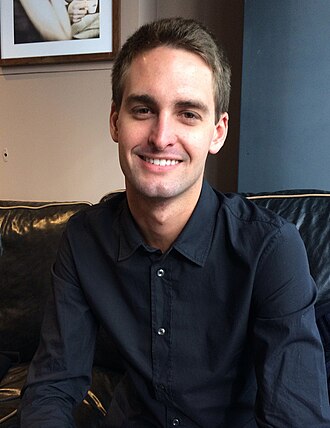
Evan Spiegel
Co-founder and CEO of Snap
Where to hear and read about Evan Spiegel2 episodes and tests

 Lenny's PodcastHow to win when software is not a moat | Evan Spiegel (Snapchat CEO)

 David SenraEvan Spiegel, Snapchat: Building a Multi-Billion Dollar Company
Evan Spiegel is co-founder and CEO of Snap, which makes Snapchat and is building Specs AR glasses. The lesson most worth taking from him is that software is easy to copy, so build what rivals cannot: networks of close friends, ecosystems and owned hardware.
It's very easy to copy software features, it's very hard to copy or to replicate a full ecosystem or a platform.
How to win when software is not a moat | Evan Spiegel (Snapchat CEO)
Evan Spiegel: the story and the lessons
1Evan Spiegel's path from computer lab to Snapchat
Spiegel grew up between art and technology. He attended Crossroads School for Arts and Sciences, where students sit in a "council" with about 12 others and speak from the heart. Graphic design and building his own computer kept him working between art and technology.
He built that computer in middle school and spent lunches in the computer lab instead of the recess yard. He says computers isolated him as a kid, and he wants one that brings people together outside.
Edwin Land became his model for personal technology. Studying the history of the camera led Snap to Land, who thought of the camera as incredibly personal. Spiegel takes from him that technology keeps getting more personal, so founders who fit it into human life have an advantage.
He also admires that Land advised government, backed talented women researchers and cared about more than his customers.
Internships showed him a small team can reach millions. He interned at Red Bull and at Abraxis BioScience, where he first used GPUs for early drug discovery. At Intuit, a team of three or four launched TextWeb, a micro-website service for touchpad phones in India.
His dad kept telling him to get a job, though Spiegel never wanted a boss. He had lived across the hall from Bobby Murphy, and both loved building things.
Future Freshman failed because they polished too long and ignored distribution. He and Murphy spent 18 months perfecting the product before getting feedback, against the MVP advice he knew. Competitor Naviance reached students through college counselors, and two Stanford kids had no way in.
Almost no one used it except his mom. The App Store showed them a distribution channel, so they chose to build quickly things they would use with friends. That led to Picaboo and then Snapchat.
He left Stanford with classes unfinished and later called graduation absurd. Spiegel left with five or six classes incomplete, yet walked at graduation for an empty diploma.
He wrote that we do silly things to avoid appearing different, and that people are most human when they follow the whispers of their soul instead of conforming.
2How Facebook's Poke taught Spiegel there is no moat in software
Facebook cloned Snapchat as Poke, and Snapchat still hit number one. Around 2012 and 2013 Facebook put a "Download Poke" banner at the top of every Facebook app. Snapchat was still number one in the App Store on Christmas Day.
Spiegel was about 22, living in his dad's house with three college friends, and nervous going into the holidays. The book calls the episode the greatest Christmas present Snap ever received, and he calls it a formative experience.
He responded by investing only in what is hard to copy. Snap built a network of people who actually message each other, an AR platform where developers have made millions of lenses, and a creator content ecosystem. These are communities of people, not code a rival can copy.
He says the lesson now looks right as AI lets nearly anyone copy a piece of software almost instantly.
Network effects and patents alone did not stop cloning. Snap holds a lot of patents, yet rivals can still iterate on the ideas. A platform linking creators, developers and community has been far harder to copy.
Spiegel names ecosystems and hardware as Snap's two moats.
Spiegel treats being copied as the price of innovating. Instagram Plus launched after Snapchat Plus passed 25 million subscribers. Snap's firsts that others now copy include Stories, swipe navigation, the camera as the main screen and face swapping.
He says everyone is now learning with AI what Snap learned 15 years ago.
3Spiegel on distribution and close friends
He treats distribution as a first-class problem, not an afterthought. Most consumer teams ask whether the product will resonate and spend too little time on how people will find it. TikTok spent billions subsidizing viewers and creators, and Threads rode Meta's existing reach.
His advice is to plan your distribution route as early as your product.
Snapchat grew by linking people to their closest friends. The old belief was that the biggest network is the stickiest. Snapchat connected people to a best friend, partner or spouse, where most of the value sits, and that let it take on much larger rivals.
"It wasn't about having the most friends. It was about having your close friends." He adds that one best friend can be half of your communication on Snapchat.
Snapchat answered Facebook's popularity contest by making images conversational. Facebook was a contest over friends, likes and pretty photos. Sending a picture by MMS took a minute or two, so Snap made it fast and casual.
More selfies are taken on Snapchat than on iPhones in total, he says.
New platforms reopen distribution, and glasses are the next one. Many big consumer firms, such as Uber and Snapchat, grew out of mobile. Spiegel sees glasses as the next surface, with most upside for those who already have distribution.
4How Spiegel's team invents: Stories, screenshots and vertical video
Stories came from listening to what users disliked, not what they asked for. Users asked for a send-all button but described pressure from permanent posts judged by likes, and odd reverse chronological feeds. Snap built Stories: chronological, deleted after 24 hours, no likes or comments.
"We didn't build exactly what they asked for. We empathized and then came up with something new." Stories began as a status update and evolved by iteration, and Instagram, Facebook, WhatsApp and YouTube later adopted them.
He rejects the advice that consumer builders should skip customer talks. Spiegel suggests one or two hours with a person on how they use technology and how they feel about their products. He finds surveys not very helpful.
Listening does not mean taking advice. He says it is an endless source of inspiration even when you ignore what they ask for.
A clever mechanic answered the doubt that disappearing photos were pointless. Holding a finger on a snap while taking a screenshot made the phone report lost finger contact. Snap used that to notify the sender, when Apple offered no way to detect screenshots.
"They didn't mind if somebody saved one of their snaps. They just wanted to know." He calls it one of the first things to gain real traction, and he and Murphy worked on it out of his dad's house that summer.
Snap bet on vertical video against Apple's own guidance. Apple said to turn the phone sideways and nearly all online video was horizontal. Advertisers' vertical videos had completion rates nine times higher than horizontal ones.
Snap paid to recut advertisers' videos, without AI, to convince them.
He held to Stories through six months of near zero usage. The board objected, and Spiegel asked for time because the feature was new. By the next board meeting or the one after, it was growing rapidly.
He says the vision often seems obvious and the hard part is delivering it, with determination and consistency.
Snapchat+ funds features only a passionate minority wants. Ads pushed Snap to build only things everyone would use. For about $4 a month, subscribers get new features Snap tests for them. It reached 25 million subscribers, growing 60% year over year, at a billion-dollar run rate.
Higher tiers followed: Lens+ for heavy gen AI lens users and a platinum plan without ads. He says of starting it: "I wish we had done it earlier."
5How Spiegel bet Snap on Specs
He designs by seeing the finished product first. If he cannot see the product clearly, he says the team is off track. He cites Land and Steve Jobs, who saw a product's final form and then reverse-engineered it.
He calls this technology in service of a product vision, not chasing a technology.
He dropped camera glasses because they were not 10 times better than a phone. Spectacles sold hundreds of thousands of units, but Spiegel saw no path to hundreds of millions because a phone camera is excellent even on a jet ski. Snap's bar for any product is being 10 times better than the next best alternative.
Each Specs generation added one big capability: a second camera for depth, then a display, then in 2024 an operating system and developer platform.
The phone screen capped AR, so Snap built the device. AR on a phone is like a keyhole, driven by thumbs. People spend seven or eight hours a day on screens, and Spiegel sees people hunched over their phones when together.
Specs is meant for shared play in the real world, not notifications on your face. The first consumer version launches this year.
He argues hardware should start premium and enthusiast-led. He declined a Luxottica-style partnership. Apple and Tesla began with passionate early adopters, and high gross margins fund R&D that widens the lead.
"It's very, very hard to start with a super broad-based, low-margin consumer product, and try to work your way into premium positioning." He calls Meta Ray-Bans a volume strategy that may not build a durable business.
Snap controls only the hardware parts where it can truly differentiate. Snap owns the display stack: a high-performing waveguide and its own tiny projector, which set power draw, field of view and sharpness. It makes core components in its own US and UK facilities.
"You're going to burn yourself out if you try to control everything."
He runs Specs as a separate company because hardware punishes mistakes. Specs is a wholly owned subsidiary that grew out of Snap Lab, with its own leadership and brand. What the team does today ships in two years, and a mistake can cost another year.
"With hardware, you cannot make a mistake." Snapchat can break something and fix it that afternoon. He notes Jobs kept new inventions in a different building.
6Why Spiegel kept control of Snap and how the business funds the bet
He refused to sell Snapchat because a sale would have compromised its values. Early investors let Spiegel and Murphy each sell $10 million of stock, so money stopped being a factor in their early 20s. Nearly every choice ran against the era: private ephemeral messaging, no public likes, opening into the camera.
He cites independent studies finding Snapchat helps friendships and well-being, and says he worries about a world without it fighting for a different set of values.
Snapchat's profits fund a 12-year bet on reinventing the computer. Snap began investing in hardware in 2014. Controlling the company lets it invest in a way that, in his words, no VC would ever support.
He says people mock Snap for not being profitable enough while it reinvests cash flow in the future of computing. He expects Specs to be his last company.
He calls this year Snap's crucible moment. Snap is close to big milestones but is not yet net income profitable. It must prove the core business is strong and still growing, with Specs launching as a consumer product.
His workload is a seven-day-a-week job that he prefers that way, though he keeps Sunday protected for church, brunch and his kids. Specs will be hard to win without a solid foundation under it.
Snap rebuilt its ad business from big brands toward small and medium customers. The ad mix was the inverse of Google's and Meta's: a few hundred large US brand customers and weak lower-funnel tools. Over about two years Snap built self-serve products and retrained sales.
Big brands moved millions quickly, which built a business fast, but Spiegel says double-digit billions needs a diversified base of smaller customers.
7How Spiegel runs Snap's design team
He keeps a small flat team beside the large organization. Citing Loonshots, he says scale needs hierarchy and rigor, which makes people risk-averse, while innovation needs flat structures. Snap's design team swings between nine and twelve people.
"The dialogue between those two teams is where a lot of that innovation happens." Leaders must keep the two sides respectful of each other.
He reviews hundreds of raw ideas every week with no gate. Spiegel spends a couple of hours or more each week critiquing new work. Anyone can bring any idea, because heavy critique filters out great ideas. Fewer than 1% of ideas reach users.
"If you want to have a good idea, you have to have lots of ideas." New designers present work on day one, and he calls attachment to one idea the most toxic thing since ideas are free.
He hires designers from portfolios, looking for range. Snap ignores pedigree and experience, and most hires come straight from school. Uniform style signals an artist, while wide range signals a designer who empathizes with different needs.
He interviews every designer and asks them to pick one piece they feel strongly about and explain why they made it and what they learned. Art school graduates adapt fastest to high-volume iteration.
He rotates designers so they stay fresh. Designers do not stay on one product or vertical for long. They move across areas like chat, the map and the AR platform.
His example of a dull fate is designing the chat experience for three years.
He delayed hiring product managers so designers owned direction. Spiegel did not want designers reduced to producing visuals for a PM's direction, so designers were told to do the PM work themselves. The first PM reportedly came after roughly 200 employees.
"My view is not that we don't need PMs. My view is that designers should do that work." At scale, PMs coordinate legal, trust and safety, and data science.
He makes design approval an intentional bottleneck. Anything that ships must be approved by design, which sometimes annoys people and slows shipping. The payoff is a cohesive product with a through line.
He contrasts this with apps where separate teams own separate pages.
8Spiegel's rules for culture and leadership
He wants a culture that is uncompromising and kind. Snap's values are kind, smart and creative, with kind first because fear is the opposite of creativity. Kind means wanting the best for someone, which sometimes means hard feedback.
"There's a big difference between kind and nice." He calls his team uncompromising, with strong opinions, loosely held.
He runs Snap as a meritocracy where titles do not matter. The design team is fully flat with one title. Anyone who sees a problem and can fix it is celebrated, at the cost of blurrier swim lanes.
"If you're focused on your title, you're focused on the exact wrong thing." He expects companies to move to flatter structures and wider spans of control.
He builds routines that force problems up to him. Every Monday morning he spends two to two and a half hours on a Specs risk review, with risks rated red, orange, yellow or green. He borrowed Walmart's Friday meeting, In It to Win It, so problems get fixed company-wide.
"We can't solve a problem that we don't know about." He also keeps a list of his hardest problems, as Jobs did, and walks around talking to people.
He learned to communicate by doing it, though he resisted. Early on he was dismissive of communication and preferred to email the company. A board member told him it was his job, so he held all-hands meetings and Q&A until he enjoyed them.
"Just doing it is really the only way." President Clinton told him the job is explainer in chief, and he says the founder is the best person to explain why the product exists.
His CEO job moved from doing everything to leading people and culture. Early on he designed the product, answered support emails, sorted legal filings and raised money. Now most of the job is developing people, picking the team and building a cohesive culture.
He says staying close to the customer and the team is the most important job of any leader. He stays CEO because he sees a once-in-a-lifetime chance to transform computing.
He reframes stress and crisis as chances to grow. He relies on Kriya meditation, morning exercise and time with his wife and kids. He agrees with Michael Dell's advice to invent a crisis, with a caveat.
He does not want the team always in crisis mode, and says the test is knowing when to sprint and when to make room for experimentation.
9How Spiegel uses AI at Snap
He treats AI as the equalizer against giants with more resources. He says Snap has been in trench warfare with monopolies for 15 years, with many ideas and few resources. AI coding tools let designers ship code and give Snap far more engineering capacity.
Because Snap's business is software and rests on network effects, he sees more upside than risk. He expects Snap to operate completely differently within 18 months.
He puts guardrails around AI-assisted code at nearly a billion users. Designers ship code with AI, but it is optional and driven by curiosity. Automated code review has caught close to 10,000 bugs.
On the internal app, shaking the phone reports a problem, and agents debug what went wrong and suggest a fix. He expects agents to implement the fix soon too.
He organizes AI transformation around jobs to be done. Snap listed basic jobs for Snapchatters, such as downloading the app and adding close friends, and for advertisers, such as configuring a campaign. Cross-functional teams form around those jobs with AI tools.
"If we can define a job to be done clearly enough that we can build an agent to do it, that can really create a lot of lift."
He built an agent in Glean to flag what he might miss. It combs dashboards, documents and each leader's weekly note of three things from the week and three ahead, then tells him what to focus on. It sometimes catches things he had not noticed.
He says it enables the very flat, fast-moving leadership structure he has always wanted.
A go-to-market agent runs a whole product workflow in one pass. It takes a product idea, writes the spec, identifies who must sign off, does legal and trust and safety risk analysis, and writes launch materials like the blog post. Visuals are next.
Snap uses Claude for much of this agent work.
He expects human comfort, not technology, to set how fast AI spreads. His contrarian view is that tech leaders wrongly assume people will adopt new technology blindly, so he expects significant societal pushback.
"Humanity dictates how technology is adopted." He wants tools to advance humanity's goals as well as business goals.
How to win when software is not a moat | Evan Spiegel (Snapchat CEO)
Evan Spiegel explains why software features are easy to copy, so durable consumer businesses need distribution, ecosystems and hard-to-clone assets, and how a tiny design team with a high weekly output keeps Snap inventing. Snapchat has nearly 1 billion monthly users and about $6 billion in revenue, and the episode shows the product, hiring and AI practices behind it.
Spiegel grew up between art and technology. He attended Crossroads School for Arts and Sciences, where students sit in a "council" with about 12 others and speak from the heart. Graphic design and building his own computer kept him working between art and technology.
He built that computer in middle school and spent lunches in the computer lab instead of the recess yard. He says computers isolated him as a kid, and he wants one that brings people together outside.
He responded by investing only in what is hard to copy. Snap built a network of people who actually message each other, an AR platform where developers have made millions of lenses, and a creator content ecosystem. These are communities of people, not code a rival can copy.
He says the lesson now looks right as AI lets nearly anyone copy a piece of software almost instantly.
Network effects and patents alone did not stop cloning. Snap holds a lot of patents, yet rivals can still iterate on the ideas. A platform linking creators, developers and community has been far harder to copy.
Spiegel names ecosystems and hardware as Snap's two moats.
Spiegel treats being copied as the price of innovating. Instagram Plus launched after Snapchat Plus passed 25 million subscribers. Snap's firsts that others now copy include Stories, swipe navigation, the camera as the main screen and face swapping.
He says everyone is now learning with AI what Snap learned 15 years ago.
He treats distribution as a first-class problem, not an afterthought. Most consumer teams ask whether the product will resonate and spend too little time on how people will find it. TikTok spent billions subsidizing viewers and creators, and Threads rode Meta's existing reach.
His advice is to plan your distribution route as early as your product.
Snapchat grew by linking people to their closest friends. The old belief was that the biggest network is the stickiest. Snapchat connected people to a best friend, partner or spouse, where most of the value sits, and that let it take on much larger rivals.
"It wasn't about having the most friends. It was about having your close friends." He adds that one best friend can be half of your communication on Snapchat.
New platforms reopen distribution, and glasses are the next one. Many big consumer firms, such as Uber and Snapchat, grew out of mobile. Spiegel sees glasses as the next surface, with most upside for those who already have distribution.
Stories came from listening to what users disliked, not what they asked for. Users asked for a send-all button but described pressure from permanent posts judged by likes, and odd reverse chronological feeds. Snap built Stories: chronological, deleted after 24 hours, no likes or comments.
"We didn't build exactly what they asked for. We empathized and then came up with something new." Stories began as a status update and evolved by iteration, and Instagram, Facebook, WhatsApp and YouTube later adopted them.
He rejects the advice that consumer builders should skip customer talks. Spiegel suggests one or two hours with a person on how they use technology and how they feel about their products. He finds surveys not very helpful.
Listening does not mean taking advice. He says it is an endless source of inspiration even when you ignore what they ask for.
A clever mechanic answered the doubt that disappearing photos were pointless. Holding a finger on a snap while taking a screenshot made the phone report lost finger contact. Snap used that to notify the sender, when Apple offered no way to detect screenshots.
"They didn't mind if somebody saved one of their snaps. They just wanted to know." He calls it one of the first things to gain real traction, and he and Murphy worked on it out of his dad's house that summer.
Snapchat+ funds features only a passionate minority wants. Ads pushed Snap to build only things everyone would use. For about $4 a month, subscribers get new features Snap tests for them. It reached 25 million subscribers, growing 60% year over year, at a billion-dollar run rate.
Higher tiers followed: Lens+ for heavy gen AI lens users and a platinum plan without ads. He says of starting it: "I wish we had done it earlier."
He dropped camera glasses because they were not 10 times better than a phone. Spectacles sold hundreds of thousands of units, but Spiegel saw no path to hundreds of millions because a phone camera is excellent even on a jet ski. Snap's bar for any product is being 10 times better than the next best alternative.
Each Specs generation added one big capability: a second camera for depth, then a display, then in 2024 an operating system and developer platform.
The phone screen capped AR, so Snap built the device. AR on a phone is like a keyhole, driven by thumbs. People spend seven or eight hours a day on screens, and Spiegel sees people hunched over their phones when together.
Specs is meant for shared play in the real world, not notifications on your face. The first consumer version launches this year.
He calls this year Snap's crucible moment. Snap is close to big milestones but is not yet net income profitable. It must prove the core business is strong and still growing, with Specs launching as a consumer product.
His workload is a seven-day-a-week job that he prefers that way, though he keeps Sunday protected for church, brunch and his kids. Specs will be hard to win without a solid foundation under it.
He keeps a small flat team beside the large organization. Citing Loonshots, he says scale needs hierarchy and rigor, which makes people risk-averse, while innovation needs flat structures. Snap's design team swings between nine and twelve people.
"The dialogue between those two teams is where a lot of that innovation happens." Leaders must keep the two sides respectful of each other.
He reviews hundreds of raw ideas every week with no gate. Spiegel spends a couple of hours or more each week critiquing new work. Anyone can bring any idea, because heavy critique filters out great ideas. Fewer than 1% of ideas reach users.
"If you want to have a good idea, you have to have lots of ideas." New designers present work on day one, and he calls attachment to one idea the most toxic thing since ideas are free.
He hires designers from portfolios, looking for range. Snap ignores pedigree and experience, and most hires come straight from school. Uniform style signals an artist, while wide range signals a designer who empathizes with different needs.
He interviews every designer and asks them to pick one piece they feel strongly about and explain why they made it and what they learned. Art school graduates adapt fastest to high-volume iteration.
He rotates designers so they stay fresh. Designers do not stay on one product or vertical for long. They move across areas like chat, the map and the AR platform.
His example of a dull fate is designing the chat experience for three years.
He delayed hiring product managers so designers owned direction. Spiegel did not want designers reduced to producing visuals for a PM's direction, so designers were told to do the PM work themselves. The first PM reportedly came after roughly 200 employees.
"My view is not that we don't need PMs. My view is that designers should do that work." At scale, PMs coordinate legal, trust and safety, and data science.
He makes design approval an intentional bottleneck. Anything that ships must be approved by design, which sometimes annoys people and slows shipping. The payoff is a cohesive product with a through line.
He contrasts this with apps where separate teams own separate pages.
He learned to communicate by doing it, though he resisted. Early on he was dismissive of communication and preferred to email the company. A board member told him it was his job, so he held all-hands meetings and Q&A until he enjoyed them.
"Just doing it is really the only way." President Clinton told him the job is explainer in chief, and he says the founder is the best person to explain why the product exists.
His CEO job moved from doing everything to leading people and culture. Early on he designed the product, answered support emails, sorted legal filings and raised money. Now most of the job is developing people, picking the team and building a cohesive culture.
He says staying close to the customer and the team is the most important job of any leader. He stays CEO because he sees a once-in-a-lifetime chance to transform computing.
He puts guardrails around AI-assisted code at nearly a billion users. Designers ship code with AI, but it is optional and driven by curiosity. Automated code review has caught close to 10,000 bugs.
On the internal app, shaking the phone reports a problem, and agents debug what went wrong and suggest a fix. He expects agents to implement the fix soon too.
He organizes AI transformation around jobs to be done. Snap listed basic jobs for Snapchatters, such as downloading the app and adding close friends, and for advertisers, such as configuring a campaign. Cross-functional teams form around those jobs with AI tools.
"If we can define a job to be done clearly enough that we can build an agent to do it, that can really create a lot of lift."
He built an agent in Glean to flag what he might miss. It combs dashboards, documents and each leader's weekly note of three things from the week and three ahead, then tells him what to focus on. It sometimes catches things he had not noticed.
He says it enables the very flat, fast-moving leadership structure he has always wanted.
A go-to-market agent runs a whole product workflow in one pass. It takes a product idea, writes the spec, identifies who must sign off, does legal and trust and safety risk analysis, and writes launch materials like the blog post. Visuals are next.
Snap uses Claude for much of this agent work.
He expects human comfort, not technology, to set how fast AI spreads. His contrarian view is that tech leaders wrongly assume people will adopt new technology blindly, so he expects significant societal pushback.
"Humanity dictates how technology is adopted." He wants tools to advance humanity's goals as well as business goals.
Evan Spiegel, Snapchat: Building a Multi-Billion Dollar Company
Spiegel built Snapchat by doing the opposite of the social media of its day, and learned early that software can be copied, so Snap invested in network effects, platforms and its own hardware. He kept control of the company so its profitable core could fund a 12-year bet on reinventing the computer with Specs.
Spiegel grew up between art and technology. He attended Crossroads School for Arts and Sciences, where students sit in a "council" with about 12 others and speak from the heart. Graphic design and building his own computer kept him working between art and technology.
He built that computer in middle school and spent lunches in the computer lab instead of the recess yard. He says computers isolated him as a kid, and he wants one that brings people together outside.
Edwin Land became his model for personal technology. Studying the history of the camera led Snap to Land, who thought of the camera as incredibly personal. Spiegel takes from him that technology keeps getting more personal, so founders who fit it into human life have an advantage.
He also admires that Land advised government, backed talented women researchers and cared about more than his customers.
Internships showed him a small team can reach millions. He interned at Red Bull and at Abraxis BioScience, where he first used GPUs for early drug discovery. At Intuit, a team of three or four launched TextWeb, a micro-website service for touchpad phones in India.
His dad kept telling him to get a job, though Spiegel never wanted a boss. He had lived across the hall from Bobby Murphy, and both loved building things.
Future Freshman failed because they polished too long and ignored distribution. He and Murphy spent 18 months perfecting the product before getting feedback, against the MVP advice he knew. Competitor Naviance reached students through college counselors, and two Stanford kids had no way in.
Almost no one used it except his mom. The App Store showed them a distribution channel, so they chose to build quickly things they would use with friends. That led to Picaboo and then Snapchat.
He left Stanford with classes unfinished and later called graduation absurd. Spiegel left with five or six classes incomplete, yet walked at graduation for an empty diploma.
He wrote that we do silly things to avoid appearing different, and that people are most human when they follow the whispers of their soul instead of conforming.
Facebook cloned Snapchat as Poke, and Snapchat still hit number one. Around 2012 and 2013 Facebook put a "Download Poke" banner at the top of every Facebook app. Snapchat was still number one in the App Store on Christmas Day.
Spiegel was about 22, living in his dad's house with three college friends, and nervous going into the holidays. The book calls the episode the greatest Christmas present Snap ever received, and he calls it a formative experience.
He responded by investing only in what is hard to copy. Snap built a network of people who actually message each other, an AR platform where developers have made millions of lenses, and a creator content ecosystem. These are communities of people, not code a rival can copy.
He says the lesson now looks right as AI lets nearly anyone copy a piece of software almost instantly.
Snapchat grew by linking people to their closest friends. The old belief was that the biggest network is the stickiest. Snapchat connected people to a best friend, partner or spouse, where most of the value sits, and that let it take on much larger rivals.
"It wasn't about having the most friends. It was about having your close friends." He adds that one best friend can be half of your communication on Snapchat.
Snapchat answered Facebook's popularity contest by making images conversational. Facebook was a contest over friends, likes and pretty photos. Sending a picture by MMS took a minute or two, so Snap made it fast and casual.
More selfies are taken on Snapchat than on iPhones in total, he says.
Stories came from listening to what users disliked, not what they asked for. Users asked for a send-all button but described pressure from permanent posts judged by likes, and odd reverse chronological feeds. Snap built Stories: chronological, deleted after 24 hours, no likes or comments.
"We didn't build exactly what they asked for. We empathized and then came up with something new." Stories began as a status update and evolved by iteration, and Instagram, Facebook, WhatsApp and YouTube later adopted them.
Snap bet on vertical video against Apple's own guidance. Apple said to turn the phone sideways and nearly all online video was horizontal. Advertisers' vertical videos had completion rates nine times higher than horizontal ones.
Snap paid to recut advertisers' videos, without AI, to convince them.
He held to Stories through six months of near zero usage. The board objected, and Spiegel asked for time because the feature was new. By the next board meeting or the one after, it was growing rapidly.
He says the vision often seems obvious and the hard part is delivering it, with determination and consistency.
Snapchat+ funds features only a passionate minority wants. Ads pushed Snap to build only things everyone would use. For about $4 a month, subscribers get new features Snap tests for them. It reached 25 million subscribers, growing 60% year over year, at a billion-dollar run rate.
Higher tiers followed: Lens+ for heavy gen AI lens users and a platinum plan without ads. He says of starting it: "I wish we had done it earlier."
He designs by seeing the finished product first. If he cannot see the product clearly, he says the team is off track. He cites Land and Steve Jobs, who saw a product's final form and then reverse-engineered it.
He calls this technology in service of a product vision, not chasing a technology.
He dropped camera glasses because they were not 10 times better than a phone. Spectacles sold hundreds of thousands of units, but Spiegel saw no path to hundreds of millions because a phone camera is excellent even on a jet ski. Snap's bar for any product is being 10 times better than the next best alternative.
Each Specs generation added one big capability: a second camera for depth, then a display, then in 2024 an operating system and developer platform.
The phone screen capped AR, so Snap built the device. AR on a phone is like a keyhole, driven by thumbs. People spend seven or eight hours a day on screens, and Spiegel sees people hunched over their phones when together.
Specs is meant for shared play in the real world, not notifications on your face. The first consumer version launches this year.
He argues hardware should start premium and enthusiast-led. He declined a Luxottica-style partnership. Apple and Tesla began with passionate early adopters, and high gross margins fund R&D that widens the lead.
"It's very, very hard to start with a super broad-based, low-margin consumer product, and try to work your way into premium positioning." He calls Meta Ray-Bans a volume strategy that may not build a durable business.
Snap controls only the hardware parts where it can truly differentiate. Snap owns the display stack: a high-performing waveguide and its own tiny projector, which set power draw, field of view and sharpness. It makes core components in its own US and UK facilities.
"You're going to burn yourself out if you try to control everything."
He runs Specs as a separate company because hardware punishes mistakes. Specs is a wholly owned subsidiary that grew out of Snap Lab, with its own leadership and brand. What the team does today ships in two years, and a mistake can cost another year.
"With hardware, you cannot make a mistake." Snapchat can break something and fix it that afternoon. He notes Jobs kept new inventions in a different building.
He refused to sell Snapchat because a sale would have compromised its values. Early investors let Spiegel and Murphy each sell $10 million of stock, so money stopped being a factor in their early 20s. Nearly every choice ran against the era: private ephemeral messaging, no public likes, opening into the camera.
He cites independent studies finding Snapchat helps friendships and well-being, and says he worries about a world without it fighting for a different set of values.
Snapchat's profits fund a 12-year bet on reinventing the computer. Snap began investing in hardware in 2014. Controlling the company lets it invest in a way that, in his words, no VC would ever support.
He says people mock Snap for not being profitable enough while it reinvests cash flow in the future of computing. He expects Specs to be his last company.
He calls this year Snap's crucible moment. Snap is close to big milestones but is not yet net income profitable. It must prove the core business is strong and still growing, with Specs launching as a consumer product.
His workload is a seven-day-a-week job that he prefers that way, though he keeps Sunday protected for church, brunch and his kids. Specs will be hard to win without a solid foundation under it.
Snap rebuilt its ad business from big brands toward small and medium customers. The ad mix was the inverse of Google's and Meta's: a few hundred large US brand customers and weak lower-funnel tools. Over about two years Snap built self-serve products and retrained sales.
Big brands moved millions quickly, which built a business fast, but Spiegel says double-digit billions needs a diversified base of smaller customers.
He reviews hundreds of raw ideas every week with no gate. Spiegel spends a couple of hours or more each week critiquing new work. Anyone can bring any idea, because heavy critique filters out great ideas. Fewer than 1% of ideas reach users.
"If you want to have a good idea, you have to have lots of ideas." New designers present work on day one, and he calls attachment to one idea the most toxic thing since ideas are free.
He hires designers from portfolios, looking for range. Snap ignores pedigree and experience, and most hires come straight from school. Uniform style signals an artist, while wide range signals a designer who empathizes with different needs.
He interviews every designer and asks them to pick one piece they feel strongly about and explain why they made it and what they learned. Art school graduates adapt fastest to high-volume iteration.
He wants a culture that is uncompromising and kind. Snap's values are kind, smart and creative, with kind first because fear is the opposite of creativity. Kind means wanting the best for someone, which sometimes means hard feedback.
"There's a big difference between kind and nice." He calls his team uncompromising, with strong opinions, loosely held.
He runs Snap as a meritocracy where titles do not matter. The design team is fully flat with one title. Anyone who sees a problem and can fix it is celebrated, at the cost of blurrier swim lanes.
"If you're focused on your title, you're focused on the exact wrong thing." He expects companies to move to flatter structures and wider spans of control.
He builds routines that force problems up to him. Every Monday morning he spends two to two and a half hours on a Specs risk review, with risks rated red, orange, yellow or green. He borrowed Walmart's Friday meeting, In It to Win It, so problems get fixed company-wide.
"We can't solve a problem that we don't know about." He also keeps a list of his hardest problems, as Jobs did, and walks around talking to people.
He learned to communicate by doing it, though he resisted. Early on he was dismissive of communication and preferred to email the company. A board member told him it was his job, so he held all-hands meetings and Q&A until he enjoyed them.
"Just doing it is really the only way." President Clinton told him the job is explainer in chief, and he says the founder is the best person to explain why the product exists.
He reframes stress and crisis as chances to grow. He relies on Kriya meditation, morning exercise and time with his wife and kids. He agrees with Michael Dell's advice to invent a crisis, with a caveat.
He does not want the team always in crisis mode, and says the test is knowing when to sprint and when to make room for experimentation.
He treats AI as the equalizer against giants with more resources. He says Snap has been in trench warfare with monopolies for 15 years, with many ideas and few resources. AI coding tools let designers ship code and give Snap far more engineering capacity.
Because Snap's business is software and rests on network effects, he sees more upside than risk. He expects Snap to operate completely differently within 18 months.