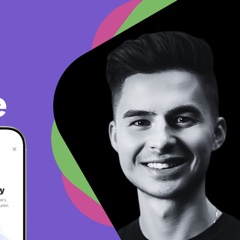
Ethan Ethier
Head of growth and operations at Built With Science
Where to hear and read about Ethan Ethier1 episode or test

Ethan Ethier runs growth and operations at Built With Science, the fitness app from YouTuber Jeremy Ethier. The lesson most worth taking from him is to fix the product and name the real problem first, because even a 7 million subscriber audience cannot replace a strong product, a good funnel and disciplined testing.
we're obsessed with the problem and not the solution.
Why 90% of their paid traffic goes to a quiz, not the App Store
Ethan Ethier: the story and the lessons
1Why Ethan Ethier says a big audience is not a growth engine
Ethier treats the YouTube audience as a launch spike and a baseline. The app launched with a spike at about 3 million subscribers. Older videos now bring a steady number of trials each month.
The channel began in 2018 and about 100,000 people joined the web courses over the years. Members were tracking workouts in spreadsheets, and they kept asking for an app.
Ethier's team spent a year fixing the product before buying ads. The app launched in January 2025 and Meta ads began in January 2026. The year went into trial-to-paid, retention and churn.
Launch feedback drove the work. Spending $100,000 a month on ads does not fix a product people don't believe in, use or stay with.
Ethier expects paid traffic to convert below organic and plans for it. Meta trial-to-paid is about 25%, against 35 to 40% for organic YouTube traffic. Organic is warm and paid is cold.
Raising the trial-to-paid and retention floor first lifts every channel added later: "as long as we're constantly improving our trial-to-paid and retention, that lifts the floor for everything else."
2How Ethier scaled Meta from zero to $100,000 a month
Ethier's team got a one-month baseline before testing creative. A month of Meta data set the ceiling on what a customer could cost. Cold users convert to paid at a lower rate than warm ones, so they needed that number first.
They then tested angles and avatars built from surveys of past customers and warm traffic. They keep iterating on winners and add new avatars slowly.
Cheap trials from click-bait ads hurt Built With Science. Click-bait creative brought trial starts, but trial-to-paid dropped sharply. Ads built around a specific person's pain points bring better traffic.
The aim: "we want people to start the trial at the cheapest cost, but also we don't want just anyone to start the trial." An engineer built a dashboard that confirms each trial came from Meta, and the highest-intent users are fed back to Meta.
Ethier puts creative ahead of time in Ads Manager. After Meta's Andromeda update, much of the targeting is done through the creative itself. Bids and targeting settings are largely out of the advertiser's control.
His advice is to make content people enjoy, as on YouTube.
Ethier built ads that run without Jeremy. Ads use B-roll, testimonials and AI-made statics instead of Jeremy, to solve the "bus problem" of everything resting on his channel.
Jeremy's face would likely help ads perform, but his time is the scarce resource. It stays on long-form YouTube, which the team judges the highest-ROI work.
Ethier runs Meta in-house rather than through an agency. The person making the ads knows and likes the product, and does not over-promise.
The goal is a seamless handoff from marketing to the product experience, promoting the app "in a way that isn't faking anything."
3Ethier's web quiz, pricing and paywall
Ethier sends about 90% of traffic to a long web quiz. The quiz educates, overcomes objections and raises perceived value. Its answers also build the user's plan in the app.
Quiz traffic converted much better than App Store traffic, and the same quiz on Android converted like the web. Ethier concedes App Store visitors may have higher intent, so the test may not be like for like, and a retest is under consideration.
Ethier holds a premium price by selling a coach, not a tracker. The price is about $189 a year or $30 a month, unchanged since the 2025 launch. Buyers compare it with a human trainer.
Meta ads never call the app a tracker. Price stays put until retention and trial-to-paid are healthy, because a price change moves many metrics at once and would blur other tests.
Ethier moved buyers to annual by showing it first. The new paywall shows only annual, with a day 1, day 7 and day 12 trial timeline and a promised reminder. Annual share rose from about 60/40 to 75 to 80%.
Price and positioning did not change. "We made the risk of actually starting the trial a lot more clear."
Ethier added a gym buddy plan that raised order value and retention. The quiz offers a two-person plan with 15% off for both users. Around 15% of trial starts add a buddy.
A product manager proposed it after members asked to bring a husband or wife. People who say no see only a small toggle on the pricing page, so the paywall stays simple. The retention gain is stated without data.
4How Ethier's team runs experiments
Ethier's team names the biggest problem before brainstorming fixes. Amplitude shows the biggest drop-offs. The team lists every reason a page underperforms, agrees on the biggest, and only then lists solutions.
Writing it down, instead of sending a quick Slack message to an engineer, deepens understanding. About 70% of experiments fail first, and the team iterates on failures.
Ethier tests big batches because traffic is limited. Hypotheses for one problem are tested together, and stripped down if the batch fails. Button colors and small text rarely move the needle.
"We won't have enough to do a bunch of mini tests. So we'd rather focus on a bigger swing." A test that takes a week to reach significance gives far fewer chances than one that takes an hour.
Ethier's team reframed a losing no-trial toggle into a winner. The toggle offered 20% off for paying up front and lost on warm organic traffic, because the copy made the trial look like a loss. A 30-day money-back guarantee applied.
A revised arm that makes both options sound good has run a few weeks with a very strong lift: "we make both options seem pleasant."
Ethier learned that extra paywall context can hurt ready buyers. Adding context to make the value proposition clearer converted worse than a page with none.
Too much information can overwhelm a user who is already excited and motivated to buy.
Ethier ships features quietly to read real engagement. Emailing all members about a feature inflated engagement metrics. Now the team ships without announcing and publicly launches only if there is signal.
Beta pools of about 100 longtime web course members and roughly 1,000 wider testers hear first. Beta users are the most engaged, so the quiet release is the real test.
5Content, search and product bets under Ethier
Ethier's team tracks trial yield per video and favors story pitches. Nearly every click from videos and description links is tracked. Broad diet or program videos reach more people but activate fewer trials than a user transformation story.
Most videos mention the app mid-video or near the end with a soft call to action, and a full pitch is kept for formats like Instagram shorts.
Ethier built calculators to win back search traffic lost to AI. SEO from old blog posts was 30 to 40% of traffic and slipped as people moved to AI search. The team built calorie and macro calculators that lead into the quiz.
Tools convert slightly better than blog posts and tend to rank well in AI search. An outside consultant optimizes existing content.
Ethier's team shipped Jeremy AI in a weekend and it became a favorite. The chat is trained on Jeremy's videos and blog history and reads each user's workout, nutrition and progress data. An engineer, Kevin, built it in-house.
It was never promoted, yet became one of customers' favorite features.
Ethier is narrowing to one or two big bets. Past attempts to do too much got nowhere. The team now stays hyper focused, with long-form YouTube as the priority and outside clippers handling short-form.
Research is part of the brand: studies with UBC and an in-app experiment where users trained three or six days a week.

Why 90% of their paid traffic goes to a quiz, not the App Store
Built With Science, the fitness app from YouTuber Jeremy Ethier, shows that even a 7 million subscriber audience needs a strong product, a web quiz funnel and structured experimentation to grow. They waited a year after launch to fix trial-to-paid, then scaled Meta from zero to $100,000 a month in ad spend profitably, and a pricing page change moved annual plan share from 60/40 to 75 to 80%.
Ethier treats the YouTube audience as a launch spike and a baseline. The app launched with a spike at about 3 million subscribers. Older videos now bring a steady number of trials each month.
The channel began in 2018 and about 100,000 people joined the web courses over the years. Members were tracking workouts in spreadsheets, and they kept asking for an app.
Ethier's team spent a year fixing the product before buying ads. The app launched in January 2025 and Meta ads began in January 2026. The year went into trial-to-paid, retention and churn.
Launch feedback drove the work. Spending $100,000 a month on ads does not fix a product people don't believe in, use or stay with.
Ethier expects paid traffic to convert below organic and plans for it. Meta trial-to-paid is about 25%, against 35 to 40% for organic YouTube traffic. Organic is warm and paid is cold.
Raising the trial-to-paid and retention floor first lifts every channel added later: "as long as we're constantly improving our trial-to-paid and retention, that lifts the floor for everything else."
Ethier's team got a one-month baseline before testing creative. A month of Meta data set the ceiling on what a customer could cost. Cold users convert to paid at a lower rate than warm ones, so they needed that number first.
They then tested angles and avatars built from surveys of past customers and warm traffic. They keep iterating on winners and add new avatars slowly.
Cheap trials from click-bait ads hurt Built With Science. Click-bait creative brought trial starts, but trial-to-paid dropped sharply. Ads built around a specific person's pain points bring better traffic.
The aim: "we want people to start the trial at the cheapest cost, but also we don't want just anyone to start the trial." An engineer built a dashboard that confirms each trial came from Meta, and the highest-intent users are fed back to Meta.
Ethier puts creative ahead of time in Ads Manager. After Meta's Andromeda update, much of the targeting is done through the creative itself. Bids and targeting settings are largely out of the advertiser's control.
His advice is to make content people enjoy, as on YouTube.
Ethier built ads that run without Jeremy. Ads use B-roll, testimonials and AI-made statics instead of Jeremy, to solve the "bus problem" of everything resting on his channel.
Jeremy's face would likely help ads perform, but his time is the scarce resource. It stays on long-form YouTube, which the team judges the highest-ROI work.
Ethier runs Meta in-house rather than through an agency. The person making the ads knows and likes the product, and does not over-promise.
The goal is a seamless handoff from marketing to the product experience, promoting the app "in a way that isn't faking anything."
Ethier sends about 90% of traffic to a long web quiz. The quiz educates, overcomes objections and raises perceived value. Its answers also build the user's plan in the app.
Quiz traffic converted much better than App Store traffic, and the same quiz on Android converted like the web. Ethier concedes App Store visitors may have higher intent, so the test may not be like for like, and a retest is under consideration.
Ethier holds a premium price by selling a coach, not a tracker. The price is about $189 a year or $30 a month, unchanged since the 2025 launch. Buyers compare it with a human trainer.
Meta ads never call the app a tracker. Price stays put until retention and trial-to-paid are healthy, because a price change moves many metrics at once and would blur other tests.
Ethier moved buyers to annual by showing it first. The new paywall shows only annual, with a day 1, day 7 and day 12 trial timeline and a promised reminder. Annual share rose from about 60/40 to 75 to 80%.
Price and positioning did not change. "We made the risk of actually starting the trial a lot more clear."
Ethier added a gym buddy plan that raised order value and retention. The quiz offers a two-person plan with 15% off for both users. Around 15% of trial starts add a buddy.
A product manager proposed it after members asked to bring a husband or wife. People who say no see only a small toggle on the pricing page, so the paywall stays simple. The retention gain is stated without data.
Ethier's team names the biggest problem before brainstorming fixes. Amplitude shows the biggest drop-offs. The team lists every reason a page underperforms, agrees on the biggest, and only then lists solutions.
Writing it down, instead of sending a quick Slack message to an engineer, deepens understanding. About 70% of experiments fail first, and the team iterates on failures.
Ethier tests big batches because traffic is limited. Hypotheses for one problem are tested together, and stripped down if the batch fails. Button colors and small text rarely move the needle.
"We won't have enough to do a bunch of mini tests. So we'd rather focus on a bigger swing." A test that takes a week to reach significance gives far fewer chances than one that takes an hour.
Ethier's team reframed a losing no-trial toggle into a winner. The toggle offered 20% off for paying up front and lost on warm organic traffic, because the copy made the trial look like a loss. A 30-day money-back guarantee applied.
A revised arm that makes both options sound good has run a few weeks with a very strong lift: "we make both options seem pleasant."
Ethier learned that extra paywall context can hurt ready buyers. Adding context to make the value proposition clearer converted worse than a page with none.
Too much information can overwhelm a user who is already excited and motivated to buy.
Ethier ships features quietly to read real engagement. Emailing all members about a feature inflated engagement metrics. Now the team ships without announcing and publicly launches only if there is signal.
Beta pools of about 100 longtime web course members and roughly 1,000 wider testers hear first. Beta users are the most engaged, so the quiet release is the real test.
Ethier's team tracks trial yield per video and favors story pitches. Nearly every click from videos and description links is tracked. Broad diet or program videos reach more people but activate fewer trials than a user transformation story.
Most videos mention the app mid-video or near the end with a soft call to action, and a full pitch is kept for formats like Instagram shorts.
Ethier built calculators to win back search traffic lost to AI. SEO from old blog posts was 30 to 40% of traffic and slipped as people moved to AI search. The team built calorie and macro calculators that lead into the quiz.
Tools convert slightly better than blog posts and tend to rank well in AI search. An outside consultant optimizes existing content.
Ethier's team shipped Jeremy AI in a weekend and it became a favorite. The chat is trained on Jeremy's videos and blog history and reads each user's workout, nutrition and progress data. An engineer, Kevin, built it in-house.
It was never promoted, yet became one of customers' favorite features.
Ethier is narrowing to one or two big bets. Past attempts to do too much got nowhere. The team now stays hyper focused, with long-form YouTube as the priority and outside clippers handling short-form.
Research is part of the brand: studies with UBC and an in-app experiment where users trained three or six days a week.