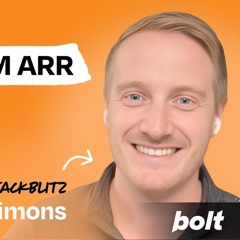
Eric Simons
Co-founder and CEO of StackBlitz
Where to hear and read about Eric Simons1 episode or test

Eric Simons is co-founder and CEO of StackBlitz, which launched Bolt days from shutting down and took it to about $40M ARR in roughly five months with a team of 15 to 20. The lesson most worth learning is to spend almost nothing, build a deep technology bet, and stay alive until a market shift like a better model makes it land.
Until you see pull, just people pulling the product out of your hands, you don't want to be spending money.
Inside Bolt: From near-death to one of the fastest-growing products in history | Eric Simons
Eric Simons: the story and the lessons
1Eric Simons's path from a dollar a day to Bolt
Simons lived inside AOL's headquarters for months after his money ran out. In 2012 he was in Imagine K12, a program that gave $20,000 and office space at AOL. The money ran out after three or four months, but his access card still worked, and the office had couches, ramen, a gym with showers and laundry.
Guards on 12-hour shifts saw him coding all day and assumed he worked hard. When Stanford students also set up bunks, a guard threw him out at 4:00 AM. He slept outside a Starbucks, then asked another founder for a couch.
His scrappiness began at 19, when he lived on a dollar a day. His burn rate was a dollar a day, spent on McDonald's Dollar Menu cheeseburgers. The press picked up the story worldwide.
Simons and his co-founder skipped college. The co-founder dropped out. Simons says in-state tuition at U of I was about $120,000 then, and the promised high-paying job often did not come.
He calls college a big bet without strong conviction, since learning online costs nothing.
Years of bootstrapping and failed ideas trained his sense for a real one. His previous company was bootstrapped to acquisition, which taught the founders to stretch every dollar. They had churned through about 20 failed ideas, so they could tell when one felt different.
He says the product instinct comes from years of getting his butt kicked by the free market.
Bolt was an overnight success seven years in the making. WebContainer took four or five years to build, and developers loved it but did not use it in ways they would pay for. The team kept taking shots on goal until one connected, and Bolt launched when the company was about to shut down.
Simons says cool technology alone is not enough for a venture-scale company. In his words: "Bolt's this overnight success, seven years in the making."
2How Simons bet on WebContainer and stayed alive
Simons copied Figma's bet that new browser capabilities could move heavy software. The founders met Figma's creators in 2012. Around 2016 and 2017, WebAssembly, shared memory and service workers made an in-browser operating system look feasible, with a goal of booting in about 100 milliseconds.
They built the technology first because the web had no tool to build the web: Mac has Xcode and Windows has Visual Studio. They even thought Google should buy it or put it in Chrome.
He runs compute on the user's device, so the free tier can be generous. WebContainer runs on the user's own CPU instead of a cloud VM per user. Startup is near instant, environments do not get stuck, and the free tier cannot be abused for Bitcoin mining or DDoS.
His argument is that there are not even 100 million VMs to rent but there are a billion devices. A Spotify clone built in about 60 seconds, and deploying to Netlify cost the company nothing.
Simons kept burn very low until customers pulled the product from him. StackBlitz raised nothing for the first two or three years and did not grow headcount in 2020 and 2021. The default answer to any spend was no, and vendors were asked to sell at half price.
He says tripling the company in 2020 would have meant there would be no Bolt. Low burn bought more shots on goal.
He shelved Bolt for a year until a model was good enough. The team tried building it a year earlier with the frontier models of the time, but the code broke or looked ugly. They revived it after an early look at Claude 3.5 Sonnet in May.
Bolt was built in 90 days, and he says the rapid growth started the second Sonnet went online.
3How Bolt grew and what Simons did at launch
Bolt went from near shutdown to about $40M ARR in five months. It reached $20M ARR two months after its October launch and later passed $30 million, with about a million monthly active users and a three-person support team. The original goal was $100K of ARR over the first few months.
Simons has done startups for 15 years and says he never saw anything like it. Critics said ARR could go to zero at $4 to 5 million, then said the same at $20 million.
The launch tweet worked on day one, and Simons tried to temper the excitement. Day one added $60K of ARR to a base of about $600K, and day two added about $80K. He worried launch day is often the peak of inflated expectations.
The growth kept compounding instead.
Simons shipped an incomplete v1 and let users pay anyway. Bolt was built in 90 days with corners cut and reached $20M ARR without a mobile responsive view.
He compares it to the iPhone shipping without copy and paste. "We got to 20 million of ARR without a mobile responsive view, by the way."
He replaced the flat $9 plan with upgrade tiers within a week. StackBlitz had only ever sold one $9 plan, and users burned through it in 48 hours and asked how to buy more. Rivals have since copied the tiered plans.
He argues all-you-can-eat pricing forces cheap inference and rules out agentic products. Anthropic ran out of GPUs for Bolt, and Dario Amodei emailed to say he had nothing more to give. Simons and his chief of staff did customer support 95% of the day.
4How Simons runs a small team and sets priorities
Simons holds one daily call with the whole company. The team meets at 8:00 AM Pacific for about an hour, starting the week after launch. Everyone knows everything, so people decide alone and are usually right.
Critics call it the most expensive use of everyone's time, but he says there is 0% fidelity loss. He plans to split it into smaller syncs as the team grows.
He favors fewer people with more context each. Five to seven core people have stayed five years or more. Engineers took a customer call, built the UI fix on the spot and shipped it alone.
He says turnover makes long bets like WebContainer impossible.
Simons hires from the community and avoids the brilliant jerk. Most hires came from the StackBlitz community, found by a tweet and DMs. The company is fully remote, mostly in Europe.
The founders rented a Bay Area office in 2018 and dropped it a year later because their hires were elsewhere. He looks for people who ignore titles and leave their egos at the door.
He bets on things nobody has asked for, not only on loud requests. Native mobile app support was doubted by some staff, yet it was the best-received launch, with thousands of mobile apps created per day.
He compares it to a chef balancing customer feedback against a dish he believes is a killer: "We put some chips into the middle of the table on. And had it dead right."
Simons keeps PRDs short and links a working prototype. Long PRDs get glossed over, so many Bolt PRDs link to a Bolt prototype showing how the feature will feel. Linear handles engineering and Notion handles roadmaps and PRDs.
"If a picture is worth a thousand words, a live actual demo is worth millions."
5What Simons knows about building with AI
He aims AI at deterministic domains like code. Code either runs or it doesn't, so models can be trained with reinforcement learning on huge numbers of generated apps. He says that should make coding improve faster than fields like law.
Simons expects PMs and designers to lead interface work. 67% of Bolt users are not developers, though the team expected only developers. He sees future pods of product and design people with one or two engineers reviewing pull requests.
He says PMs know how to spec work without losing meaning and help an agent debug. He says this is not yet reflected in company org charts.
He tells users to prompt like they write a Linear or Jira ticket. Be specific on what matters and leave the rest open for the AI to be creative. Taking time on the ask avoids being stuck with a poor first version.
His suggested first project is a personal website: paste a LinkedIn bio, name a favorite color and deploy. It would take an hour or more on Wix.
Simons is plain about where Bolt does not fit yet. Models are not yet reliable on apps of a thousand files or more, so large existing code bases still need developers and a tool like Cursor. He expects that to change within a year.
Bolt is strongest on greenfield work: a non-coder built a CRM with Stripe billing in three weeks for about $300 of Bolt, against an agency quote of $30,000 and six months.
He plans paid human experts for when the AI gets stuck. Bolt Builders will connect users to certified experts at roughly $50 an hour, like the genius bar at the Apple Store.
It flips the Copilot order: the AI comes first and the human steps in second.
Simons builds into the tools PMs and designers already use. With Anima, putting bolt.new in front of a Figma URL turns the design into a full-stack or mobile app. A Slack bot will read a thread, build the page and reply with a URL.
Bolt is meant for rapid product development, not for opening a 20-year-old production code base.

Inside Bolt: From near-death to one of the fastest-growing products in history | Eric Simons
Eric Simons explains how StackBlitz, days from shutting down, launched Bolt on top of seven years of WebContainer technology and a new Claude Sonnet model. It went from zero to about $40M ARR and 1M monthly users in roughly five months with a team of 15 to 20.
Simons lived inside AOL's headquarters for months after his money ran out. In 2012 he was in Imagine K12, a program that gave $20,000 and office space at AOL. The money ran out after three or four months, but his access card still worked, and the office had couches, ramen, a gym with showers and laundry.
Guards on 12-hour shifts saw him coding all day and assumed he worked hard. When Stanford students also set up bunks, a guard threw him out at 4:00 AM. He slept outside a Starbucks, then asked another founder for a couch.
His scrappiness began at 19, when he lived on a dollar a day. His burn rate was a dollar a day, spent on McDonald's Dollar Menu cheeseburgers. The press picked up the story worldwide.
Simons and his co-founder skipped college. The co-founder dropped out. Simons says in-state tuition at U of I was about $120,000 then, and the promised high-paying job often did not come.
He calls college a big bet without strong conviction, since learning online costs nothing.
Years of bootstrapping and failed ideas trained his sense for a real one. His previous company was bootstrapped to acquisition, which taught the founders to stretch every dollar. They had churned through about 20 failed ideas, so they could tell when one felt different.
He says the product instinct comes from years of getting his butt kicked by the free market.
Bolt was an overnight success seven years in the making. WebContainer took four or five years to build, and developers loved it but did not use it in ways they would pay for. The team kept taking shots on goal until one connected, and Bolt launched when the company was about to shut down.
Simons says cool technology alone is not enough for a venture-scale company. In his words: "Bolt's this overnight success, seven years in the making."
Simons copied Figma's bet that new browser capabilities could move heavy software. The founders met Figma's creators in 2012. Around 2016 and 2017, WebAssembly, shared memory and service workers made an in-browser operating system look feasible, with a goal of booting in about 100 milliseconds.
They built the technology first because the web had no tool to build the web: Mac has Xcode and Windows has Visual Studio. They even thought Google should buy it or put it in Chrome.
He runs compute on the user's device, so the free tier can be generous. WebContainer runs on the user's own CPU instead of a cloud VM per user. Startup is near instant, environments do not get stuck, and the free tier cannot be abused for Bitcoin mining or DDoS.
His argument is that there are not even 100 million VMs to rent but there are a billion devices. A Spotify clone built in about 60 seconds, and deploying to Netlify cost the company nothing.
Simons kept burn very low until customers pulled the product from him. StackBlitz raised nothing for the first two or three years and did not grow headcount in 2020 and 2021. The default answer to any spend was no, and vendors were asked to sell at half price.
He says tripling the company in 2020 would have meant there would be no Bolt. Low burn bought more shots on goal.
He shelved Bolt for a year until a model was good enough. The team tried building it a year earlier with the frontier models of the time, but the code broke or looked ugly. They revived it after an early look at Claude 3.5 Sonnet in May.
Bolt was built in 90 days, and he says the rapid growth started the second Sonnet went online.
Bolt went from near shutdown to about $40M ARR in five months. It reached $20M ARR two months after its October launch and later passed $30 million, with about a million monthly active users and a three-person support team. The original goal was $100K of ARR over the first few months.
Simons has done startups for 15 years and says he never saw anything like it. Critics said ARR could go to zero at $4 to 5 million, then said the same at $20 million.
The launch tweet worked on day one, and Simons tried to temper the excitement. Day one added $60K of ARR to a base of about $600K, and day two added about $80K. He worried launch day is often the peak of inflated expectations.
The growth kept compounding instead.
Simons shipped an incomplete v1 and let users pay anyway. Bolt was built in 90 days with corners cut and reached $20M ARR without a mobile responsive view.
He compares it to the iPhone shipping without copy and paste. "We got to 20 million of ARR without a mobile responsive view, by the way."
He replaced the flat $9 plan with upgrade tiers within a week. StackBlitz had only ever sold one $9 plan, and users burned through it in 48 hours and asked how to buy more. Rivals have since copied the tiered plans.
He argues all-you-can-eat pricing forces cheap inference and rules out agentic products. Anthropic ran out of GPUs for Bolt, and Dario Amodei emailed to say he had nothing more to give. Simons and his chief of staff did customer support 95% of the day.
Simons holds one daily call with the whole company. The team meets at 8:00 AM Pacific for about an hour, starting the week after launch. Everyone knows everything, so people decide alone and are usually right.
Critics call it the most expensive use of everyone's time, but he says there is 0% fidelity loss. He plans to split it into smaller syncs as the team grows.
He favors fewer people with more context each. Five to seven core people have stayed five years or more. Engineers took a customer call, built the UI fix on the spot and shipped it alone.
He says turnover makes long bets like WebContainer impossible.
Simons hires from the community and avoids the brilliant jerk. Most hires came from the StackBlitz community, found by a tweet and DMs. The company is fully remote, mostly in Europe.
The founders rented a Bay Area office in 2018 and dropped it a year later because their hires were elsewhere. He looks for people who ignore titles and leave their egos at the door.
He bets on things nobody has asked for, not only on loud requests. Native mobile app support was doubted by some staff, yet it was the best-received launch, with thousands of mobile apps created per day.
He compares it to a chef balancing customer feedback against a dish he believes is a killer: "We put some chips into the middle of the table on. And had it dead right."
Simons keeps PRDs short and links a working prototype. Long PRDs get glossed over, so many Bolt PRDs link to a Bolt prototype showing how the feature will feel. Linear handles engineering and Notion handles roadmaps and PRDs.
"If a picture is worth a thousand words, a live actual demo is worth millions."
He aims AI at deterministic domains like code. Code either runs or it doesn't, so models can be trained with reinforcement learning on huge numbers of generated apps. He says that should make coding improve faster than fields like law.
Simons expects PMs and designers to lead interface work. 67% of Bolt users are not developers, though the team expected only developers. He sees future pods of product and design people with one or two engineers reviewing pull requests.
He says PMs know how to spec work without losing meaning and help an agent debug. He says this is not yet reflected in company org charts.
He tells users to prompt like they write a Linear or Jira ticket. Be specific on what matters and leave the rest open for the AI to be creative. Taking time on the ask avoids being stuck with a poor first version.
His suggested first project is a personal website: paste a LinkedIn bio, name a favorite color and deploy. It would take an hour or more on Wix.
Simons is plain about where Bolt does not fit yet. Models are not yet reliable on apps of a thousand files or more, so large existing code bases still need developers and a tool like Cursor. He expects that to change within a year.
Bolt is strongest on greenfield work: a non-coder built a CRM with Stripe billing in three weeks for about $300 of Bolt, against an agency quote of $30,000 and six months.
He plans paid human experts for when the AI gets stuck. Bolt Builders will connect users to certified experts at roughly $50 an hour, like the genius bar at the Apple Store.
It flips the Copilot order: the AI comes first and the human steps in second.
Simons builds into the tools PMs and designers already use. With Anima, putting bolt.new in front of a Figma URL turns the design into a full-stack or mobile app. A Slack bot will read a thread, build the page and reply with a URL.
Bolt is meant for rapid product development, not for opening a 20-year-old production code base.