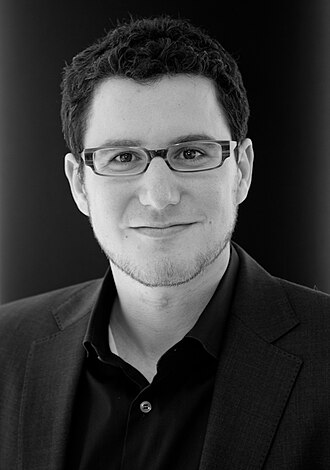
Eric Ries
Creator of the Lean Startup methodology; founder and executive chairman of the Long-Term Stock Exchange (LTSE)
Where to hear and read about Eric Ries1 episode or test

Eric Ries created the Lean Startup method and now leads the Long-Term Stock Exchange as founder and executive chairman. The most useful thing to learn from him is to test your riskiest belief with the smallest experiment, then build your values into the company's structure so they outlast you.
if you can't fail, you can't learn
Reflections on a movement | Eric Ries (creator of the Lean Startup methodology)
Eric Ries: the story and the lessons
1How Eric Ries came to Lean Startup
Ries started writing anonymously to avoid meetings that went badly. Blogging felt like career suicide, so he left his name off his first essays. The top three startup bloggers found him through their referrer logs, and demand to unmask the author then took over his life.
VCs had wanted him to bring 'magic pixie dust' to their engineering teams. When he explained the method, some yelled at him and asked him to leave.
He wanted to know why a practice works, not who used it. Ries calls himself a failed scientist. His parents are doctors, and respect for truth was a family value.
Advice like 'Steve Jobs did this' bothered him. He asked whether the black turtleneck was part of it too.
Lean Startup mostly describes what teams already did, and the advice follows by deduction. At IMVU the team shipped about 50 times a day when monthly was considered advanced, and people called that impossible. Ries started from the question of what a startup really is and why big-company best practices fail in one.
Pivot is simply the name for changing strategy while staying faithful to the vision. It needed a name because teams do it constantly.
Ries was ready to be fired for his convictions, and it helped his career. He once walked into a board meeting expecting to be fired over his unconventional way of building products. He had no name for the method yet, only a strong conviction, and planned to switch industries if nobody wanted it.
His view is that being known for a principle you would lose a job over attracts the right people.
He refuses to revise the book and names its two flaws. The scaling chapter reads 'step one, do this, step two, do that' and makes a hard task sound easy. The book also never says to change the world 'for the better'.
He later wrote a whole longer book on scaling after working with very large companies. He thinks a second edition would smother what made the first work, and he regrets missing the chance to take a stand.
Ries wants Lean Startup judged by whether it helps people. The book cites Six Sigma, lean manufacturing, design thinking, customer development and DevOps. Readers asked him to silence critics and excommunicate heretics, and he refused.
He treats it as a scientific theory, so a new practice that works is welcome, not heresy. He says anyone who puts an idea into the world bears some responsibility for its effects.
2Ries on the minimum viable product
Ries defines the MVP by the hypothesis, not by low quality. An MVP is the most efficient way to get the validation you need for whatever hypothesis you hold. In pivot stories, often 90% of the first version's work is thrown away however good it was.
That experience disillusioned him with Agile, which never protected him from building what nobody wants.
Ries tells teams to cut the feature list in half, twice. Teams are usually off by one or two orders of magnitude and plan about 100 times more work than the test needs. He says to write every feature down, halve the list, halve it again, and build that.
The MVP is a U-shaped curve, so landing near the optimum is good enough.
A brochure killed an $18 million research plan. A data-center equipment team with PhDs was about to spend three years and $18 million on research. Customers laughed their brochure out of the room because they did not pay for efficiency.
The founder objected that he couldn't have a crappy brochure. Ries replied that nobody asked for a crappy one, only for real specifications that test the leap-of-faith assumption.
He tells founders to find 10 customers, not 10 million. Customers use the early product and say what is awful. A product launch can happen without a marketing launch, so a quiet test hurts no brand.
Sometimes the features customers demanded were exactly the next three on his roadmap, and shipping them later gave those customers a sense of ownership.
At IMVU, Ries shipped an embarrassing teleport hack instead of a costly feature. IMVU avatars were anchored in place because inverse kinematics was too costly, and customers called it claustrophobic next to The Sims. Ries hacked in a jump-cut teleport.
Tracking surveys then rated IMVU more advanced than The Sims. One customer explained that in The Sims you wait for the guy to walk around. The team skipped inverse kinematics for a very long time.
He warns against reading one failed experiment as a wrong idea. One company shipped a beautiful product with a JavaScript error on the signup button and got 0% signups. It looked like a failed value proposition but was a bug.
His fix is to run a series of experiments before concluding anything.
Ries protects craft but not as an excuse to avoid feedback. Simplicity and good code speed a team up. Craft turns into an excuse when it is used to dodge customer feedback.
If an aesthetic is a core value, state it instead of pretending to test it, and test everything else harder. If craft is the promise to customers, an MVP without it does not test the thesis.
3Eric Ries on pivots and stuck startups
Ries says pivots are common and often go unadmitted. Roughly a fifth of consumer startups and 40% of B2B startups pivot to a different product. Many more pivot without admitting it.
He told the IMVU story twice, once as idiots who pivoted constantly and once as geniuses, and both were true. Famous pivots look random from outside but share a link: Segment began as a classroom lecture tool, Slack as the game Glitch, Box as a Facebook photo box.
He argues vision is discovered, not chosen. Dustin Moskovitz taught himself to program to keep up with demand for Facebook at new schools. Meanwhile Zuckerberg and D'Angelo had drifted to other projects, such as webcam gestural controls.
For Ries, visionaries are people with the courage to dance with the world as it turns out.
Ries has founders write hypotheses down because memory rewrites the past. He found a whiteboard in his own handwriting holding ideas he believed were his co-founder's. He had no memory of changing his mind.
He quotes his own conclusion: 'human psychology is so buggy'. Written hypotheses guard against that bias.
He says a rising metric can still mean a stalled business. A metric creeping from 10% to 10.5%, 10.6%, 10.65% is up and to the right but is not what the business needs. Stuck startups sit in diminishing returns where every experiment moves the number a hair.
He ties it to Thomas Kuhn: the old paradigm runs out of fruitful experiments and ambitious people drift to one where every experiment reveals something.
Ries gives a failing team a fixed window for one decisive test. Set six weeks, or even one weekend, where everyone works on one thing, or put one full-time person on the new idea. Then have everyone say what they would build if starting over.
Sometimes the first person to speak finds everyone has wanted the same change for months. With three equally exciting ideas and three months of money, each gets one month.
He asks stuck founders whether they would start this company again. Run the magic wand test: if you could start a new company today, would it be this one? If not, you can shut down, return the money, pivot hard or step aside for a new CEO.
A zombie company you hate but can't leave is, in his view, worse than failing. Ries once sat in month six of a plan that promised the hockey stick would start, and it stayed flat.
Ries treated the LTSE partnership as a learning goal, then watched it collapse. The team spent almost two years on a partnership agreement and SEC approval. The SEC then withdrew approval and the partnership ended, so all that work was wasted.
The team that lived through it moved much faster on the pivot that won approval. Ries calls it the worst thing that ever happened to him and also the best. LTSE took 10 years to reach its MVP.
4Why Ries builds values into company structure
Ries says no founder can promise on behalf of an organization. Investors can replace a founder, so 'I'm a good guy' is no answer to questions about harm. Only governance keeps a promise once the founder is gone.
A company recruiting tenured professors found that a manifesto and a friendly investor's word would not satisfy them. It had to make the promise binding with lawyers.
He warns that standard incorporation can force a board to accept a bad buyer. Ries tells founders to ask their lawyer whether a standard Silicon Valley charter would oblige them to take a higher bid from a company they find abhorrent. He gives Philip Morris selling cigarettes to children as the example.
Options include a public benefit corporation, a board mission pledge, a foundation holding shares, or an LTSPV. He says to ask for pros and cons of each, not 'should I?'.
Ries says it is always too early until it is too late. At each financing round the lawyer says the change can wait. By 18 months before the IPO, with a CFO and bankers involved, it is too late.
He knows one founder who stopped his IPO and refused to file until the protection was in. It took huge political capital, and most founders just go along.
He argues shareholder primacy fails even on its own terms. Shareholders tend to kill the goose that lays the golden egg, a pattern he traces back 150 years. In a Danish study, foundation-controlled companies outperformed matched public companies on financial results.
In some European countries 20 to 25% of public companies are foundation controlled. Hershey's founder donated the shares to a foundation that runs a school. Ries was horrified that this open secret was never offered to him as a way to build a company.
Ries proposes a 'spiritual holding company' to guard a company's mission. A central entity is responsible for the soul of the whole enterprise. He says OpenAI's structure came about by accident and asks why not do it on purpose.
He notes Anthropic's long-term benefit trust is structured this way, and not by coincidence. Some founders cried when he pitched it, saying it was what they always wanted but thought impossible.
He sees mental health as the cost of building a company you hate. A failed startup is, to Ries, not even in the top 10 of the worst outcomes for a founder. Worse are a zombie company, or selling to a buyer who turns it into something abhorrent.
He cites a friend of a friend who sold a company for about $300 million and took his own life soon after, and mentions Tony Hsieh, whom he knew.
5Ries on AI and acting under uncertainty
Ries treats AI as a management technology. AI does nothing alone, since humans with poor alignment deploy it. He would be calmer about AI alignment if the companies doing it were better at aligning their own people.
He expects AI to widen each manager's span of control. Hierarchy exists to summarize information, and AI is strong at summarizing.
He says to pick actions that make ethical sense across many futures. Nobody knows whether AI leads to utopia or dystopia, so firm convictions mislead. He recommends more transparency, more state capacity, competent leaders and companies committed to values.
The aim is to get people out of paralysis. He says: 'pick actions today that make ethical sense in a wide variety of future scenarios and do those'.
He sees buyer-side AI agents making marketplaces fairer. A salesman bought a list of 10,000 Shopify stores for about $100 and had GPT-4 write a pitch for each, reading none and talking only to those who replied. Ries expects every channel to saturate with such experiments.
A buyer's agent could apply a procurement policy and ignore whether you played golf with the sender last week. He thinks this is less silly than it sounds.
6How Ries interviews and organizes product decisions
Ries interviews by asking where a best practice would not apply. He asks candidates for a best practice they learned and the story behind it, then for a situation where it would not apply. Most people can't answer.
The question reveals whether someone understands why the practice works or only that it does.
He admires Toyota's chief engineer who owns every trade-off in a car. Toyota's chief engineer has moral authority over a whole car line and no direct reports. That person settles fights over cost, such as whether a button stays metal.
Inside Toyota the car is called 'so-and-so san's car'. Ries also tried ten humidifiers before settling on the $60 Levoit 300S, which he praises for real attention to detail.

Reflections on a movement | Eric Ries (creator of the Lean Startup methodology)
Eric Ries explains that an MVP is the most efficient test of a hypothesis rather than a low-quality product, and how to decide when to pivot, handle uncertainty such as AI, and build governance that protects a company's values. The episode is worth hearing for concrete stories, such as a $18 million research plan killed by one brochure and an LTSE partnership that collapsed after two years, that show why fast learning beats polish.
Ries started writing anonymously to avoid meetings that went badly. Blogging felt like career suicide, so he left his name off his first essays. The top three startup bloggers found him through their referrer logs, and demand to unmask the author then took over his life.
VCs had wanted him to bring 'magic pixie dust' to their engineering teams. When he explained the method, some yelled at him and asked him to leave.
He wanted to know why a practice works, not who used it. Ries calls himself a failed scientist. His parents are doctors, and respect for truth was a family value.
Advice like 'Steve Jobs did this' bothered him. He asked whether the black turtleneck was part of it too.
Lean Startup mostly describes what teams already did, and the advice follows by deduction. At IMVU the team shipped about 50 times a day when monthly was considered advanced, and people called that impossible. Ries started from the question of what a startup really is and why big-company best practices fail in one.
Pivot is simply the name for changing strategy while staying faithful to the vision. It needed a name because teams do it constantly.
Ries was ready to be fired for his convictions, and it helped his career. He once walked into a board meeting expecting to be fired over his unconventional way of building products. He had no name for the method yet, only a strong conviction, and planned to switch industries if nobody wanted it.
His view is that being known for a principle you would lose a job over attracts the right people.
He refuses to revise the book and names its two flaws. The scaling chapter reads 'step one, do this, step two, do that' and makes a hard task sound easy. The book also never says to change the world 'for the better'.
He later wrote a whole longer book on scaling after working with very large companies. He thinks a second edition would smother what made the first work, and he regrets missing the chance to take a stand.
Ries wants Lean Startup judged by whether it helps people. The book cites Six Sigma, lean manufacturing, design thinking, customer development and DevOps. Readers asked him to silence critics and excommunicate heretics, and he refused.
He treats it as a scientific theory, so a new practice that works is welcome, not heresy. He says anyone who puts an idea into the world bears some responsibility for its effects.
Ries defines the MVP by the hypothesis, not by low quality. An MVP is the most efficient way to get the validation you need for whatever hypothesis you hold. In pivot stories, often 90% of the first version's work is thrown away however good it was.
That experience disillusioned him with Agile, which never protected him from building what nobody wants.
Ries tells teams to cut the feature list in half, twice. Teams are usually off by one or two orders of magnitude and plan about 100 times more work than the test needs. He says to write every feature down, halve the list, halve it again, and build that.
The MVP is a U-shaped curve, so landing near the optimum is good enough.
A brochure killed an $18 million research plan. A data-center equipment team with PhDs was about to spend three years and $18 million on research. Customers laughed their brochure out of the room because they did not pay for efficiency.
The founder objected that he couldn't have a crappy brochure. Ries replied that nobody asked for a crappy one, only for real specifications that test the leap-of-faith assumption.
He tells founders to find 10 customers, not 10 million. Customers use the early product and say what is awful. A product launch can happen without a marketing launch, so a quiet test hurts no brand.
Sometimes the features customers demanded were exactly the next three on his roadmap, and shipping them later gave those customers a sense of ownership.
At IMVU, Ries shipped an embarrassing teleport hack instead of a costly feature. IMVU avatars were anchored in place because inverse kinematics was too costly, and customers called it claustrophobic next to The Sims. Ries hacked in a jump-cut teleport.
Tracking surveys then rated IMVU more advanced than The Sims. One customer explained that in The Sims you wait for the guy to walk around. The team skipped inverse kinematics for a very long time.
He warns against reading one failed experiment as a wrong idea. One company shipped a beautiful product with a JavaScript error on the signup button and got 0% signups. It looked like a failed value proposition but was a bug.
His fix is to run a series of experiments before concluding anything.
Ries protects craft but not as an excuse to avoid feedback. Simplicity and good code speed a team up. Craft turns into an excuse when it is used to dodge customer feedback.
If an aesthetic is a core value, state it instead of pretending to test it, and test everything else harder. If craft is the promise to customers, an MVP without it does not test the thesis.
Ries says pivots are common and often go unadmitted. Roughly a fifth of consumer startups and 40% of B2B startups pivot to a different product. Many more pivot without admitting it.
He told the IMVU story twice, once as idiots who pivoted constantly and once as geniuses, and both were true. Famous pivots look random from outside but share a link: Segment began as a classroom lecture tool, Slack as the game Glitch, Box as a Facebook photo box.
He argues vision is discovered, not chosen. Dustin Moskovitz taught himself to program to keep up with demand for Facebook at new schools. Meanwhile Zuckerberg and D'Angelo had drifted to other projects, such as webcam gestural controls.
For Ries, visionaries are people with the courage to dance with the world as it turns out.
Ries has founders write hypotheses down because memory rewrites the past. He found a whiteboard in his own handwriting holding ideas he believed were his co-founder's. He had no memory of changing his mind.
He quotes his own conclusion: 'human psychology is so buggy'. Written hypotheses guard against that bias.
He says a rising metric can still mean a stalled business. A metric creeping from 10% to 10.5%, 10.6%, 10.65% is up and to the right but is not what the business needs. Stuck startups sit in diminishing returns where every experiment moves the number a hair.
He ties it to Thomas Kuhn: the old paradigm runs out of fruitful experiments and ambitious people drift to one where every experiment reveals something.
Ries gives a failing team a fixed window for one decisive test. Set six weeks, or even one weekend, where everyone works on one thing, or put one full-time person on the new idea. Then have everyone say what they would build if starting over.
Sometimes the first person to speak finds everyone has wanted the same change for months. With three equally exciting ideas and three months of money, each gets one month.
He asks stuck founders whether they would start this company again. Run the magic wand test: if you could start a new company today, would it be this one? If not, you can shut down, return the money, pivot hard or step aside for a new CEO.
A zombie company you hate but can't leave is, in his view, worse than failing. Ries once sat in month six of a plan that promised the hockey stick would start, and it stayed flat.
Ries treated the LTSE partnership as a learning goal, then watched it collapse. The team spent almost two years on a partnership agreement and SEC approval. The SEC then withdrew approval and the partnership ended, so all that work was wasted.
The team that lived through it moved much faster on the pivot that won approval. Ries calls it the worst thing that ever happened to him and also the best. LTSE took 10 years to reach its MVP.
Ries says no founder can promise on behalf of an organization. Investors can replace a founder, so 'I'm a good guy' is no answer to questions about harm. Only governance keeps a promise once the founder is gone.
A company recruiting tenured professors found that a manifesto and a friendly investor's word would not satisfy them. It had to make the promise binding with lawyers.
He warns that standard incorporation can force a board to accept a bad buyer. Ries tells founders to ask their lawyer whether a standard Silicon Valley charter would oblige them to take a higher bid from a company they find abhorrent. He gives Philip Morris selling cigarettes to children as the example.
Options include a public benefit corporation, a board mission pledge, a foundation holding shares, or an LTSPV. He says to ask for pros and cons of each, not 'should I?'.
Ries says it is always too early until it is too late. At each financing round the lawyer says the change can wait. By 18 months before the IPO, with a CFO and bankers involved, it is too late.
He knows one founder who stopped his IPO and refused to file until the protection was in. It took huge political capital, and most founders just go along.
He argues shareholder primacy fails even on its own terms. Shareholders tend to kill the goose that lays the golden egg, a pattern he traces back 150 years. In a Danish study, foundation-controlled companies outperformed matched public companies on financial results.
In some European countries 20 to 25% of public companies are foundation controlled. Hershey's founder donated the shares to a foundation that runs a school. Ries was horrified that this open secret was never offered to him as a way to build a company.
Ries proposes a 'spiritual holding company' to guard a company's mission. A central entity is responsible for the soul of the whole enterprise. He says OpenAI's structure came about by accident and asks why not do it on purpose.
He notes Anthropic's long-term benefit trust is structured this way, and not by coincidence. Some founders cried when he pitched it, saying it was what they always wanted but thought impossible.
He sees mental health as the cost of building a company you hate. A failed startup is, to Ries, not even in the top 10 of the worst outcomes for a founder. Worse are a zombie company, or selling to a buyer who turns it into something abhorrent.
He cites a friend of a friend who sold a company for about $300 million and took his own life soon after, and mentions Tony Hsieh, whom he knew.
Ries treats AI as a management technology. AI does nothing alone, since humans with poor alignment deploy it. He would be calmer about AI alignment if the companies doing it were better at aligning their own people.
He expects AI to widen each manager's span of control. Hierarchy exists to summarize information, and AI is strong at summarizing.
He says to pick actions that make ethical sense across many futures. Nobody knows whether AI leads to utopia or dystopia, so firm convictions mislead. He recommends more transparency, more state capacity, competent leaders and companies committed to values.
The aim is to get people out of paralysis. He says: 'pick actions today that make ethical sense in a wide variety of future scenarios and do those'.
He sees buyer-side AI agents making marketplaces fairer. A salesman bought a list of 10,000 Shopify stores for about $100 and had GPT-4 write a pitch for each, reading none and talking only to those who replied. Ries expects every channel to saturate with such experiments.
A buyer's agent could apply a procurement policy and ignore whether you played golf with the sender last week. He thinks this is less silly than it sounds.
Ries interviews by asking where a best practice would not apply. He asks candidates for a best practice they learned and the story behind it, then for a situation where it would not apply. Most people can't answer.
The question reveals whether someone understands why the practice works or only that it does.
He admires Toyota's chief engineer who owns every trade-off in a car. Toyota's chief engineer has moral authority over a whole car line and no direct reports. That person settles fights over cost, such as whether a button stays metal.
Inside Toyota the car is called 'so-and-so san's car'. Ries also tried ten humidifiers before settling on the $60 Levoit 300S, which he praises for real attention to detail.