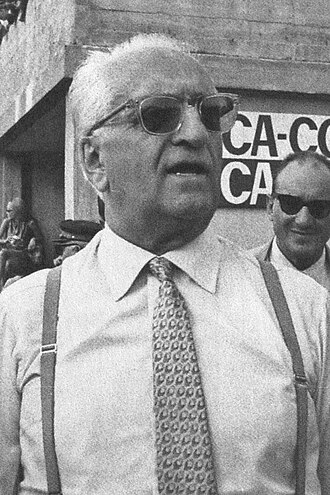
Enzo Ferrari
Founder of Ferrari and the chairman who rebuilt it
Where to hear and read about Enzo Ferrari1 episode or test

Enzo Ferrari was a failed coachbuilder and a cautious racing driver from Modena who found his calling running a racing team, then turned that team, a borrowed war hero's horse and a color into the most mythic car brand in the world. The lesson most worth taking from him is that he built the myth first and sold the product second, and guarded control of the thing that fed the myth, racing, through every deal.
I sell engines and the car I throw in for free.
Ferrari: What happens when you staple a luxury brand to a sports team?
Enzo Ferrari: the story and the lessons
1Enzo Ferrari's early losses in Modena
Enzo was the unruly younger son, never meant to inherit anything. Born in Modena in 1898, he skipped school while his older brother Dino was groomed to take over the family metalworking shop.
His father and then Dino died of pneumonia, and Enzo nearly died of it too in the army. He later wrote of feeling almost guilty of having survived, and titled his memoirs My Terrible Joys.
His father taught him to avoid partners and stay self-sufficient. Alfredo Ferrari told him a company is perfect when its partners are odd in number and fewer than three.
The rule explains why Enzo guarded control of racing in every sale talk, with Ford and later with Fiat.
He pledged his future salary to get into racing. Fiat turned him down for a job in 1918 because he had no skills. At the startup CMN in 1919 he pledged months of future pay to buy a sports car and race it.
His mother had refused to let him sell the family house to fund a racing car. The wealthy gentleman racers of that era later became his core clients.
2How Enzo Ferrari found his place running a team
Ferrari failed as a coachbuilder and held back as a driver. Alfa Romeo hired him as a driver, and in 1920 he opened the coachbuilding firm Carrozzeria Emilia, which was bankrupt within two years.
After watching two mentors on the Alfa team die racing, one of them in his arms, he could not push to the limit. He quit driving in 1924 and opened an Alfa dealership.
Scuderia Ferrari began as Alfa Romeo's outsourced racing arm. When Alfa cut its racing budget, Enzo offered to run its races as official racing agent from 1929, paying drivers and mechanics himself, and took over the whole operation in 1933.
Alfa saved costs and Enzo kept the publicity that sold his cars. Scuderia means stable, and the SF still sits on the shield.
He planned from the start to build his own cars. The step from preparing race cars to building them was small, and the Maserati brothers across town had already made it.
Fired by Alfa in 1939, he was barred for four years from using the Ferrari name or building race cars. During the war his company Auto Avio Costruzioni made machine tools stamped with the prancing horse, and in 1943 he moved to Maranello to escape bombing, where the factory still stands.
3How Enzo Ferrari built the myth before the cars
The prancing horse came from a fallen war hero's mother. Francesco Baracca, Italy's top ace with 34 aerial victories, painted a black horse on his plane, and his mother gave Enzo his photo with an inscription telling him to use it.
Enzo set the horse in a Modena-yellow shield, used the flag colors to signal the aim of being Italy's national team, and claimed Rosso Corsa as Ferrari's own color.
Ferrari was a marketer who understood technology, not an engineer. Luca di Montezemolo called him Italy's Steve Jobs, a natural-born entrepreneur and marketer. Enzo called himself an agitator of men.
He cultivated the look of a man who cared only about racing because that image sold cars. He was 49 and had sold no car until the 166 in 1948, so the legend that he only wanted to race is false.
He played the aloof artist, and wealthy buyers loved it. He wore dark sunglasses only for the press and clients and took them off once they left.
He kept the engine in front for years, saying God put the horse before the carriage, while rivals moved to mid-engine designs. Flaws did not hurt demand, because reliability does not drive desire for luxury.
4How Enzo Ferrari turned a race team into a car company
Racing team, carmaker and client services sat under one roof. From 1947 Ferrari combined a professional team, a constructor building cars for itself and private clients, and staff to tune those cars for races.
Rivals like Mercedes ran racing as a separate operation. Ferrari is the only F1 team that has operated continuously since the sport began in 1950.
Luigi Chinetti opened the American market for him. Chinetti, an old Alfa teammate who spent the war in New York, told Enzo wealthy Americans would pay a king's ransom for his cars.
About a dozen 166s were built in 1948, for buyers including Cadillac dealer Tommy Lee, Briggs Cunningham and Gianni Agnelli of Fiat.
A private client's car won Le Mans in 1949. Chinetti entered Lord Selsdon's 166 at Le Mans even though Enzo thought it was not ready, and it won without the factory team.
It proved the engine and the brand sold cars no matter who raced them. Ferrari had already won 7 of 14 races in 1947.
Ferrari let Pininfarina design the bodies for 61 years. Having failed as a coachbuilder, Enzo recognized Battista Pininfarina as the master and brought him in from the start so body and engine were born together.
The 250, launched in 1952, was the first real production Ferrari. Nearly every road Ferrari came from Pininfarina until 2013, when the LaFerrari became the first designed in-house.
He built one car less than the market wanted. Fewer than 100 of the 166 were made, even though demand was higher.
5Tragedy and controversy in Enzo Ferrari's 1950s
Death took his surrogate son and then his real heir. Alberto Ascari, whom Enzo treated almost like a son, died at Monza in 1955. In 1956 his son Dino died at 24 of muscular dystrophy, and Enzo stopped attending races.
His other son Piero, born of an affair with Lina Lardi, could not legally inherit because divorce was illegal in Italy until the 1970s. Piero now owns about 10% of Ferrari and sits on its board.
A 1957 crash put the state and the Church against him. At the last Mille Miglia a Ferrari killed its driver and nine spectators, five of them children. Enzo was charged with manslaughter and acquitted.
The Vatican paper called him a modern Saturn who devours his sons, and he agreed never to hire Italian drivers.
Notoriety made Ferraris more desirable, not less. Output reached 300 cars in 1960 and 500 in 1962, split roughly in thirds across Italy, America and the rest of Europe.
Papal disapproval made the cars forbidden fruit. Asked at 65 in 1963 who would inherit the company, he answered après moi le déluge.
6How Enzo Ferrari handled Ford and sold to Fiat
Ferrari blew up Ford's 1963 offer over control of racing. Ford's price fell from an $18 million ask to $10 million. The draft gave Ford 90% of road cars and Enzo 90% of racing, but Ford held the budget and so the final say.
Enzo read the fine print and walked at the finish line, while the press framed it as Americans trying to buy an Italian treasure. Ferrari had won Le Mans in 1958 and every year from 1960 to 1965.
Losing Le Mans to Ford fed his myth more than it hurt. Henry Ford II vowed to beat him, and with Carroll Shelby and Ken Miles Ford finished first, second and third at Le Mans in 1966.
The saga signaled that Enzo would deal only on his own terms. His view, as quoted from Brock Yates: treat an American like a hick and you will own him for life.
Thinking he was dying, he sold half to Fiat in 1969. Fiat took 50% for under $3.5 million, valuing Ferrari at $6.8 million, with a secret clause for 40% more on his death and 10% for Piero.
Fiat ran road cars while Enzo kept final authority over racing. He had one real bidder, a factory needing investment, costly racing, labor unrest and Lamborghini's Miura to contend with, and Fiat was the only route that kept Ferrari Italian. He lived until 1988.
7Enzo Ferrari's last years and the successor he found
Ferrari hired a young outsider he heard on the radio. He heard law student Luca di Montezemolo defend motor racing on a call-in show and hired him as an assistant to report what was really happening, and as a spy inside Fiat.
Made team manager before 30, Luca saw the sport had moved to aerodynamics and chassis while Ferrari stayed fixed on engines. He hired specialists and Niki Lauda, and Ferrari won both 1975 titles after a 10-year drought.
Enzo was a prisoner of his own myth. After Lauda's 1976 crash Enzo lost faith in him, Luca left for Fiat, and racing glory did not return until after Enzo's death.
Enzo's last car, the F40, was a raw racer with a string door handle and bare carbon fiber. He died in summer 1988 at 90, and Ferrari's next Grand Prix was a one-two at Monza.
Fiat's volume push after Enzo nearly broke the brand. Output rose from 2,200 cars in 1982 to 4,500 in 1991, with shared Fiat parts, until cars went unsold and workers were furloughed.
A Honda NSX beat the 348 in Luca's own test. Returning as chairman, Luca cut output to 2,300 by 1993, built to order, and rebuilt the team with Jean Todt, Ross Brawn and Michael Schumacher, adding the luxury playbook Enzo never knew.
8What builders can take from Enzo Ferrari
Build the myth before the product. Enzo spent two decades on a team, a logo and a color before selling a road car.
Keep control of whatever feeds the myth. In both the Ford and Fiat talks he gave up road cars sooner than racing.
Partner with the best where you are weak. A failed coachbuilder himself, he gave the bodies to Pininfarina and the American market to Chinetti.
Bring in outsiders to change what you cannot. Luca di Montezemolo fixed the team in the 1970s and later the company Enzo left behind.
Ferrari went from a $192 million valuation in 1988 to a $9.8 billion market cap at its 2015 IPO.

Ferrari: What happens when you staple a luxury brand to a sports team?
Ferrari shows how a luxury brand and a racing team can sit under one roof and strengthen each other, built on scarcity, myth and a vertically integrated factory. The decisions that make it worth hearing are Enzo's myth-making and his selective sale to Fiat, and Luca di Montezemolo's 1991 turnaround that cut production almost in half and put the luxury strategy in place.
Enzo was the unruly younger son, never meant to inherit anything. Born in Modena in 1898, he skipped school while his older brother Dino was groomed to take over the family metalworking shop.
His father and then Dino died of pneumonia, and Enzo nearly died of it too in the army. He later wrote of feeling almost guilty of having survived, and titled his memoirs My Terrible Joys.
His father taught him to avoid partners and stay self-sufficient. Alfredo Ferrari told him a company is perfect when its partners are odd in number and fewer than three.
The rule explains why Enzo guarded control of racing in every sale talk, with Ford and later with Fiat.
He pledged his future salary to get into racing. Fiat turned him down for a job in 1918 because he had no skills. At the startup CMN in 1919 he pledged months of future pay to buy a sports car and race it.
His mother had refused to let him sell the family house to fund a racing car. The wealthy gentleman racers of that era later became his core clients.
Ferrari failed as a coachbuilder and held back as a driver. Alfa Romeo hired him as a driver, and in 1920 he opened the coachbuilding firm Carrozzeria Emilia, which was bankrupt within two years.
After watching two mentors on the Alfa team die racing, one of them in his arms, he could not push to the limit. He quit driving in 1924 and opened an Alfa dealership.
Scuderia Ferrari began as Alfa Romeo's outsourced racing arm. When Alfa cut its racing budget, Enzo offered to run its races as official racing agent from 1929, paying drivers and mechanics himself, and took over the whole operation in 1933.
Alfa saved costs and Enzo kept the publicity that sold his cars. Scuderia means stable, and the SF still sits on the shield.
He planned from the start to build his own cars. The step from preparing race cars to building them was small, and the Maserati brothers across town had already made it.
Fired by Alfa in 1939, he was barred for four years from using the Ferrari name or building race cars. During the war his company Auto Avio Costruzioni made machine tools stamped with the prancing horse, and in 1943 he moved to Maranello to escape bombing, where the factory still stands.
The prancing horse came from a fallen war hero's mother. Francesco Baracca, Italy's top ace with 34 aerial victories, painted a black horse on his plane, and his mother gave Enzo his photo with an inscription telling him to use it.
Enzo set the horse in a Modena-yellow shield, used the flag colors to signal the aim of being Italy's national team, and claimed Rosso Corsa as Ferrari's own color.
Ferrari was a marketer who understood technology, not an engineer. Luca di Montezemolo called him Italy's Steve Jobs, a natural-born entrepreneur and marketer. Enzo called himself an agitator of men.
He cultivated the look of a man who cared only about racing because that image sold cars. He was 49 and had sold no car until the 166 in 1948, so the legend that he only wanted to race is false.
He played the aloof artist, and wealthy buyers loved it. He wore dark sunglasses only for the press and clients and took them off once they left.
He kept the engine in front for years, saying God put the horse before the carriage, while rivals moved to mid-engine designs. Flaws did not hurt demand, because reliability does not drive desire for luxury.
Racing team, carmaker and client services sat under one roof. From 1947 Ferrari combined a professional team, a constructor building cars for itself and private clients, and staff to tune those cars for races.
Rivals like Mercedes ran racing as a separate operation. Ferrari is the only F1 team that has operated continuously since the sport began in 1950.
Luigi Chinetti opened the American market for him. Chinetti, an old Alfa teammate who spent the war in New York, told Enzo wealthy Americans would pay a king's ransom for his cars.
About a dozen 166s were built in 1948, for buyers including Cadillac dealer Tommy Lee, Briggs Cunningham and Gianni Agnelli of Fiat.
A private client's car won Le Mans in 1949. Chinetti entered Lord Selsdon's 166 at Le Mans even though Enzo thought it was not ready, and it won without the factory team.
It proved the engine and the brand sold cars no matter who raced them. Ferrari had already won 7 of 14 races in 1947.
Ferrari let Pininfarina design the bodies for 61 years. Having failed as a coachbuilder, Enzo recognized Battista Pininfarina as the master and brought him in from the start so body and engine were born together.
The 250, launched in 1952, was the first real production Ferrari. Nearly every road Ferrari came from Pininfarina until 2013, when the LaFerrari became the first designed in-house.
He built one car less than the market wanted. Fewer than 100 of the 166 were made, even though demand was higher.
Death took his surrogate son and then his real heir. Alberto Ascari, whom Enzo treated almost like a son, died at Monza in 1955. In 1956 his son Dino died at 24 of muscular dystrophy, and Enzo stopped attending races.
His other son Piero, born of an affair with Lina Lardi, could not legally inherit because divorce was illegal in Italy until the 1970s. Piero now owns about 10% of Ferrari and sits on its board.
A 1957 crash put the state and the Church against him. At the last Mille Miglia a Ferrari killed its driver and nine spectators, five of them children. Enzo was charged with manslaughter and acquitted.
The Vatican paper called him a modern Saturn who devours his sons, and he agreed never to hire Italian drivers.
Notoriety made Ferraris more desirable, not less. Output reached 300 cars in 1960 and 500 in 1962, split roughly in thirds across Italy, America and the rest of Europe.
Papal disapproval made the cars forbidden fruit. Asked at 65 in 1963 who would inherit the company, he answered après moi le déluge.
Ferrari blew up Ford's 1963 offer over control of racing. Ford's price fell from an $18 million ask to $10 million. The draft gave Ford 90% of road cars and Enzo 90% of racing, but Ford held the budget and so the final say.
Enzo read the fine print and walked at the finish line, while the press framed it as Americans trying to buy an Italian treasure. Ferrari had won Le Mans in 1958 and every year from 1960 to 1965.
Losing Le Mans to Ford fed his myth more than it hurt. Henry Ford II vowed to beat him, and with Carroll Shelby and Ken Miles Ford finished first, second and third at Le Mans in 1966.
The saga signaled that Enzo would deal only on his own terms. His view, as quoted from Brock Yates: treat an American like a hick and you will own him for life.
Thinking he was dying, he sold half to Fiat in 1969. Fiat took 50% for under $3.5 million, valuing Ferrari at $6.8 million, with a secret clause for 40% more on his death and 10% for Piero.
Fiat ran road cars while Enzo kept final authority over racing. He had one real bidder, a factory needing investment, costly racing, labor unrest and Lamborghini's Miura to contend with, and Fiat was the only route that kept Ferrari Italian. He lived until 1988.
Ferrari hired a young outsider he heard on the radio. He heard law student Luca di Montezemolo defend motor racing on a call-in show and hired him as an assistant to report what was really happening, and as a spy inside Fiat.
Made team manager before 30, Luca saw the sport had moved to aerodynamics and chassis while Ferrari stayed fixed on engines. He hired specialists and Niki Lauda, and Ferrari won both 1975 titles after a 10-year drought.
Enzo was a prisoner of his own myth. After Lauda's 1976 crash Enzo lost faith in him, Luca left for Fiat, and racing glory did not return until after Enzo's death.
Enzo's last car, the F40, was a raw racer with a string door handle and bare carbon fiber. He died in summer 1988 at 90, and Ferrari's next Grand Prix was a one-two at Monza.
Fiat's volume push after Enzo nearly broke the brand. Output rose from 2,200 cars in 1982 to 4,500 in 1991, with shared Fiat parts, until cars went unsold and workers were furloughed.
A Honda NSX beat the 348 in Luca's own test. Returning as chairman, Luca cut output to 2,300 by 1993, built to order, and rebuilt the team with Jean Todt, Ross Brawn and Michael Schumacher, adding the luxury playbook Enzo never knew.
Build the myth before the product. Enzo spent two decades on a team, a logo and a color before selling a road car.
Keep control of whatever feeds the myth. In both the Ford and Fiat talks he gave up road cars sooner than racing.
Partner with the best where you are weak. A failed coachbuilder himself, he gave the bodies to Pininfarina and the American market to Chinetti.
Bring in outsiders to change what you cannot. Luca di Montezemolo fixed the team in the 1970s and later the company Enzo left behind.
Ferrari went from a $192 million valuation in 1988 to a $9.8 billion market cap at its 2015 IPO.