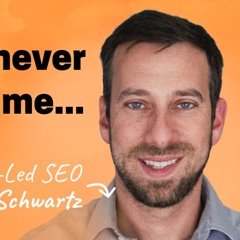
Eli Schwartz
SEO advisor and author of Product-Led SEO
Where to hear and read about Eli Schwartz1 episode or test

Eli Schwartz is an SEO advisor and author of Product-Led SEO who has run search for Quora, Tinder, Zapier, SurveyMonkey and others. The thing most worth learning from him is to treat SEO as a product built for a searcher who is ready to act, and to skip it where buyers don't search and then buy.
If you can't answer the question about what is it that someone's going to do a search on, then don't do SEO.
Rethinking SEO in the age of AI | Eli Schwartz (SEO advisor, author)
Eli Schwartz: the story and the lessons
1Who Eli Schwartz is and how he came to rethink SEO
Schwartz has run SEO inside big products for over a decade. He has worked with Quora, Coinbase, Tinder, LinkedIn, WordPress and Zapier, and wrote the book Product-Led SEO.
He says SEO is not a dark art and that it is simple. His recent work looks at how chatbots and Google's in-result answers change it.
A CEO's blunt question made him rethink the old SEO pitch. The CEO summed up Schwartz's pitch as finding keywords, putting them in content and building links, then asked why he should pay for that. Schwartz went silent, because that really was SEO, and he changed how he approached it.
Other practitioners kept the old tactics because the tactics had worked. He argues AI exposes how little thinking that playbook needed.
His mentors taught him to sell advice, not to operate better. Casey Winters, Yuriy Timen and Ethan Smith taught him how to sell and propose. He coached for almost a year with the author of Million Dollar Consulting.
His view is that being a good operator doesn't make you a good advisor. He tells would-be advisors to keep the day job, practice selling and closing, and remember: "You're building a brand. You're not building a consultancy."
2How Schwartz builds SEO as a product
Schwartz treats SEO as a product question owned by product managers. He wants product managers, design, engineering and user research involved, and every page leading into what the company monetizes. Pages with no product journey behind them just dead-end.
"I think of SEO as a product. And I think the product managers are the people that should be thinking about this SEO question because it's a product question."
He starts by becoming the user and naming what they would search. The order is: be your own customer, decide what asset to build, then build it with a full product team. At SurveyMonkey every new hire got an account and was told to run a survey, yet for years almost no one did.
He says most teams treat SEO as a work challenge, not a customer empathy challenge. If you cannot say what someone would type into Google, skip SEO.
Zapier grew by showing people what its product could connect. Zapier built programmatic pages for each pair of apps, such as Gmail to Salesforce. People knew their tools didn't connect but didn't know Zapier existed, and each page made them wonder what else they could connect.
Schwartz had invested in Zapier and met CEO Wade Foster about ten years earlier, and calls his role in the programmatic SEO accidental. Results took a couple of years because nobody was searching for what it built.
Tinder won by matching a loneliness problem, not by writing about dating. All of Tinder's inbound traffic came from the word Tinder. Growth chief Udi Milo pushed SEO forward, and the team built local pages offering Tinder as the fix for someone lonely in a new city such as Dubai.
An AI Overview may describe a dating scene but can't solve the loneliness, so the click to Tinder remains. At an earlier job a CTO with no engineers to spare killed his plan, so product backing is what let Tinder's get built. He values it as his best SEO win because it linked the whole user journey.
He uses programmatic pages only where there is scale and a real use case. TripAdvisor merged hotels, cities and reviews into one page per property, and Zillow merged government data, photos and neighborhood data. Hand-writing 500 million property pages at $1,000 each would be cost prohibitive.
Pages for every US zip code failed because users don't search that way. SurveyMonkey had a fat head of about a hundred templates, not a long tail of 10,000.
Schwartz quadrupled Quora's traffic in three months by removing two blockers. Quora made users log in before seeing answers, so Google saw none, and it gave Google no way to navigate. He told it to show the answers and added a categorized HTML sitemap.
The sitemap pages were organized by topic, like health page one and health page two.
He runs SEO on product milestones, not on rankings. Month one to ideate, month two to write the PRD, month three to ship, then a target such as a number of indexed pages. Missed milestones, not a lack of rankings, show that SEO failed.
Results can arrive as a hockey stick, which is invisible while you are inside it. At Tinder, once built, a well-known brand started earning at once.
3When Schwartz says skip SEO, and how he judges it
Schwartz tells many B2B SaaS companies not to do SEO. If buyers don't search for the problem or buy through sales committees, SEO plateaus. A gardening SaaS was quoted $15,000 a month for content, but its customers came from $10,000 trade show booths.
Nobody searches for a problem they don't know exists, which is a brand challenge. He says Google Cloud shouldn't do SEO even at scale, because buying is a committee decision and nobody sees Google ranked first and then buys.
He followed every SEO rule at Mixpanel and it still didn't convert. He chose the keywords, wrote the content and built the links. Mixpanel is expensive and integrated across a company, so it could not be bought on a credit card and a search click rarely became a purchase.
The CEO had told him how SEO should work and planned to run it himself.
He insists SEO is never free and must out-earn other channels. An agency starts around $10,000 a month, about $120,000 a year, before CMS, engineering, design and content. He asks whether a million dollars in SEO returns a million soon, or whether brand ads, influencers or paid would return it faster.
At SurveyMonkey, organic traffic produced a couple of hundred million dollars a year, because it was a freemium tool where people searched for the problem, found the free solution and later paid. Having funding or competitors who do SEO are weak reasons to invest.
Schwartz measures SEO by conversions, never rankings or raw traffic. He picks the metric the business needs, such as MQLs, sales or page views for a media company. A two-sided HR marketplace monetized only one side, so he advised deleting content aimed at the other.
"If you are driving leads and that traffic number goes up, you're not driving more leads from SEO. You're getting worthless traffic."
He forecasts SEO top-down from market size, a method he devised at Faire. Start from population, narrow by segment and share who buy online, pick a penetration goal, then multiply by purchases per year and AOV. The bottoms-up version, for shoes in Japan, gave about 500 users, which no one would fund.
Each input can be revised later. He has never seen a plan hit the exact truth, and the aim is a better decision than a guess.
He uses keyword tools only for relative sizing and trusts Search Console. Against Search Console, some keywords were over-estimated by 10 times and others under-estimated by 10 times. For WordPress, every tool had the number badly wrong.
In early COVID a public company's board member read a tool and said they were being crushed, while Search Console showed traffic had quadrupled. "Tools are helpful. But I don't think they are a source of actual truth."
He says technical SEO and agency audits are rarely the cure. Technical SEO matters for sites with tens of millions of pages like Zillow or Airbnb, not a hundred-page SaaS site. Sites hit by Google updates usually made content users didn't value, which an audit won't fix.
Agencies are paid on deliverables, and content is the easiest one to sell, so he asks whether you need the content at all. A growth advisor is expensive but shortens the learning curve.
4Schwartz on AI answers, Google and brand
He expects AI answers to take the top of the funnel and leave mid-funnel to search. AI Overviews turn unstructured content into a direct answer, and the user then searches deeper, such as "Riverside price". Big vague keywords lose value, and review sites like G2 and Capterra will be hit hard.
Conversions have always happened mid-funnel, so he sees this pushing SEO to where it should have been. Informational sites like WebMD lose the most.
Schwartz says Google rushed AI answers out under investor pressure. A falling stock price would hurt Google's hiring and fundraising, so it had to answer OpenAI. The Bard demo went badly, and AI Overviews launched in May and produced the glue-on-pizza screenshots.
He says showing an AI answer conflicts with showing ads, which are most of Google's revenue, and that this is still unsolved.
He does not expect Google to lose its dominance soon. The antitrust verdict puts Google at 98% of mobile searches. DuckDuckGo went from about 1% to 2% in twelve years.
Neeva had a better product but no default deals and could not succeed. The Apple deal is a revenue share worth about $20 billion, and even if default deals ended, he thinks users would still type Google.
He backs AI for useful scaled content and rejects AI filler. AI turns cheap worthless content into free worthless content, like the $50 Fiverr articles. E-commerce product descriptions are a good use, because shoppers search for the products on the page, not the text about them.
Google's documentation says helpfulness is the issue, not AI. He thinks CNET would have been fine had it stayed quiet about using AI.
Schwartz treats showing up in an AI Overview as a brand result. A named mention means brand work is paying off, and a link as a source means you probably already rank beneath it. A link without a mention means Google lifted your content.
"If you show up as a brand, you've done good branding, but if you show up as a link, it means Google has stolen your content." His LinkedIn poll of a couple hundred people split about 50/50 on clicking those links.
He says the right way to earn links is to build a brand. Bought guest posts on low-authority sites help no one because no one reads them, and Google can now read a brand mention like a link. What you do for PR you do for SEO.
His own site, with modest domain authority, outranks Amazon for Product-Led SEO, and for his own name he outranks LinkedIn. Fit with what people look for matters more than rank.

Rethinking SEO in the age of AI | Eli Schwartz (SEO advisor, author)
SEO should be run as a product tied to the buyer journey, aimed at mid-funnel intent that AI Overviews and chatbots do not swallow. Eli draws on work at Zapier, Tinder, Quora, SurveyMonkey and others, including a Quora fix that quadrupled traffic in three months.
Schwartz has run SEO inside big products for over a decade. He has worked with Quora, Coinbase, Tinder, LinkedIn, WordPress and Zapier, and wrote the book Product-Led SEO.
He says SEO is not a dark art and that it is simple. His recent work looks at how chatbots and Google's in-result answers change it.
A CEO's blunt question made him rethink the old SEO pitch. The CEO summed up Schwartz's pitch as finding keywords, putting them in content and building links, then asked why he should pay for that. Schwartz went silent, because that really was SEO, and he changed how he approached it.
Other practitioners kept the old tactics because the tactics had worked. He argues AI exposes how little thinking that playbook needed.
His mentors taught him to sell advice, not to operate better. Casey Winters, Yuriy Timen and Ethan Smith taught him how to sell and propose. He coached for almost a year with the author of Million Dollar Consulting.
His view is that being a good operator doesn't make you a good advisor. He tells would-be advisors to keep the day job, practice selling and closing, and remember: "You're building a brand. You're not building a consultancy."
Schwartz treats SEO as a product question owned by product managers. He wants product managers, design, engineering and user research involved, and every page leading into what the company monetizes. Pages with no product journey behind them just dead-end.
"I think of SEO as a product. And I think the product managers are the people that should be thinking about this SEO question because it's a product question."
He starts by becoming the user and naming what they would search. The order is: be your own customer, decide what asset to build, then build it with a full product team. At SurveyMonkey every new hire got an account and was told to run a survey, yet for years almost no one did.
He says most teams treat SEO as a work challenge, not a customer empathy challenge. If you cannot say what someone would type into Google, skip SEO.
Zapier grew by showing people what its product could connect. Zapier built programmatic pages for each pair of apps, such as Gmail to Salesforce. People knew their tools didn't connect but didn't know Zapier existed, and each page made them wonder what else they could connect.
Schwartz had invested in Zapier and met CEO Wade Foster about ten years earlier, and calls his role in the programmatic SEO accidental. Results took a couple of years because nobody was searching for what it built.
Tinder won by matching a loneliness problem, not by writing about dating. All of Tinder's inbound traffic came from the word Tinder. Growth chief Udi Milo pushed SEO forward, and the team built local pages offering Tinder as the fix for someone lonely in a new city such as Dubai.
An AI Overview may describe a dating scene but can't solve the loneliness, so the click to Tinder remains. At an earlier job a CTO with no engineers to spare killed his plan, so product backing is what let Tinder's get built. He values it as his best SEO win because it linked the whole user journey.
He uses programmatic pages only where there is scale and a real use case. TripAdvisor merged hotels, cities and reviews into one page per property, and Zillow merged government data, photos and neighborhood data. Hand-writing 500 million property pages at $1,000 each would be cost prohibitive.
Pages for every US zip code failed because users don't search that way. SurveyMonkey had a fat head of about a hundred templates, not a long tail of 10,000.
Schwartz quadrupled Quora's traffic in three months by removing two blockers. Quora made users log in before seeing answers, so Google saw none, and it gave Google no way to navigate. He told it to show the answers and added a categorized HTML sitemap.
The sitemap pages were organized by topic, like health page one and health page two.
He runs SEO on product milestones, not on rankings. Month one to ideate, month two to write the PRD, month three to ship, then a target such as a number of indexed pages. Missed milestones, not a lack of rankings, show that SEO failed.
Results can arrive as a hockey stick, which is invisible while you are inside it. At Tinder, once built, a well-known brand started earning at once.
Schwartz tells many B2B SaaS companies not to do SEO. If buyers don't search for the problem or buy through sales committees, SEO plateaus. A gardening SaaS was quoted $15,000 a month for content, but its customers came from $10,000 trade show booths.
Nobody searches for a problem they don't know exists, which is a brand challenge. He says Google Cloud shouldn't do SEO even at scale, because buying is a committee decision and nobody sees Google ranked first and then buys.
He followed every SEO rule at Mixpanel and it still didn't convert. He chose the keywords, wrote the content and built the links. Mixpanel is expensive and integrated across a company, so it could not be bought on a credit card and a search click rarely became a purchase.
The CEO had told him how SEO should work and planned to run it himself.
He insists SEO is never free and must out-earn other channels. An agency starts around $10,000 a month, about $120,000 a year, before CMS, engineering, design and content. He asks whether a million dollars in SEO returns a million soon, or whether brand ads, influencers or paid would return it faster.
At SurveyMonkey, organic traffic produced a couple of hundred million dollars a year, because it was a freemium tool where people searched for the problem, found the free solution and later paid. Having funding or competitors who do SEO are weak reasons to invest.
Schwartz measures SEO by conversions, never rankings or raw traffic. He picks the metric the business needs, such as MQLs, sales or page views for a media company. A two-sided HR marketplace monetized only one side, so he advised deleting content aimed at the other.
"If you are driving leads and that traffic number goes up, you're not driving more leads from SEO. You're getting worthless traffic."
He forecasts SEO top-down from market size, a method he devised at Faire. Start from population, narrow by segment and share who buy online, pick a penetration goal, then multiply by purchases per year and AOV. The bottoms-up version, for shoes in Japan, gave about 500 users, which no one would fund.
Each input can be revised later. He has never seen a plan hit the exact truth, and the aim is a better decision than a guess.
He uses keyword tools only for relative sizing and trusts Search Console. Against Search Console, some keywords were over-estimated by 10 times and others under-estimated by 10 times. For WordPress, every tool had the number badly wrong.
In early COVID a public company's board member read a tool and said they were being crushed, while Search Console showed traffic had quadrupled. "Tools are helpful. But I don't think they are a source of actual truth."
He says technical SEO and agency audits are rarely the cure. Technical SEO matters for sites with tens of millions of pages like Zillow or Airbnb, not a hundred-page SaaS site. Sites hit by Google updates usually made content users didn't value, which an audit won't fix.
Agencies are paid on deliverables, and content is the easiest one to sell, so he asks whether you need the content at all. A growth advisor is expensive but shortens the learning curve.
He expects AI answers to take the top of the funnel and leave mid-funnel to search. AI Overviews turn unstructured content into a direct answer, and the user then searches deeper, such as "Riverside price". Big vague keywords lose value, and review sites like G2 and Capterra will be hit hard.
Conversions have always happened mid-funnel, so he sees this pushing SEO to where it should have been. Informational sites like WebMD lose the most.
Schwartz says Google rushed AI answers out under investor pressure. A falling stock price would hurt Google's hiring and fundraising, so it had to answer OpenAI. The Bard demo went badly, and AI Overviews launched in May and produced the glue-on-pizza screenshots.
He says showing an AI answer conflicts with showing ads, which are most of Google's revenue, and that this is still unsolved.
He does not expect Google to lose its dominance soon. The antitrust verdict puts Google at 98% of mobile searches. DuckDuckGo went from about 1% to 2% in twelve years.
Neeva had a better product but no default deals and could not succeed. The Apple deal is a revenue share worth about $20 billion, and even if default deals ended, he thinks users would still type Google.
He backs AI for useful scaled content and rejects AI filler. AI turns cheap worthless content into free worthless content, like the $50 Fiverr articles. E-commerce product descriptions are a good use, because shoppers search for the products on the page, not the text about them.
Google's documentation says helpfulness is the issue, not AI. He thinks CNET would have been fine had it stayed quiet about using AI.
Schwartz treats showing up in an AI Overview as a brand result. A named mention means brand work is paying off, and a link as a source means you probably already rank beneath it. A link without a mention means Google lifted your content.
"If you show up as a brand, you've done good branding, but if you show up as a link, it means Google has stolen your content." His LinkedIn poll of a couple hundred people split about 50/50 on clicking those links.
He says the right way to earn links is to build a brand. Bought guest posts on low-authority sites help no one because no one reads them, and Google can now read a brand mention like a link. What you do for PR you do for SEO.
His own site, with modest domain authority, outranks Amazon for Product-Led SEO, and for his own name he outranks LinkedIn. Fit with what people look for matters more than rank.