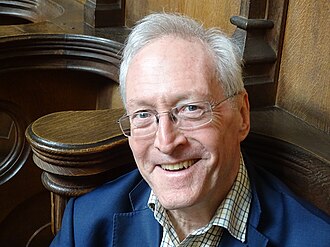
Diarmaid MacCulloch
Oxford professor of the history of the Church and author of major histories of Christianity and the Reformation
Where to hear and read about Diarmaid MacCulloch1 episode or test

Diarmaid MacCulloch is an Oxford professor of the history of the Church and the author of major histories of Christianity and the Reformation, including biographies of Thomas Cranmer and Thomas Cromwell. The most useful thing to learn from him is to be skeptical and then sympathetic, to say 'yes, but' against heroic stories, and to tell readers your biases.
The historian's motto really ought to be yes, but.
Oxford Professor Teaches the Craft of Writing (Diarmaid MacCulloch Interview)
Diarmaid MacCulloch: the story and the lessons
1Why MacCulloch thinks history keeps a society sane
MacCulloch sees history as a defense against the lies of the powerful. He says lies told by the powerful erode a society's moral balance. He points to the demotion of Martin Luther King Day and to tampered museum labels that create a sanitized narrative.
His verdict is that tampering is a wicked thing to do and also an insane one.
His father's job left him free to speak, and he carries that on. His father was a Church of England rector with Parson's Freehold, which meant he could not be sacked for what he said.
That freedom to speak is what MacCulloch brings to his own work.
A Suffolk parish church with a 16th century building made him a Tudor historian. He grew up in a Suffolk parish where the biggest tomb belonged to a Catholic still buried in the Protestant parish church. His Cambridge doctoral thesis was on Suffolk.
He holds that place can show you the character you are studying.
He gives moral formation to the humanities, not to science. STEM subjects can get you to the moon or cure cancer, but he says they do not make you a good person. History, philosophy and literature show that you are one person among many.
They also teach that other people's opinions need listening to and their interests need defending, above all the weak.
2How MacCulloch keeps his history honest
MacCulloch reads the classic older accounts before the primary sources. For his biographies of Thomas Cranmer and Thomas Cromwell he first read the 17th century writers Bishop Burnet and John Strype. Burnet's work runs to eight volumes in its early Victorian edition.
It stops you reinventing the wheel and shows the received version before you test it. In his words: "Get the cliches in your mind. Do not be dominated by the cliches, but know what they are."
He is skeptical of his subjects first, then sympathetic. He asks why a person is telling him something, since everyone has an agenda. Then he remembers they are interesting human beings.
Skepticism keeps sympathy from turning into credulity, and sympathy keeps skepticism from turning cold.
He uses 'yes, but' to stop history turning heroic. Beautifully written history can mislead through what it leaves out, as Churchill's history of the Second World War makes him an essential player. MacCulloch adds the 'but' to any simple, heroic version.
The balanced account is less simple and less satisfying at first sight, but more true, and it stops the past becoming a glorious standard for judging the present.
He marks what is known and what is only likely. Where sources survive as fragments, he writes phrases like 'we may think it is quite likely'. A novelist such as Hilary Mantel can invent a romance in Antwerp to account for a known illegitimate child of Cromwell.
A historian has to say 'may have' and give degrees of confidence.
He reads victors' histories for their agendas, then corrects them. Bede played down the Christianity already in England when Augustine arrived, yet MacCulloch keeps him because his motives are visible in the text.
Archaeology adds what Bede left out. Richly furnished Christian graves of women in the roughly 80 years after Augustine landed suggest abbesses led the mission as much as the male bishops. Of such history he says: "It is not true, but it contains truth."
MacCulloch opens his books by telling readers who he is. His introductions, including the one on Christianity, state his convictions so readers can think 'he would say that, wouldn't he?'
He says hiding your position is dishonest: "You are depriving them of essential data."
He allows for lunacy, pain and irrationality as explanations. He suggests the simple explanation may be that someone was mad, ill or narcissistic. Rosslyn Chapel is lavish with a very simple ground plan, probably the work of a rich and mad Earl Sinclair.
A doctor told him to read Henry VIII's last-decade reversals through his constant pain and how he felt that morning.
He uses his own failures to spot excuses in the successful. Thucydides had been a defeated Athenian general, and his account of Athens' fall as hubris came from that experience.
MacCulloch says knowing disappointment and rejection helps you see how apparently successful people build narratives that let them off the hook.
3How MacCulloch writes and what he learns from place
MacCulloch visits the place and lets it rewrite the script. Alone for 45 minutes in a deserted St Basil's Cathedral in Moscow while the crew set up, he saw that the plan is logical and symmetrical but that visitors feel vertical, claustrophobic space.
He changed the on-camera script, then wrote it into the book on the flight home: "It is the mind of a mad czar." He cites Robert Caro living three years in Texas to understand LBJ as a stronger case of the same principle.
His test of good prose is whether a sentence makes him smile. A sentence that makes him smile two or three times, then still strikes him as clever and illuminating, passes. Purple prose and leaden cliche both fail.
He accepts plain technical history for its purpose, such as a study of the water supply in 19th century Wigan, but does not call it beautiful writing. As a Wolfson Prize judge he reads about 180 books a year and narrows them to six.
He uses humor and irony only when they tell readers something. He likes crafting a funny sentence, but it must be funny in a constructive way and reveal something about the subject.
Human life is bizarre, so the odd is occasionally simply true. He admits he put funny, probably untrue stories into his large volume on sex and Christianity.
He asked Mantel's questions the other way: fix mistakes, keep fictions. Hilary Mantel sent him the last Wolf Hall typescript and asked for mistakes, not fictions. He told her it was the Prior, not the Abbot, of St Bartholomew's.
He found her portrait of Cromwell's devotion to Wolsey and hatred of Anne Boleyn startlingly right, and he thinks a novelist can reach a mind the sources cannot.
He sees a historian as counselor, guide and entertainer. A non-directive counselor lets readers look at themselves through a story while avoiding bias and direction. An entertainer knows that a boring book earns a black mark.
He admits he is very easily bored.
4MacCulloch's working day and how he teaches
He works in two blocks a day and never in the evening. He starts no earlier than 8:30, works until lunch, takes a proper break, then works from mid-afternoon until 7:00. He has napped almost daily since his twenties.
He calls himself systematic and a bit ruthless about the routine.
His supervisor Geoffrey Elton told him to rest for a third of the day. Sir Geoffrey Elton, a workaholic, advised dividing the day into three and working two of the thirds. The rule removes the guilt about resting.
MacCulloch's view: "You simply cannot work well if you just work nonstop."
He teaches claim testing with a game about a carrot. Students sort 20 statements about Elizabeth I into historical and not historical. Her accession in 1558 is a true statement, 1559 is false, and 'Elizabeth the First was a carrot' is nonsense.
Students have tried to justify the carrot with a Tudor red-hair idiom, which he admitted he made up. He uses the game with sixth formers and undergraduates.
He tells students history is play and also about sanity. He opens the course by promising it will keep them sane. Play is what all good human activities share, and if we don't enjoy history it isn't worth doing.
He adds that getting it right matters passionately, because it is about sanity.

Oxford Professor Teaches the Craft of Writing (Diarmaid MacCulloch Interview)
MacCulloch explains how a historian turns long research into honest, entertaining prose: be skeptical then sympathetic, tell readers your biases, and say 'yes, but' to keep the story true rather than heroic. His most useful habits are reading the old standard accounts before the primary sources and going to the place itself so the writing carries what a plan or document cannot.
MacCulloch sees history as a defense against the lies of the powerful. He says lies told by the powerful erode a society's moral balance. He points to the demotion of Martin Luther King Day and to tampered museum labels that create a sanitized narrative.
His verdict is that tampering is a wicked thing to do and also an insane one.
His father's job left him free to speak, and he carries that on. His father was a Church of England rector with Parson's Freehold, which meant he could not be sacked for what he said.
That freedom to speak is what MacCulloch brings to his own work.
A Suffolk parish church with a 16th century building made him a Tudor historian. He grew up in a Suffolk parish where the biggest tomb belonged to a Catholic still buried in the Protestant parish church. His Cambridge doctoral thesis was on Suffolk.
He holds that place can show you the character you are studying.
He gives moral formation to the humanities, not to science. STEM subjects can get you to the moon or cure cancer, but he says they do not make you a good person. History, philosophy and literature show that you are one person among many.
They also teach that other people's opinions need listening to and their interests need defending, above all the weak.
MacCulloch reads the classic older accounts before the primary sources. For his biographies of Thomas Cranmer and Thomas Cromwell he first read the 17th century writers Bishop Burnet and John Strype. Burnet's work runs to eight volumes in its early Victorian edition.
It stops you reinventing the wheel and shows the received version before you test it. In his words: "Get the cliches in your mind. Do not be dominated by the cliches, but know what they are."
He is skeptical of his subjects first, then sympathetic. He asks why a person is telling him something, since everyone has an agenda. Then he remembers they are interesting human beings.
Skepticism keeps sympathy from turning into credulity, and sympathy keeps skepticism from turning cold.
He uses 'yes, but' to stop history turning heroic. Beautifully written history can mislead through what it leaves out, as Churchill's history of the Second World War makes him an essential player. MacCulloch adds the 'but' to any simple, heroic version.
The balanced account is less simple and less satisfying at first sight, but more true, and it stops the past becoming a glorious standard for judging the present.
He marks what is known and what is only likely. Where sources survive as fragments, he writes phrases like 'we may think it is quite likely'. A novelist such as Hilary Mantel can invent a romance in Antwerp to account for a known illegitimate child of Cromwell.
A historian has to say 'may have' and give degrees of confidence.
He reads victors' histories for their agendas, then corrects them. Bede played down the Christianity already in England when Augustine arrived, yet MacCulloch keeps him because his motives are visible in the text.
Archaeology adds what Bede left out. Richly furnished Christian graves of women in the roughly 80 years after Augustine landed suggest abbesses led the mission as much as the male bishops. Of such history he says: "It is not true, but it contains truth."
MacCulloch opens his books by telling readers who he is. His introductions, including the one on Christianity, state his convictions so readers can think 'he would say that, wouldn't he?'
He says hiding your position is dishonest: "You are depriving them of essential data."
He allows for lunacy, pain and irrationality as explanations. He suggests the simple explanation may be that someone was mad, ill or narcissistic. Rosslyn Chapel is lavish with a very simple ground plan, probably the work of a rich and mad Earl Sinclair.
A doctor told him to read Henry VIII's last-decade reversals through his constant pain and how he felt that morning.
He uses his own failures to spot excuses in the successful. Thucydides had been a defeated Athenian general, and his account of Athens' fall as hubris came from that experience.
MacCulloch says knowing disappointment and rejection helps you see how apparently successful people build narratives that let them off the hook.
MacCulloch visits the place and lets it rewrite the script. Alone for 45 minutes in a deserted St Basil's Cathedral in Moscow while the crew set up, he saw that the plan is logical and symmetrical but that visitors feel vertical, claustrophobic space.
He changed the on-camera script, then wrote it into the book on the flight home: "It is the mind of a mad czar." He cites Robert Caro living three years in Texas to understand LBJ as a stronger case of the same principle.
His test of good prose is whether a sentence makes him smile. A sentence that makes him smile two or three times, then still strikes him as clever and illuminating, passes. Purple prose and leaden cliche both fail.
He accepts plain technical history for its purpose, such as a study of the water supply in 19th century Wigan, but does not call it beautiful writing. As a Wolfson Prize judge he reads about 180 books a year and narrows them to six.
He uses humor and irony only when they tell readers something. He likes crafting a funny sentence, but it must be funny in a constructive way and reveal something about the subject.
Human life is bizarre, so the odd is occasionally simply true. He admits he put funny, probably untrue stories into his large volume on sex and Christianity.
He asked Mantel's questions the other way: fix mistakes, keep fictions. Hilary Mantel sent him the last Wolf Hall typescript and asked for mistakes, not fictions. He told her it was the Prior, not the Abbot, of St Bartholomew's.
He found her portrait of Cromwell's devotion to Wolsey and hatred of Anne Boleyn startlingly right, and he thinks a novelist can reach a mind the sources cannot.
He sees a historian as counselor, guide and entertainer. A non-directive counselor lets readers look at themselves through a story while avoiding bias and direction. An entertainer knows that a boring book earns a black mark.
He admits he is very easily bored.
He works in two blocks a day and never in the evening. He starts no earlier than 8:30, works until lunch, takes a proper break, then works from mid-afternoon until 7:00. He has napped almost daily since his twenties.
He calls himself systematic and a bit ruthless about the routine.
His supervisor Geoffrey Elton told him to rest for a third of the day. Sir Geoffrey Elton, a workaholic, advised dividing the day into three and working two of the thirds. The rule removes the guilt about resting.
MacCulloch's view: "You simply cannot work well if you just work nonstop."
He teaches claim testing with a game about a carrot. Students sort 20 statements about Elizabeth I into historical and not historical. Her accession in 1558 is a true statement, 1559 is false, and 'Elizabeth the First was a carrot' is nonsense.
Students have tried to justify the carrot with a Tudor red-hair idiom, which he admitted he made up. He uses the game with sixth formers and undergraduates.
He tells students history is play and also about sanity. He opens the course by promising it will keep them sane. Play is what all good human activities share, and if we don't enjoy history it isn't worth doing.
He adds that getting it right matters passionately, because it is about sanity.