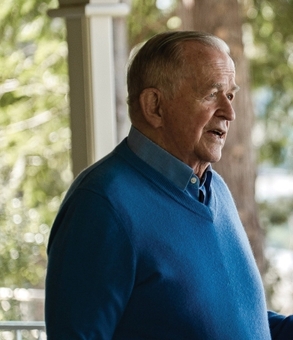
Dee Hock
Founder of Visa
Where to hear and read about Dee Hock1 episode or test

Dee Hock was a self-taught outsider from rural Utah who turned Bank of America's collapsing BankAmericard franchise into Visa, a global payments network owned by the competing banks that use it. The lesson most worth taking from him is how to get rivals to cooperate: design ownership, governance and technology so that every member earns more from a small share of a huge shared network than from all of a small one.
until someone has repeatedly said no and adamantly refuses another word on the subject, they are in the process of saying yes and don't know it.
Visa
Dee Hock: the story and the lessons
1Who Dee Hock was before Visa
Hock grew up poor in rural Utah and taught himself. He held only an associate's degree, had been fired from several finance jobs, and had read every book he could find since age seven.
He came to the card business as a small-bank outsider from Seattle, not as a respected senior banker.
Hock treated a no as a yes still in progress. From his college debate years he held that until someone repeatedly refuses another word on a subject, they are in the process of saying yes.
That persistence runs through every negotiation that built Visa, from Bank of America's board to the holdout international banks.
His outsider status made his pitch easier to accept. A respected banker would have made peers lose face by asking them to subordinate themselves to him. Handing the program to a nobody cost Bank of America nothing in prestige.
He still stood in front of Bank of America's vice chairman and argued that giving up the program was in the bank's own self-interest.
2The broken card program Dee Hock inherited
Bank of America launched the first mass credit card and absorbed brutal losses. The 1958 Fresno drop mailed unsolicited cards to 65,000 customers; about 22% of credit went delinquent or defaulted and fraud reached $2 million. The bank expanded anyway to 2 million California cardholders and 20,000 merchants in year one.
By 1961 it was profitable but kept quiet, and only 10 new US credit cards launched from 1960 to 1966.
Franchising failed because Bank of America sold a brand, not an operating system. From 1966 banks paid a $25,000 fee plus a share of revenue, and within two years a couple hundred banks and 6 million cardholders joined. But in California Bank of America sat on both sides of every transaction, so it had never solved settlement between banks.
Franchisees mailed paper sales drafts to each other with no standard discount rate.
Hock turned a token committee into a mandate. At the October 1968 Columbus, Ohio summit, angry franchisees faced only two mid-level Bank of America marketers. Hock took the committee they appointed and used it to take over the redesign.
3How Dee Hock got rival banks to co-own one network
Hock sold a small share of a global network over all of a local one. He told Bank of America's board a network owned by all banks would be worth far more than 100% of BankAmericard, and they handed the program over.
He wrote that moving value as electronic particles would be a market that "beggared the imagination," one no bank, corporation or nation could build alone. He also had to persuade franchisees to give up territorial exclusivity.
Ownership was membership, sized to each bank's volume. National BankAmericard Inc. was a for-profit, non-stock membership corporation with non-transferable participation rights. A bank sending 17% of transactions paid 17% of fees and received 17% of profits.
Because rights could not be sold, no bank could cash out and lose its incentive to grow the network. Hock called it a reverse holding company, like the NFL; it was never a nonprofit later converted.
Hock wrote a constitution members could change only by 80% vote. Every member had a vote and could call one anytime, but the 80% threshold discouraged wasted votes. One set of operating regulations bound everyone, and members could not join rival networks.
In practice it left Hock, as CEO, with most of the practical control because members listened to him.
Hock got the Justice Department's blessing before asking rivals to cooperate. He argued to the DOJ that the system would be so useful it deserved a pass, and carried the resulting letter on his tour of banks.
It answered the first question every bank asked. Every one of the 200-plus franchisee banks signed on and none jumped ship; the process ran from 1968 to about 1970 or 1971.
4How Dee Hock took Visa global
Hock built for the world from the start. In 1972 he formed a parallel group including Barclays, Sumitomo and banks in Europe, Canada and Latin America.
International banks were harder to win because some could do better dominating their own country.
Gold cuff links turned the international holdouts. At a final dinner in Sausalito, Hock gave a nostalgic speech about a dream that would not reach the whole world, then handed out cuff links reading "the will to succeed" and "the grace to compromise." The holdouts joined the next morning.
He also invited board members' spouses into 25-member board meetings to keep everyone on good behavior.
One name and one card design made a single global brand. A $50 internal contest produced Visa, a name that reads like an entry pass in almost any language. The blue, white and gold bands stayed fixed while each bank branded the top band as it liked.
That freedom produced affinity cards like Southwest and the San Francisco 49ers, and the name implied acceptance everywhere when Visa had only a few hundred banks.
The 1977 rebrand set off a race that put Visa ahead. Banks mailed about 100 million unsolicited Visa applications to rivals' customers. Member banks grew 20% and active cardholders 45% from 1977 to 1978, passing Master Charge, which led in 1976 with 7,400 banks to Visa's 7,000.
Signing one bank brought millions of cardholders and merchants, while American Express had to become a bank in each new country.
5How Dee Hock built Visa's technology
Hock replaced 20-minute phone authorizations with a computer network. Phone authorization chained merchant bank to issuing bank by hand and failed outside banking hours. In 1971 Hock launched BASE, the ancestor of today's VisaNet.
Overseas it was worse: a Japanese merchant's bank calling a closed US bank could not complete a sale.
He hired one engineer and set a nine-month deadline. IBM and other integrators bid over budget and over time, and a joint venture with American Express collapsed under antitrust threats. Hock hired TRW's Aram Tulan to build the telecom network, bank computers, training and data center in nine months, and it worked.
He held that "if you give computer people more time they will just consume it," so he demanded short projects with hard deadlines.
Automated settlement cut a week to overnight. BASE II, built in under a year, netted offsetting flows between banks and saved them about $15 million in labor and postage in year one.
Settlement is an n-squared problem: every new bank must deal with every other, so paper broke as Visa grew.
Hock ran two live data centers instead of a cold backup. Warned that the network ran on one computer in a wooden building near the San Andreas fault, Hock gave the engineer a weekend, then sent him east to build a second site in six months. The team re-architected BASE I and II to run across both at once.
Visa had fewer than 50 employees then, and this is now how data centers run.
Visa set open standards and let vendors build hardware. It refused to pay City Bank a toll for a proprietary magnetic system, wrote a terminal spec and invited bids. Verifone won with a device under $500, and pilot chargebacks fell 82%.
Merchants got lower fees on swiped transactions to adopt terminals, and Visa rented CompuServe's spare daytime capacity to carry the traffic.
6Dee Hock's fights and his exit
Hock warned that dual membership would freeze US payments. When the DOJ let banks join both Visa and MasterCard in 1975, he testified the two would move in lockstep with no room for new rivals. The DOJ sued them as a duopoly in 1988.
His prediction held: banks switch freely between them and no open-loop challenger has broken in.
Pushing into debit helped cost Hock his job. Banks guarded deposits and saw debit as Visa reaching into their customer relationships. Hock also wanted the Visa card to double as the ATM card, which ATM networks fought.
He left in 1984; consumers eventually forced debit by demanding a card that does not extend a loan.
7What Dee Hock's design became
Volume compounded 17.3% a year for 51 years. Visa processed $14 trillion last year across more than 190 billion transactions and about 4.1 billion cards, serving 16,000 banks in 200 countries.
It handles about 8,600 transactions per second at 99.999% uptime from six data centers.
The network earns about 50% net margins. Visa makes about $29 billion in revenue at roughly 98% gross margin, about 20 cents on a $100 sale, with about 27,000 employees.
Mastercard earns 43% net, Microsoft 34% and Apple 25%. Visa bears no credit risk and has no cost of goods sold.
The 2008 IPO paid the banks Hock had organized. Visa put merchant lawsuit liability in B shares held by the banks, and raised about $18 billion, all secondary sales, in the largest US IPO to that point.
Visa is now larger than any former member bank.

Visa
Dee Hock turned Bank of America's failing franchise program into a global payments network owned by the banks that use it, and then built the technology to make it run everywhere at near zero marginal cost. The story shows how aligning rival banks around a shared network can produce one of the most profitable businesses in the world, with 50%+ net income margins on about $30B of revenue.
Hock grew up poor in rural Utah and taught himself. He held only an associate's degree, had been fired from several finance jobs, and had read every book he could find since age seven.
He came to the card business as a small-bank outsider from Seattle, not as a respected senior banker.
Hock treated a no as a yes still in progress. From his college debate years he held that until someone repeatedly refuses another word on a subject, they are in the process of saying yes.
That persistence runs through every negotiation that built Visa, from Bank of America's board to the holdout international banks.
His outsider status made his pitch easier to accept. A respected banker would have made peers lose face by asking them to subordinate themselves to him. Handing the program to a nobody cost Bank of America nothing in prestige.
He still stood in front of Bank of America's vice chairman and argued that giving up the program was in the bank's own self-interest.
Bank of America launched the first mass credit card and absorbed brutal losses. The 1958 Fresno drop mailed unsolicited cards to 65,000 customers; about 22% of credit went delinquent or defaulted and fraud reached $2 million. The bank expanded anyway to 2 million California cardholders and 20,000 merchants in year one.
By 1961 it was profitable but kept quiet, and only 10 new US credit cards launched from 1960 to 1966.
Franchising failed because Bank of America sold a brand, not an operating system. From 1966 banks paid a $25,000 fee plus a share of revenue, and within two years a couple hundred banks and 6 million cardholders joined. But in California Bank of America sat on both sides of every transaction, so it had never solved settlement between banks.
Franchisees mailed paper sales drafts to each other with no standard discount rate.
Hock turned a token committee into a mandate. At the October 1968 Columbus, Ohio summit, angry franchisees faced only two mid-level Bank of America marketers. Hock took the committee they appointed and used it to take over the redesign.
Hock sold a small share of a global network over all of a local one. He told Bank of America's board a network owned by all banks would be worth far more than 100% of BankAmericard, and they handed the program over.
He wrote that moving value as electronic particles would be a market that "beggared the imagination," one no bank, corporation or nation could build alone. He also had to persuade franchisees to give up territorial exclusivity.
Ownership was membership, sized to each bank's volume. National BankAmericard Inc. was a for-profit, non-stock membership corporation with non-transferable participation rights. A bank sending 17% of transactions paid 17% of fees and received 17% of profits.
Because rights could not be sold, no bank could cash out and lose its incentive to grow the network. Hock called it a reverse holding company, like the NFL; it was never a nonprofit later converted.
Hock wrote a constitution members could change only by 80% vote. Every member had a vote and could call one anytime, but the 80% threshold discouraged wasted votes. One set of operating regulations bound everyone, and members could not join rival networks.
In practice it left Hock, as CEO, with most of the practical control because members listened to him.
Hock got the Justice Department's blessing before asking rivals to cooperate. He argued to the DOJ that the system would be so useful it deserved a pass, and carried the resulting letter on his tour of banks.
It answered the first question every bank asked. Every one of the 200-plus franchisee banks signed on and none jumped ship; the process ran from 1968 to about 1970 or 1971.
Hock built for the world from the start. In 1972 he formed a parallel group including Barclays, Sumitomo and banks in Europe, Canada and Latin America.
International banks were harder to win because some could do better dominating their own country.
Gold cuff links turned the international holdouts. At a final dinner in Sausalito, Hock gave a nostalgic speech about a dream that would not reach the whole world, then handed out cuff links reading "the will to succeed" and "the grace to compromise." The holdouts joined the next morning.
He also invited board members' spouses into 25-member board meetings to keep everyone on good behavior.
One name and one card design made a single global brand. A $50 internal contest produced Visa, a name that reads like an entry pass in almost any language. The blue, white and gold bands stayed fixed while each bank branded the top band as it liked.
That freedom produced affinity cards like Southwest and the San Francisco 49ers, and the name implied acceptance everywhere when Visa had only a few hundred banks.
The 1977 rebrand set off a race that put Visa ahead. Banks mailed about 100 million unsolicited Visa applications to rivals' customers. Member banks grew 20% and active cardholders 45% from 1977 to 1978, passing Master Charge, which led in 1976 with 7,400 banks to Visa's 7,000.
Signing one bank brought millions of cardholders and merchants, while American Express had to become a bank in each new country.
Hock replaced 20-minute phone authorizations with a computer network. Phone authorization chained merchant bank to issuing bank by hand and failed outside banking hours. In 1971 Hock launched BASE, the ancestor of today's VisaNet.
Overseas it was worse: a Japanese merchant's bank calling a closed US bank could not complete a sale.
He hired one engineer and set a nine-month deadline. IBM and other integrators bid over budget and over time, and a joint venture with American Express collapsed under antitrust threats. Hock hired TRW's Aram Tulan to build the telecom network, bank computers, training and data center in nine months, and it worked.
He held that "if you give computer people more time they will just consume it," so he demanded short projects with hard deadlines.
Automated settlement cut a week to overnight. BASE II, built in under a year, netted offsetting flows between banks and saved them about $15 million in labor and postage in year one.
Settlement is an n-squared problem: every new bank must deal with every other, so paper broke as Visa grew.
Hock ran two live data centers instead of a cold backup. Warned that the network ran on one computer in a wooden building near the San Andreas fault, Hock gave the engineer a weekend, then sent him east to build a second site in six months. The team re-architected BASE I and II to run across both at once.
Visa had fewer than 50 employees then, and this is now how data centers run.
Visa set open standards and let vendors build hardware. It refused to pay City Bank a toll for a proprietary magnetic system, wrote a terminal spec and invited bids. Verifone won with a device under $500, and pilot chargebacks fell 82%.
Merchants got lower fees on swiped transactions to adopt terminals, and Visa rented CompuServe's spare daytime capacity to carry the traffic.
Hock warned that dual membership would freeze US payments. When the DOJ let banks join both Visa and MasterCard in 1975, he testified the two would move in lockstep with no room for new rivals. The DOJ sued them as a duopoly in 1988.
His prediction held: banks switch freely between them and no open-loop challenger has broken in.
Pushing into debit helped cost Hock his job. Banks guarded deposits and saw debit as Visa reaching into their customer relationships. Hock also wanted the Visa card to double as the ATM card, which ATM networks fought.
He left in 1984; consumers eventually forced debit by demanding a card that does not extend a loan.
Volume compounded 17.3% a year for 51 years. Visa processed $14 trillion last year across more than 190 billion transactions and about 4.1 billion cards, serving 16,000 banks in 200 countries.
It handles about 8,600 transactions per second at 99.999% uptime from six data centers.
The network earns about 50% net margins. Visa makes about $29 billion in revenue at roughly 98% gross margin, about 20 cents on a $100 sale, with about 27,000 employees.
Mastercard earns 43% net, Microsoft 34% and Apple 25%. Visa bears no credit risk and has no cost of goods sold.
The 2008 IPO paid the banks Hock had organized. Visa put merchant lawsuit liability in B shares held by the banks, and raised about $18 billion, all secondary sales, in the largest US IPO to that point.
Visa is now larger than any former member bank.