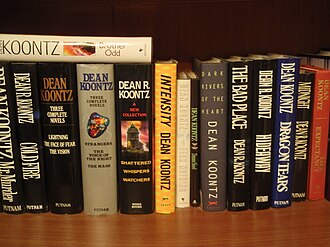
Dean Koontz
Novelist of more than 100 books, over 500 million copies sold
Where to hear and read about Dean Koontz2 episodes and tests

 How I WriteThis Is What Mystical Writing Feels Like (Dean Koontz Interview)
 How I WriteStorytelling Mastery in 107 Minutes (Dean Koontz Interview)
Dean Koontz is a novelist with more than 100 books and over 500 million copies sold, who builds each book page by page from character and a bare opening scene. The lesson most worth taking is to give up control: let characters surprise you, polish every page until it flows, and ignore the market's common wisdom.
There is an encyclopedia of common wisdom in publishing. All of it is common and none of it is wise.
Storytelling Mastery in 107 Minutes (Dean Koontz Interview)
Dean Koontz: the story and the lessons
1Dean Koontz's story: a hard childhood and a choice to write
Koontz grew up with a father he says was a sociopath. His father held 44 jobs in 34 years, often punching the boss, and chased fortunes through gambling and failed inventions. He was diagnosed first as borderline schizophrenic, then as sociopathic, and lived to 83.
A second psych-ward stay followed an attack on Koontz with a knife in front of witnesses. Koontz says he knows how to write a sociopath because he grew up with one.
Constant humiliation made him an inward, watchful child. At about 40 he saw that the deepest wound was not poverty or violence but that everyone in a small town knew his father as the drunk, gambler and womanizer. He grew up watching more than taking part.
His aunts told him he was just like his father, which he knew was false. He has said the childhood had no value except that it taught him to write a sociopath.
He decided his own life would not be dysfunctional. Koontz made a conscious decision not to repeat his father's life. A friend's family, with a banker father, showed him what a normal home looked like.
After he finally spoke publicly, thousands of letters came from readers with similar childhoods asking how he got over it. His answer: "you have to get past it or the bastard won."
His wife's Catholic family showed him what a working family looks like. On dates he visited her aunts and uncles in Johnstown, where everyone welcomed him and put food in front of him. His own family was a mess on both sides: two of his father's brothers died by suicide, one of them his father's twin.
He credits faith, together with the Italian background, for those happy families. He says there is reason to believe his father was not his biological father.
He left science fiction because talent carries a responsibility. He started in science fiction but saw he would never reach the top of the field. His comic novel Hanging On got good reviews and sold poorly, and he moved to suspense, reading Donald Westlake, Elmore Leonard and John D. MacDonald.
He could paint and sell work in college but chose writing. He sees talent as an unearned gift that must be used fully.
2How Koontz fought his publishers and won
Koontz treats publishing's rules as habit, not truth. His publisher told him he would only ever be a paperback bestseller, and every objection came as "you can't do that," answered by "nobody does that." Mixing humor into suspense was a fight that lasted decades.
He says the hardest skill for a young writer is telling what they merely believe from what they are right about. He did not think the publishers were stupid, only successful and set in their ways.
He forced the issue on Lightning and it paid off. His publisher wanted to shelve Lightning for seven years because it mixed humor with suspense and had a child hero. After six months he said it had to be the next book or he would publish it elsewhere.
It reached number three on the list and went through 20 hardcover printings. The next book became his first number one hardcover.
He kept writing Odd Thomas despite a publisher who hated it. His publisher hated the fry-cook hero so much that he refused to discuss the book. It went on to become eight novels.
Skeptics had said no one would identify with a fry cook as an action hero.
Koontz mixed genres and heard the same complaint for years. Publishers complained all his career that he never wrote the same book twice. He thinks he was the first to combine genres.
They would hate a book, the public would like it, and then they would ask for another just like it.
He tells young writers not to scope the market. Schemes like merging Jaws with an alien invasion never work, and chasing trends ends with you not liking what you do. After decades he still has no idea what will sell.
A book he thinks is his best sold about 20 percent less, while ones he doubted drew strong reader mail.
3Why Koontz stopped outlining and writes into the unknown
Outlines sold his books but capped their quality. Publishers bought on the outline and paid half the advance up front. But his imagination grew as each book went on, so the finished novel no longer matched what they bought.
They objected that it was not exactly what they had bought, though he thought it better. He says he went from an okay seller to a best seller after he quit outlining.
He starts with only an opening sequence. Part of his mind keeps asking where the story goes, and ideas arrive as he writes. Sometimes he is 30,000 words in, has no idea where to go, and throws the pages away.
He was about to start a 300,000-word novel when outlining became unthinkable. Some later turns trace back to something buried from his own life.
He tells his characters nothing and watches what they do. He gives characters free will and treats it like talking to his subconscious. When a funny line implied an action he had not planned, he learned to trust the character.
It always made a better novel. A couple of writer friends who tried it changed their process and loved it.
He knows a scene works when it makes him laugh or cry. People walking past his office hear him laughing aloud or see him in tears. If he feels nothing, he backs up to find where the draft went wrong.
His low tolerance for boredom keeps him entertaining himself at the page.
He treats self-doubt as a tool and picks projects he fears. He says all writer's block is self-doubt, and that it makes him judge his own words instead of seeing each as golden. He often chooses books everyone predicts he will botch.
The novel with the 75 IQ narrator felt like leaping out of a plane without a parachute.
4Koontz's routine: ten-hour days and page-by-page polish
Koontz writes about ten hours a day, seven days a week. He is up around 4:35 to 5:00, at work by 6:00, skips lunch and stops about 4:00. He calls it a controlled dissociation from the real world that helps the work.
He says the routine is unchanged from earlier in his career.
He perfects each page before starting the next. He makes page one as good as he can, language and imagery included, then page two. He says it comes to 20 to 30 drafts per page, so he rarely goes back.
He compares the book to a coral reef built layer by layer, and has worked this way since Strangers, his first hardcover bestseller. In another telling he says he polishes each page at least three times after finishing a chapter.
He prints every finished chapter and reads it on paper. A printout shows what the screen hides, so he reads each chapter a couple of times. After that he rarely returns to it.
Going slowly gives him several ways out of a plot knot. When a character is heading toward a narrative problem, he has time to think and arrives with two, three or four solutions instead of the quickest one.
Other writers ask how he keeps momentum at that pace. He says it builds in his head.
His wife is his first reader. She reads the draft at the same time as his agents and they talk it through afterward. She read the 400-page draft of The Friend of the Family from Friday evening into Saturday afternoon and used two boxes of Kleenex.
Koontz reads widely and returns to a few books. He and his wife went ten years without a TV and each read about 200 novels a year. He has read several thousand.
For inspiration he goes back to one or two books by writers he admires.
5How Koontz builds characters
He calls character number one in fiction. John D. MacDonald showed him a character can carry a whole novel. After college Koontz read 34 of his books in 38 days.
MacDonald would stop a 60,000 to 80,000 word story for three to five pages on one person. Koontz first wanted the plot back, then wanted more of the character.
His heroes are ordinary, wounded people. His leads are bartenders, fry cooks and people with a 70 IQ and a strange wisdom. Jane Hawk, a rogue FBI agent, is the exception.
He says suffering that does not destroy a person builds compassion. Odd Thomas is liable to use a mop instead of a gun.
He gives characters subtle flaws, not labels. Calling a character a drunk just makes him a drunk. Odd Thomas's humility makes him naive, and that naivete keeps getting him into trouble.
Critics said his leads were too good. He answers that their problems are on a human scale, not the scale of drama.
He never laughs at a character, only with him. For a narrator with an IQ of about 75, he built a syntax readers could follow with no effort and eventually find more enchanting than regular English.
The narrator becomes the wisest person in the novel. Koontz says the humor works only if it stays on the character's side.
He gives backstory quickly but with more depth than one fact. A line like his mother died when he was six is, in his words, not wonderful characterization. He looks for short ways to make a past bring the character alive.
He makes readers care before asking them to feel. Tears come when readers see their own world in the character's and think it could happen to them. In The Friend of the Family he made the narrator someone you fall in love with first, so her view of others can be trusted.
Men have written to him that it was the first time they cried reading a book.
He separates sentiment from sentimentality. Real sentiment comes from the character's condition. Piling a second tragedy on a dying character or straining the language to force tears is sentimentality.
He also warns against stripping all feeling out. He admires Joan Didion's cold clarity but does not want to reread her, since she says only that she was devastated.
He builds dialogue from rhythm, not phonetic accents. For a backwoods crime boss in a Jane Hawk novel, he used sentence structure and word choice and did not fake the accent. Two characters on a page should be distinguishable by how they sound.
He says that sequence drew a huge amount of reader mail.
He researches what he does not know. He rejects reading write what you know as personal experience only. For a recent novel he learned about gemstone mining and wrote it convincingly.
For period books he watches good films of the era and researches real figures such as Groucho Marx and his spouse.
6How Koontz plots twists and suspense
His best twists surprise him first. Intensity began with a waitress named China Shepherd hiding from a serial killer in a motorhome. Koontz expected an escape story, then the heroine overheard the killer boast about a girl in his basement and chose to go back.
His first reaction was that no one would do that. He tested it against her rotten childhood and self-respect, and it held. It comes only 15 to 20 percent into the book and makes it unstoppable.
He lets circumstances close off every other choice. He first expected her to go to the police. But the killer had no license plates and would shoot a cop, and with no cell phones finding a phone could take minutes while he vanished.
He did not know the killer would murder the store clerks until he wrote the scene.
A twist must pass the I should have seen that test. He dislikes tricks thrown in from nowhere just to make a neat turn. The reader should look back and say I should have seen that coming.
He writes suspense, not horror, and keeps the word off his books. Suspense belongs in any realistic story because nobody knows what happens an hour from now. Readers want a likable character to win after real hardship.
He cannot watch bloody movies. Books where the bad guy simply dies at the end often do not succeed.
He put suspense in character, not tricks, and long books still move. He does not ask how to juice up suspense. He puts a character in a bad spot and it keeps getting worse, as with each escape in Intensity.
Some of his novels run 300,000 words with several story lines, and readers still say they move quickly.
His aim moved from thrills to moving readers. Early on he wrote edge-of-the-seat suspense. Later he wanted readers moved to tears, laughter or anger.
In Jaws, he says, the situation carries the book and better characters would have made it even bigger.
7Koontz's rules for prose and viewpoint
He stays inside one character's head for each scene. Hopping between heads turns the novel into the author talking and breaks the illusion of reality. One viewpoint forces intimacy.
He says younger writers react like a light going off, and it would be the first thing he taught in a class.
Metaphors must belong to the narrator and fit the mood. A tense scene needs a metaphor with tension in it. A metaphor that dazzles but pops the reader out of the story has failed.
His example is clouds unraveling from the moon like a mummy's wrappings.
He rejects flat minimalist prose and polishes for flow. He blames Hemingway imitators for stripping out the strangeness under the simplicity. He uses metaphor and simile with care so the language carries the reader.
His heavy use of figures first drew negative reactions, and reader mail now praises it most. Figures should flow into the music of the language, not show off.
He learns from poets and masters of language. He reads poetry for pleasure, has read Eliot's Four Quartets hundreds of times, and learned from haiku to write about death or love without using the word. Bradbury taught him to be less afraid of colorful language.
Dickens taught him not to fear emotion. Koontz says A Tale of Two Cities moved him to tears at 3 a.m.
8Mystery, faith and wonder in Koontz's work
An unexplained room in his house echoed his manuscript. He walked a realtor friend into a 20 by 16 ft room that was not on the plans, and behind the drywall was a solid 2-ft concrete wall. He had just finished The Desperate Lover, where rooms are not where they should be.
A stone craftsman who had known him 40 years said he would think anyone else was nuts. Koontz cannot say what it means.
He stays open to a world beyond comprehension. He reads quantum mechanics and cell biology and finds the world stranger than assumed. A cell has thousands of parts, and he sees that intricacy as a source of wonder.
Giving up the belief that the world is explained also opens deeper ways into character and psychology. He notes how much science has overturned.
He says a writer who sees no meaning has one book. Koontz calls metaphysics the ink in his pen. If life is meaningless, you can only retell that story once.
Openness to mystery makes each character's life a journey toward meaning, without making the work preachy.
He looks for wonder daily and shares it with his wife. Each evening he tells his wife Gerda something he saw that day and asks if she could believe it. The one requirement is opening yourself to see how astonishing it all is.
He says it does not matter whether you hold a religious faith.
He builds a calm life to protect the work. His house mixes classical Japanese art with art deco, and he is calmer near it. He is his own harshest critic, and peace comes as he starts to achieve what he wants.
He saw his friend Vaughn Bodé chase extremes and die within a year of their estrangement, and chose a grounded life.
He does not use AI and has no desire to. Beyond fact-checking, AI-made text cannot be copyrighted, and it builds pastiche from scanned books that could bring lawsuits.
He also argues it lacks touch, taste and smell, which the best writing needs to know the world in all its sensuality.
This Is What Mystical Writing Feels Like (Dean Koontz Interview)
Koontz explains how he writes without an outline, trusting his subconscious and letting characters act freely, while polishing every page and every sentence of language. The ten-hour days, the character-first thinking and the habit of staying open to mystery explain how he has kept the work fresh for decades.
He decided his own life would not be dysfunctional. Koontz made a conscious decision not to repeat his father's life. A friend's family, with a banker father, showed him what a normal home looked like.
After he finally spoke publicly, thousands of letters came from readers with similar childhoods asking how he got over it. His answer: "you have to get past it or the bastard won."
His wife's Catholic family showed him what a working family looks like. On dates he visited her aunts and uncles in Johnstown, where everyone welcomed him and put food in front of him. His own family was a mess on both sides: two of his father's brothers died by suicide, one of them his father's twin.
He credits faith, together with the Italian background, for those happy families. He says there is reason to believe his father was not his biological father.
Koontz mixed genres and heard the same complaint for years. Publishers complained all his career that he never wrote the same book twice. He thinks he was the first to combine genres.
They would hate a book, the public would like it, and then they would ask for another just like it.
He tells young writers not to scope the market. Schemes like merging Jaws with an alien invasion never work, and chasing trends ends with you not liking what you do. After decades he still has no idea what will sell.
A book he thinks is his best sold about 20 percent less, while ones he doubted drew strong reader mail.
Outlines sold his books but capped their quality. Publishers bought on the outline and paid half the advance up front. But his imagination grew as each book went on, so the finished novel no longer matched what they bought.
They objected that it was not exactly what they had bought, though he thought it better. He says he went from an okay seller to a best seller after he quit outlining.
He starts with only an opening sequence. Part of his mind keeps asking where the story goes, and ideas arrive as he writes. Sometimes he is 30,000 words in, has no idea where to go, and throws the pages away.
He was about to start a 300,000-word novel when outlining became unthinkable. Some later turns trace back to something buried from his own life.
He tells his characters nothing and watches what they do. He gives characters free will and treats it like talking to his subconscious. When a funny line implied an action he had not planned, he learned to trust the character.
It always made a better novel. A couple of writer friends who tried it changed their process and loved it.
He knows a scene works when it makes him laugh or cry. People walking past his office hear him laughing aloud or see him in tears. If he feels nothing, he backs up to find where the draft went wrong.
His low tolerance for boredom keeps him entertaining himself at the page.
Koontz writes about ten hours a day, seven days a week. He is up around 4:35 to 5:00, at work by 6:00, skips lunch and stops about 4:00. He calls it a controlled dissociation from the real world that helps the work.
He says the routine is unchanged from earlier in his career.
He perfects each page before starting the next. He makes page one as good as he can, language and imagery included, then page two. He says it comes to 20 to 30 drafts per page, so he rarely goes back.
He compares the book to a coral reef built layer by layer, and has worked this way since Strangers, his first hardcover bestseller. In another telling he says he polishes each page at least three times after finishing a chapter.
He calls character number one in fiction. John D. MacDonald showed him a character can carry a whole novel. After college Koontz read 34 of his books in 38 days.
MacDonald would stop a 60,000 to 80,000 word story for three to five pages on one person. Koontz first wanted the plot back, then wanted more of the character.
He gives backstory quickly but with more depth than one fact. A line like his mother died when he was six is, in his words, not wonderful characterization. He looks for short ways to make a past bring the character alive.
He makes readers care before asking them to feel. Tears come when readers see their own world in the character's and think it could happen to them. In The Friend of the Family he made the narrator someone you fall in love with first, so her view of others can be trusted.
Men have written to him that it was the first time they cried reading a book.
He builds dialogue from rhythm, not phonetic accents. For a backwoods crime boss in a Jane Hawk novel, he used sentence structure and word choice and did not fake the accent. Two characters on a page should be distinguishable by how they sound.
He says that sequence drew a huge amount of reader mail.
He researches what he does not know. He rejects reading write what you know as personal experience only. For a recent novel he learned about gemstone mining and wrote it convincingly.
For period books he watches good films of the era and researches real figures such as Groucho Marx and his spouse.
His best twists surprise him first. Intensity began with a waitress named China Shepherd hiding from a serial killer in a motorhome. Koontz expected an escape story, then the heroine overheard the killer boast about a girl in his basement and chose to go back.
His first reaction was that no one would do that. He tested it against her rotten childhood and self-respect, and it held. It comes only 15 to 20 percent into the book and makes it unstoppable.
He lets circumstances close off every other choice. He first expected her to go to the police. But the killer had no license plates and would shoot a cop, and with no cell phones finding a phone could take minutes while he vanished.
He did not know the killer would murder the store clerks until he wrote the scene.
He writes suspense, not horror, and keeps the word off his books. Suspense belongs in any realistic story because nobody knows what happens an hour from now. Readers want a likable character to win after real hardship.
He cannot watch bloody movies. Books where the bad guy simply dies at the end often do not succeed.
His aim moved from thrills to moving readers. Early on he wrote edge-of-the-seat suspense. Later he wanted readers moved to tears, laughter or anger.
In Jaws, he says, the situation carries the book and better characters would have made it even bigger.
He rejects flat minimalist prose and polishes for flow. He blames Hemingway imitators for stripping out the strangeness under the simplicity. He uses metaphor and simile with care so the language carries the reader.
His heavy use of figures first drew negative reactions, and reader mail now praises it most. Figures should flow into the music of the language, not show off.
He learns from poets and masters of language. He reads poetry for pleasure, has read Eliot's Four Quartets hundreds of times, and learned from haiku to write about death or love without using the word. Bradbury taught him to be less afraid of colorful language.
Dickens taught him not to fear emotion. Koontz says A Tale of Two Cities moved him to tears at 3 a.m.
An unexplained room in his house echoed his manuscript. He walked a realtor friend into a 20 by 16 ft room that was not on the plans, and behind the drywall was a solid 2-ft concrete wall. He had just finished The Desperate Lover, where rooms are not where they should be.
A stone craftsman who had known him 40 years said he would think anyone else was nuts. Koontz cannot say what it means.
He stays open to a world beyond comprehension. He reads quantum mechanics and cell biology and finds the world stranger than assumed. A cell has thousands of parts, and he sees that intricacy as a source of wonder.
Giving up the belief that the world is explained also opens deeper ways into character and psychology. He notes how much science has overturned.
He looks for wonder daily and shares it with his wife. Each evening he tells his wife Gerda something he saw that day and asks if she could believe it. The one requirement is opening yourself to see how astonishing it all is.
He says it does not matter whether you hold a religious faith.
He builds a calm life to protect the work. His house mixes classical Japanese art with art deco, and he is calmer near it. He is his own harshest critic, and peace comes as he starts to achieve what he wants.
He saw his friend Vaughn Bodé chase extremes and die within a year of their estrangement, and chose a grounded life.
He does not use AI and has no desire to. Beyond fact-checking, AI-made text cannot be copyrighted, and it builds pastiche from scanned books that could bring lawsuits.
He also argues it lacks touch, taste and smell, which the best writing needs to know the world in all its sensuality.
Storytelling Mastery in 107 Minutes (Dean Koontz Interview)
Koontz explains why he dropped outlining and builds each novel page by page, letting characters surprise him while he polishes the language until it flows. The technique worth hearing is his habit of rewriting a single page 10 to 20 times before moving on, plus hard rules like one viewpoint per scene and metaphors that belong to the narrator.
Koontz grew up with a father he says was a sociopath. His father held 44 jobs in 34 years, often punching the boss, and chased fortunes through gambling and failed inventions. He was diagnosed first as borderline schizophrenic, then as sociopathic, and lived to 83.
A second psych-ward stay followed an attack on Koontz with a knife in front of witnesses. Koontz says he knows how to write a sociopath because he grew up with one.
Constant humiliation made him an inward, watchful child. At about 40 he saw that the deepest wound was not poverty or violence but that everyone in a small town knew his father as the drunk, gambler and womanizer. He grew up watching more than taking part.
His aunts told him he was just like his father, which he knew was false. He has said the childhood had no value except that it taught him to write a sociopath.
He decided his own life would not be dysfunctional. Koontz made a conscious decision not to repeat his father's life. A friend's family, with a banker father, showed him what a normal home looked like.
After he finally spoke publicly, thousands of letters came from readers with similar childhoods asking how he got over it. His answer: "you have to get past it or the bastard won."
He left science fiction because talent carries a responsibility. He started in science fiction but saw he would never reach the top of the field. His comic novel Hanging On got good reviews and sold poorly, and he moved to suspense, reading Donald Westlake, Elmore Leonard and John D. MacDonald.
He could paint and sell work in college but chose writing. He sees talent as an unearned gift that must be used fully.
Koontz treats publishing's rules as habit, not truth. His publisher told him he would only ever be a paperback bestseller, and every objection came as "you can't do that," answered by "nobody does that." Mixing humor into suspense was a fight that lasted decades.
He says the hardest skill for a young writer is telling what they merely believe from what they are right about. He did not think the publishers were stupid, only successful and set in their ways.
He forced the issue on Lightning and it paid off. His publisher wanted to shelve Lightning for seven years because it mixed humor with suspense and had a child hero. After six months he said it had to be the next book or he would publish it elsewhere.
It reached number three on the list and went through 20 hardcover printings. The next book became his first number one hardcover.
He kept writing Odd Thomas despite a publisher who hated it. His publisher hated the fry-cook hero so much that he refused to discuss the book. It went on to become eight novels.
Skeptics had said no one would identify with a fry cook as an action hero.
Outlines sold his books but capped their quality. Publishers bought on the outline and paid half the advance up front. But his imagination grew as each book went on, so the finished novel no longer matched what they bought.
They objected that it was not exactly what they had bought, though he thought it better. He says he went from an okay seller to a best seller after he quit outlining.
He tells his characters nothing and watches what they do. He gives characters free will and treats it like talking to his subconscious. When a funny line implied an action he had not planned, he learned to trust the character.
It always made a better novel. A couple of writer friends who tried it changed their process and loved it.
He knows a scene works when it makes him laugh or cry. People walking past his office hear him laughing aloud or see him in tears. If he feels nothing, he backs up to find where the draft went wrong.
His low tolerance for boredom keeps him entertaining himself at the page.
He treats self-doubt as a tool and picks projects he fears. He says all writer's block is self-doubt, and that it makes him judge his own words instead of seeing each as golden. He often chooses books everyone predicts he will botch.
The novel with the 75 IQ narrator felt like leaping out of a plane without a parachute.
He perfects each page before starting the next. He makes page one as good as he can, language and imagery included, then page two. He says it comes to 20 to 30 drafts per page, so he rarely goes back.
He compares the book to a coral reef built layer by layer, and has worked this way since Strangers, his first hardcover bestseller. In another telling he says he polishes each page at least three times after finishing a chapter.
He prints every finished chapter and reads it on paper. A printout shows what the screen hides, so he reads each chapter a couple of times. After that he rarely returns to it.
Going slowly gives him several ways out of a plot knot. When a character is heading toward a narrative problem, he has time to think and arrives with two, three or four solutions instead of the quickest one.
Other writers ask how he keeps momentum at that pace. He says it builds in his head.
His wife is his first reader. She reads the draft at the same time as his agents and they talk it through afterward. She read the 400-page draft of The Friend of the Family from Friday evening into Saturday afternoon and used two boxes of Kleenex.
Koontz reads widely and returns to a few books. He and his wife went ten years without a TV and each read about 200 novels a year. He has read several thousand.
For inspiration he goes back to one or two books by writers he admires.
He calls character number one in fiction. John D. MacDonald showed him a character can carry a whole novel. After college Koontz read 34 of his books in 38 days.
MacDonald would stop a 60,000 to 80,000 word story for three to five pages on one person. Koontz first wanted the plot back, then wanted more of the character.
His heroes are ordinary, wounded people. His leads are bartenders, fry cooks and people with a 70 IQ and a strange wisdom. Jane Hawk, a rogue FBI agent, is the exception.
He says suffering that does not destroy a person builds compassion. Odd Thomas is liable to use a mop instead of a gun.
He gives characters subtle flaws, not labels. Calling a character a drunk just makes him a drunk. Odd Thomas's humility makes him naive, and that naivete keeps getting him into trouble.
Critics said his leads were too good. He answers that their problems are on a human scale, not the scale of drama.
He never laughs at a character, only with him. For a narrator with an IQ of about 75, he built a syntax readers could follow with no effort and eventually find more enchanting than regular English.
The narrator becomes the wisest person in the novel. Koontz says the humor works only if it stays on the character's side.
He separates sentiment from sentimentality. Real sentiment comes from the character's condition. Piling a second tragedy on a dying character or straining the language to force tears is sentimentality.
He also warns against stripping all feeling out. He admires Joan Didion's cold clarity but does not want to reread her, since she says only that she was devastated.
He researches what he does not know. He rejects reading write what you know as personal experience only. For a recent novel he learned about gemstone mining and wrote it convincingly.
For period books he watches good films of the era and researches real figures such as Groucho Marx and his spouse.
His best twists surprise him first. Intensity began with a waitress named China Shepherd hiding from a serial killer in a motorhome. Koontz expected an escape story, then the heroine overheard the killer boast about a girl in his basement and chose to go back.
His first reaction was that no one would do that. He tested it against her rotten childhood and self-respect, and it held. It comes only 15 to 20 percent into the book and makes it unstoppable.
He lets circumstances close off every other choice. He first expected her to go to the police. But the killer had no license plates and would shoot a cop, and with no cell phones finding a phone could take minutes while he vanished.
He did not know the killer would murder the store clerks until he wrote the scene.
A twist must pass the I should have seen that test. He dislikes tricks thrown in from nowhere just to make a neat turn. The reader should look back and say I should have seen that coming.
He writes suspense, not horror, and keeps the word off his books. Suspense belongs in any realistic story because nobody knows what happens an hour from now. Readers want a likable character to win after real hardship.
He cannot watch bloody movies. Books where the bad guy simply dies at the end often do not succeed.
He put suspense in character, not tricks, and long books still move. He does not ask how to juice up suspense. He puts a character in a bad spot and it keeps getting worse, as with each escape in Intensity.
Some of his novels run 300,000 words with several story lines, and readers still say they move quickly.
He stays inside one character's head for each scene. Hopping between heads turns the novel into the author talking and breaks the illusion of reality. One viewpoint forces intimacy.
He says younger writers react like a light going off, and it would be the first thing he taught in a class.
Metaphors must belong to the narrator and fit the mood. A tense scene needs a metaphor with tension in it. A metaphor that dazzles but pops the reader out of the story has failed.
His example is clouds unraveling from the moon like a mummy's wrappings.
He rejects flat minimalist prose and polishes for flow. He blames Hemingway imitators for stripping out the strangeness under the simplicity. He uses metaphor and simile with care so the language carries the reader.
His heavy use of figures first drew negative reactions, and reader mail now praises it most. Figures should flow into the music of the language, not show off.
He learns from poets and masters of language. He reads poetry for pleasure, has read Eliot's Four Quartets hundreds of times, and learned from haiku to write about death or love without using the word. Bradbury taught him to be less afraid of colorful language.
Dickens taught him not to fear emotion. Koontz says A Tale of Two Cities moved him to tears at 3 a.m.
He stays open to a world beyond comprehension. He reads quantum mechanics and cell biology and finds the world stranger than assumed. A cell has thousands of parts, and he sees that intricacy as a source of wonder.
Giving up the belief that the world is explained also opens deeper ways into character and psychology. He notes how much science has overturned.
He says a writer who sees no meaning has one book. Koontz calls metaphysics the ink in his pen. If life is meaningless, you can only retell that story once.
Openness to mystery makes each character's life a journey toward meaning, without making the work preachy.
He builds a calm life to protect the work. His house mixes classical Japanese art with art deco, and he is calmer near it. He is his own harshest critic, and peace comes as he starts to achieve what he wants.
He saw his friend Vaughn Bodé chase extremes and die within a year of their estrangement, and chose a grounded life.