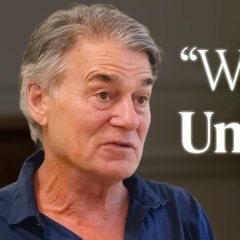
David Whyte
Poet and author
Where to hear and read about David Whyte1 episode or test

David Whyte is a poet and author of Consolations who writes and speaks from long, bodily attention to the edge between what he thinks is himself and what is not. The most useful thing to learn from him is a set of working habits: compose aloud while walking, let the body point to what you haven't yet said, build each piece around a beautiful question, and do one deliberate thing each day toward the work you want.
the act of overhearing yourself say things you didn't know you knew
Inside the Mind of a Master Writer (David Whyte Interview)
David Whyte: the story and the lessons
1David Whyte's path from Ireland to the stage
Whyte learned poetry by ear from his mother's recitations. His mother sat at the foot of his bed and recited poems and stories in English and Irish. He took poetry as a secret code to life and memorized it one line at a time.
He says that in Ireland, shake someone and two or three poems come out.
Years as a Galapagos naturalist guide taught him to distrust names. He stood a few feet from a hawk that did not fly away. Knowing its Latin name had only covered over what he was looking at.
In the same islands, individual fur seals had personalities as different as ours, then turned up dead on the beach.
He borrowed American voices to escape Ireland's literary inheritance. On arriving in the American West he wrote in the style of Robert Sund and Gary Snyder, and the Beat poets and the West Coast freed him. He sees nothing wrong with taking on a voice when young, because your own version soon emerges.
He compares Irish literature to a jungle you must machete through. One Sund line, about opening the barn doors and seeing the hides of white horses shedding rain, opened a new spaciousness in his own writing.
A Hebridean fisherman's reverence left him asking what he would revere. A fisherman near Whyte's marine biology station pressed his hat to his chest and prayed to the boat and the water before touching his gear. Whyte's poem The True Love grew from that scene and from his Sunday school childhood.
He says love often saves your life from your previous life.
He became a full-time poet through one deliberate act a day. Before the internet, he vowed to do one thing every day for a year toward going full-time: a letter, memorizing Shakespeare, talking to someone about speaking somewhere. The 365 acts ended in an invitation to speak to 600 people and a standing ovation.
Before that first talk he was so drained he could not get out of bed for days. Within minutes on stage the symptoms vanished, and he knew this was his life's work.
Whyte asks what his future self would thank him for. He turns the habit of revisiting meaningful places into a practice: thank the self who made the call or went out the door, then ask what you could do today that your future self would thank you for.
He says he has used this to shape his existence, his personality and his future self.
2How Whyte writes from attention and the body
Whyte writes from the edge between what is him and what is not. He holds that good writing comes from the edge where what you think is you meets what is not you. Attention deep enough makes the world speak back, and the writer grows larger for it.
Prose is about something, he says, while good poetry is the thing itself and keeps the world alive as it names it.
He keeps looking until the name he gave a thing breaks down. He cites Dogen: confirming the 10,000 things is delusion, but when they come and find you, that is enlightenment. Then the essence speaks back and the writer can bring the reader in to hear it.
His exercise is to spend 45 minutes with the image of someone you resent until their essence speaks back, the story behind their behavior emerges, and forgiveness follows.
Whyte composes aloud while walking and records the lines on his phone. He mutters or declaims lines on walks, then speaks them into his phone so he doesn't have to memorize them. Speech keeps the movement of the experience alive in the language.
He points to Wordsworth, who composed without paper and trained a little dog to run 50 yards ahead to warn him of locals. In Whyte's words: "I sometimes compose while I'm walking".
He puts a hand on the spot where fear tightens. Whyte treats the knot of fear as the unexplored self, a frontier between not knowing and getting to know what you don't want to know. He lays a hand over it the way you would on a speaker to feel the woofer.
Hurt children move their voices above the shoulders, and bringing the voice back down hurts, which is where revelation is. Heaney called it the coal face. Whyte: "it's that physical contact there that has a voice to speak to you."
He drops below the line of discomfort and stays until it nourishes. He describes an inner horizon felt as resistance, below which lies what you already know but won't face. Zen and writing both teach dropping beneath it and working with it until it stops feeling like resistance.
His advice: stop trying to catch up with yourself and be in step with the seasonality of your existence.
He lets lines stand before he understands them. He did not know what 'There you can be sure you are not beyond love' meant when he wrote it in Sweet Darkness. The line that anger is the deepest form of care also surprised him, arriving from a physical sense of what lies below anger.
He compares it to a safari guide who stopped his group before a clearing without knowing why. A male lion was 20 yards away, and the guide's deeper mind had combined smell, flattened grass and faint tracks into one signal.
He starts from darkness rather than from the fire. Night keeps him from naming things too fast, so it gives a different horizon to write from. He takes from Rilke the idea of seeing your life from the darkness, because a fire makes a circle of light and no one comes to find you.
His poem Sweet Darkness says anything or anyone that does not bring you alive is too small for you.
3Whyte's writing routine and how his books got made
Whyte's writing time grows as a book tightens around its theme. A book starts at half an hour a day, or opportunistically, and ends at 8 to 12 hours a day. He compares it to a spiral going closer and closer until the whole thing breaks open.
During lockdown on Whidbey Island he wrote most of Still Possible in one study looking onto a garden.
He wrote Consolations 2 everywhere, in fragments on his phone. He wrote in the gym, on planes, on the London Underground and on a bus with a laptop on his knee. When an idea came he put a few lines on his phone, so the final burst drew on material gathered all along.
One quote: "even in the gym, I'd go over to my phone, I'd get an idea, put a few lines down".
He finished Consolations 2 with seven essays in seven days in a castle. In a castle in central Italy he wrote at 8 to 10 hours a day. He wrote 68 essays in 7 months, and the book holds 52.
He calls it a season that may never return, 'a kind of fire'. He had near-daily out-of-body experiences there, and the 700 to 900 year old walls seemed to look back at him.
He found his time essay by questioning a stock phrase. Almost every phrase about time casts it as an enemy: we don't have the time, we need to make time. He asked what would surprise time, since nothing could live without its rhythms, and flipped the image.
The result was the line "time is not slipping through our fingers." The essay was written in the castle.
4What Whyte knows about questions, language and love
Whyte builds each piece around a beautiful question and answers it. He calls the beautiful question the axis of invitation, going out to the writer and then the reader. It should be hard to answer and ask the reader to bring all their faculties.
His example is the Zen koan 'A bird calls announcing the difference between heaven and hell': heaven is if you heard the bird, hell is if you didn't. He warns that "there's nothing more disappointing when a book doesn't live up to the questions that it started you off on."
He keeps a whole book of beautiful questions and keeps adding. The poem Coleman's Bed grew from the question of why we return to places where an ancestor lived. It took him a dozen years of visits to write, and a reader counted 26 questions in it.
His answer is a pilgrimage back to a threshold moment, to thank the self who picked up the phone or went out the door.
He restores the truth in clichés instead of avoiding them. Clichés last because they are stubbornly true. Telling a heartbroken 16-year-old daughter there's plenty more fish in the sea does no good, but witnessing the broken heart produces language that is not a cliché.
Cliché looks from the outside in, while living language speaks from the inside out. He notes that conversation comes from the Latin for inside out.
He breaks the language that keeps feelings at a distance. He says we use words against ourselves, as in 'enough to make a grown man weep', and in his Substack essay on weeping he argues the opposite: weeping is close to enlightenment because control has been given up.
His line: "We will name things in ways that keep them at a distance." When he recites poems for executives at the Rhodes building, it lands like a bow wave before the room settles.
He memorizes poems as allies for hard boundaries. Earlier this year he recited Mary Oliver's The Journey to break through a difficult boundary in his life. Its lines take you physically into the part of you that must walk through fire.
He says growing up can be a form of amnesia and that poems hold the primary vision. Reciting one at dinner crosses a threshold out of cliché-laden everyday language.
He writes so the reader is invited past the last line. A horizon is beautiful because of the world beyond it that you cannot see, so good writing invites us past its own line of beauty.
He cites Virginia Woolf, who moves between minds in Mrs. Dalloway so the reader never settles in one.
Whyte says every poem is about love, and love breaks your heart. Serious young poets are disappointed to learn it is all about love. No protective path keeps your heart intact, so he says to break it over something you care about.
Real love gives people their own lives. A father's cradle promise of absolute protection would strangle a 14-year-old's possibilities, so the promises must be given away.
He keeps conversing with the dead, notably John O'Donohue. Whyte and O'Donohue had fierce exchanges and probably stole lines from each other. After O'Donohue died, Whyte began sentences in John's voice and ended them in his own.
He says such conversations are live, not repeated, and an old teacher who saw something in you can be a companion for life.

Inside the Mind of a Master Writer (David Whyte Interview)
David Whyte treats writing as speaking from the edge between what you think is you and what is not, a place you reach through long attention and by dropping below your own discomfort. His practices make it concrete: composing aloud while walking, memorizing poems a line at a time, keeping a book of beautiful questions, and letting the body point to what you have not yet said.
Whyte learned poetry by ear from his mother's recitations. His mother sat at the foot of his bed and recited poems and stories in English and Irish. He took poetry as a secret code to life and memorized it one line at a time.
He says that in Ireland, shake someone and two or three poems come out.
Years as a Galapagos naturalist guide taught him to distrust names. He stood a few feet from a hawk that did not fly away. Knowing its Latin name had only covered over what he was looking at.
In the same islands, individual fur seals had personalities as different as ours, then turned up dead on the beach.
He borrowed American voices to escape Ireland's literary inheritance. On arriving in the American West he wrote in the style of Robert Sund and Gary Snyder, and the Beat poets and the West Coast freed him. He sees nothing wrong with taking on a voice when young, because your own version soon emerges.
He compares Irish literature to a jungle you must machete through. One Sund line, about opening the barn doors and seeing the hides of white horses shedding rain, opened a new spaciousness in his own writing.
A Hebridean fisherman's reverence left him asking what he would revere. A fisherman near Whyte's marine biology station pressed his hat to his chest and prayed to the boat and the water before touching his gear. Whyte's poem The True Love grew from that scene and from his Sunday school childhood.
He says love often saves your life from your previous life.
He became a full-time poet through one deliberate act a day. Before the internet, he vowed to do one thing every day for a year toward going full-time: a letter, memorizing Shakespeare, talking to someone about speaking somewhere. The 365 acts ended in an invitation to speak to 600 people and a standing ovation.
Before that first talk he was so drained he could not get out of bed for days. Within minutes on stage the symptoms vanished, and he knew this was his life's work.
Whyte asks what his future self would thank him for. He turns the habit of revisiting meaningful places into a practice: thank the self who made the call or went out the door, then ask what you could do today that your future self would thank you for.
He says he has used this to shape his existence, his personality and his future self.
Whyte writes from the edge between what is him and what is not. He holds that good writing comes from the edge where what you think is you meets what is not you. Attention deep enough makes the world speak back, and the writer grows larger for it.
Prose is about something, he says, while good poetry is the thing itself and keeps the world alive as it names it.
He keeps looking until the name he gave a thing breaks down. He cites Dogen: confirming the 10,000 things is delusion, but when they come and find you, that is enlightenment. Then the essence speaks back and the writer can bring the reader in to hear it.
His exercise is to spend 45 minutes with the image of someone you resent until their essence speaks back, the story behind their behavior emerges, and forgiveness follows.
Whyte composes aloud while walking and records the lines on his phone. He mutters or declaims lines on walks, then speaks them into his phone so he doesn't have to memorize them. Speech keeps the movement of the experience alive in the language.
He points to Wordsworth, who composed without paper and trained a little dog to run 50 yards ahead to warn him of locals. In Whyte's words: "I sometimes compose while I'm walking".
He puts a hand on the spot where fear tightens. Whyte treats the knot of fear as the unexplored self, a frontier between not knowing and getting to know what you don't want to know. He lays a hand over it the way you would on a speaker to feel the woofer.
Hurt children move their voices above the shoulders, and bringing the voice back down hurts, which is where revelation is. Heaney called it the coal face. Whyte: "it's that physical contact there that has a voice to speak to you."
He drops below the line of discomfort and stays until it nourishes. He describes an inner horizon felt as resistance, below which lies what you already know but won't face. Zen and writing both teach dropping beneath it and working with it until it stops feeling like resistance.
His advice: stop trying to catch up with yourself and be in step with the seasonality of your existence.
He lets lines stand before he understands them. He did not know what 'There you can be sure you are not beyond love' meant when he wrote it in Sweet Darkness. The line that anger is the deepest form of care also surprised him, arriving from a physical sense of what lies below anger.
He compares it to a safari guide who stopped his group before a clearing without knowing why. A male lion was 20 yards away, and the guide's deeper mind had combined smell, flattened grass and faint tracks into one signal.
He starts from darkness rather than from the fire. Night keeps him from naming things too fast, so it gives a different horizon to write from. He takes from Rilke the idea of seeing your life from the darkness, because a fire makes a circle of light and no one comes to find you.
His poem Sweet Darkness says anything or anyone that does not bring you alive is too small for you.
Whyte's writing time grows as a book tightens around its theme. A book starts at half an hour a day, or opportunistically, and ends at 8 to 12 hours a day. He compares it to a spiral going closer and closer until the whole thing breaks open.
During lockdown on Whidbey Island he wrote most of Still Possible in one study looking onto a garden.
He wrote Consolations 2 everywhere, in fragments on his phone. He wrote in the gym, on planes, on the London Underground and on a bus with a laptop on his knee. When an idea came he put a few lines on his phone, so the final burst drew on material gathered all along.
One quote: "even in the gym, I'd go over to my phone, I'd get an idea, put a few lines down".
He finished Consolations 2 with seven essays in seven days in a castle. In a castle in central Italy he wrote at 8 to 10 hours a day. He wrote 68 essays in 7 months, and the book holds 52.
He calls it a season that may never return, 'a kind of fire'. He had near-daily out-of-body experiences there, and the 700 to 900 year old walls seemed to look back at him.
He found his time essay by questioning a stock phrase. Almost every phrase about time casts it as an enemy: we don't have the time, we need to make time. He asked what would surprise time, since nothing could live without its rhythms, and flipped the image.
The result was the line "time is not slipping through our fingers." The essay was written in the castle.
Whyte builds each piece around a beautiful question and answers it. He calls the beautiful question the axis of invitation, going out to the writer and then the reader. It should be hard to answer and ask the reader to bring all their faculties.
His example is the Zen koan 'A bird calls announcing the difference between heaven and hell': heaven is if you heard the bird, hell is if you didn't. He warns that "there's nothing more disappointing when a book doesn't live up to the questions that it started you off on."
He keeps a whole book of beautiful questions and keeps adding. The poem Coleman's Bed grew from the question of why we return to places where an ancestor lived. It took him a dozen years of visits to write, and a reader counted 26 questions in it.
His answer is a pilgrimage back to a threshold moment, to thank the self who picked up the phone or went out the door.
He restores the truth in clichés instead of avoiding them. Clichés last because they are stubbornly true. Telling a heartbroken 16-year-old daughter there's plenty more fish in the sea does no good, but witnessing the broken heart produces language that is not a cliché.
Cliché looks from the outside in, while living language speaks from the inside out. He notes that conversation comes from the Latin for inside out.
He breaks the language that keeps feelings at a distance. He says we use words against ourselves, as in 'enough to make a grown man weep', and in his Substack essay on weeping he argues the opposite: weeping is close to enlightenment because control has been given up.
His line: "We will name things in ways that keep them at a distance." When he recites poems for executives at the Rhodes building, it lands like a bow wave before the room settles.
He memorizes poems as allies for hard boundaries. Earlier this year he recited Mary Oliver's The Journey to break through a difficult boundary in his life. Its lines take you physically into the part of you that must walk through fire.
He says growing up can be a form of amnesia and that poems hold the primary vision. Reciting one at dinner crosses a threshold out of cliché-laden everyday language.
He writes so the reader is invited past the last line. A horizon is beautiful because of the world beyond it that you cannot see, so good writing invites us past its own line of beauty.
He cites Virginia Woolf, who moves between minds in Mrs. Dalloway so the reader never settles in one.
Whyte says every poem is about love, and love breaks your heart. Serious young poets are disappointed to learn it is all about love. No protective path keeps your heart intact, so he says to break it over something you care about.
Real love gives people their own lives. A father's cradle promise of absolute protection would strangle a 14-year-old's possibilities, so the promises must be given away.
He keeps conversing with the dead, notably John O'Donohue. Whyte and O'Donohue had fierce exchanges and probably stole lines from each other. After O'Donohue died, Whyte began sentences in John's voice and ended them in his own.
He says such conversations are live, not repeated, and an old teacher who saw something in you can be a companion for life.