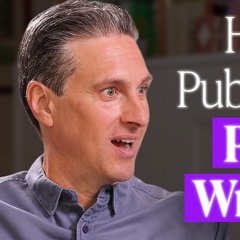
David Shelley
CEO of Hachette in the US and UK, publisher for more than 30 years
Where to hear and read about David Shelley1 episode or test

David Shelley is CEO of Hachette in the US and UK and has been a publisher for more than 30 years, starting as an editorial assistant in 1997. The most useful thing to learn from him is to decide before you write whether you want lasting art or the widest readership, then choose your work method, editor and publisher to fit that aim.
You want a soulmate.
Watch This Before Publishing Your Book (Hachette CEO Interview)
David Shelley: the story and the lessons
1David Shelley's path to running Hachette
Shelley began as an editorial assistant in 1997 and worked up to CEO. He started in 1997 going through the slush pile, when submissions came as hard copy with two sample chapters and a synopsis. He later edited authors directly and now runs Hachette in both the US and UK after about 30 years.
He has seen the business from several sides, which lets him speak to how writers should approach it and how it works inside.
He defines a publisher's job as making readers want one book. About 200,000 new books appear each year. Publishing spans getting bookstores to stock a title, press and podcast coverage, advertising, making the book as good as it can be, and shipping it.
Hachette sells about 220 million books a year and earns roughly $3.5 billion. Its Indiana warehouse has about 400 people and ships roughly 150 million books to 220 countries.
Shelley says the industry is more open to writers than in the 1990s. Digital publishing lowered the barriers to entry, so there are more startups than at any time in his career. Bookouture takes direct submissions, publishes ebook and audio first, and adds print if the book does well.
In 1997 a publisher's refusal left writers nowhere to go. Now a rejection from the big houses is not the end of a book.
2Shelley on writing for art or for readers
Shelley tells writers to decide whether they want art or wide reach. He has worked with writers whose aims run from a tiny cerebral audience to millions of readers, and he says neither is wrong. What hurts is being unclear about which one you are.
He cites Ronald Firbank, who privately printed experimental novels in the 1920s knowing there was no market, and James Patterson, who wants the widest number of people to enjoy storytelling. He calls writing for the widest audience 'very pure and artistic' too.
He advises art-first writers to keep the market out of their heads. A good agent can later tell a publisher what is artistically new and find the houses open to it. Shelley has seen too many such writers start thinking about what is commercial, and it dilutes their art.
He names Patricia Lockwood and Ocean Vuong as writers doing something really different. His advice: 'it's actively helpful to put that stuff out of your mind'.
Writers who want a wide audience should study the field like researchers. Read heavily in the genre, visit bookstores, study bestseller lists and covers, and read reader reviews. Lee Child did a lot of research before he started.
Child even chose his agent because the agent had a record of launching big commercial authors.
Shelley says take some feedback, but not all of it. The industry is noisy, and well-meaning opinions can knock an author off course. He suggests a few trusted readers and a clear sense of your own direction.
A good agent can act as a North Star and say, just let me deal with that.
He treats even a functional book as craft. His tutor, the poet Craig Raine, told him poetry and advertising copy both aim for 'the best possible words in the best possible order'. Shelley applies that to self-help and how-to books.
Hessayon's plain gardening guides sold millions because he explained gardening in a way the brain could take in, and they still sell today.
3How Shelley advises authors on editors, agents and money
Shelley says choose your editor for chemistry and passion. In a bidding war, he urges authors to meet every editor and see whether they understand what the author is trying to do. The editor, and the publicist, will be close partners for years, sometimes decades.
He has spent more time with some authors than with good friends and has been to their weddings.
A thriller author took less money for the editor who could fix the ending. The book was very good except for an ending that did not work. The author accepted an advance about $10,000 lower for the editor who said he knew exactly what to do, and the book sold a million copies.
The reworked ending became the part readers praised most. A celebrity memoir that took the biggest offer with no plan for the book sank.
He warns that the biggest advance is the right choice only for money now. A big advance that fails weakens the author's track record and the next negotiation, and the publisher may lose interest. The underbidder may have the better editor or vision.
Offers can reflect who caught the finance director on a better day, or a house keen to fill a list. Over a long career, he says, everything evens out.
Shelley says most books lose money and nobody can predict the winners. Only 35 of 100 books turn a profit, and the top 4% of profitable books generate 60% of profitability. A Department of Justice filing on the Penguin Simon & Schuster merger found over 85% of authors never earn beyond their advance.
Where the Crawdads Sing came with a small advance and became one of the best-selling books of the last 20 years. He compares publishers to angel investors and calls it a 'feast or famine' business.
He sees agents as matchmakers and negotiators, not better judges. Agents are the usual gateway to a big publisher because editors lack time to read direct submissions. Their hit rate is no better than publishers', and many authors succeed without one.
The best agents often do three or four rounds of edits before going on submission. Authors without an agent or publisher can use a freelance editor, but once a publisher has bought the book they do not need one.
Shelley tells writers to trust their gut when rejections pile up. Publishers do not know everything, and he has seen rejected books find big audiences. Callie Hart's self-published Quicksilver did enormously well, and Hachette then signed her as one of its biggest authors.
He calls self-publishing surprisingly cost-efficient and says a writer with the resources should give it a shot, citing the Hollywood line 'no one knows anything'.
He wants radical candor in disagreements and frames them around sales. Shelley welcomed authors who said plainly they hated a cover. He asks both sides to be direct and polite, and to argue about how to sell the maximum number of copies, not about taste.
He contrasts British indirectness, which he finds exhausting, with New York directness. Rudeness can damage a relationship, but a polite, straightforward point rarely does.
4How Shelley thinks about covers, bookstores and marketing
Shelley wants a cover that pops in two or three seconds. Average dwell time at a table of books is two to three seconds, so the most beautiful cover may not be the one that pops. He calls the cover a Trojan horse that gets the book into hands.
James Patterson, whom Shelley calls the biggest marketing genius he has worked with, uses the rule 'I see it, I want it'.
He says a good publisher handles marketing, so authors add a layer on top. A publisher that tells an author to hire their own marketing team is showing a warning sign. Shelley describes three layers: what only a publisher can do, such as distribution and billboards; grassroots author work; and paid publicity.
James Clear did roughly 80 podcasts in launch week. Marketing-minded authors like Clear and Patterson tried channels publishing had not, and the publisher learned from them.
He lets booksellers shape covers and promotions. James Daunt revived Waterstones and Barnes & Noble by making stores places people want to stay and having his teams read and choose the books. Publishers used to pay for space, and now can barely pitch.
Shelley will change a cover if Barnes & Noble says another would reach more people, because retailers know their customers best.
Shelley treats the physical book as part of its appeal. Hachette's manufacturing departments work with the best printers and hold high standards for paper and type, and special editions with sprayed edges are a growing way to make a book desirable. Younger readers are choosing physical books over digital ones.
He gives three reasons: books are beautiful objects, they signal that you read, and time off a device helps mental health. Alice Oseman's Heartstopper, tied to a Netflix series, sold overwhelmingly in print to a very young readership.
5What Shelley says makes genre stories work
Shelley says lasting stories rest on a coherent moral universe. Readers gravitate to writers with a strong moral anchor, even when it sits in the subtext, as in Sally Rooney. He cannot name an exception among the biggest creative IP.
He lists Narnia, Lord of the Rings, Harry Potter and Disney. His test is whether a story has a 'there' there, a point beneath the plot.
In a mystery, the villain is brought to justice. Shelley describes a mystery as a crime, a puzzle and someone working it out. He has published hundreds, and in every one the villain does not prevail.
He compares the form to a haiku, where the artistry lies in texture and nuance. Highsmith's Ripley is the one arguable exception, and he says it has its own morality.
A thriller promises the unexpected, at speed. Good does not always prevail, and readers come for twists they did not see coming. Pace is fast and televisual.
Jeff Abbott described his books as the most dramatic moment of an ordinary person's life. Shelley cites Gone Girl and Mick Herron's spy series as forms of the genre.
Horror is about dread, and has fewer rules than other genres. Shelley describes it as a visceral feeling in the pit of the stomach. Good need not prevail and characters need not be likeable, which invites subversion from queer and feminist voices.
He calls this theory of horror's comeback 'slightly unformed'. Stephen King sits outside the category as a genius of menace and unease.
Children's books need a coherent, safe universe and sell for decades. Picture books, middle grade and YA each have their own sub-types, but the child should inhabit a coherent world that is to some degree safe. A picture book can start with a 1,000-copy print run and sell 10 million over 40 years.
Readers grow up and buy the book for their own children, so back catalog counts for far more in children's than in adult books. For authors it can be feast or famine, because only some titles capture the imagination.

Watch This Before Publishing Your Book (Hachette CEO Interview)
A publishing chief explains how books get picked up, packaged and sold, and what that means for how a writer should think about the work itself. The most useful idea is to decide before you write whether you are making lasting art or reaching the widest readership, then work in the way that goal demands.
Shelley began as an editorial assistant in 1997 and worked up to CEO. He started in 1997 going through the slush pile, when submissions came as hard copy with two sample chapters and a synopsis. He later edited authors directly and now runs Hachette in both the US and UK after about 30 years.
He has seen the business from several sides, which lets him speak to how writers should approach it and how it works inside.
He defines a publisher's job as making readers want one book. About 200,000 new books appear each year. Publishing spans getting bookstores to stock a title, press and podcast coverage, advertising, making the book as good as it can be, and shipping it.
Hachette sells about 220 million books a year and earns roughly $3.5 billion. Its Indiana warehouse has about 400 people and ships roughly 150 million books to 220 countries.
Shelley says the industry is more open to writers than in the 1990s. Digital publishing lowered the barriers to entry, so there are more startups than at any time in his career. Bookouture takes direct submissions, publishes ebook and audio first, and adds print if the book does well.
In 1997 a publisher's refusal left writers nowhere to go. Now a rejection from the big houses is not the end of a book.
Shelley tells writers to decide whether they want art or wide reach. He has worked with writers whose aims run from a tiny cerebral audience to millions of readers, and he says neither is wrong. What hurts is being unclear about which one you are.
He cites Ronald Firbank, who privately printed experimental novels in the 1920s knowing there was no market, and James Patterson, who wants the widest number of people to enjoy storytelling. He calls writing for the widest audience 'very pure and artistic' too.
He advises art-first writers to keep the market out of their heads. A good agent can later tell a publisher what is artistically new and find the houses open to it. Shelley has seen too many such writers start thinking about what is commercial, and it dilutes their art.
He names Patricia Lockwood and Ocean Vuong as writers doing something really different. His advice: 'it's actively helpful to put that stuff out of your mind'.
Writers who want a wide audience should study the field like researchers. Read heavily in the genre, visit bookstores, study bestseller lists and covers, and read reader reviews. Lee Child did a lot of research before he started.
Child even chose his agent because the agent had a record of launching big commercial authors.
Shelley says take some feedback, but not all of it. The industry is noisy, and well-meaning opinions can knock an author off course. He suggests a few trusted readers and a clear sense of your own direction.
A good agent can act as a North Star and say, just let me deal with that.
He treats even a functional book as craft. His tutor, the poet Craig Raine, told him poetry and advertising copy both aim for 'the best possible words in the best possible order'. Shelley applies that to self-help and how-to books.
Hessayon's plain gardening guides sold millions because he explained gardening in a way the brain could take in, and they still sell today.
Shelley says choose your editor for chemistry and passion. In a bidding war, he urges authors to meet every editor and see whether they understand what the author is trying to do. The editor, and the publicist, will be close partners for years, sometimes decades.
He has spent more time with some authors than with good friends and has been to their weddings.
A thriller author took less money for the editor who could fix the ending. The book was very good except for an ending that did not work. The author accepted an advance about $10,000 lower for the editor who said he knew exactly what to do, and the book sold a million copies.
The reworked ending became the part readers praised most. A celebrity memoir that took the biggest offer with no plan for the book sank.
He warns that the biggest advance is the right choice only for money now. A big advance that fails weakens the author's track record and the next negotiation, and the publisher may lose interest. The underbidder may have the better editor or vision.
Offers can reflect who caught the finance director on a better day, or a house keen to fill a list. Over a long career, he says, everything evens out.
Shelley says most books lose money and nobody can predict the winners. Only 35 of 100 books turn a profit, and the top 4% of profitable books generate 60% of profitability. A Department of Justice filing on the Penguin Simon & Schuster merger found over 85% of authors never earn beyond their advance.
Where the Crawdads Sing came with a small advance and became one of the best-selling books of the last 20 years. He compares publishers to angel investors and calls it a 'feast or famine' business.
He sees agents as matchmakers and negotiators, not better judges. Agents are the usual gateway to a big publisher because editors lack time to read direct submissions. Their hit rate is no better than publishers', and many authors succeed without one.
The best agents often do three or four rounds of edits before going on submission. Authors without an agent or publisher can use a freelance editor, but once a publisher has bought the book they do not need one.
Shelley tells writers to trust their gut when rejections pile up. Publishers do not know everything, and he has seen rejected books find big audiences. Callie Hart's self-published Quicksilver did enormously well, and Hachette then signed her as one of its biggest authors.
He calls self-publishing surprisingly cost-efficient and says a writer with the resources should give it a shot, citing the Hollywood line 'no one knows anything'.
He wants radical candor in disagreements and frames them around sales. Shelley welcomed authors who said plainly they hated a cover. He asks both sides to be direct and polite, and to argue about how to sell the maximum number of copies, not about taste.
He contrasts British indirectness, which he finds exhausting, with New York directness. Rudeness can damage a relationship, but a polite, straightforward point rarely does.
Shelley wants a cover that pops in two or three seconds. Average dwell time at a table of books is two to three seconds, so the most beautiful cover may not be the one that pops. He calls the cover a Trojan horse that gets the book into hands.
James Patterson, whom Shelley calls the biggest marketing genius he has worked with, uses the rule 'I see it, I want it'.
He says a good publisher handles marketing, so authors add a layer on top. A publisher that tells an author to hire their own marketing team is showing a warning sign. Shelley describes three layers: what only a publisher can do, such as distribution and billboards; grassroots author work; and paid publicity.
James Clear did roughly 80 podcasts in launch week. Marketing-minded authors like Clear and Patterson tried channels publishing had not, and the publisher learned from them.
He lets booksellers shape covers and promotions. James Daunt revived Waterstones and Barnes & Noble by making stores places people want to stay and having his teams read and choose the books. Publishers used to pay for space, and now can barely pitch.
Shelley will change a cover if Barnes & Noble says another would reach more people, because retailers know their customers best.
Shelley treats the physical book as part of its appeal. Hachette's manufacturing departments work with the best printers and hold high standards for paper and type, and special editions with sprayed edges are a growing way to make a book desirable. Younger readers are choosing physical books over digital ones.
He gives three reasons: books are beautiful objects, they signal that you read, and time off a device helps mental health. Alice Oseman's Heartstopper, tied to a Netflix series, sold overwhelmingly in print to a very young readership.
Shelley says lasting stories rest on a coherent moral universe. Readers gravitate to writers with a strong moral anchor, even when it sits in the subtext, as in Sally Rooney. He cannot name an exception among the biggest creative IP.
He lists Narnia, Lord of the Rings, Harry Potter and Disney. His test is whether a story has a 'there' there, a point beneath the plot.
In a mystery, the villain is brought to justice. Shelley describes a mystery as a crime, a puzzle and someone working it out. He has published hundreds, and in every one the villain does not prevail.
He compares the form to a haiku, where the artistry lies in texture and nuance. Highsmith's Ripley is the one arguable exception, and he says it has its own morality.
A thriller promises the unexpected, at speed. Good does not always prevail, and readers come for twists they did not see coming. Pace is fast and televisual.
Jeff Abbott described his books as the most dramatic moment of an ordinary person's life. Shelley cites Gone Girl and Mick Herron's spy series as forms of the genre.
Horror is about dread, and has fewer rules than other genres. Shelley describes it as a visceral feeling in the pit of the stomach. Good need not prevail and characters need not be likeable, which invites subversion from queer and feminist voices.
He calls this theory of horror's comeback 'slightly unformed'. Stephen King sits outside the category as a genius of menace and unease.
Children's books need a coherent, safe universe and sell for decades. Picture books, middle grade and YA each have their own sub-types, but the child should inhabit a coherent world that is to some degree safe. A picture book can start with a 1,000-copy print run and sell 10 million over 40 years.
Readers grow up and buy the book for their own children, so back catalog counts for far more in children's than in adult books. For authors it can be feast or famine, because only some titles capture the imagination.