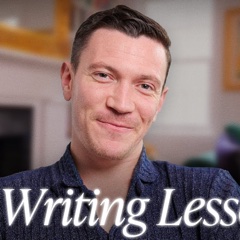
David Perell
Writer, teacher and host of the How I Write podcast
Where to hear and read about David Perell4 episodes and tests

 How I WriteI Interviewed 40 Writers in 2025 (Here's What I Learned)
 How I WriteThe Ultimate Guide to Writing with AI
 How I Write171 Years of Writing Knowledge in 90 Minutes
 How I WriteI Spent 50 Hours With 20 Master Writers
David Perell is a writer and teacher who runs the writing school Write of Passage and hosts the How I Write podcast, where he interviews master writers and pulls out their methods. The most useful thing to learn from him is his shift from publishing consistently to publishing one excellent, distinctive piece, and his practical loop for writing with AI while supplying the experience and stories himself.
I'm not interested in the best writing that only humans can do. I'm not interested in that. I'm interested in the best writing, period.
The Ultimate Guide to Writing with AI
David Perell: the story and the lessons
1David Perell's path from New York habits to an Austin podcast
Perell built his writing habit in daily morning sessions in New York. He used to write 90 minutes every morning at a Starbucks in New York. Since starting Write of Passage he writes less than he did from 2018 to 2020, and he wants the habit back.
He read Robert Caro's The Power Broker only because he lived in New York, and says he never would have in Austin.
Tyler Cowen funded Perell early and became a model for his career. Cowen funded Perell in 2018 through Emergent Ventures. Perell calls the match of Cowen's enjoyment, income and service to the world the most underrated thing about him.
From Cowen he takes the test of aligning head, heart and wallet, which produces what he calls "motion without force."
A coach reduced Perell's life to one core value: pursuing excellence. A coach spent about three months on the first of five planned core values, found it was the pursuit of excellence, and dropped the other four. Perell says everything in his life orbits around it.
He wants to bring to his bootcamp the intensity he once brought to competitive golf.
Perell went from New York atheism to Christian faith. He is writing an 11,000-word story of how he went from a Jewish upbringing and New York atheism to believing Jesus is the son of God. He calls it the biggest change of mind of his life.
Ten years ago the idea seemed absolutely crazy to him. He chose to write it because it is deeply personal and has a spiky point of view.
2How Perell built Write of Passage and How I Write
He designed How I Write for instant credibility with top writers. Perell interviewed top-level writers from the start, modeling the show on Patrick O'Shaughnessy's Invest Like the Best and wanting it to be the Paris Review interviews in podcast form.
That is why few early guests had small audiences, though he plans to change that over time.
He refocused Write of Passage from consistency to one core idea. The old mission was to help people publish consistently. The new one is to help people find, publish and share their core idea and make it the best thing they've written, with editors and coaching added.
His process: write the idea as one essay, distill it to a sentence or one-pager, then get it out. He admits the concept is still developing.
AI went from a tenth of his curriculum to its linchpin in six months. When the last Write of Passage cohort ended in November, AI was under 10% of the curriculum. Six months later he couldn't imagine it as anything but the center.
In 2023 he had told a mentor who made his company AI first that LLMs "hallucinate all the time." Watching the rate of improvement changed his mind.
Perell bankrolled the Cultural Tutor on one condition. The Cultural Tutor was 25, swept floors at McDonald's and lived with his parents. Perell became his patron on the condition that he write every day and keep the quality bar high, and a year and a half later he had about 1.6 million Twitter followers.
Perell's pitch was "I don't care what you write about." He only asked how much money it would take to publish daily.
3Why Perell turned against publishing volume
Perell admits five years of weekly newsletters chose consistency over quality. He sent a weekly newsletter for five years even when not fully happy with it, because distribution used to beat quality.
He defines slop as "when simply publishing or getting something done is more important than the quality of what you publish."
Tim Ferriss convinced him the returns to consistency are falling. Ferriss argued no one wins long term on volume because you lose to robots and the people using them. Perell concluded that returns to real quality are as high as ever.
A book follows its author for decades, so a mediocre one is the worst outcome. The goal now is one piece on your core idea that 10,000 people read.
He sees AI as ending slop, not starting it. Search writing was slop long before AI, with recipe pages padded to raise time on page. Algorithms now ignore almost all content to show the best, so the bar keeps rising.
Good writing needs both quality and distinctiveness. Distinctiveness without quality gives shock value, and quality without distinctiveness gives copies. Perell borrows Kevin Kelly's line: "don't aim to be the best, be the only."
Kelly told him following his nature cost him peak success. Perell was struck less by finding unclaimed niches than by Kelly's way of living.
4How David Perell writes with AI
He uses AI to write with him, never for him. For a piece on San Francisco, he would use deep research for the history and supply his own stories: his mother thrown down for her purse, a syringe picked up at the Orpheum Theater, friends in rehab.
"I've yet to meet a good writer that I admire and respect that thinks that AI can do the writing for you." AI can't give you heartbreak.
He talks ideas out on walks, then has an LLM outline them. He dictates on walks, has the model turn the transcript into an outline or prose, then asks for the weakest points, the boring parts, unclear transitions and stories needing detail.
He pasted one cleaned-up team writeup into Slack and nobody guessed AI had done the final pass. Dictation tools turn a five-minute walk into about 800 words.
He has the model interview him to surface detail. On the story of his mother's mugging, the AI asked what the night was like. He answered foggy, and fog became a motif he might not have found alone.
For his Christianity piece he had it list principles of good characters, then interview him about his characters using them.
He argues with Grok to stress-test his strongest beliefs. He states a high-conviction belief in voice mode, asks Grok to attack his core thesis, then asks for a summary of his points, its pushback and questions for next time.
He can tune it to be supportive and later argue again, and a hard fight with an AI costs no friendship.
A fake Steinbeck quote taught him never to trust exact facts. He spent two days building an article and video around a Steinbeck quote GPT-4 invented, and sent it to about 30,000 people before readers caught it.
He follows Benedict Evans: LLMs are good where there is no wrong answer and bad at precise retrieval. He uses them for rough orientation only where he can spot an absurd claim.
He matches each model to a job. He uses a fast model, GPT-4.5, when creating, and waits for o1 Pro or Deep Research when reading, queuing a prompt while he makes dinner. Claude sounds most human and makes the best charts; Grok is for current events and arguing.
He has 10 to 20 AI interactions a day and says skeptics should judge the newest paid models, since free ones trail by about six months.
He is building a style guide and notes for AI to read. His style project opens with about 10 bullets on what his writing is and isn't, then paragraphs he admires with notes on why. He now prefers a few long documents over many small notes.
"I'm starting to think about how do I write for LLM as much as my future self when it comes to taking notes."
5Where Perell thinks human writers keep an edge
Experience and expertise form a moat LLMs can't copy. He knows things models won't: the vibe of Austin, how to run live Zoom sessions after almost 200 of them, what friends say over dinner about the YouTube algorithm.
Knowledge moves from tight circles to conferences and podcasts to books, and reaches LLMs last.
Personal writing is the most AI-proof. His rule: the more a piece comes from personal experience, the less likely AI is to overtake it. Readers, as David Foster Wallace said, read to countenance loneliness.
The Wikipedia co-founder's testimony of becoming a Christian was the most moving thing he read all year, and he uses it as a test of what to write.
Taste and a spiky point of view matter with or without AI. Most generated text gets cut, like Michelangelo removing everything that isn't the statue. He cites Peter Thiel's question about what true thing few agree with, and offers his own: Austin is a mediocre city but a good place to live.
He judges writing on polish and on fit to the reader. A Deep Research report on I-35 traffic was about 7 out of 10 as writing but 10 out of 10 tailored, and he preferred it to a great book on highway design.
He expects AI help in non-fiction to become as ordinary as sampling in music, judged only on the result in 10 to 15 years.
6Perell's lessons on originality and influence
Originality grows from deep study of those who came before. Perell urges writers to pick one or two people they admire and learn everything about their process and how they put pen to paper. He calls avoiding influence for fear of taint misguided.
He saw this in Paul Harding, comparing it to Tiger Woods with Jack Nicklaus posters on his wall.
Far-off influences make a writer sound original. A screenwriter who learns from poets and speechwriters brings in something other screenwriters lack.
You choose the soil your ideas grow in. From the Cultural Tutor's refusal to read anything under 50 years old and Andreessen's current-or-timeless barbell, Perell concludes the aim is not to consume better but to consume different.
He saw Ruskin and Plutarch on the Cultural Tutor's bedside and heard him recite an 1874 poem from memory at dinner.
He keeps documents of sentences he admires and revises toward them. He saves Riva Tez's best sentences in Evernote, rereads them, then revises his draft asking how to make it more like hers.
He treats writing advice like thrift shopping. He expected one way to write and found great writers work very differently. Take what resonates and leave the rest.
He doesn't mind listeners disagreeing with a guest, and sometimes disagrees himself.
He warns against stripping out personality to sound professional. Corporate-speak now reads as hollow, and "AI is just accelerating that." A friend's Twitter posts became a husk when he cut his personality to appeal to people.
7How Perell thinks through writing
Writing is vertical and thinking is horizontal. Thinking hops between ideas like lily pads; writing chains you to one topic and reaches rigor the wandering mind can't. When his thinking feels shallow, he assumes he hasn't written enough.
The slow pace frustrates him, and he only sees the gain after stepping away and talking to people.
He writes past murky first ideas until clean ones come. Borrowing Ed Sheeran's creativity faucet, he treats first ideas as recycled dirty water and keeps drafting until he finds what surprises him.
He looks at the thing itself, almost before words. Building on Henrik Karlsson, he describes looking so carefully you are almost pre-words, like a child, then rereading to notice what is off.
Memorizing poems he liked made poetry come alive for him. He wrote down lines from poems on a Portland bar ceiling and memorized them over a few weeks, after a conversation with Dana Gioia changed his relationship with poetry.
He used David Whyte's poem The True Love at a wedding he officiated in 2024.
I Interviewed 40 Writers in 2025 (Here's What I Learned)
A highlights reel of 2025 conversations with Henrik Karlsson, Paul Harding, Dana Gioia, Lulu Cheng Meservey, Mitch Albom, David Whyte and others shows that good writing starts with attention, ambition and honesty rather than polish. The most usable ideas are Karlsson's habit of checking every sentence against reality, Albom's rule to tell the slow parts fast, and the practice of memorizing what you love.
Originality grows from deep study of those who came before. Perell urges writers to pick one or two people they admire and learn everything about their process and how they put pen to paper. He calls avoiding influence for fear of taint misguided.
He saw this in Paul Harding, comparing it to Tiger Woods with Jack Nicklaus posters on his wall.
Far-off influences make a writer sound original. A screenwriter who learns from poets and speechwriters brings in something other screenwriters lack.
He warns against stripping out personality to sound professional. Corporate-speak now reads as hollow, and "AI is just accelerating that." A friend's Twitter posts became a husk when he cut his personality to appeal to people.
He looks at the thing itself, almost before words. Building on Henrik Karlsson, he describes looking so carefully you are almost pre-words, like a child, then rereading to notice what is off.
Memorizing poems he liked made poetry come alive for him. He wrote down lines from poems on a Portland bar ceiling and memorized them over a few weeks, after a conversation with Dana Gioia changed his relationship with poetry.
He used David Whyte's poem The True Love at a wedding he officiated in 2024.
The Ultimate Guide to Writing with AI
David Perell explains how to write with AI instead of handing writing over to it, and where human writers keep an edge: lived experience, expertise and a spiky point of view. The technique worth hearing is his loop of speaking ideas aloud on a walk, then using an LLM to outline, interview and critique the draft while he supplies the stories.
Perell built his writing habit in daily morning sessions in New York. He used to write 90 minutes every morning at a Starbucks in New York. Since starting Write of Passage he writes less than he did from 2018 to 2020, and he wants the habit back.
He read Robert Caro's The Power Broker only because he lived in New York, and says he never would have in Austin.
Perell went from New York atheism to Christian faith. He is writing an 11,000-word story of how he went from a Jewish upbringing and New York atheism to believing Jesus is the son of God. He calls it the biggest change of mind of his life.
Ten years ago the idea seemed absolutely crazy to him. He chose to write it because it is deeply personal and has a spiky point of view.
AI went from a tenth of his curriculum to its linchpin in six months. When the last Write of Passage cohort ended in November, AI was under 10% of the curriculum. Six months later he couldn't imagine it as anything but the center.
In 2023 he had told a mentor who made his company AI first that LLMs "hallucinate all the time." Watching the rate of improvement changed his mind.
Perell admits five years of weekly newsletters chose consistency over quality. He sent a weekly newsletter for five years even when not fully happy with it, because distribution used to beat quality.
He defines slop as "when simply publishing or getting something done is more important than the quality of what you publish."
He sees AI as ending slop, not starting it. Search writing was slop long before AI, with recipe pages padded to raise time on page. Algorithms now ignore almost all content to show the best, so the bar keeps rising.
He uses AI to write with him, never for him. For a piece on San Francisco, he would use deep research for the history and supply his own stories: his mother thrown down for her purse, a syringe picked up at the Orpheum Theater, friends in rehab.
"I've yet to meet a good writer that I admire and respect that thinks that AI can do the writing for you." AI can't give you heartbreak.
He talks ideas out on walks, then has an LLM outline them. He dictates on walks, has the model turn the transcript into an outline or prose, then asks for the weakest points, the boring parts, unclear transitions and stories needing detail.
He pasted one cleaned-up team writeup into Slack and nobody guessed AI had done the final pass. Dictation tools turn a five-minute walk into about 800 words.
He has the model interview him to surface detail. On the story of his mother's mugging, the AI asked what the night was like. He answered foggy, and fog became a motif he might not have found alone.
For his Christianity piece he had it list principles of good characters, then interview him about his characters using them.
He argues with Grok to stress-test his strongest beliefs. He states a high-conviction belief in voice mode, asks Grok to attack his core thesis, then asks for a summary of his points, its pushback and questions for next time.
He can tune it to be supportive and later argue again, and a hard fight with an AI costs no friendship.
A fake Steinbeck quote taught him never to trust exact facts. He spent two days building an article and video around a Steinbeck quote GPT-4 invented, and sent it to about 30,000 people before readers caught it.
He follows Benedict Evans: LLMs are good where there is no wrong answer and bad at precise retrieval. He uses them for rough orientation only where he can spot an absurd claim.
He matches each model to a job. He uses a fast model, GPT-4.5, when creating, and waits for o1 Pro or Deep Research when reading, queuing a prompt while he makes dinner. Claude sounds most human and makes the best charts; Grok is for current events and arguing.
He has 10 to 20 AI interactions a day and says skeptics should judge the newest paid models, since free ones trail by about six months.
He is building a style guide and notes for AI to read. His style project opens with about 10 bullets on what his writing is and isn't, then paragraphs he admires with notes on why. He now prefers a few long documents over many small notes.
"I'm starting to think about how do I write for LLM as much as my future self when it comes to taking notes."
Experience and expertise form a moat LLMs can't copy. He knows things models won't: the vibe of Austin, how to run live Zoom sessions after almost 200 of them, what friends say over dinner about the YouTube algorithm.
Knowledge moves from tight circles to conferences and podcasts to books, and reaches LLMs last.
Personal writing is the most AI-proof. His rule: the more a piece comes from personal experience, the less likely AI is to overtake it. Readers, as David Foster Wallace said, read to countenance loneliness.
The Wikipedia co-founder's testimony of becoming a Christian was the most moving thing he read all year, and he uses it as a test of what to write.
Taste and a spiky point of view matter with or without AI. Most generated text gets cut, like Michelangelo removing everything that isn't the statue. He cites Peter Thiel's question about what true thing few agree with, and offers his own: Austin is a mediocre city but a good place to live.
He judges writing on polish and on fit to the reader. A Deep Research report on I-35 traffic was about 7 out of 10 as writing but 10 out of 10 tailored, and he preferred it to a great book on highway design.
He expects AI help in non-fiction to become as ordinary as sampling in music, judged only on the result in 10 to 15 years.
171 Years of Writing Knowledge in 90 Minutes
A highlight reel of eleven very different writers shows that any style can work if it is done with real craft, from sentence shapes and rhetorical formulas to story stakes and ad rewrites. The most useful habit is to draft loosely and then rework a piece many times, whether that means cutting for the reader, polishing for rhythm or testing against friends.
I Spent 50 Hours With 20 Master Writers
A recap of lessons from about 20 interviews with master writers: set a low bar for starting and a very high bar for what you publish, read what others are not reading, and write long enough to find ideas that are yours. The most useful moves are Tim Ferriss's 20% keep and cut feedback question and the habit of writing past the murky first ideas until the clean ones come.
Perell built his writing habit in daily morning sessions in New York. He used to write 90 minutes every morning at a Starbucks in New York. Since starting Write of Passage he writes less than he did from 2018 to 2020, and he wants the habit back.
He read Robert Caro's The Power Broker only because he lived in New York, and says he never would have in Austin.
Tyler Cowen funded Perell early and became a model for his career. Cowen funded Perell in 2018 through Emergent Ventures. Perell calls the match of Cowen's enjoyment, income and service to the world the most underrated thing about him.
From Cowen he takes the test of aligning head, heart and wallet, which produces what he calls "motion without force."
A coach reduced Perell's life to one core value: pursuing excellence. A coach spent about three months on the first of five planned core values, found it was the pursuit of excellence, and dropped the other four. Perell says everything in his life orbits around it.
He wants to bring to his bootcamp the intensity he once brought to competitive golf.
He designed How I Write for instant credibility with top writers. Perell interviewed top-level writers from the start, modeling the show on Patrick O'Shaughnessy's Invest Like the Best and wanting it to be the Paris Review interviews in podcast form.
That is why few early guests had small audiences, though he plans to change that over time.
He refocused Write of Passage from consistency to one core idea. The old mission was to help people publish consistently. The new one is to help people find, publish and share their core idea and make it the best thing they've written, with editors and coaching added.
His process: write the idea as one essay, distill it to a sentence or one-pager, then get it out. He admits the concept is still developing.
Perell bankrolled the Cultural Tutor on one condition. The Cultural Tutor was 25, swept floors at McDonald's and lived with his parents. Perell became his patron on the condition that he write every day and keep the quality bar high, and a year and a half later he had about 1.6 million Twitter followers.
Perell's pitch was "I don't care what you write about." He only asked how much money it would take to publish daily.
Tim Ferriss convinced him the returns to consistency are falling. Ferriss argued no one wins long term on volume because you lose to robots and the people using them. Perell concluded that returns to real quality are as high as ever.
A book follows its author for decades, so a mediocre one is the worst outcome. The goal now is one piece on your core idea that 10,000 people read.
Good writing needs both quality and distinctiveness. Distinctiveness without quality gives shock value, and quality without distinctiveness gives copies. Perell borrows Kevin Kelly's line: "don't aim to be the best, be the only."
Kelly told him following his nature cost him peak success. Perell was struck less by finding unclaimed niches than by Kelly's way of living.
You choose the soil your ideas grow in. From the Cultural Tutor's refusal to read anything under 50 years old and Andreessen's current-or-timeless barbell, Perell concludes the aim is not to consume better but to consume different.
He saw Ruskin and Plutarch on the Cultural Tutor's bedside and heard him recite an 1874 poem from memory at dinner.
He keeps documents of sentences he admires and revises toward them. He saves Riva Tez's best sentences in Evernote, rereads them, then revises his draft asking how to make it more like hers.
He treats writing advice like thrift shopping. He expected one way to write and found great writers work very differently. Take what resonates and leave the rest.
He doesn't mind listeners disagreeing with a guest, and sometimes disagrees himself.
Writing is vertical and thinking is horizontal. Thinking hops between ideas like lily pads; writing chains you to one topic and reaches rigor the wandering mind can't. When his thinking feels shallow, he assumes he hasn't written enough.
The slow pace frustrates him, and he only sees the gain after stepping away and talking to people.
He writes past murky first ideas until clean ones come. Borrowing Ed Sheeran's creativity faucet, he treats first ideas as recycled dirty water and keeps drafting until he finds what surprises him.