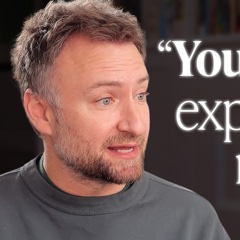
David Gelb
Director of Jiro Dreams of Sushi and Chef's Table
Where to hear and read about David Gelb1 episode or test

David Gelb is the director of Jiro Dreams of Sushi and a creator of Chef's Table, known for making documentaries about craft that are really about people. The thing most worth learning from him is to build every story on a character who wants one thing and needs another, and to let facts arrive through that person.
character and emotion is much more important than information.
The Secret to Great Stories (David Gelb Interview)
David Gelb: the story and the lessons
1How David Gelb turned Jiro Dreams of Sushi into a story about people
Gelb set out to film sushi technique and found the people instead. Jiro Dreams of Sushi began as a film about how different chefs make sushi. Test shorts showed him the people were the interesting part.
He shows an apprentice who made egg sushi 200 times and wept when the master approved it, rather than explaining the recipe. Chef's Table teaches almost nothing about cooking, yet it lasts because it follows a character's journey.
He hunts for the reason a person does the work. The mystery of each Chef's Table episode is why the chef cooks, not how. The team peels back the onion to find the best reason, including the moments the person got it wrong and what they learned.
He points to Spider-Man, whose origin (letting a burglar go, then losing his uncle) explains the whole character. Once viewers know the motive, the craft and mannerisms start to matter.
Gelb plans an outline, then asks personal questions and shares his own. The team builds a biographical outline from reading and first lets the subject tell the story the usual way. Then they ask probing personal questions across interviews over about two weeks, where other food shows historically stayed about an hour.
Directors talk about their own hard moments, and the subject gives the same energy back. Many chefs call the process therapy.
He follows the material when the story is not the one he planned. Jiro changed from a sushi information film into a story about a father and son. The team's phrase is lean into the truth.
Forcing dialogue into a preset story kills authenticity, and viewers can tell. In documentary the story has to drive, not the original template.
Gelb shoots wide variety first, then goes back to fill the holes. He quotes cinematographer Cesar Charlone: quantity first. Jiro was shot in two stages, the first in a month, and the first assembly showed what was missing.
Pacing felt on set differs from how it plays in the edit, so varied shots give choices later and single-shot approaches are a gamble.
He lifts the filmmaking to match the subject's craft. Jiro was shot on the Red One, and the score used Mozart because Jiro's sushi is compared to a concerto, and Philip Glass because his repeating, escalating refrain echoes Jiro's two steps forward, one step back.
Gelb starts every project with a playlist shared with his editor, Brandon Driscoll Leininger, his high school roommate. Shared taste gives them a common language, and their differences let them stretch.
2How Gelb builds a story: hooks, endings and change
Gelb opens on a moment that grabs a character, not on a biography. He took the cold open from James Bond films: one or two minutes of hook, then the credits. Chef's Table opens Massimo Bottura's episode with the earthquake that wrecked the Parmigiano Reggiano wheels.
The hook only has to give viewers something to hold, not fit the whole episode. The Stan Lee film opens by asking where Spider-Man came from, not with where Lee was born. Streaming means one bored second can lose a viewer.
He fixes the ending early and builds everything toward it. For Jiro, the discovery that Jiro's son Yoshikazu earned the Michelin stars set up the ending: the son is worthy of the mantle. The lesson, that the journey is the destination, is left to emerge.
The ending came from Gelb's own family. His grandfather, managing editor of the New York Times, told his father to do anything he wanted as long as he was the best at it, and his father became general manager of the Metropolitan Opera. Gelb asks where he fits in that line, as Yoshikazu asks how to fill his father's shoes.
Gelb gives every character a want that differs from what they need. The character believes they know who they are, then the world flips and the thing they wanted proves an illusion. The hope comes from accepting that.
He ties it to the lyric about not always getting what you want but getting what you need. He says this is what makes a story rather than a description.
He makes each scene change the character. A character should enter a scene with a goal, meet an obstacle, then adjust or hit a wall, and the next scene picks up from that blockage.
Actors ask directors what they are coming in with and what they are leaving with, especially when shooting out of order.
Gelb places a false victory at the midpoint before things get worse. Titanic has the lovers happy just before the iceberg. In The Fellowship of the Ring, the Mines of Moria precede the loss of Gandalf.
The audience is lulled so the fall hurts more, and the turn after still needs a glimmer of hope. He treats documentary structure the same as feature film structure.
He treats the audience as a character with an expectation. Exit Through the Gift Shop seems to be about Banksy, then becomes about Mr. Brainwash. What viewers expect has to be appealing enough that they sign up, and the reveal pays it off.
Gelb learns the structural rules so he can break them. He values Save the Cat as a skeleton showing how early themes pay off later, though he finds it overprescriptive for giving page numbers.
Chef's Table also keeps its identity through set scene types he calls buckets: cold open, opening credits, a critic's analysis, a farm and the hometown.
3How Gelb edits and handles feedback
He watches every cut with another person in the room. A trusted viewer who is not cruel is enough, even without any notes. Gelb feels responsible for the viewer's time, and boredom in the room kills him.
The same urge to skip ahead shows up when reading your own text aloud to someone.
Gelb overcuts on the second pass, then lets air back in. His assembly runs far too long and his second cut goes far too fast. The right pace sits between them.
His extra context can make a scene seem more or less interesting than it is to the audience.
He expects the first full assembly to be terrible and keeps going. Dailies and the trailer feel great, but the first assembly, with no music or color, feels awful. The film ends up somewhere in the middle of the original plan.
The pitfall is staying stuck on one project because it is never good enough. Therapy helps him remember he is not bad, he just has to keep going.
Gelb reads feedback as symptoms and fixes them through his own taste. He compares viewers to patients who can name what hurts but should not prescribe the cure. He asks what the story meant to them and which parts they did not understand.
After test screenings on a studio movie he saw viewers suddenly act like directors. He kept the long octopus massage in Jiro even though Jiro called the film the most boring ever, but cut to one of four rice scenes when the audience showed it was needed.
He asks for the fewest words that get the idea across. Even loved dialogue goes if it does not serve clarity and momentum. He prefers cutting to something that moves the story forward, such as the response.
A strong performance can carry a scene's intent so lines can be cut.
Gelb prizes scenes that show the beat without saying it. He calls wordless scenes the hardest and best thing to do, citing the 40 to 50 second listening booth scene in Before Sunrise.
At USC film school, first-year student films were not allowed dialogue, so students had to show without saying.
4Gelb on taste, perfection and being the best
Gelb keeps doing the reps through the taste gap. Taste outruns skill, so early work disappoints. His answer, from Ira Glass's idea, is to keep making the next thing.
While making Jiro he chased Fog of War and even licensed a piece of its Philip Glass score. Chasing a model while making something else is how the work becomes original.
He rejects his family's advice to be the best at it. The line passed from his grandfather to his father to Gelb, who is now 42. He sees it as a trap because it makes you measure yourself against everyone.
He would reword it to do your best at it, or be yourself. Nobody is the best at anything because it is subjective, and even if you are now, you won't be in 20 years.

The Secret to Great Stories (David Gelb Interview)
David Gelb explains how character, not information, makes a story stick, and how scenes, openings, endings and midpoints are built around what a character wants versus what they need. His most useful habits are testing a cut with another person in the room and treating feedback as a diagnosis of symptoms, never a prescription.
Gelb set out to film sushi technique and found the people instead. Jiro Dreams of Sushi began as a film about how different chefs make sushi. Test shorts showed him the people were the interesting part.
He shows an apprentice who made egg sushi 200 times and wept when the master approved it, rather than explaining the recipe. Chef's Table teaches almost nothing about cooking, yet it lasts because it follows a character's journey.
He hunts for the reason a person does the work. The mystery of each Chef's Table episode is why the chef cooks, not how. The team peels back the onion to find the best reason, including the moments the person got it wrong and what they learned.
He points to Spider-Man, whose origin (letting a burglar go, then losing his uncle) explains the whole character. Once viewers know the motive, the craft and mannerisms start to matter.
Gelb plans an outline, then asks personal questions and shares his own. The team builds a biographical outline from reading and first lets the subject tell the story the usual way. Then they ask probing personal questions across interviews over about two weeks, where other food shows historically stayed about an hour.
Directors talk about their own hard moments, and the subject gives the same energy back. Many chefs call the process therapy.
He follows the material when the story is not the one he planned. Jiro changed from a sushi information film into a story about a father and son. The team's phrase is lean into the truth.
Forcing dialogue into a preset story kills authenticity, and viewers can tell. In documentary the story has to drive, not the original template.
Gelb shoots wide variety first, then goes back to fill the holes. He quotes cinematographer Cesar Charlone: quantity first. Jiro was shot in two stages, the first in a month, and the first assembly showed what was missing.
Pacing felt on set differs from how it plays in the edit, so varied shots give choices later and single-shot approaches are a gamble.
He lifts the filmmaking to match the subject's craft. Jiro was shot on the Red One, and the score used Mozart because Jiro's sushi is compared to a concerto, and Philip Glass because his repeating, escalating refrain echoes Jiro's two steps forward, one step back.
Gelb starts every project with a playlist shared with his editor, Brandon Driscoll Leininger, his high school roommate. Shared taste gives them a common language, and their differences let them stretch.
Gelb opens on a moment that grabs a character, not on a biography. He took the cold open from James Bond films: one or two minutes of hook, then the credits. Chef's Table opens Massimo Bottura's episode with the earthquake that wrecked the Parmigiano Reggiano wheels.
The hook only has to give viewers something to hold, not fit the whole episode. The Stan Lee film opens by asking where Spider-Man came from, not with where Lee was born. Streaming means one bored second can lose a viewer.
He fixes the ending early and builds everything toward it. For Jiro, the discovery that Jiro's son Yoshikazu earned the Michelin stars set up the ending: the son is worthy of the mantle. The lesson, that the journey is the destination, is left to emerge.
The ending came from Gelb's own family. His grandfather, managing editor of the New York Times, told his father to do anything he wanted as long as he was the best at it, and his father became general manager of the Metropolitan Opera. Gelb asks where he fits in that line, as Yoshikazu asks how to fill his father's shoes.
Gelb gives every character a want that differs from what they need. The character believes they know who they are, then the world flips and the thing they wanted proves an illusion. The hope comes from accepting that.
He ties it to the lyric about not always getting what you want but getting what you need. He says this is what makes a story rather than a description.
He makes each scene change the character. A character should enter a scene with a goal, meet an obstacle, then adjust or hit a wall, and the next scene picks up from that blockage.
Actors ask directors what they are coming in with and what they are leaving with, especially when shooting out of order.
Gelb places a false victory at the midpoint before things get worse. Titanic has the lovers happy just before the iceberg. In The Fellowship of the Ring, the Mines of Moria precede the loss of Gandalf.
The audience is lulled so the fall hurts more, and the turn after still needs a glimmer of hope. He treats documentary structure the same as feature film structure.
He treats the audience as a character with an expectation. Exit Through the Gift Shop seems to be about Banksy, then becomes about Mr. Brainwash. What viewers expect has to be appealing enough that they sign up, and the reveal pays it off.
Gelb learns the structural rules so he can break them. He values Save the Cat as a skeleton showing how early themes pay off later, though he finds it overprescriptive for giving page numbers.
Chef's Table also keeps its identity through set scene types he calls buckets: cold open, opening credits, a critic's analysis, a farm and the hometown.
He watches every cut with another person in the room. A trusted viewer who is not cruel is enough, even without any notes. Gelb feels responsible for the viewer's time, and boredom in the room kills him.
The same urge to skip ahead shows up when reading your own text aloud to someone.
Gelb overcuts on the second pass, then lets air back in. His assembly runs far too long and his second cut goes far too fast. The right pace sits between them.
His extra context can make a scene seem more or less interesting than it is to the audience.
He expects the first full assembly to be terrible and keeps going. Dailies and the trailer feel great, but the first assembly, with no music or color, feels awful. The film ends up somewhere in the middle of the original plan.
The pitfall is staying stuck on one project because it is never good enough. Therapy helps him remember he is not bad, he just has to keep going.
Gelb reads feedback as symptoms and fixes them through his own taste. He compares viewers to patients who can name what hurts but should not prescribe the cure. He asks what the story meant to them and which parts they did not understand.
After test screenings on a studio movie he saw viewers suddenly act like directors. He kept the long octopus massage in Jiro even though Jiro called the film the most boring ever, but cut to one of four rice scenes when the audience showed it was needed.
He asks for the fewest words that get the idea across. Even loved dialogue goes if it does not serve clarity and momentum. He prefers cutting to something that moves the story forward, such as the response.
A strong performance can carry a scene's intent so lines can be cut.
Gelb prizes scenes that show the beat without saying it. He calls wordless scenes the hardest and best thing to do, citing the 40 to 50 second listening booth scene in Before Sunrise.
At USC film school, first-year student films were not allowed dialogue, so students had to show without saying.
Gelb keeps doing the reps through the taste gap. Taste outruns skill, so early work disappoints. His answer, from Ira Glass's idea, is to keep making the next thing.
While making Jiro he chased Fog of War and even licensed a piece of its Philip Glass score. Chasing a model while making something else is how the work becomes original.
He rejects his family's advice to be the best at it. The line passed from his grandfather to his father to Gelb, who is now 42. He sees it as a trap because it makes you measure yourself against everyone.
He would reword it to do your best at it, or be yourself. Nobody is the best at anything because it is subjective, and even if you are now, you won't be in 20 years.