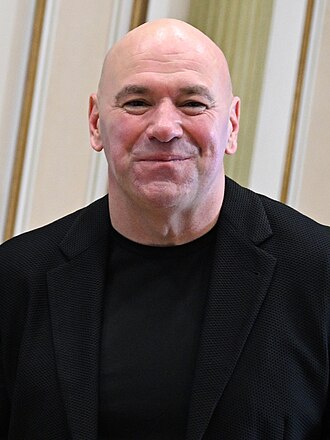
Dana White
President of the UFC
Where to hear and read about Dana White1 episode or test

Dana White is the president of the UFC, which he and the Fertitta brothers bought as a near-empty shell for $2M and sold for $4.025 billion in 2016. The thing most worth learning from him is how far a founder can go by trusting his own taste as the product's biggest fan, owning the risk himself, and never planning for failure.
Never even crosses my mind that something's not going to work. I just keep going until it does work.
Dana White: The Man Behind the UFC
Dana White: the story and the lessons
1How Dana White and the Fertittas rescued a near-dead UFC
White left a bellman job for Vegas while young with nothing to lose. He says he barely graduated high school and could take that risk only because he was young.
Looking back at 56, he calls it believing in something and doing the right things, and he rejects any victim mentality about other people's success.
The UFC they bought was little more than three letters. For $2M the owners got the UFC name, an old wooden octagon and eight or nine fighter contracts. The previous owner had sold merchandise, library, video games and DVD rights to Lionsgate to survive.
They paid roughly $2.5 to 3 million to buy those rights back, which later let the brand earn from everything it made. White contrasts this with Bruce Lee's daughter Shannon Lee, who still can't buy back her father's film rights.
Fans with no production experience learned the show by trial and error. The owners had about three weeks to stage their first event and ran only five a year, using the gaps to learn. The UFC now runs 43 or 44 events a year.
Early experiments included WWE-style fireworks and pyro before they settled on a simpler, technology-driven show. White still tries to be first, or among the first, to use new technology.
The company nearly got sold off, and a night's sleep saved it. With events costing about $2M each, five a year, against roughly $10M in revenue, Lorenzo Fertitta told White to find a buyer. White put the price at six to eight million.
The next morning Fertitta called back and said "Let's keep going." White says that even if they had sold, he would have found another way into the business the next day.
2How Dana White bet the UFC on The Ultimate Fighter
White used a taped reality show as a Trojan horse onto free TV. The UFC was barred from pay-per-view at the time, so free television looked impossible. Around 2004 or 2005 he built a reality format with taped fights that cautious networks felt they could edit.
The format also let fans get to know fighters before they fought. White calls it "sort of our Trojan horse."
White paid for production so Spike TV carried no risk. Spike passed at first over cost. White came back offering to pay for the whole production with Spike supplying only airtime, so the UFC owned the show outright.
Spike was a young men's network that had already lost money on content, which made a no-downside offer easy to accept. White figured that if the UFC didn't fit on Spike, it fit nowhere.
The show was the owners' last $10M bet on the UFC. After years of losses, they agreed that if this failed the company was finished. It became a runaway hit with ratings that kept climbing.
White says that painful check turned out to be the greatest thing that ever happened to them.
The Bonnar vs. Griffin finale won a renewal on a napkin. The crowd stomped and chanted "one more round," and White gave both fighters contracts on the spot. The renewal was a few bullet points and a handshake in an alley.
Forrest Griffin became a pay-per-view star, and the show is now in season 34, which White thinks may draw its biggest audience under the Paramount deal.
White reuses the reality format to launch new leagues. Power Slap's reality show has 50 million YouTube views, and he did the same for UFC BJJ.
3Why Dana White trusts a fan's taste over industry convention
White never edits a fight and lets fans judge it. He watched The Contender, the most expensive reality show of its time, fail because it edited its boxing fights. A fan would never cut a fight.
His production adds what he calls the bells and whistles, then hands the torch to the fighters, who have to deliver. "You let the fans judge whether the fight is good or bad."
He tells the audience when a fight was bad. Growing up, he saw promoters call fights great when everyone knew they weren't, and he refuses to do it.
He also says no one can judge a card before it happens, so fans calling it bad in advance are wrong.
White talks like a fan, not a CEO reading a statement. He grew up watching CEOs read lawyer-written statements and calls it phony. He makes the fights he wants to see.
David Senra points founders to White's post-fight press conferences as the model of a founder as storyteller, a job that can't be handed to a hired Chief Storyteller.
He built growth on a live event that turns attendees into fans. White credits fast growth to taking a strong live show around the US and the world. The first event after the purchase, at the Trump Taj Mahal, sold 3,500 tickets and drew 5,000 with comps.
He says nobody leaves a live UFC event swearing off another, and each new fan brings five to ten more. Power Slap was profitable from its first event because he applied the same playbook.
4How Dana White runs production as a dictatorship
Ringside, White watches the experience, not the fight. He sits with a phone to the production truck, checking music volume and the broadcast, and calls what to keep or cut.
Producer Zach tries new things and White answers "That was cool. That wasn't cool." "There is no committee here."
He fired the entire inherited production crew for ignoring him. The first crew were Showtime boxing staff. When fighter Phil Baroni snapped mid-interview and they refused to show it, White kicked open the truck door and later replaced them all.
He had already called Showtime's boxing production the worst in the sport in public.
Years later, his team rarely needs correcting. They screen material in a room on his campus and he seldom changes anything. Head of production Craig Borsari has been there for years.
He wants "a bunch of sick animals that are just wired the way you are" across art, production and PR. When one producer left to start a company, White helped him build it.
5How Dana White grew the TV deals while critics called a peak
Spike's ultimatum pushed the UFC to Fox. Viacom executive Phil Dauman said he had built the UFC and would build another if they disliked his offer. White's reply was "Okay, Phil Dauman. We'll see."
White says everything happens for a reason, since the exit led to Fox.
Every deal was called the peak, and every next deal was bigger. TV deals went from $35M at Spike to $100M at Fox, $3 billion at ESPN and $7.7 billion over seven years at Paramount. The 2016 sale happened with no TV deal in place.
His challenge to critics: "What have we done in the last 25 years that hasn't worked?" He says they misjudge the UFC by measuring it against old businesses.
White argues streamers must buy live sports. A scripted series can be watched any time, but a live fight is a destination. He says Netflix was slow on sports, and the Ellisons won Paramount's deal by going after everything.
He expects the world to return to a few global channels.
He admits he under-exploited the DVD boom. Compilations like Ultimate Knockouts and Ultimate Submissions brought in millions, but he assumed DVDs would last forever. "I would've murdered the DVD era."
He once dismissed a streaming demo that buffered after a few seconds. Now the UFC adopts each new medium, including AI video, and lets critics complain: "right here, right now, we're in."
6Dana White on loyalty, partners and COVID
White kept every employee through COVID and held fights anyway. While others laid people off, he offered up his own pay and cut no jobs, bonuses or salaries. When venues bailed, his lawyer called every arena in America and they found a place within weeks.
Bob Iger offered to pay ESPN's fee whether the UFC held none or all 44 events, but White expected ESPN to cut the UFC first if it didn't deliver. As the only live sport, it pulled huge numbers and the business grew, using a Yas Island bubble in Abu Dhabi with repeated testing and chartered planes.
He refuses to drop Joe Rogan for any sponsor. White picked Rogan after seeing him on a talk show, and Rogan did the first 12 fights for free. The two split early radio tours, waking at 3 a.m. West Coast time for years.
When sponsors demanded action against Rogan, White told them not to call him. He calls loyalty "the most important thing in the world to me."
A partner who needs board permission is not a partner. A sponsor kept demanding he remove a video supporting Trump. When its executive said the board was losing patience, White turned down the offer and never did another deal with them.
Since then he works only with people he is aligned with. He says you don't know who is real until things go bad.
7How Dana White keeps building after the UFC
White launched Power Slap on a $3M gut bet. In 2017 he saw slap fights from Russia and Poland and noticed he stayed to see who won, despite being jaded about fighting. The Fertittas put up $3M.
After it took off, Michael Rubin offered $10M for whatever White did next, unseen.
He gives creators full access and no instructions. He runs nine brands, including UFC, WWE, PBR and Power Slap, and lets influencers film whatever they want.
He believes traditional media has lost trust and that creators who must go viral daily know their craft better than any brand. "Film what you want, create what you want."
White treats entrepreneurship as a daily war. He mocks founders who start companies to set their own hours, since someone is always trying to take what you have. He says he could have retired 10 years ago.
He now wants to build the biggest combat sports company ever within 10 years, through TKO, rebuilding boxing and a jiu jitsu league, and connects founders who pitch him at his bar without taking a piece.
8Dana White's no plan B mindset
White assumes things will work and keeps going until they do. He says failure never crosses his mind. At 56 he is still adding to his plate.
He blocks out critics who have never built anything. His question for them: "who the f*** are you, and what the f*** have you ever done?"
He cites Bruce Lee's advice never to speak negatively about yourself, even as a joke.
White surrounds himself with his own conviction. His office and gym walls are covered with affirmations, like Raising Cane's founder Todd Graves did. One reads "Nothing ever happens until someone pursues a vision fanatically."
He responds to others' wealth with "if he can do it, I can.". He sees three kinds of workers, none wrong: the 9-to-5 worker, the grinder who helps build a company, and the founder who works for nobody.
He learns from great builders and from leaders who mistreat employees, whose mistakes he refuses to repeat.

Dana White: The Man Behind the UFC
Dana White turned a near-bankrupt $2M purchase into a multibillion-dollar company by betting on the product fans actually wanted, owning what he built, and refusing to quit or take direction from outsiders. The decision to fund The Ultimate Fighter himself, in a last $10M bet, gave the UFC the television audience and full ownership that everything since has been built on.
White left a bellman job for Vegas while young with nothing to lose. He says he barely graduated high school and could take that risk only because he was young.
Looking back at 56, he calls it believing in something and doing the right things, and he rejects any victim mentality about other people's success.
The UFC they bought was little more than three letters. For $2M the owners got the UFC name, an old wooden octagon and eight or nine fighter contracts. The previous owner had sold merchandise, library, video games and DVD rights to Lionsgate to survive.
They paid roughly $2.5 to 3 million to buy those rights back, which later let the brand earn from everything it made. White contrasts this with Bruce Lee's daughter Shannon Lee, who still can't buy back her father's film rights.
Fans with no production experience learned the show by trial and error. The owners had about three weeks to stage their first event and ran only five a year, using the gaps to learn. The UFC now runs 43 or 44 events a year.
Early experiments included WWE-style fireworks and pyro before they settled on a simpler, technology-driven show. White still tries to be first, or among the first, to use new technology.
The company nearly got sold off, and a night's sleep saved it. With events costing about $2M each, five a year, against roughly $10M in revenue, Lorenzo Fertitta told White to find a buyer. White put the price at six to eight million.
The next morning Fertitta called back and said "Let's keep going." White says that even if they had sold, he would have found another way into the business the next day.
White used a taped reality show as a Trojan horse onto free TV. The UFC was barred from pay-per-view at the time, so free television looked impossible. Around 2004 or 2005 he built a reality format with taped fights that cautious networks felt they could edit.
The format also let fans get to know fighters before they fought. White calls it "sort of our Trojan horse."
White paid for production so Spike TV carried no risk. Spike passed at first over cost. White came back offering to pay for the whole production with Spike supplying only airtime, so the UFC owned the show outright.
Spike was a young men's network that had already lost money on content, which made a no-downside offer easy to accept. White figured that if the UFC didn't fit on Spike, it fit nowhere.
The show was the owners' last $10M bet on the UFC. After years of losses, they agreed that if this failed the company was finished. It became a runaway hit with ratings that kept climbing.
White says that painful check turned out to be the greatest thing that ever happened to them.
The Bonnar vs. Griffin finale won a renewal on a napkin. The crowd stomped and chanted "one more round," and White gave both fighters contracts on the spot. The renewal was a few bullet points and a handshake in an alley.
Forrest Griffin became a pay-per-view star, and the show is now in season 34, which White thinks may draw its biggest audience under the Paramount deal.
White reuses the reality format to launch new leagues. Power Slap's reality show has 50 million YouTube views, and he did the same for UFC BJJ.
White never edits a fight and lets fans judge it. He watched The Contender, the most expensive reality show of its time, fail because it edited its boxing fights. A fan would never cut a fight.
His production adds what he calls the bells and whistles, then hands the torch to the fighters, who have to deliver. "You let the fans judge whether the fight is good or bad."
He tells the audience when a fight was bad. Growing up, he saw promoters call fights great when everyone knew they weren't, and he refuses to do it.
He also says no one can judge a card before it happens, so fans calling it bad in advance are wrong.
White talks like a fan, not a CEO reading a statement. He grew up watching CEOs read lawyer-written statements and calls it phony. He makes the fights he wants to see.
David Senra points founders to White's post-fight press conferences as the model of a founder as storyteller, a job that can't be handed to a hired Chief Storyteller.
He built growth on a live event that turns attendees into fans. White credits fast growth to taking a strong live show around the US and the world. The first event after the purchase, at the Trump Taj Mahal, sold 3,500 tickets and drew 5,000 with comps.
He says nobody leaves a live UFC event swearing off another, and each new fan brings five to ten more. Power Slap was profitable from its first event because he applied the same playbook.
Ringside, White watches the experience, not the fight. He sits with a phone to the production truck, checking music volume and the broadcast, and calls what to keep or cut.
Producer Zach tries new things and White answers "That was cool. That wasn't cool." "There is no committee here."
He fired the entire inherited production crew for ignoring him. The first crew were Showtime boxing staff. When fighter Phil Baroni snapped mid-interview and they refused to show it, White kicked open the truck door and later replaced them all.
He had already called Showtime's boxing production the worst in the sport in public.
Years later, his team rarely needs correcting. They screen material in a room on his campus and he seldom changes anything. Head of production Craig Borsari has been there for years.
He wants "a bunch of sick animals that are just wired the way you are" across art, production and PR. When one producer left to start a company, White helped him build it.
Spike's ultimatum pushed the UFC to Fox. Viacom executive Phil Dauman said he had built the UFC and would build another if they disliked his offer. White's reply was "Okay, Phil Dauman. We'll see."
White says everything happens for a reason, since the exit led to Fox.
Every deal was called the peak, and every next deal was bigger. TV deals went from $35M at Spike to $100M at Fox, $3 billion at ESPN and $7.7 billion over seven years at Paramount. The 2016 sale happened with no TV deal in place.
His challenge to critics: "What have we done in the last 25 years that hasn't worked?" He says they misjudge the UFC by measuring it against old businesses.
White argues streamers must buy live sports. A scripted series can be watched any time, but a live fight is a destination. He says Netflix was slow on sports, and the Ellisons won Paramount's deal by going after everything.
He expects the world to return to a few global channels.
He admits he under-exploited the DVD boom. Compilations like Ultimate Knockouts and Ultimate Submissions brought in millions, but he assumed DVDs would last forever. "I would've murdered the DVD era."
He once dismissed a streaming demo that buffered after a few seconds. Now the UFC adopts each new medium, including AI video, and lets critics complain: "right here, right now, we're in."
White kept every employee through COVID and held fights anyway. While others laid people off, he offered up his own pay and cut no jobs, bonuses or salaries. When venues bailed, his lawyer called every arena in America and they found a place within weeks.
Bob Iger offered to pay ESPN's fee whether the UFC held none or all 44 events, but White expected ESPN to cut the UFC first if it didn't deliver. As the only live sport, it pulled huge numbers and the business grew, using a Yas Island bubble in Abu Dhabi with repeated testing and chartered planes.
He refuses to drop Joe Rogan for any sponsor. White picked Rogan after seeing him on a talk show, and Rogan did the first 12 fights for free. The two split early radio tours, waking at 3 a.m. West Coast time for years.
When sponsors demanded action against Rogan, White told them not to call him. He calls loyalty "the most important thing in the world to me."
A partner who needs board permission is not a partner. A sponsor kept demanding he remove a video supporting Trump. When its executive said the board was losing patience, White turned down the offer and never did another deal with them.
Since then he works only with people he is aligned with. He says you don't know who is real until things go bad.
White launched Power Slap on a $3M gut bet. In 2017 he saw slap fights from Russia and Poland and noticed he stayed to see who won, despite being jaded about fighting. The Fertittas put up $3M.
After it took off, Michael Rubin offered $10M for whatever White did next, unseen.
He gives creators full access and no instructions. He runs nine brands, including UFC, WWE, PBR and Power Slap, and lets influencers film whatever they want.
He believes traditional media has lost trust and that creators who must go viral daily know their craft better than any brand. "Film what you want, create what you want."
White treats entrepreneurship as a daily war. He mocks founders who start companies to set their own hours, since someone is always trying to take what you have. He says he could have retired 10 years ago.
He now wants to build the biggest combat sports company ever within 10 years, through TKO, rebuilding boxing and a jiu jitsu league, and connects founders who pitch him at his bar without taking a piece.
White assumes things will work and keeps going until they do. He says failure never crosses his mind. At 56 he is still adding to his plate.
He blocks out critics who have never built anything. His question for them: "who the f*** are you, and what the f*** have you ever done?"
He cites Bruce Lee's advice never to speak negatively about yourself, even as a joke.
White surrounds himself with his own conviction. His office and gym walls are covered with affirmations, like Raising Cane's founder Todd Graves did. One reads "Nothing ever happens until someone pursues a vision fanatically."
He responds to others' wealth with "if he can do it, I can.". He sees three kinds of workers, none wrong: the 9-to-5 worker, the grinder who helps build a company, and the founder who works for nobody.
He learns from great builders and from leaders who mistreat employees, whose mistakes he refuses to repeat.