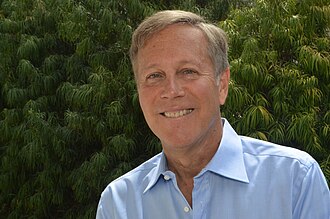
Dana Gioia
Poet, critic and former Chairman of the National Endowment for the Arts
Where to hear and read about Dana Gioia1 episode or test

Dana Gioia is a poet, critic and former Chairman of the National Endowment for the Arts, best known for the essay Can Poetry Matter? He built a life around protecting his writing time and refused to release anything before it was ready, and that is the habit most worth copying.
I don't date The Muse via a dating site. I just go to places where The Muse might hang around, and if she shows up, it'll be great.
Writing Advice Every Writer Should Hear (Dana Gioia Interview)
Dana Gioia: the story and the lessons
1Dana Gioia's path from business school to poet
Gioia woke at about 20 knowing he would be a poet. He had expected to be a composer and had no idea what poets do with their lives. The vocation came to him in Vienna as something given, not chosen.
He cites Seneca: if you follow your destiny it guides you, and if you resist it drags you. He fears gifted people who resist their calling end up with a sense of the unlived life.
He turned down the professor's path and chose business school. After Stanford and Harvard he declined academia, which gave security but put a writer in a hothouse. He wanted bright working-class people like his family to be able to respond to his poems, so he took a business path that left three or four hours a day for reading and writing.
His Harvard professors saw business school as the equivalent of being the janitor in a bordello and thought his plan to keep writing was a delusion. He says the odds of failing were overwhelming.
He wrote around ten-hour office days for fifteen years. At business school he gave three to four hours a day to reading and writing, published a piece a week for two years, earned his MBA and met his wife. In New York he got up at 7, drank coffee and worked 10 hours, never with a long stretch free.
He has worked since age nine, even through Easter vacations.
He quit to write full time and nearly went bankrupt. He left to be a literary journalist and nearly went bankrupt for two years before it worked. He then moved back to California so his sons would know their working-class grandparents.
Later he served as NEA chairman for six and a half years and stopped writing for six of them to keep his public and literary careers separate.
2How Gioia arranged his life around the work
Gioia treats time as a wallet of one-hour bills. He kept only three things in it: family, a job, and writing. He took a business job because T.S. Eliot worked in a bank and Wallace Stevens was an insurance lawyer, and both still wrote major work.
He says young poets need patron saints who show how to get through a life, not only how to write.
He guarded a fixed block of daily hours at every stage. His routine changed with each stage of life, but it always protected hours for reading and writing. With about 90 minutes a night, he burnished each poem.
He agrees with Flaubert: be regular and orderly in life so you can be violent and original in work.
He stayed out of the market for six or seven years. He stopped submitting poems to find his own sound. Friends pitied him, assuming everything was being refused, but the poems editors had accepted were the ones that sounded like other poets.
The Hudson Review then took about seven poems and ran them in the very next issue. The New Yorker's editor phoned to ask why he hadn't submitted, and Gioia refused because nobody at his office knew he was a poet.
He avoids wasting time and works nearly all the time. Most people waste most of their time and then grow used to it. Gioia works all the time and is happiest that way.
He adds that reading by impulse and wasting time sometimes turns up what he did not intend to find, and he turns the internet off most of the day.
3Why Gioia says no to the short-term market
Gioia holds back any piece he thinks is unfinished. The night after he sent Can Poetry Matter? to the Atlantic, he reread it and asked editor Bill Whitworth not to run it yet. Two months later he added a section in the middle, and Whitworth agreed it was far better.
The essay drew more mail than any article in the Atlantic's history. Gioia says saying no has been the key to his success.
He returned Harper's advance rather than change an essay. He published it in the Hudson Review, with 2,500 readers, instead of a magazine with a quarter of a million.
He chose tiny Graywolf Press over Knopf. He guessed the Knopf editor had not read the poems and wanted a name hot from the New Yorker, and he trusted Graywolf founder Scott Walker's integrity. His poetry books are still in print 42 years later.
He expects Knopf would have let them go out of print within two years. A writer gets only one debut, so he chose to make his deliberate.
He refused the New Yorker's poetry editorship and a first publisher offer. He turned down a publisher's first offer, saying he wasn't ready, and declined the editorship because the job would have owned him.
He names three traps that swap long-term work for quick income: a university job, a weekly freelance grind, and a quick book written for an advance.
He warns against stretching a good article into a padded book. He advised a young writer with a viral article not to inflate it. Most nonfiction books have a wonderful first chapter, a mediocre second, then padding.
Chapters two, three and four must do something different from chapter one. His advice is to be your own editor and your own agent, since the agent wants the commission and the editor wants set dates.
4How Gioia drafts a poem
Inspiration arrives involuntarily and leaves a mess to sort out. Gioia feels it in his temples and throat and writes in a frenzy for 30 to 45 minutes, then it vanishes. The page is always a mess, and the work is finding the poem hidden in it.
He has lost many good lines in elevators, meetings and while driving, because he can't stop for 30 minutes to write.
He pushes a feeling to its limit, then turns against it. Once the reader is fully involved for or against a feeling, he qualifies it or says almost the opposite. In his wedding poem two people meet and nothing happens, and months later he added a last 8 to 12 lines showing the man 20 years on, haunted by might have beens.
He says most poems he reads amount to 'I'm sad, the end' or 'I'm happy, the end', and he adds turns to prose as well.
He lets the language show what the poem wants to sound like. He writes about ten handwritten drafts first. In his moth poem the rhyme only appeared around draft four, and only the first two words survived to the final version.
The working title, Apology to a Luna Moth, was terrible, so the opening line 'Pardon me, Pilgrim' became both title and first line. He says lines aloud to test the music.
He moves the draft onto a computer to see it fresh. Typing it two months later gave him a moment of objectivity, because it looked and sounded different from what he thought. He then took the poem through about ten more drafts.
He says people cheat themselves if they skip this step.
5How Gioia revises
He swings between wild invention and a cold critical eye. A piece looks great at night, and the next morning he sees only the flaws. He then plunges back in, forgetting the criticism, and has taken some poems to 100 drafts.
His opera book Weep, Shudder, Die began 20 years ago as a short piece, and in the last three months he wrote chapters and tore them apart again and again.
He crosses out the worst line and checks where energy falls. He asks where the energy peaks and where it drops, builds to a climax, pulls back, builds another, and cuts dead patches.
Readers told him his opera book was finished in one sitting, which is the pacing he aimed for.
He recopies yesterday's paragraph to get back into the work. After a ten-hour job he had about 90 minutes at 9 p.m. and wanted to watch TV. He recopied the last paragraph, revising small words, and within about 20 minutes he was back in the argument and tone and could write new lines.
For poems it brought back the music. He stopped around a quarter to eleven and did not count that as defeat.
He asks one or two honest peers what is wrong. For almost seven years he sent poems to one or two writers and asked what was wrong, because praise was no help. About half a dozen such readers served him over his career.
When two readers flag the same line, he does not cut it but changes the context so the line becomes stronger. Both sides improve from the exchange.
He treats revision as creating again, not tidying. A real writer returns to the draft with the same openness as in the first pass. Passages that fail in a first draft often become magnificent once reconsidered over and over.
He coached a mentee through 200 changes, then 200 more, and told him not to listen to the editor who called the book ready.
6How Gioia writes prose
He writes for two or three imagined readers at different levels. He pictures a bright teenager who knows little, a fellow writer who knows too much, and someone in between. He picks examples that will still be around in 20 years, or explains them.
He will spend a whole day on one paragraph of examples, trying angles until it strikes like a chord.
He describes a person through one scene, never a list of traits. Details gathered from different times make an abstract portrait. He recreates the person in one moment as a small story with a beginning, middle and end, even in three sentences.
His essay on the neglected poet Samuel Menashe stayed flat until he opened with Menashe standing in room corners at readings and answering 'I am a pariah'.
He leaves out the scaffolding so readers can walk in. Most poets leave the backstory and explanation standing, and by the heart of the poem it is the poet's poem and not yours. Gioia cuts enough that a reader can bring their own life.
A woman showed him his poem Reunion framed beside a photo of her father, who has Alzheimer's. She said it explained how he must feel, which was not what he meant it to mean but exactly what he meant it to do.
He writes simply but keeps the flavor of his own sensibility. He says to use no unnecessary words, but he warns against a house style of one-sentence paragraphs. Raymond Chandler's plots have holes, yet readers return for his sensibility.
He argues that diet vanilla books will not last.
He studies one paragraph of a writer he admires. He works out sentence by sentence why a page by Orwell, Clive James, Randall Jarrell or Cheever works. It always proves simpler and shorter than he remembered, built on radiant details and what was left out.
When stuck, he reads two or three pages of Orwell, gets annoyed at how well Orwell writes, and goes back to cross out his own page.
He revises every email until it is sharper and funnier. Gioia treats everyday writing as practice, down to a note to his spouse, so that quality becomes instinctive.
He compares it to a boxer's 10,000 hours in the gym behind 20 professional fights.
7How Gioia uses the body, patience and notebooks
He tests lines with his body, not his mind. He built his studio so he can walk a circle, muttering and changing lines until they feel right. He thinks the more physical intelligence goes into a poem, the better it is.
He once threw keys at a student in his USC class, who caught them unasked, to show the body has its own intelligence.
He prunes trees when a piece is stuck. Stuck on an opera libretto, he prunes a tree for an hour and comes back to find the problem solved. He now spends two or three hours each morning, and again after lunch, on land work, with writing in between.
He credits the move from New York office work to physical work in the country for the discovery.
He waits and meditates before writing that surprises him. He can write on demand, but the pieces that surprise him are involuntary. He reads around a subject first, such as 20 pages of Eliot a day for his one essay on Eliot.
A sheet reading Nulla dies sine linea, not a day without a line, greets him at the studio door. When no poem comes he revises lyrics for the operas he writes with composers.
He copies what he wants to remember into commonplace books. He has filled three or four notebooks of passages from his reading. One runs from 1986 to 2016 and holds about a thousand quotations.
Entries like Balanchine's 'God creates, I assemble' can start a long chain of thought.
He annotates poems he loves to see how the sound is built. He copies a poem in ink, then marks syllable counts, rhyme scheme, metrical stresses and speech stresses in pencil. It shows him how other poets made their sound.
He built a whole book of such analysed poems early in his career.
8Gioia on grief, honesty and finding a voice
Gioia says a voice comes from admitting the embarrassing parts of your life. Every life looks trite and boring from some angle, and that is the material. It took him about 20 years to learn to write about his ugly, second-rate urban upbringing.
Readers identify with shared weakness, which lets them believe in the writer's strengths. He points to Philip Larkin, who found the poetry of tedium.
His son's death made his work simpler and more musical. After his four-month-old son died, his poems became more emotionally direct. He went to work every day dead inside, and two or three evenings a week cleaned an old working-class cemetery.
There older women asked is this your boy? and told him about their own children, and a Stanford-Harvard executive and an immigrant woman were equals.
Facing grief gave him a bond with strangers. At poetry readings someone always hung back, and when he asked if they had lost a child too, they always had. Coworkers of years told him their own losses with an intimacy they could not have shared before.
He says it made him a better parent to his next two sons, and kinder, more patient and more empathetic.
He refuses to turn his own life into the art. He says the people he knew who tried were self-destructive. His family was full of failure, with jail and early death, and he says he has enough drama in his own heart and mind.
At midnight he sometimes decides everything he has written is worthless, and once threw his pages on the floor.
He writes from gratitude rather than anger. He sees a culture that is angry, entitled and envious, and says those emotions rarely grow into powerful art. In 30 years he has seen the Luna Moth only nine or ten times.
He warns this is bad advice for most writers and is only his own experience.
9What Gioia built and taught beyond his own poems
Gioia saw Harvard's experts get poetry's future wrong. At Harvard he learned that poetry would only grow harder, the public would never return, and rhyme and meter were finished. Within ten years Kool Herc in the South Bronx had started hip-hop.
He still calls Harvard a wonderful school, and says the failure was in prediction, not teaching.
He argues print culture was a bounded era that has ended. Most people now meet his poems at readings and in broadcasts, as they met Homer's. His filmmaker son filmed his recitals and lectures, and Gioia added visuals so they were not talking heads.
He advises a writer to be polymathic but keep one identity across platforms.
He made USC students memorize and recite poems. About 30 to 40% of his students came from immigrant homes and about 40% were first in their family at college. He aimed to raise their command of English and their self-presentation, and about 90 to 95% were converted.
He brought three undergraduates to recite for USC's trustees, and the board loved it.
He builds communities for writers, not only poems. He helped create the Westchester conference on form and narrative, which became the largest poetry conference in the United States, with no budget and no staff. He also wrote the essay The Catholic Writer Today and founded a free conference for Catholic writers.
It has moved to Loyola Chicago, the University of Dallas and Notre Dame, where 1300 registered. At 74 he wants to foster a serious Catholic artistic culture, knowing he won't see the results.
He writes opera libretti as lyric peaks and little connecting story. A libretto must serve the composer, the audience and the singer, so the text stays simple enough to leave the composer room. He says most libretti read like stage plays rather than lyrics.
He holds that a writer should learn why people come to a genre and give them the best version of that experience.

Writing Advice Every Writer Should Hear (Dana Gioia Interview)
Dana Gioia explains how he drafts, rewrites and judges his own work, from poems taken through 100 drafts to essays he refused to publish until they were ready. The habits worth hearing are his pairing of an emotion with its opposite, his recopying of yesterday's paragraph to restart, and his habit of studying one paragraph of a writer he admires.
Gioia woke at about 20 knowing he would be a poet. He had expected to be a composer and had no idea what poets do with their lives. The vocation came to him in Vienna as something given, not chosen.
He cites Seneca: if you follow your destiny it guides you, and if you resist it drags you. He fears gifted people who resist their calling end up with a sense of the unlived life.
He turned down the professor's path and chose business school. After Stanford and Harvard he declined academia, which gave security but put a writer in a hothouse. He wanted bright working-class people like his family to be able to respond to his poems, so he took a business path that left three or four hours a day for reading and writing.
His Harvard professors saw business school as the equivalent of being the janitor in a bordello and thought his plan to keep writing was a delusion. He says the odds of failing were overwhelming.
He wrote around ten-hour office days for fifteen years. At business school he gave three to four hours a day to reading and writing, published a piece a week for two years, earned his MBA and met his wife. In New York he got up at 7, drank coffee and worked 10 hours, never with a long stretch free.
He has worked since age nine, even through Easter vacations.
He quit to write full time and nearly went bankrupt. He left to be a literary journalist and nearly went bankrupt for two years before it worked. He then moved back to California so his sons would know their working-class grandparents.
Later he served as NEA chairman for six and a half years and stopped writing for six of them to keep his public and literary careers separate.
Gioia treats time as a wallet of one-hour bills. He kept only three things in it: family, a job, and writing. He took a business job because T.S. Eliot worked in a bank and Wallace Stevens was an insurance lawyer, and both still wrote major work.
He says young poets need patron saints who show how to get through a life, not only how to write.
He guarded a fixed block of daily hours at every stage. His routine changed with each stage of life, but it always protected hours for reading and writing. With about 90 minutes a night, he burnished each poem.
He agrees with Flaubert: be regular and orderly in life so you can be violent and original in work.
He stayed out of the market for six or seven years. He stopped submitting poems to find his own sound. Friends pitied him, assuming everything was being refused, but the poems editors had accepted were the ones that sounded like other poets.
The Hudson Review then took about seven poems and ran them in the very next issue. The New Yorker's editor phoned to ask why he hadn't submitted, and Gioia refused because nobody at his office knew he was a poet.
He avoids wasting time and works nearly all the time. Most people waste most of their time and then grow used to it. Gioia works all the time and is happiest that way.
He adds that reading by impulse and wasting time sometimes turns up what he did not intend to find, and he turns the internet off most of the day.
Gioia holds back any piece he thinks is unfinished. The night after he sent Can Poetry Matter? to the Atlantic, he reread it and asked editor Bill Whitworth not to run it yet. Two months later he added a section in the middle, and Whitworth agreed it was far better.
The essay drew more mail than any article in the Atlantic's history. Gioia says saying no has been the key to his success.
He returned Harper's advance rather than change an essay. He published it in the Hudson Review, with 2,500 readers, instead of a magazine with a quarter of a million.
He chose tiny Graywolf Press over Knopf. He guessed the Knopf editor had not read the poems and wanted a name hot from the New Yorker, and he trusted Graywolf founder Scott Walker's integrity. His poetry books are still in print 42 years later.
He expects Knopf would have let them go out of print within two years. A writer gets only one debut, so he chose to make his deliberate.
He refused the New Yorker's poetry editorship and a first publisher offer. He turned down a publisher's first offer, saying he wasn't ready, and declined the editorship because the job would have owned him.
He names three traps that swap long-term work for quick income: a university job, a weekly freelance grind, and a quick book written for an advance.
He warns against stretching a good article into a padded book. He advised a young writer with a viral article not to inflate it. Most nonfiction books have a wonderful first chapter, a mediocre second, then padding.
Chapters two, three and four must do something different from chapter one. His advice is to be your own editor and your own agent, since the agent wants the commission and the editor wants set dates.
Inspiration arrives involuntarily and leaves a mess to sort out. Gioia feels it in his temples and throat and writes in a frenzy for 30 to 45 minutes, then it vanishes. The page is always a mess, and the work is finding the poem hidden in it.
He has lost many good lines in elevators, meetings and while driving, because he can't stop for 30 minutes to write.
He pushes a feeling to its limit, then turns against it. Once the reader is fully involved for or against a feeling, he qualifies it or says almost the opposite. In his wedding poem two people meet and nothing happens, and months later he added a last 8 to 12 lines showing the man 20 years on, haunted by might have beens.
He says most poems he reads amount to 'I'm sad, the end' or 'I'm happy, the end', and he adds turns to prose as well.
He lets the language show what the poem wants to sound like. He writes about ten handwritten drafts first. In his moth poem the rhyme only appeared around draft four, and only the first two words survived to the final version.
The working title, Apology to a Luna Moth, was terrible, so the opening line 'Pardon me, Pilgrim' became both title and first line. He says lines aloud to test the music.
He moves the draft onto a computer to see it fresh. Typing it two months later gave him a moment of objectivity, because it looked and sounded different from what he thought. He then took the poem through about ten more drafts.
He says people cheat themselves if they skip this step.
He swings between wild invention and a cold critical eye. A piece looks great at night, and the next morning he sees only the flaws. He then plunges back in, forgetting the criticism, and has taken some poems to 100 drafts.
His opera book Weep, Shudder, Die began 20 years ago as a short piece, and in the last three months he wrote chapters and tore them apart again and again.
He crosses out the worst line and checks where energy falls. He asks where the energy peaks and where it drops, builds to a climax, pulls back, builds another, and cuts dead patches.
Readers told him his opera book was finished in one sitting, which is the pacing he aimed for.
He recopies yesterday's paragraph to get back into the work. After a ten-hour job he had about 90 minutes at 9 p.m. and wanted to watch TV. He recopied the last paragraph, revising small words, and within about 20 minutes he was back in the argument and tone and could write new lines.
For poems it brought back the music. He stopped around a quarter to eleven and did not count that as defeat.
He asks one or two honest peers what is wrong. For almost seven years he sent poems to one or two writers and asked what was wrong, because praise was no help. About half a dozen such readers served him over his career.
When two readers flag the same line, he does not cut it but changes the context so the line becomes stronger. Both sides improve from the exchange.
He treats revision as creating again, not tidying. A real writer returns to the draft with the same openness as in the first pass. Passages that fail in a first draft often become magnificent once reconsidered over and over.
He coached a mentee through 200 changes, then 200 more, and told him not to listen to the editor who called the book ready.
He writes for two or three imagined readers at different levels. He pictures a bright teenager who knows little, a fellow writer who knows too much, and someone in between. He picks examples that will still be around in 20 years, or explains them.
He will spend a whole day on one paragraph of examples, trying angles until it strikes like a chord.
He describes a person through one scene, never a list of traits. Details gathered from different times make an abstract portrait. He recreates the person in one moment as a small story with a beginning, middle and end, even in three sentences.
His essay on the neglected poet Samuel Menashe stayed flat until he opened with Menashe standing in room corners at readings and answering 'I am a pariah'.
He leaves out the scaffolding so readers can walk in. Most poets leave the backstory and explanation standing, and by the heart of the poem it is the poet's poem and not yours. Gioia cuts enough that a reader can bring their own life.
A woman showed him his poem Reunion framed beside a photo of her father, who has Alzheimer's. She said it explained how he must feel, which was not what he meant it to mean but exactly what he meant it to do.
He writes simply but keeps the flavor of his own sensibility. He says to use no unnecessary words, but he warns against a house style of one-sentence paragraphs. Raymond Chandler's plots have holes, yet readers return for his sensibility.
He argues that diet vanilla books will not last.
He studies one paragraph of a writer he admires. He works out sentence by sentence why a page by Orwell, Clive James, Randall Jarrell or Cheever works. It always proves simpler and shorter than he remembered, built on radiant details and what was left out.
When stuck, he reads two or three pages of Orwell, gets annoyed at how well Orwell writes, and goes back to cross out his own page.
He revises every email until it is sharper and funnier. Gioia treats everyday writing as practice, down to a note to his spouse, so that quality becomes instinctive.
He compares it to a boxer's 10,000 hours in the gym behind 20 professional fights.
He tests lines with his body, not his mind. He built his studio so he can walk a circle, muttering and changing lines until they feel right. He thinks the more physical intelligence goes into a poem, the better it is.
He once threw keys at a student in his USC class, who caught them unasked, to show the body has its own intelligence.
He prunes trees when a piece is stuck. Stuck on an opera libretto, he prunes a tree for an hour and comes back to find the problem solved. He now spends two or three hours each morning, and again after lunch, on land work, with writing in between.
He credits the move from New York office work to physical work in the country for the discovery.
He waits and meditates before writing that surprises him. He can write on demand, but the pieces that surprise him are involuntary. He reads around a subject first, such as 20 pages of Eliot a day for his one essay on Eliot.
A sheet reading Nulla dies sine linea, not a day without a line, greets him at the studio door. When no poem comes he revises lyrics for the operas he writes with composers.
He copies what he wants to remember into commonplace books. He has filled three or four notebooks of passages from his reading. One runs from 1986 to 2016 and holds about a thousand quotations.
Entries like Balanchine's 'God creates, I assemble' can start a long chain of thought.
He annotates poems he loves to see how the sound is built. He copies a poem in ink, then marks syllable counts, rhyme scheme, metrical stresses and speech stresses in pencil. It shows him how other poets made their sound.
He built a whole book of such analysed poems early in his career.
Gioia says a voice comes from admitting the embarrassing parts of your life. Every life looks trite and boring from some angle, and that is the material. It took him about 20 years to learn to write about his ugly, second-rate urban upbringing.
Readers identify with shared weakness, which lets them believe in the writer's strengths. He points to Philip Larkin, who found the poetry of tedium.
His son's death made his work simpler and more musical. After his four-month-old son died, his poems became more emotionally direct. He went to work every day dead inside, and two or three evenings a week cleaned an old working-class cemetery.
There older women asked is this your boy? and told him about their own children, and a Stanford-Harvard executive and an immigrant woman were equals.
Facing grief gave him a bond with strangers. At poetry readings someone always hung back, and when he asked if they had lost a child too, they always had. Coworkers of years told him their own losses with an intimacy they could not have shared before.
He says it made him a better parent to his next two sons, and kinder, more patient and more empathetic.
He refuses to turn his own life into the art. He says the people he knew who tried were self-destructive. His family was full of failure, with jail and early death, and he says he has enough drama in his own heart and mind.
At midnight he sometimes decides everything he has written is worthless, and once threw his pages on the floor.
He writes from gratitude rather than anger. He sees a culture that is angry, entitled and envious, and says those emotions rarely grow into powerful art. In 30 years he has seen the Luna Moth only nine or ten times.
He warns this is bad advice for most writers and is only his own experience.
Gioia saw Harvard's experts get poetry's future wrong. At Harvard he learned that poetry would only grow harder, the public would never return, and rhyme and meter were finished. Within ten years Kool Herc in the South Bronx had started hip-hop.
He still calls Harvard a wonderful school, and says the failure was in prediction, not teaching.
He argues print culture was a bounded era that has ended. Most people now meet his poems at readings and in broadcasts, as they met Homer's. His filmmaker son filmed his recitals and lectures, and Gioia added visuals so they were not talking heads.
He advises a writer to be polymathic but keep one identity across platforms.
He made USC students memorize and recite poems. About 30 to 40% of his students came from immigrant homes and about 40% were first in their family at college. He aimed to raise their command of English and their self-presentation, and about 90 to 95% were converted.
He brought three undergraduates to recite for USC's trustees, and the board loved it.
He builds communities for writers, not only poems. He helped create the Westchester conference on form and narrative, which became the largest poetry conference in the United States, with no budget and no staff. He also wrote the essay The Catholic Writer Today and founded a free conference for Catholic writers.
It has moved to Loyola Chicago, the University of Dallas and Notre Dame, where 1300 registered. At 74 he wants to foster a serious Catholic artistic culture, knowing he won't see the results.
He writes opera libretti as lyric peaks and little connecting story. A libretto must serve the composer, the audience and the singer, so the text stays simple enough to leave the composer room. He says most libretti read like stage plays rather than lyrics.
He holds that a writer should learn why people come to a genre and give them the best version of that experience.