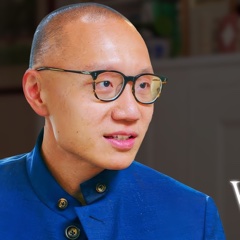
Dan Wang
Writer and China analyst, author of Breakneck and the annual letters from China
Where to hear and read about Dan Wang1 episode or test

Dan Wang is a Kunming-born, Canada-raised writer and China analyst, author of Breakneck and of annual letters from China that built his reputation. The thing most worth learning from him is to publish one carefully shaped piece a year, pairing street-level detail with a committed answer to a big question.
And I was trying to bring down the average. I was trying to write one piece a year.
Why You Should Write Less Often (Dan Wang Interview)
Dan Wang: the story and the lessons
1Dan Wang's path from outsider to China writer
Wang moved from Kunming to Ottawa at seven and stayed an outsider. He is from Kunming in China's southwest, not the prosperous coasts. His family moved to Canada when he was seven and he grew up in Ottawa.
He says being an outsider in several places sharpened his sense that the world should be better than it is. Writing is driven by disappointment at the gap between what elites are and what they should be.
He became an autodidact by reading novels instead of coursework. As a philosophy major at the University of Rochester, he spent his time in the library basement reading novels rather than assigned texts. Poor grades meant grad school was never an option.
So he wrote for a general audience and aimed to be "syncretic", combining the big with the small and the formal with the informal. At 18 he had wanted to be a classical clarinetist.
His day job taught him which questions mattered. He wrote fast notes for hedge funds, endowments and pension clients, who were asking the same big questions about China that general readers had.
The public essay was the slower, more personal counterpart. His clients would "give no figs" about what he ate at a noodle shop in Qujing, so that material needed a different reader.
Wang built his network by fighting for it, and distrusts coasting elites. At Rochester he had to earn recognition. A Stanford graduate, by contrast, is plugged into the party scene on day one.
A LinkedIn search showed nearly all his smartest high school friends ended up in New York or San Francisco, and those cities disappointed him. He finds elites smart and ambitious but protective of their in-group.
2How Wang runs the annual letter
One considered essay a year built Wang's name. Six or seven annual letters made his reputation. He also placed essays in the Atlantic, Foreign Affairs and the New York Times.
Being deliberate did not mean quitting other work. The pace left room for a day job and occasional magazine pieces.
A January 1 deadline governs his whole year. Because the deadline is fixed, the year's work points at it and there is no mystery about what December holds.
He admits he blew the deadline twice. Because of the day job, he could only write in roughly the last ten days of December, while everyone else relaxed.
He dumps notes and stray sentences into one phone note all year. A single vast Apple Notes file holds what happened in the news, his evolving thoughts on it, and any good sentence that surfaces.
Sentences arrive while he listens to Mozart or eats a dumpling, and he saves them on the spot. At year end he shapes a disorganized pile instead of facing a blank page.
He picks the biggest question of the year and answers it. His 2021 letter took on the tech crackdown, how zero COVID would end, and what common prosperity meant. These were what his clients were asking.
He urges writers to find the subject that animates them and commit to an answer rather than only mapping the issues.
Wang treats each letter as a draft 1.5 of history and accepts errors. Reporters write the first draft and historians the final one. His essay sits in between.
He has been "embarrassed three times a day before breakfast" by things he got wrong. Zero COVID was expected to wind down gradually, and nobody foresaw the complete collapse the next year.
He argues platforms push writers to post too often. Substack and Twitter nudge toward a piece a week or even shorter. He would like to read most writers every quarter or month.
He wants the reflections and well-crafted sentences that look past the immediate headlines, and leaves breaking news to the Wall Street Journal.
Wang settles for 85% and wishes he had trimmed more. New Yorker essayists told him no writer gets above 85% satisfaction. He is about 85% satisfied with his book.
He wishes the letters had been better edited and trimmed, and says with another month on the book he would refine the links between sentences and paragraphs.
3How Wang builds a writing voice
Wang retypes great articles sentence by sentence to learn the choices. As a clarinetist he copied a Beethoven string quartet and a Mahler symphony note for note. He ported the exercise to New Yorker paragraphs.
It makes you ask whether a different adjective would fit or a sentence should run another way, so writing stops being random. Other authors work too.
He borrows irony and cadence from Stendhal and Mozart's comic operas. The Red and the Black is his favorite novel and he reread it a fourth time. Mozart's Da Ponte operas show how to be beautiful and ironic together.
He wants clean lines with a few flourishes, varying sentence length and structure so the reader is carried along.
He puts a few jokes into writing about a humorless subject. Official China is "one of the least funny entities", so he wants a slight element of Mozart in his prose.
Nearly every Mozart love song is ironic, and that layering is what he aims for.
Wang will build an essay around one beautiful sentence. He recommends collecting strong sentences early and polishing them, so the later structure has something to hang on.
A year with nothing due until year end lets him refine single lines as they arrive.
He refuses to be captured by a genre. Trade books chase audiences and formula, while academic books defend a discipline and need only satisfy tenure.
He points to Stephen Kotkin choosing Penguin Press for his Stalin biography. Wang skipped the dragons and red of typical China book covers.
4How Wang travels and reports on China
He travels with no agenda and organizes days around meals. He books a hotel, builds each day around three or four places to eat, and walks between them to stay hungry.
Walking "bombards" him with insight, such as spicy noodles or Chongqing's cliffs that let you enter a building at ground level, climb nine flights and exit at ground level again.
Wang pairs what he sees with analysis, not his own ecstasy. Travel writing fails when the writer's revelation cannot be passed on. He ties a bowl of noodles in the countryside to what Beijing wants from its people.
He zooms in on the concrete and then out to the argument, avoiding both anecdote and the tectonic-plates cliche.
He refuses to rest a piece on one expert. He criticizes reporterly books that relay one interviewee's view, such as one on Danish pension reform.
His alternative is to read the literature, interview several experts and check the data.
Wang says China cannot be understood from its capital. Nobody would explain the US through Washington alone, so China needs Shanghai, the windswept north, the rust-belt northeast and the informal southwest too.
He says China has no boring place. Ningxia grows wine grapes, the southeast around Guangzhou is seafood country, and the southwest is full of tea drinkers who don't like to hustle.
5What Wang knows about how China works
He reads China as friction between official and lived life. Official China lives in Xi Jinping's speeches and party magazines, pursued with "deadly seriousness". Informal life is "hardly serious", humorous and wonderful.
Xi tours villages swept clean for him, and people go back to ordinary life soon after he leaves.
Wang calls propaganda the Party's most important instrument. The other two are the organization department, which picks whom to promote, and the coercive security apparatus.
The 7 p.m. newscast reaches an estimated 300 to 400 million people a night. It reports bad news so it is believed, then shows what the state is doing about it.
He experienced Chinese censorship directly in 2022. His own site, danwang.co, was blocked, though China usually blocks giants like Wikipedia or the New York Times.
He asked the Canadian consul general in Shanghai whether to leave, since two Canadians had been taken hostage after Canada arrested Huawei's CFO. The cause may have been an algorithmic keyword, with no censor to ask.
He argues China's functional cities are a real freedom, but not intellectual freedom. Subway stations are close, logistics work and high-speed trains run. A San Francisco friend keeps car keys in a drawer in case burglars take the car too.
Intellectually China is not freer, because the state censors from above and nationalist mobs on Weibo police from below. Wang indicted the one-child policy and zero COVID in his book anyway.
Wang dislikes how phones now mediate Chinese social life. People in Shanghai cafes barely drink coffee or talk and mostly photograph each other. Some areas are rebuilt as wanghong, "famous on the internet", photo spots.
He calls this his least favorite part of Chinese culture today, while noting it is not unique to China.
6How Wang wrote Breakneck
He gave the book a throughline before writing it. Without a clear structure and narrative you are "moving pieces of facts around". The throughline also sells the 40 to 50 page proposal.
His agent Toby helped build the proposal, which he wrote largely in Barcelona. Several interested publishers allow an auction.
He kept going through the long middle by changing where he wrote. He worked at home in Ann Arbor and at his Yale Law School office, and his wife Sylvia arranged retreats in Austin, Da Nang and Barcelona.
He repeated a mantra to be a "calm, collected Canadian" who would meet his deadline.
Packaging and promotion took more work than he expected. The title Breakneck came almost last minute and replaced Move fast and break people. The cover avoids dragons and red.
After his Morning Joe appearance, his mother, a former TV news anchor, told him he looked terrible.
Wang tries to write history as not yet decided. He says good historians imagine counterfactuals. Events feel impossible before they happen and inevitable afterward.
He cites Franz Ferdinand's driver taking a wrong turn toward the assassin, and the Soviet collapse nobody expected.
Writing a book gave him x-ray vision as a reader. He can now tell what an author loves from what an editor forced in, such as the potted history of Mao's Cultural Revolution.
He suspects this is how Tyler Cowen reads so fast: skip the context and find the key analytical phrase.
7Wang on AI, learning and keeping his voice
He kept AI out of the book and out of his sentences. Early ChatGPT disappointed him with hallucinations and flat prose, and he wanted one last big project finished first. He may declare AI verboten in his writing.
"I want the sentences to come from within myself." He says the o3 model showed him how good it could become, and for a next book he would talk to AI much more to find research pieces.
He uses AI as an instant Tyler Cowen for ideas. He keeps a running list of questions for Cowen, then put them to ChatGPT, such as why Spain had a fierce Inquisition and Austria did not.
After rereading The Red and the Black he questioned it about what critics have said, while still doing research in books and databases.
Wang warns students who run everything through AI that they skip learning. At Stanford libraries, as a Hoover Institution fellow, he sees students running everything through ChatGPT, then watching TikTok.
He lived half his life without it, learning to read, build spreadsheets and use databases first, and advises doing the same.
He thinks learning should compound with age, not depreciate. Tyler Cowen taught him that the more you read, the faster you read. Wang prefers the Silicon Valley network-effects model over a machine that wears out.
He admires how Cowen reinvents his career and generously platforms interesting people.
He encourages books from people with real experience and a fresh view. He thinks being an author becomes a filter AI makes more valuable, and the story-then-point Gladwell formula is now copied and spent.
Personal experience that overturns consensus makes a durable book, since so much training data covers convention that writers must go around it to stand out.

Why You Should Write Less Often (Dan Wang Interview)
Dan Wang explains how he built a name with one carefully shaped essay a year instead of constant posting, mixing street-level texture with big analytical questions. The habit worth hearing is his year-long dump of notes and stray sentences into a phone, then a deadline sprint, plus copying great articles out sentence by sentence to learn the writer's choices.
Wang moved from Kunming to Ottawa at seven and stayed an outsider. He is from Kunming in China's southwest, not the prosperous coasts. His family moved to Canada when he was seven and he grew up in Ottawa.
He says being an outsider in several places sharpened his sense that the world should be better than it is. Writing is driven by disappointment at the gap between what elites are and what they should be.
He became an autodidact by reading novels instead of coursework. As a philosophy major at the University of Rochester, he spent his time in the library basement reading novels rather than assigned texts. Poor grades meant grad school was never an option.
So he wrote for a general audience and aimed to be "syncretic", combining the big with the small and the formal with the informal. At 18 he had wanted to be a classical clarinetist.
His day job taught him which questions mattered. He wrote fast notes for hedge funds, endowments and pension clients, who were asking the same big questions about China that general readers had.
The public essay was the slower, more personal counterpart. His clients would "give no figs" about what he ate at a noodle shop in Qujing, so that material needed a different reader.
Wang built his network by fighting for it, and distrusts coasting elites. At Rochester he had to earn recognition. A Stanford graduate, by contrast, is plugged into the party scene on day one.
A LinkedIn search showed nearly all his smartest high school friends ended up in New York or San Francisco, and those cities disappointed him. He finds elites smart and ambitious but protective of their in-group.
One considered essay a year built Wang's name. Six or seven annual letters made his reputation. He also placed essays in the Atlantic, Foreign Affairs and the New York Times.
Being deliberate did not mean quitting other work. The pace left room for a day job and occasional magazine pieces.
A January 1 deadline governs his whole year. Because the deadline is fixed, the year's work points at it and there is no mystery about what December holds.
He admits he blew the deadline twice. Because of the day job, he could only write in roughly the last ten days of December, while everyone else relaxed.
He dumps notes and stray sentences into one phone note all year. A single vast Apple Notes file holds what happened in the news, his evolving thoughts on it, and any good sentence that surfaces.
Sentences arrive while he listens to Mozart or eats a dumpling, and he saves them on the spot. At year end he shapes a disorganized pile instead of facing a blank page.
He picks the biggest question of the year and answers it. His 2021 letter took on the tech crackdown, how zero COVID would end, and what common prosperity meant. These were what his clients were asking.
He urges writers to find the subject that animates them and commit to an answer rather than only mapping the issues.
Wang treats each letter as a draft 1.5 of history and accepts errors. Reporters write the first draft and historians the final one. His essay sits in between.
He has been "embarrassed three times a day before breakfast" by things he got wrong. Zero COVID was expected to wind down gradually, and nobody foresaw the complete collapse the next year.
He argues platforms push writers to post too often. Substack and Twitter nudge toward a piece a week or even shorter. He would like to read most writers every quarter or month.
He wants the reflections and well-crafted sentences that look past the immediate headlines, and leaves breaking news to the Wall Street Journal.
Wang settles for 85% and wishes he had trimmed more. New Yorker essayists told him no writer gets above 85% satisfaction. He is about 85% satisfied with his book.
He wishes the letters had been better edited and trimmed, and says with another month on the book he would refine the links between sentences and paragraphs.
Wang retypes great articles sentence by sentence to learn the choices. As a clarinetist he copied a Beethoven string quartet and a Mahler symphony note for note. He ported the exercise to New Yorker paragraphs.
It makes you ask whether a different adjective would fit or a sentence should run another way, so writing stops being random. Other authors work too.
He borrows irony and cadence from Stendhal and Mozart's comic operas. The Red and the Black is his favorite novel and he reread it a fourth time. Mozart's Da Ponte operas show how to be beautiful and ironic together.
He wants clean lines with a few flourishes, varying sentence length and structure so the reader is carried along.
He puts a few jokes into writing about a humorless subject. Official China is "one of the least funny entities", so he wants a slight element of Mozart in his prose.
Nearly every Mozart love song is ironic, and that layering is what he aims for.
Wang will build an essay around one beautiful sentence. He recommends collecting strong sentences early and polishing them, so the later structure has something to hang on.
A year with nothing due until year end lets him refine single lines as they arrive.
He refuses to be captured by a genre. Trade books chase audiences and formula, while academic books defend a discipline and need only satisfy tenure.
He points to Stephen Kotkin choosing Penguin Press for his Stalin biography. Wang skipped the dragons and red of typical China book covers.
He travels with no agenda and organizes days around meals. He books a hotel, builds each day around three or four places to eat, and walks between them to stay hungry.
Walking "bombards" him with insight, such as spicy noodles or Chongqing's cliffs that let you enter a building at ground level, climb nine flights and exit at ground level again.
Wang pairs what he sees with analysis, not his own ecstasy. Travel writing fails when the writer's revelation cannot be passed on. He ties a bowl of noodles in the countryside to what Beijing wants from its people.
He zooms in on the concrete and then out to the argument, avoiding both anecdote and the tectonic-plates cliche.
He refuses to rest a piece on one expert. He criticizes reporterly books that relay one interviewee's view, such as one on Danish pension reform.
His alternative is to read the literature, interview several experts and check the data.
Wang says China cannot be understood from its capital. Nobody would explain the US through Washington alone, so China needs Shanghai, the windswept north, the rust-belt northeast and the informal southwest too.
He says China has no boring place. Ningxia grows wine grapes, the southeast around Guangzhou is seafood country, and the southwest is full of tea drinkers who don't like to hustle.
He reads China as friction between official and lived life. Official China lives in Xi Jinping's speeches and party magazines, pursued with "deadly seriousness". Informal life is "hardly serious", humorous and wonderful.
Xi tours villages swept clean for him, and people go back to ordinary life soon after he leaves.
Wang calls propaganda the Party's most important instrument. The other two are the organization department, which picks whom to promote, and the coercive security apparatus.
The 7 p.m. newscast reaches an estimated 300 to 400 million people a night. It reports bad news so it is believed, then shows what the state is doing about it.
He experienced Chinese censorship directly in 2022. His own site, danwang.co, was blocked, though China usually blocks giants like Wikipedia or the New York Times.
He asked the Canadian consul general in Shanghai whether to leave, since two Canadians had been taken hostage after Canada arrested Huawei's CFO. The cause may have been an algorithmic keyword, with no censor to ask.
He argues China's functional cities are a real freedom, but not intellectual freedom. Subway stations are close, logistics work and high-speed trains run. A San Francisco friend keeps car keys in a drawer in case burglars take the car too.
Intellectually China is not freer, because the state censors from above and nationalist mobs on Weibo police from below. Wang indicted the one-child policy and zero COVID in his book anyway.
Wang dislikes how phones now mediate Chinese social life. People in Shanghai cafes barely drink coffee or talk and mostly photograph each other. Some areas are rebuilt as wanghong, "famous on the internet", photo spots.
He calls this his least favorite part of Chinese culture today, while noting it is not unique to China.
He gave the book a throughline before writing it. Without a clear structure and narrative you are "moving pieces of facts around". The throughline also sells the 40 to 50 page proposal.
His agent Toby helped build the proposal, which he wrote largely in Barcelona. Several interested publishers allow an auction.
He kept going through the long middle by changing where he wrote. He worked at home in Ann Arbor and at his Yale Law School office, and his wife Sylvia arranged retreats in Austin, Da Nang and Barcelona.
He repeated a mantra to be a "calm, collected Canadian" who would meet his deadline.
Packaging and promotion took more work than he expected. The title Breakneck came almost last minute and replaced Move fast and break people. The cover avoids dragons and red.
After his Morning Joe appearance, his mother, a former TV news anchor, told him he looked terrible.
Wang tries to write history as not yet decided. He says good historians imagine counterfactuals. Events feel impossible before they happen and inevitable afterward.
He cites Franz Ferdinand's driver taking a wrong turn toward the assassin, and the Soviet collapse nobody expected.
Writing a book gave him x-ray vision as a reader. He can now tell what an author loves from what an editor forced in, such as the potted history of Mao's Cultural Revolution.
He suspects this is how Tyler Cowen reads so fast: skip the context and find the key analytical phrase.
He kept AI out of the book and out of his sentences. Early ChatGPT disappointed him with hallucinations and flat prose, and he wanted one last big project finished first. He may declare AI verboten in his writing.
"I want the sentences to come from within myself." He says the o3 model showed him how good it could become, and for a next book he would talk to AI much more to find research pieces.
He uses AI as an instant Tyler Cowen for ideas. He keeps a running list of questions for Cowen, then put them to ChatGPT, such as why Spain had a fierce Inquisition and Austria did not.
After rereading The Red and the Black he questioned it about what critics have said, while still doing research in books and databases.
Wang warns students who run everything through AI that they skip learning. At Stanford libraries, as a Hoover Institution fellow, he sees students running everything through ChatGPT, then watching TikTok.
He lived half his life without it, learning to read, build spreadsheets and use databases first, and advises doing the same.
He thinks learning should compound with age, not depreciate. Tyler Cowen taught him that the more you read, the faster you read. Wang prefers the Silicon Valley network-effects model over a machine that wears out.
He admires how Cowen reinvents his career and generously platforms interesting people.
He encourages books from people with real experience and a fresh view. He thinks being an author becomes a filter AI makes more valuable, and the story-then-point Gladwell formula is now copied and spent.
Personal experience that overturns consensus makes a durable book, since so much training data covers convention that writers must go around it to stand out.