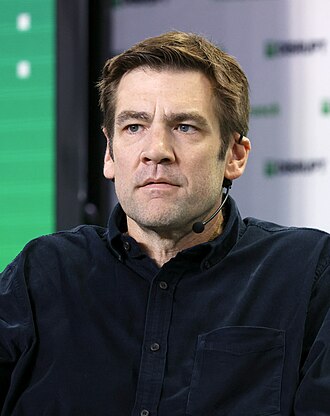
Chris Dixon
Venture capitalist, early tech blogger and author of Read Write Own
Where to hear and read about Chris Dixon1 episode or test

Chris Dixon is a venture capitalist who built and sold two companies, built his career through years of public blogging, and wrote the book Read Write Own. The most useful thing to learn from him is how to make an idea simple, concrete and honest through repeated rewrites, outside readers and fresh rereads.
I sort of feel like everything should be simple and if it's not simple, then I haven't thought about it enough.
How Blogging Made This Investor a Deca-Millionaire — Chris Dixon
Chris Dixon: the story and the lessons
1How blogging built Chris Dixon's career
Dixon began blogging around 2008 after a philosophy degree and two startups. He earned a master's in philosophy, started two internet startups, then switched to investing in them. He started the blog when social media was rising and he felt he had a lot to say.
Both his parents were English professors, but he says he did not yet know how to write.
Almost nobody read his blog for the first year. Readership arrived only when Fred Wilson linked to one of his posts.
His takeaway is that you have to enjoy the writing, because the early payoff is close to nothing.
About 10 of roughly 500 posts went viral. He wrote about 500 posts over roughly four years, close to one every week or two. Around 490 probably missed, and the few that landed are the ones people remember.
Readers did the filtering for him. He later drifted to Twitter as work and life took over.
Blogging moved him from New York's minor leagues to top Silicon Valley circles. His first startup was a security company that was not well known. He credits almost all of his move to a big Silicon Valley firm to his writing.
He expected everyone to copy this and is surprised blogging stayed a niche art, with Tyler Cowen and Fred Wilson among the few still at it.
At about 11, Dixon wrote to Apple and got a box of books. In Springfield, Ohio, he had a computer and no manual, so he wrote to Apple. Alan Kay replied and sent a giant box of books.
He says polite letters to Fortune 500 CEOs still get answers, while angry ones go to legal.
2How Dixon wrote Read Write Own
He wrote the book because the public misunderstood blockchains. He saw a huge gap between crypto's public image of scams and casinos and what he sees in blockchains. He called it 'the greatest opportunity in my career to write a book'.
He also wrote it to test himself, since long-form forces you to show every step, which is why Bezos banned PowerPoint at Amazon. After writing out the argument he concluded he was not crazy.
He drafted fast, then rewrote for about a year. The first two-thirds took a month or two to draft. The whole book took about 12 months, with thousands of iterations.
The last third covers seven standalone application areas for blockchains. The book follows the history of the internet so abstract ideas get data and stories.
He cut the book into short standalone sections with plain titles. His first draft used chapters. Getting it down to sections of a few pages with simple titles took a long time. 'Software as LEGO bricks' made composability clear at once, where a definition had left a curious reader cold.
His editor found the cross-references, which work like hyperlinks, eccentric. Dixon likens the modular layout to engineering habits.
He kept a plain three-word title against early readers' advice. The words name the read era, the write era and the own era. Early readers said it was obscure and should be called blockchains or web3, and Dixon held firm.
Simple words signal that every reader is welcome. The publisher used Random House's low-punctuation style and the Caslon typeface from 1722 to make it feel approachable.
Dixon hired an outside fact-checker and gave her no limits. Laura Fox, who has magazine experience, was told to find any mistakes. She fixed wrong dates and attributions and found a strong quote from the Read Write Web blog.
He knew the book would be checked by the world. Dixon did not coin 'read write'. He added 'own'.
3Dixon's rewrite passes for simple writing
He cut nearly every adjective, adverb and crutch word. His biggest rewrite removed almost every adjective and adverb. Phrases like 'genuine ownership' and 'strong commitment' forced him to ask what they actually meant.
'Every time there's like a word very, what that really means is I haven't explained it well enough.' He shows consequences and tells the story instead.
He fixed passive voice by finding out who actually acted. Flipping the grammar does not work if you do not know who did the thing. 'The internet was built to be a decentralized system' became a story about Vint Cerf or Tim Berners-Lee doing something.
He says you cannot paste text into ChatGPT and ask for active voice. 'You need to go do the work of like what happened, right? Like tell a story.'
His philosophy professors trained him to choose the simpler word. They marked pretentious diction with red pen and wanted the simpler word whenever one existed. In analytic philosophy the best work has almost no jargon or footnotes.
In the book he defines every uncommon word and almost never uses 'decentralization'.
He opens each section with an anecdote and ends by returning to it. The order is anecdote, main argument, supporting arguments, the strongest counterarguments, replies, then a tie back to the opening.
It gives each section emotion and rigor. He warns it becomes formulaic if overused.
He learned to name exactly what is wrong in a draft. His ear ran ahead of his ability to fix his own writing. He could sense something was off but not why.
Writing the book closed the gap. He can now name the cause quickly: a wrong topic sentence, a misplaced clause, bad word choice, too much telling, or a weak transition.
4How Dixon works and gets feedback
His blog posts carried one concept in about four paragraphs. Each post captured one new idea from that week's conversations. Longer posts got less attention, and shorter ones could not state an idea.
'Probably the sweet spot was like four paragraphs.'
His best one-liners came out of conversations, not solitary thinking. 'Come for the tool, stay for the network' came from explaining a strategy to an entrepreneur in a meeting. His job of talking to smart people all day keeps refining his ideas.
When he is stuck, he explains the problem to a friend until the line surfaces. A one-liner then gives structure, and anything off it gets cut.
He treats a tangled section as a missing distinction. When things feel jumbled, he assumes he lacks the right concept, not the right words. He keeps simplifying, often while exercising. The finance and social networking sections took about 50 iterations each.
He writes in the morning and gets three or four creative hours.
He sent forked drafts to about 20 close readers. General readers, technologists and lawyers commented on almost every paragraph, with notes like 'I don't buy this argument' or 'this phrase didn't land'. He merged each forked Google Doc back into the master.
Word with Dropbox was a nightmare for version control. Google Docs worked, but a comment limit made it buggy, so he copied to a new doc every two weeks. Former-journalist colleague Robert Hackett helped a great deal.
He reread the whole book only after a two-week gap. Without the gap he could not spot repetition, omission, or an idea picked up on page 60 that was explained on page 30. Early drafts re-explained composability too often.
While waiting for fresh eyes, he worked on one stubborn section at a time.
He changed his lifestyle to finish the book. That meant exercise, early bedtimes and colleagues picking up slack.
He notes not everyone has that kind of support.
5Dixon's mistakes on the book and what he changed
His first draft was abstract, passive and sometimes encyclopedic. It was too abstract and relied on telling, not showing. A friendly reader called some sections encyclopedic, meaning lists with no narrative, structure or story.
The fix was concrete anecdotes and the right analogy or metaphor for each abstract idea.
He first raised objections only to dismiss them. The draft was defensive. In the rewrite, Moxie Marlinspike's objection became 'that's a good argument', and Dixon drew design lessons from it.
Steelmanning the other side keeps the writing intellectually honest.
He overclaimed on governance and pulled the claim back. The governance section first said blockchains give much better governance, which was too strong. It now says they open a richer design space, but nobody has found the best design.
Layering reader comments onto the draft wrecked its structure. He took two weeks off in a beach house and worked alone through every comment, thinking the book was nearly done. A fresh read left him horrified, because the fixes were layered over each other.
Restructuring took about four more months.
Dixon admits two chapters never fully worked. The composability chapter, the most abstract concept, took longest and worked best. Two other chapters he feels he never cracked.
He concluded some parts simply have to convey information.
6What Dixon thinks is worth writing, and when to write a book
Write an earned secret that the world misunderstands. Using Peter Thiel's test, a good secret is something true that most people have not noticed, learned by doing the work. A phone with longer battery life is no secret, because Apple already has a large lab on it.
Zuckerberg's secret was that people would want to socialize online. Gates's was that you could make money selling software while everyone thought computer makers earned it from machines.
His default advice is to write a blog post, not a book. A book is worth writing only when the argument can't be compressed into posts. His covers internet history, blockchains and future uses in about 213 pages.
Books carry cultural weight bloggers lack. The best-selling non-romance nonfiction book of the previous year sold about 400,000 copies, and a hobbyist website can get a million views.
He hopes the book becomes someone's canon event. A book may reach fewer people than a blog post, but it can change a small group of them for good.
Canon event is a term from Spider-Verse 2. He hopes someone tells him in ten years that the book was theirs.
Dixon thinks most business books fail because authors can't tell the truth. Business people face heavy constraints on what they can say, so they skip the messy parts or don't write the book themselves. A bestseller he read felt fake because it left out the chaos of any large project.
He says the honest version would be a roman à clef, where everything happened but names, dates and events are changed.
7Dixon on platforms, creators and AI
Platforms reversed the promise of 1000 true fans. Kevin Kelly's idea, written in the early 2000s, said removing intermediaries would let creators serve niches. Now opaque algorithms steer creators toward mass appeal.
Dixon is most angry about recency bias. Kelly's blurb on the book says it changed his mind about blockchains.
Platforms keep most of the money creators generate. An author keeps 15% and YouTube shares 45%. Facebook earns about $150 billion a year in ads and shares none of it.
Spotify takes 30%, and labels take another large share.
He sees technology emptying the middle and rewarding both ends. In retail, JCPenney, Sears and Kmart went bankrupt or are close to it, while Amazon and Walmart won on cost and Gucci and LVMH on high-touch boutiques. Blogs and magazines are dying too.
Books held up, with revenues flat or slightly up, because the internet changed how people find books, not whether they buy them.
He uses AI as a copilot and keeps his own voice. His ChatGPT experiments were impressive, but the output was not his voice or quality. He would want a smart editor that flags passive voice, suggests clause moves and recalls what he already explained.
'If you have the machine do all of it, you're going to at least for the near term lose the voice and the humanity of it.' A ZeroGPT check scored his book at about 0%.
Dixon reads 50 pages of a book every day. He calls books the protein of the mind and picked 50 pages because after that he usually wants 50 more.
He sees social media as in its sugary-cereal phase and expects people to find a better balance, as new media first imitate the old.

How Blogging Made This Investor a Deca-Millionaire — Chris Dixon
Chris Dixon explains how a year of short weekly blog posts, then a book rewritten over many months, taught him to make ideas simple, concrete and honest. The most useful parts are his specific rewrite passes (cut crutch words, fix passive voice, steelman objections) and his habit of using outside readers and fresh rereads to catch what he cannot see.
Dixon began blogging around 2008 after a philosophy degree and two startups. He earned a master's in philosophy, started two internet startups, then switched to investing in them. He started the blog when social media was rising and he felt he had a lot to say.
Both his parents were English professors, but he says he did not yet know how to write.
Almost nobody read his blog for the first year. Readership arrived only when Fred Wilson linked to one of his posts.
His takeaway is that you have to enjoy the writing, because the early payoff is close to nothing.
About 10 of roughly 500 posts went viral. He wrote about 500 posts over roughly four years, close to one every week or two. Around 490 probably missed, and the few that landed are the ones people remember.
Readers did the filtering for him. He later drifted to Twitter as work and life took over.
Blogging moved him from New York's minor leagues to top Silicon Valley circles. His first startup was a security company that was not well known. He credits almost all of his move to a big Silicon Valley firm to his writing.
He expected everyone to copy this and is surprised blogging stayed a niche art, with Tyler Cowen and Fred Wilson among the few still at it.
At about 11, Dixon wrote to Apple and got a box of books. In Springfield, Ohio, he had a computer and no manual, so he wrote to Apple. Alan Kay replied and sent a giant box of books.
He says polite letters to Fortune 500 CEOs still get answers, while angry ones go to legal.
He wrote the book because the public misunderstood blockchains. He saw a huge gap between crypto's public image of scams and casinos and what he sees in blockchains. He called it 'the greatest opportunity in my career to write a book'.
He also wrote it to test himself, since long-form forces you to show every step, which is why Bezos banned PowerPoint at Amazon. After writing out the argument he concluded he was not crazy.
He drafted fast, then rewrote for about a year. The first two-thirds took a month or two to draft. The whole book took about 12 months, with thousands of iterations.
The last third covers seven standalone application areas for blockchains. The book follows the history of the internet so abstract ideas get data and stories.
He cut the book into short standalone sections with plain titles. His first draft used chapters. Getting it down to sections of a few pages with simple titles took a long time. 'Software as LEGO bricks' made composability clear at once, where a definition had left a curious reader cold.
His editor found the cross-references, which work like hyperlinks, eccentric. Dixon likens the modular layout to engineering habits.
He kept a plain three-word title against early readers' advice. The words name the read era, the write era and the own era. Early readers said it was obscure and should be called blockchains or web3, and Dixon held firm.
Simple words signal that every reader is welcome. The publisher used Random House's low-punctuation style and the Caslon typeface from 1722 to make it feel approachable.
Dixon hired an outside fact-checker and gave her no limits. Laura Fox, who has magazine experience, was told to find any mistakes. She fixed wrong dates and attributions and found a strong quote from the Read Write Web blog.
He knew the book would be checked by the world. Dixon did not coin 'read write'. He added 'own'.
He cut nearly every adjective, adverb and crutch word. His biggest rewrite removed almost every adjective and adverb. Phrases like 'genuine ownership' and 'strong commitment' forced him to ask what they actually meant.
'Every time there's like a word very, what that really means is I haven't explained it well enough.' He shows consequences and tells the story instead.
He fixed passive voice by finding out who actually acted. Flipping the grammar does not work if you do not know who did the thing. 'The internet was built to be a decentralized system' became a story about Vint Cerf or Tim Berners-Lee doing something.
He says you cannot paste text into ChatGPT and ask for active voice. 'You need to go do the work of like what happened, right? Like tell a story.'
His philosophy professors trained him to choose the simpler word. They marked pretentious diction with red pen and wanted the simpler word whenever one existed. In analytic philosophy the best work has almost no jargon or footnotes.
In the book he defines every uncommon word and almost never uses 'decentralization'.
He opens each section with an anecdote and ends by returning to it. The order is anecdote, main argument, supporting arguments, the strongest counterarguments, replies, then a tie back to the opening.
It gives each section emotion and rigor. He warns it becomes formulaic if overused.
He learned to name exactly what is wrong in a draft. His ear ran ahead of his ability to fix his own writing. He could sense something was off but not why.
Writing the book closed the gap. He can now name the cause quickly: a wrong topic sentence, a misplaced clause, bad word choice, too much telling, or a weak transition.
His blog posts carried one concept in about four paragraphs. Each post captured one new idea from that week's conversations. Longer posts got less attention, and shorter ones could not state an idea.
'Probably the sweet spot was like four paragraphs.'
His best one-liners came out of conversations, not solitary thinking. 'Come for the tool, stay for the network' came from explaining a strategy to an entrepreneur in a meeting. His job of talking to smart people all day keeps refining his ideas.
When he is stuck, he explains the problem to a friend until the line surfaces. A one-liner then gives structure, and anything off it gets cut.
He treats a tangled section as a missing distinction. When things feel jumbled, he assumes he lacks the right concept, not the right words. He keeps simplifying, often while exercising. The finance and social networking sections took about 50 iterations each.
He writes in the morning and gets three or four creative hours.
He sent forked drafts to about 20 close readers. General readers, technologists and lawyers commented on almost every paragraph, with notes like 'I don't buy this argument' or 'this phrase didn't land'. He merged each forked Google Doc back into the master.
Word with Dropbox was a nightmare for version control. Google Docs worked, but a comment limit made it buggy, so he copied to a new doc every two weeks. Former-journalist colleague Robert Hackett helped a great deal.
He reread the whole book only after a two-week gap. Without the gap he could not spot repetition, omission, or an idea picked up on page 60 that was explained on page 30. Early drafts re-explained composability too often.
While waiting for fresh eyes, he worked on one stubborn section at a time.
He changed his lifestyle to finish the book. That meant exercise, early bedtimes and colleagues picking up slack.
He notes not everyone has that kind of support.
His first draft was abstract, passive and sometimes encyclopedic. It was too abstract and relied on telling, not showing. A friendly reader called some sections encyclopedic, meaning lists with no narrative, structure or story.
The fix was concrete anecdotes and the right analogy or metaphor for each abstract idea.
He first raised objections only to dismiss them. The draft was defensive. In the rewrite, Moxie Marlinspike's objection became 'that's a good argument', and Dixon drew design lessons from it.
Steelmanning the other side keeps the writing intellectually honest.
He overclaimed on governance and pulled the claim back. The governance section first said blockchains give much better governance, which was too strong. It now says they open a richer design space, but nobody has found the best design.
Layering reader comments onto the draft wrecked its structure. He took two weeks off in a beach house and worked alone through every comment, thinking the book was nearly done. A fresh read left him horrified, because the fixes were layered over each other.
Restructuring took about four more months.
Dixon admits two chapters never fully worked. The composability chapter, the most abstract concept, took longest and worked best. Two other chapters he feels he never cracked.
He concluded some parts simply have to convey information.
Write an earned secret that the world misunderstands. Using Peter Thiel's test, a good secret is something true that most people have not noticed, learned by doing the work. A phone with longer battery life is no secret, because Apple already has a large lab on it.
Zuckerberg's secret was that people would want to socialize online. Gates's was that you could make money selling software while everyone thought computer makers earned it from machines.
His default advice is to write a blog post, not a book. A book is worth writing only when the argument can't be compressed into posts. His covers internet history, blockchains and future uses in about 213 pages.
Books carry cultural weight bloggers lack. The best-selling non-romance nonfiction book of the previous year sold about 400,000 copies, and a hobbyist website can get a million views.
He hopes the book becomes someone's canon event. A book may reach fewer people than a blog post, but it can change a small group of them for good.
Canon event is a term from Spider-Verse 2. He hopes someone tells him in ten years that the book was theirs.
Dixon thinks most business books fail because authors can't tell the truth. Business people face heavy constraints on what they can say, so they skip the messy parts or don't write the book themselves. A bestseller he read felt fake because it left out the chaos of any large project.
He says the honest version would be a roman à clef, where everything happened but names, dates and events are changed.
Platforms reversed the promise of 1000 true fans. Kevin Kelly's idea, written in the early 2000s, said removing intermediaries would let creators serve niches. Now opaque algorithms steer creators toward mass appeal.
Dixon is most angry about recency bias. Kelly's blurb on the book says it changed his mind about blockchains.
Platforms keep most of the money creators generate. An author keeps 15% and YouTube shares 45%. Facebook earns about $150 billion a year in ads and shares none of it.
Spotify takes 30%, and labels take another large share.
He sees technology emptying the middle and rewarding both ends. In retail, JCPenney, Sears and Kmart went bankrupt or are close to it, while Amazon and Walmart won on cost and Gucci and LVMH on high-touch boutiques. Blogs and magazines are dying too.
Books held up, with revenues flat or slightly up, because the internet changed how people find books, not whether they buy them.
He uses AI as a copilot and keeps his own voice. His ChatGPT experiments were impressive, but the output was not his voice or quality. He would want a smart editor that flags passive voice, suggests clause moves and recalls what he already explained.
'If you have the machine do all of it, you're going to at least for the near term lose the voice and the humanity of it.' A ZeroGPT check scored his book at about 0%.
Dixon reads 50 pages of a book every day. He calls books the protein of the mind and picked 50 pages because after that he usually wants 50 more.
He sees social media as in its sugary-cereal phase and expects people to find a better balance, as new media first imitate the old.