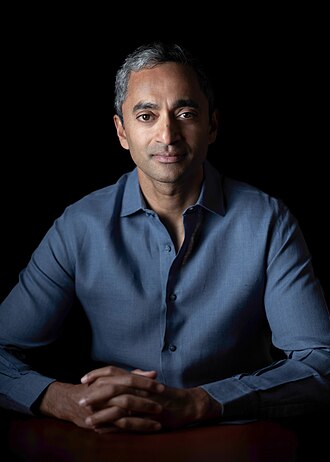
Chamath Palihapitiya
Venture capitalist and founder of Social Capital
Where to hear and read about Chamath Palihapitiya1 episode or test

Chamath Palihapitiya is a venture capitalist and the founder of Social Capital, who writes a widely read annual letter and long posts on Twitter. The most useful thing to learn from him is his writing structure: a punchy hook, a clear line between fact and interpretation, and a conclusion that repays the reader's time.
it's very important to be able to separate what is fact and what is interpretation
Write Like a Billionaire | Chamath Palihapitiya | How I Write Podcast
Chamath Palihapitiya: the story and the lessons
1Why Chamath Palihapitiya writes
Palihapitiya sees writing as a way to put ideas in front of capital. He argues that written ideas let money vote on the good ones, and more money in good ideas turns more of them into good things in the world.
He says he wants to be a small part of documenting capitalism, and that bad ideas with too much money widen the gap between what could be and what is.
A reader of his annual letters led to a cancer test. A reader wrote to the firm's public inbox. Three years later the firm has a stage zero bladder cancer test and is working on one for prostate cancer.
A long Twitter post on one company also led a senior chemist to ask for an introduction to its CEO. He credits the CEO with closing the hire and gives writing 1% of it, the part that earned the first look.
He writes his annual letter for his future self. The letter gets about a million page views, but most readers get through only 10 to 20% of it. He is the one person sure to reread it.
So it records what he learned, tried and got wrong, and ignores what others want documented. He keeps one running phone note all year, gives it structure in February or March, has his team dig into the research, and writes the intro, ending and connective tissue himself.
He learned to write by rereading Warren Buffett's letters. He keeps a printed binder of every Buffett letter, indexed by year, and has reread some of them 20 or 30 times.
He calls Buffett consistently good every year, in content and style, unlike other writers of public letters who are good only now and then.
Facebook and AOL taught him when writing matters. At AOL, after a failed hundred billion dollar merger, writing was the neutral record used to judge people. At Facebook, a few dashboards were the source of truth and communication got sloppy.
At Facebook he dialed his style down from an eight to a four, cruder and more colloquial, so 22-year-olds would not see him as lame. He says his writing got slightly worse because it did not matter there.
2Palihapitiya's structure for a piece that gets read
He borrowed Facebook's growth cycle to structure his writing. Open with a hook, then a short TL;DR, then the explanation, then a conclusion. This mirrors acquisition, activation, engagement and virality.
Alex Schulz, who came from eBay and is now Facebook's CMO, taught him the framework. He says Buffett's letters and Good to Great follow the same shape.
He keeps fact and interpretation visibly separate. He marks where objective material ends and his opinion begins, in plainly labeled sections, so readers can drop the opinion and keep the facts.
He cites a finding that only about 30% of papers in Cell, Science and Nature are reproducible, yet readers treat them as pure fact. He recalls Michael Mauboussin using one highlighter for objective text and one for subjective. The lesson is not that everything should be objective, only that the two stay apart.
Mixed fact and opinion makes him stop reading. When a writer blends the two, he has to work out whether he is being informed or steered, and he quits at that point.
He says he will throw most of the subjective part away, but he values a clear boundary: "bad writing is when you don't know what you're getting."
He ends conclusively so the reader's time is repaid. He treats three minutes of silent reading as a real payment, and the ending should be overwhelmingly objective and leave the reader better off.
The reader may disagree, but should feel the time was worth it.
He writes the intro, table and conclusion for scanners. Because most readers take in 10 to 20% of a long letter, he puts his own effort into the parts they will read and lets his team build the data sections.
He also reads Bloomberg partly for its graphics and says building around charts pushes him toward the objective.
He practices with three to five long posts a week. One letter a year leaves a writer rusty, and short tweets do not build the muscle either, so he writes long threads on Twitter.
Each time he asks how to stay objective, mark the subjectivity, be punchy, give the TL;DR and conclude objectively.
He starts with a point and a name for the reader's problem. He says throwing shade in comments adds nothing to the world's knowledge, and he judges his pieces by whether they are slightly additive.
He praises Adult Children of Alcoholics for naming each dysfunction by chapter so readers saw themselves, and for offering coping mechanisms instead of an answer key.
3How Palihapitiya edits and manages his own emotions
He writes in two modes, cold on paper and fiery online. For learning he uses pen and paper with diagrams to dissect ideas, which helps precision and recall. Online, mostly on Twitter, his writing is reactive.
He says online writing can take on a life of its own, and that being the center of attention on Twitter for 24 hours is very destabilizing.
He writes the unsayable version in a doc, then deletes it. When he wants to lash out or feels insecure, he writes what he really wants to say in a Google doc and deletes it.
Deleting it releases the hurt, so he can return to what he actually wants to communicate.
He edits a post 20 or 30 times, waiting less each round. He rereads drafts after an hour, then 20 minutes, then 5. When the gaps shrink and edits stop changing anything, he publishes.
Each pass asks whether the piece is interesting, factual and true.
He asks whether each line is insecurity or truth. If a line is his insecurity talking and not something he learned or can support, he cuts it.
He calls the process therapeutic.
He believes online reactions reveal the reactor, not him. He says explaining an idea so it spreads is under 1% of communication and the other 99% is psychology, so real-time replies are a snapshot of the sender's mood.
He admits it took him a long time to believe this because it is hard to pause in the moment.
4Where Palihapitiya says fear has made his writing guarded
Success and stakeholders have drained the rawness from his writing. He says his reach is at a global maximum, but his voice is at a local minimum. His old Quora answers were raw and instinctual, written when he had no stakeholders.
He now chokes up on the bat. Writing is permanent, and a blunt "this thing sucks" could stop someone from joining a company.
He admits his reliance on facts is partly a shield. He describes a 51-to-49 "politician syndrome", where half of readers like you and half hate you, and says it makes him second guess his better instincts.
He puts returns at the top of his letters for the same reason. He considered stripping the letter to a raw two pages but says he can't, because there are winners and losers on both sides of what he does.
He plans to draft out loud on a walk. David Perell's suggestion is to record himself walking and talking, transcribe it with GPT-4 style tools, and write from the transcript.
The aim is a first draft that comes from passion and not fear. Chamath agrees he reads repression in his current writing and that this could help.
He thinks very little prose is good, and subjective prose is rarest. He guesses 98% of prose is trashy, 1% is good fact and 1% is good subjective prose, and says a good writer aims at those last 2%.
He names René Girard as subjective, with no data behind his conclusions, yet a deep influence on him.

Write Like a Billionaire | Chamath Palihapitiya | How I Write Podcast
Chamath Palihapitiya explains how he writes long, factual pieces that readers finish and that attract people to his ideas, and how fear of public reaction has made his writing guarded. The technique worth hearing is his acquisition, activation, engagement, virality structure combined with a hard line between fact and interpretation.
Palihapitiya sees writing as a way to put ideas in front of capital. He argues that written ideas let money vote on the good ones, and more money in good ideas turns more of them into good things in the world.
He says he wants to be a small part of documenting capitalism, and that bad ideas with too much money widen the gap between what could be and what is.
A reader of his annual letters led to a cancer test. A reader wrote to the firm's public inbox. Three years later the firm has a stage zero bladder cancer test and is working on one for prostate cancer.
A long Twitter post on one company also led a senior chemist to ask for an introduction to its CEO. He credits the CEO with closing the hire and gives writing 1% of it, the part that earned the first look.
He writes his annual letter for his future self. The letter gets about a million page views, but most readers get through only 10 to 20% of it. He is the one person sure to reread it.
So it records what he learned, tried and got wrong, and ignores what others want documented. He keeps one running phone note all year, gives it structure in February or March, has his team dig into the research, and writes the intro, ending and connective tissue himself.
He learned to write by rereading Warren Buffett's letters. He keeps a printed binder of every Buffett letter, indexed by year, and has reread some of them 20 or 30 times.
He calls Buffett consistently good every year, in content and style, unlike other writers of public letters who are good only now and then.
Facebook and AOL taught him when writing matters. At AOL, after a failed hundred billion dollar merger, writing was the neutral record used to judge people. At Facebook, a few dashboards were the source of truth and communication got sloppy.
At Facebook he dialed his style down from an eight to a four, cruder and more colloquial, so 22-year-olds would not see him as lame. He says his writing got slightly worse because it did not matter there.
He borrowed Facebook's growth cycle to structure his writing. Open with a hook, then a short TL;DR, then the explanation, then a conclusion. This mirrors acquisition, activation, engagement and virality.
Alex Schulz, who came from eBay and is now Facebook's CMO, taught him the framework. He says Buffett's letters and Good to Great follow the same shape.
He keeps fact and interpretation visibly separate. He marks where objective material ends and his opinion begins, in plainly labeled sections, so readers can drop the opinion and keep the facts.
He cites a finding that only about 30% of papers in Cell, Science and Nature are reproducible, yet readers treat them as pure fact. He recalls Michael Mauboussin using one highlighter for objective text and one for subjective. The lesson is not that everything should be objective, only that the two stay apart.
Mixed fact and opinion makes him stop reading. When a writer blends the two, he has to work out whether he is being informed or steered, and he quits at that point.
He says he will throw most of the subjective part away, but he values a clear boundary: "bad writing is when you don't know what you're getting."
He ends conclusively so the reader's time is repaid. He treats three minutes of silent reading as a real payment, and the ending should be overwhelmingly objective and leave the reader better off.
The reader may disagree, but should feel the time was worth it.
He writes the intro, table and conclusion for scanners. Because most readers take in 10 to 20% of a long letter, he puts his own effort into the parts they will read and lets his team build the data sections.
He also reads Bloomberg partly for its graphics and says building around charts pushes him toward the objective.
He practices with three to five long posts a week. One letter a year leaves a writer rusty, and short tweets do not build the muscle either, so he writes long threads on Twitter.
Each time he asks how to stay objective, mark the subjectivity, be punchy, give the TL;DR and conclude objectively.
He starts with a point and a name for the reader's problem. He says throwing shade in comments adds nothing to the world's knowledge, and he judges his pieces by whether they are slightly additive.
He praises Adult Children of Alcoholics for naming each dysfunction by chapter so readers saw themselves, and for offering coping mechanisms instead of an answer key.
He writes in two modes, cold on paper and fiery online. For learning he uses pen and paper with diagrams to dissect ideas, which helps precision and recall. Online, mostly on Twitter, his writing is reactive.
He says online writing can take on a life of its own, and that being the center of attention on Twitter for 24 hours is very destabilizing.
He writes the unsayable version in a doc, then deletes it. When he wants to lash out or feels insecure, he writes what he really wants to say in a Google doc and deletes it.
Deleting it releases the hurt, so he can return to what he actually wants to communicate.
He edits a post 20 or 30 times, waiting less each round. He rereads drafts after an hour, then 20 minutes, then 5. When the gaps shrink and edits stop changing anything, he publishes.
Each pass asks whether the piece is interesting, factual and true.
He asks whether each line is insecurity or truth. If a line is his insecurity talking and not something he learned or can support, he cuts it.
He calls the process therapeutic.
He believes online reactions reveal the reactor, not him. He says explaining an idea so it spreads is under 1% of communication and the other 99% is psychology, so real-time replies are a snapshot of the sender's mood.
He admits it took him a long time to believe this because it is hard to pause in the moment.
Success and stakeholders have drained the rawness from his writing. He says his reach is at a global maximum, but his voice is at a local minimum. His old Quora answers were raw and instinctual, written when he had no stakeholders.
He now chokes up on the bat. Writing is permanent, and a blunt "this thing sucks" could stop someone from joining a company.
He admits his reliance on facts is partly a shield. He describes a 51-to-49 "politician syndrome", where half of readers like you and half hate you, and says it makes him second guess his better instincts.
He puts returns at the top of his letters for the same reason. He considered stripping the letter to a raw two pages but says he can't, because there are winners and losers on both sides of what he does.
He plans to draft out loud on a walk. David Perell's suggestion is to record himself walking and talking, transcribe it with GPT-4 style tools, and write from the transcript.
The aim is a first draft that comes from passion and not fear. Chamath agrees he reads repression in his current writing and that this could help.
He thinks very little prose is good, and subjective prose is rarest. He guesses 98% of prose is trashy, 1% is good fact and 1% is good subjective prose, and says a good writer aims at those last 2%.
He names René Girard as subjective, with no data behind his conclusions, yet a deep influence on him.