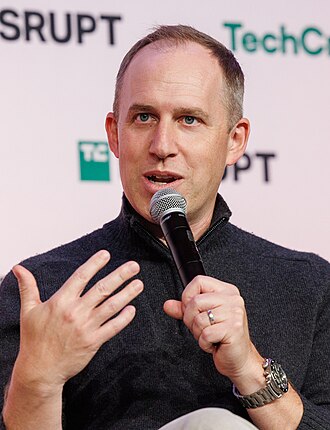
Bret Taylor
Founder and CEO of Sierra; chairman of the board at OpenAI; former co-CEO of Salesforce, CTO of Facebook, co-creator of Google Maps
Where to hear and read about Bret Taylor1 episode or test

Bret Taylor is the founder and CEO of Sierra and chairman of OpenAI, and he earlier co-created Google Maps, served as CTO of Facebook and was co-CEO of Salesforce. The most useful thing to learn from him is to ask daily what is most impactful, check the answer against honest outside views, and build AI agents that complete a job and are paid by outcome.
What is the most impactful thing I can do today?
He saved OpenAI, invented the “Like” button, and built Google Maps: Bret Taylor (Sierra)
Bret Taylor: the story and the lessons
1Bret Taylor's career from Google to Sierra
Taylor has built at every level, from associate product manager to founder. He co-created Google Maps, co-founded FriendFeed, became CTO of Facebook, then co-CEO of Salesforce. His productivity company Quip sold to Salesforce for $750 million.
He was chairman of the board at Twitter and is chairman at OpenAI. His current company, Sierra, builds AI agents for customer service, sales and more.
He calls himself a builder and sees companies as the best way to build. Colleagues remember him differently: an engineer at Facebook, a product person at Google, a suit at Salesforce. He treats his identity as flexible enough to grow into whatever the company needs.
He says a founder must sell to investors, candidates and customers, and must have design taste and engineering skill.
His first Google job was growing the search index tenfold. He took the index from 1 billion to 10 billion web pages. That work led Marissa Mayer to hand him Google Local, his first big bet as a product manager.
2How Google Local's failure became Google Maps
Google Local flopped because it copied the Yellow Pages. It had a link on the Google homepage next to Web and Images and still did poorly. Local search was also hard because the content was not online and users wanted plumbers in their own city.
He now sees it as "a little bit of a me too version of Yahoo Yellow Pages".
A harsh product review gave him a second chance, not a firing. Marissa Mayer and Larry Page reviewed Local harshly. He felt his reputation fading, from hot-shot new PM to someone on a second try.
He did not think it was his last shot, but he felt dejected. The V2 question was how to build something more compelling than a digital directory.
The team made the most mocked part of the product the centerpiece. The small licensed MapQuest map beside search results was the part the team joked about. They inverted the hierarchy, found Lars and Jens Rasmussen, and merged mapping, local search and driving directions.
Launch day drew about 10 million users, huge for the internet at that scale.
A new technology should create a new experience, not digitize an old one. Maps worked because it was native to the platform in a way a paper map could not be. Taylor asks why a user should pick a product over the alternative, not only what features it has.
His phrase was "disassembling the Lego set and reassembling into something new rather than just digitizing what was there before."
Satellite imagery gave Maps a viral reason to try it. Imagery from Keyhole, later Google Earth, arrived in August 2005 and drew 90 million users in one day. Maps even ended up on Saturday Night Live in Lazy Sunday.
Taylor calls it "the sizzle to the steak", not the most important part. Why people try a product and what keeps them are related but different, so plan for both.
3What FriendFeed and Facebook taught Taylor
FriendFeed lost to Twitter because it polished the product and ignored distribution. Eleven of its 12 people were engineers, and FriendFeed stayed up while Twitter's fail whale kept it down. Twitter focused on getting celebrities, and Obama, Ashton Kutcher and Oprah joined in one summer.
He says Google's AdWords riches meant PMs rarely learned distribution or business models. The team was myopic and did not ask outsiders what could go wrong.
The Like button began as a one-click comment to remove filler. At least 70% of FriendFeed comments were one-word replies like cool or wow, which crowded out real discussion. The first version used a heart.
A colleague, Anna Yang, said she would vomit seeing hearts on every post, and a heart fit badly on a story about a tragedy. The team chose a more neutral positive symbol.
Sheryl Sandberg's blunt feedback taught him to ask what is most impactful. After his Facebook group grew to over 1,000 people, he was doing okay but not great, because he shaped the job around what he liked, such as product and technology. Reframing it around what the mobile and platform teams needed made him better.
He sulked that night and admitted the next morning she was right. He realized he liked impact itself, not engineering, and became happy doing recruiting, sales and partnerships he once avoided.
Facebook made designers show newsfeed mock-ups with real, messy data. Newsfeed designs looked perfect in Photoshop and ugly once real photos, posts and comments filled them. The fix forced designs to hold up under input nobody controls.
Taylor says systems thinking has always been the hardest part of making products.
4How Taylor decides and takes advice
Taylor distrusts the fix that matches his own superpower. Founders are single-issue voters: engineers see engineering, designers see a redesign. If your answer is what you have done your whole career, he says it is at least 30% likely chosen from comfort.
A good co-founder and leadership team make the conversations real. He asks the impact question daily, like an outside board telling him where to focus.
He doubts the reasons given for a lost deal. A deal blamed on price may really be lost on weak differentiation. Customers are polite, so what they tell salespeople or focus groups is rarely the real reason.
Digging for the honest cause matters before building strategy on a story that has turned from intuition into fact.
He asks advice givers why, and whom else to talk to. Confidence has little correlation with the quality of an opinion. He asks for other names, looks for the same ones, and keeps asking why until he sees the framework behind the advice.
Most advice extrapolates from one experience. Three similar answers let him build a first-principles view and apply it with nuance. His line: "Be an obnoxious two-year-old kid, why? Why? Why? Why?"
He wants advisors who say what founders do not want to hear. Taylor is a firm believer in boards and good advice. A good board would have flagged FriendFeed's distribution and celebrity gap.
In his words, "the advisors will actually tell you what you not want to hear, but you need to hear."
5Why Taylor says build applied agents, not frontier models
He sees frontier models and tooling as poor places for a startup. A frontier model is a function of CapEx, and startups like Inflection, Adept and Character have been consolidated. Tooling sits close to the sun, because infrastructure providers move up the stack.
He calls Elon the exception because he can raise billions, and says nobody should compare themselves to him. The risk for tooling is a developer day where a model company releases exactly what you do.
Taylor argues the agent is the new app. Agent companies sell a business outcome, not a by-product of the models, so margins should be higher. The edge is knowing one business problem deeply, with examples like Sierra for customer service and Harvey for legal work.
He expects wiring up an agent to be easy in three or four years, as hosting a database in the cloud became. Value will be unlocked by entrepreneurs who deeply understand one problem.
He sells measurable autonomous jobs, not vague productivity. Software since the first computing wave has made people only slightly more productive, and that is hard to sell because nobody can prove whether everyone became 10% more productive or something else changed. An agent that does a job autonomously has measurable value.
His father's engineering firm once had mostly draftspeople, and CAD and Revit removed the job because drafting was an output nobody valued. He says he learned the difficulty of selling productivity software "the hard way".
Sierra's agents already automate most customer service work. Customers see 50 to 90% of service interactions fully automated. The Weight Watchers agent scores 4.6 out of 5 on satisfaction and an airport service agent scores 4.7.
Customers include health insurers, banks, DIRECTV, SiriusXM, Wayfair and a dating app. His goal is a store-associate feel, like a butcher who knows him, at the scale of 100 million customers.
6How Sierra prices and sells its agents
Sierra charges per outcome, mainly a resolved call. A typical call costs $10 to $20, mostly labor. Sierra charges a pre-negotiated rate when the agent resolves it, saving about $15, and some sales agents are paid a commission.
The agent must be autonomous and the outcome measurable. Customers include ADT and Sonos. "There's a huge difference between outcomes-based pricing and usage based pricing because especially in AI, they're not necessarily even correlated."
He thinks tokens and usage are a poor measure of value. A long call can still leave the customer unhelped, and so adds negative value. He compares tokens to counting lines of code, like the Apple engineer who reported a negative line count after a refactor.
For coding agents, he would ask whether it produced a good pull request.
Outcome pricing forces the vendor to act as a partner. You cannot throw software at the wall, because you only get paid if it works. That makes the company extremely customer-centric.
He says it is right from first principles, right for procurement and right for the world, and expects the market to be pulled toward it, as it was toward the cloud.
He matches the sales motion to who buys and who uses. Developer-led sales suit platform products sold to engineers, as Stripe and Twilio did. Product-led growth works only when user and buyer are the same person, as in early Shopify, and fails for expense software.
"Where I see entrepreneurs stumble is they'll choose a go-to-market motion without thinking through what is the process of purchasing this software?"
He expects direct sales to return for AI products. Many AI buyers are lines of business without engineering teams or the latitude to adopt a new service. Direct sales runs from Oracle and SAP through ServiceNow, Salesforce and Adobe.
He says "if PLG means that you aren't actually engaging with the buyer of your software, you're not going to grow." He thinks many companies should use direct sales more, despite its bad name.
7Taylor on building with imperfect AI and the future of code
Taylor stacks an AI reviewer on top of an AI generator. An agent right 90% of the time, checked by a second agent that catches 90% of its errors, gives about 99%. You spend compute for cognitive capacity and can add more layers.
"So it's just a math problem."
He root-causes every bad AI-written line by fixing its context. Sierra has an engineer who works exclusively on the MCP server that feeds its Cursor instance. A bad output is traced to the missing context, since a good model that decides badly almost always lacks context.
"People are waiting for the models to just magically get better. And I'm like, well that will happen eventually, but if you want the gains now you got to put in the work."
Sierra customers improve agents through a loop of AI-found fixes. Going from a 65% to a 75% resolution rate is done with tools that find why people are frustrated. AI surfaces the needles in the haystack.
He says computer science still matters for systems thinking. Creating software is turning into operating a code-generating machine, which needs a mental model of the whole system. Computer science covers Big O, why a cache miss matters and why equal-complexity algorithms perform differently.
He says to hold your way of working loosely, noting the Google Maps rewrite story may become a relic, like the human calculators at NASA.
He wants languages rebuilt to verify AI code, not to be pleasant. Python was designed to read like pseudo code for humans, is slow and hides many errors until runtime. Rust shows the better direction, since a program that compiles is already proven free of memory leaks.
He calls it a programming system, with compilers, testing and supervisor models, because a person reading every line becomes the bottleneck. The goal is the operator in the Matrix, watching green letters fall and knowing the software works.
He says prototypes were never the limit, maintaining systems is. He is excited about vibe coding, but robustness and agility in changing a system are the hard parts. Many blame the Netscape 1 to Netscape 2 rewrite for part of its loss to Internet Explorer.
Coding tools are still immature, and finding a subtle logic error in someone else's code is harder than editing your own. Shipping many features with hidden bugs can upset customers.
8How Taylor thinks about kids and AI
He treats AI like the calculator, and says testing must adapt. He took the AP calculus exams in '97 and '98 with a graphing calculator, which forced the questions to be rethought. An essay on a book can now be faked easily, so current ways of evaluating students are broken.
His kids use ChatGPT in audio or chat mode to quiz themselves before tests. When his daughter built a website, he made her ask ChatGPT first so she would learn the tool.
He sees AI tutoring as a boost for motivated kids, not phones. Every child can have a tutor who teaches in their best style, and a kid whose school has no advanced statistics class can now learn it. The same tools give students who want to avoid learning many ways to do so.
He thinks of ChatGPT as closer to Google search than to a phone, and advocates waiting a long time on phones. His kids use a computer on a desk, not a handheld device.

He saved OpenAI, invented the “Like” button, and built Google Maps: Bret Taylor (Sierra)
Bret Taylor shares lessons from a failed Google product that led to Google Maps, a daily question for choosing the highest-impact work, and how AI agents, outcome-based pricing and direct sales will reshape software. Sierra's agents automate 50 to 90% of customer service interactions for its customers, which makes his go-to-market and pricing views worth hearing.
Taylor has built at every level, from associate product manager to founder. He co-created Google Maps, co-founded FriendFeed, became CTO of Facebook, then co-CEO of Salesforce. His productivity company Quip sold to Salesforce for $750 million.
He was chairman of the board at Twitter and is chairman at OpenAI. His current company, Sierra, builds AI agents for customer service, sales and more.
He calls himself a builder and sees companies as the best way to build. Colleagues remember him differently: an engineer at Facebook, a product person at Google, a suit at Salesforce. He treats his identity as flexible enough to grow into whatever the company needs.
He says a founder must sell to investors, candidates and customers, and must have design taste and engineering skill.
His first Google job was growing the search index tenfold. He took the index from 1 billion to 10 billion web pages. That work led Marissa Mayer to hand him Google Local, his first big bet as a product manager.
Google Local flopped because it copied the Yellow Pages. It had a link on the Google homepage next to Web and Images and still did poorly. Local search was also hard because the content was not online and users wanted plumbers in their own city.
He now sees it as "a little bit of a me too version of Yahoo Yellow Pages".
A harsh product review gave him a second chance, not a firing. Marissa Mayer and Larry Page reviewed Local harshly. He felt his reputation fading, from hot-shot new PM to someone on a second try.
He did not think it was his last shot, but he felt dejected. The V2 question was how to build something more compelling than a digital directory.
The team made the most mocked part of the product the centerpiece. The small licensed MapQuest map beside search results was the part the team joked about. They inverted the hierarchy, found Lars and Jens Rasmussen, and merged mapping, local search and driving directions.
Launch day drew about 10 million users, huge for the internet at that scale.
A new technology should create a new experience, not digitize an old one. Maps worked because it was native to the platform in a way a paper map could not be. Taylor asks why a user should pick a product over the alternative, not only what features it has.
His phrase was "disassembling the Lego set and reassembling into something new rather than just digitizing what was there before."
Satellite imagery gave Maps a viral reason to try it. Imagery from Keyhole, later Google Earth, arrived in August 2005 and drew 90 million users in one day. Maps even ended up on Saturday Night Live in Lazy Sunday.
Taylor calls it "the sizzle to the steak", not the most important part. Why people try a product and what keeps them are related but different, so plan for both.
FriendFeed lost to Twitter because it polished the product and ignored distribution. Eleven of its 12 people were engineers, and FriendFeed stayed up while Twitter's fail whale kept it down. Twitter focused on getting celebrities, and Obama, Ashton Kutcher and Oprah joined in one summer.
He says Google's AdWords riches meant PMs rarely learned distribution or business models. The team was myopic and did not ask outsiders what could go wrong.
The Like button began as a one-click comment to remove filler. At least 70% of FriendFeed comments were one-word replies like cool or wow, which crowded out real discussion. The first version used a heart.
A colleague, Anna Yang, said she would vomit seeing hearts on every post, and a heart fit badly on a story about a tragedy. The team chose a more neutral positive symbol.
Sheryl Sandberg's blunt feedback taught him to ask what is most impactful. After his Facebook group grew to over 1,000 people, he was doing okay but not great, because he shaped the job around what he liked, such as product and technology. Reframing it around what the mobile and platform teams needed made him better.
He sulked that night and admitted the next morning she was right. He realized he liked impact itself, not engineering, and became happy doing recruiting, sales and partnerships he once avoided.
Facebook made designers show newsfeed mock-ups with real, messy data. Newsfeed designs looked perfect in Photoshop and ugly once real photos, posts and comments filled them. The fix forced designs to hold up under input nobody controls.
Taylor says systems thinking has always been the hardest part of making products.
Taylor distrusts the fix that matches his own superpower. Founders are single-issue voters: engineers see engineering, designers see a redesign. If your answer is what you have done your whole career, he says it is at least 30% likely chosen from comfort.
A good co-founder and leadership team make the conversations real. He asks the impact question daily, like an outside board telling him where to focus.
He doubts the reasons given for a lost deal. A deal blamed on price may really be lost on weak differentiation. Customers are polite, so what they tell salespeople or focus groups is rarely the real reason.
Digging for the honest cause matters before building strategy on a story that has turned from intuition into fact.
He asks advice givers why, and whom else to talk to. Confidence has little correlation with the quality of an opinion. He asks for other names, looks for the same ones, and keeps asking why until he sees the framework behind the advice.
Most advice extrapolates from one experience. Three similar answers let him build a first-principles view and apply it with nuance. His line: "Be an obnoxious two-year-old kid, why? Why? Why? Why?"
He wants advisors who say what founders do not want to hear. Taylor is a firm believer in boards and good advice. A good board would have flagged FriendFeed's distribution and celebrity gap.
In his words, "the advisors will actually tell you what you not want to hear, but you need to hear."
He sees frontier models and tooling as poor places for a startup. A frontier model is a function of CapEx, and startups like Inflection, Adept and Character have been consolidated. Tooling sits close to the sun, because infrastructure providers move up the stack.
He calls Elon the exception because he can raise billions, and says nobody should compare themselves to him. The risk for tooling is a developer day where a model company releases exactly what you do.
Taylor argues the agent is the new app. Agent companies sell a business outcome, not a by-product of the models, so margins should be higher. The edge is knowing one business problem deeply, with examples like Sierra for customer service and Harvey for legal work.
He expects wiring up an agent to be easy in three or four years, as hosting a database in the cloud became. Value will be unlocked by entrepreneurs who deeply understand one problem.
He sells measurable autonomous jobs, not vague productivity. Software since the first computing wave has made people only slightly more productive, and that is hard to sell because nobody can prove whether everyone became 10% more productive or something else changed. An agent that does a job autonomously has measurable value.
His father's engineering firm once had mostly draftspeople, and CAD and Revit removed the job because drafting was an output nobody valued. He says he learned the difficulty of selling productivity software "the hard way".
Sierra's agents already automate most customer service work. Customers see 50 to 90% of service interactions fully automated. The Weight Watchers agent scores 4.6 out of 5 on satisfaction and an airport service agent scores 4.7.
Customers include health insurers, banks, DIRECTV, SiriusXM, Wayfair and a dating app. His goal is a store-associate feel, like a butcher who knows him, at the scale of 100 million customers.
Sierra charges per outcome, mainly a resolved call. A typical call costs $10 to $20, mostly labor. Sierra charges a pre-negotiated rate when the agent resolves it, saving about $15, and some sales agents are paid a commission.
The agent must be autonomous and the outcome measurable. Customers include ADT and Sonos. "There's a huge difference between outcomes-based pricing and usage based pricing because especially in AI, they're not necessarily even correlated."
He thinks tokens and usage are a poor measure of value. A long call can still leave the customer unhelped, and so adds negative value. He compares tokens to counting lines of code, like the Apple engineer who reported a negative line count after a refactor.
For coding agents, he would ask whether it produced a good pull request.
Outcome pricing forces the vendor to act as a partner. You cannot throw software at the wall, because you only get paid if it works. That makes the company extremely customer-centric.
He says it is right from first principles, right for procurement and right for the world, and expects the market to be pulled toward it, as it was toward the cloud.
He matches the sales motion to who buys and who uses. Developer-led sales suit platform products sold to engineers, as Stripe and Twilio did. Product-led growth works only when user and buyer are the same person, as in early Shopify, and fails for expense software.
"Where I see entrepreneurs stumble is they'll choose a go-to-market motion without thinking through what is the process of purchasing this software?"
He expects direct sales to return for AI products. Many AI buyers are lines of business without engineering teams or the latitude to adopt a new service. Direct sales runs from Oracle and SAP through ServiceNow, Salesforce and Adobe.
He says "if PLG means that you aren't actually engaging with the buyer of your software, you're not going to grow." He thinks many companies should use direct sales more, despite its bad name.
Taylor stacks an AI reviewer on top of an AI generator. An agent right 90% of the time, checked by a second agent that catches 90% of its errors, gives about 99%. You spend compute for cognitive capacity and can add more layers.
"So it's just a math problem."
He root-causes every bad AI-written line by fixing its context. Sierra has an engineer who works exclusively on the MCP server that feeds its Cursor instance. A bad output is traced to the missing context, since a good model that decides badly almost always lacks context.
"People are waiting for the models to just magically get better. And I'm like, well that will happen eventually, but if you want the gains now you got to put in the work."
Sierra customers improve agents through a loop of AI-found fixes. Going from a 65% to a 75% resolution rate is done with tools that find why people are frustrated. AI surfaces the needles in the haystack.
He says computer science still matters for systems thinking. Creating software is turning into operating a code-generating machine, which needs a mental model of the whole system. Computer science covers Big O, why a cache miss matters and why equal-complexity algorithms perform differently.
He says to hold your way of working loosely, noting the Google Maps rewrite story may become a relic, like the human calculators at NASA.
He wants languages rebuilt to verify AI code, not to be pleasant. Python was designed to read like pseudo code for humans, is slow and hides many errors until runtime. Rust shows the better direction, since a program that compiles is already proven free of memory leaks.
He calls it a programming system, with compilers, testing and supervisor models, because a person reading every line becomes the bottleneck. The goal is the operator in the Matrix, watching green letters fall and knowing the software works.
He says prototypes were never the limit, maintaining systems is. He is excited about vibe coding, but robustness and agility in changing a system are the hard parts. Many blame the Netscape 1 to Netscape 2 rewrite for part of its loss to Internet Explorer.
Coding tools are still immature, and finding a subtle logic error in someone else's code is harder than editing your own. Shipping many features with hidden bugs can upset customers.
He treats AI like the calculator, and says testing must adapt. He took the AP calculus exams in '97 and '98 with a graphing calculator, which forced the questions to be rethought. An essay on a book can now be faked easily, so current ways of evaluating students are broken.
His kids use ChatGPT in audio or chat mode to quiz themselves before tests. When his daughter built a website, he made her ask ChatGPT first so she would learn the tool.
He sees AI tutoring as a boost for motivated kids, not phones. Every child can have a tutor who teaches in their best style, and a kid whose school has no advanced statistics class can now learn it. The same tools give students who want to avoid learning many ways to do so.
He thinks of ChatGPT as closer to Google search than to a phone, and advocates waiting a long time on phones. His kids use a computer on a desk, not a handheld device.