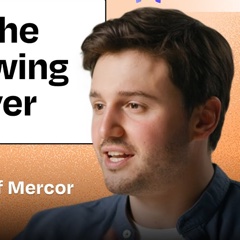
Brendan Foody
CEO and co-founder of Mercor
Where to hear and read about Brendan Foody1 episode or test

Brendan Foody is the 22-year-old CEO and co-founder of Mercor, a marketplace of vetted expert professionals who write evals and training data for AI labs. The lesson most worth taking is to follow the fastest-moving demand, find the customer who is surprisingly easy to sell to, and put everything into them.
If the model is the product, then the eval is the product requirement document.
Why experts writing AI evals is creating the fastest-growing companies in history | Brendan Foody
Brendan Foody: the story and the lessons
1How Brendan Foody got from doughnuts to Mercor
Foody ran a doughnut business in eighth grade and learned initiative matters most. He bought doughnuts at Safeway for $5 a dozen and sold them at school for $2 each. To scale, he paid his mom $20 to drive him in her minivan to buy 10 dozen at a time.
When the school objected, he moved the stand 50 feet off campus. When rivals sold $1 doughnuts, he cut his price to $1 for two weeks and paid friends in doughnuts. His takeaway: you can just do things, and early reps make later scale easier.
Foody started Mercor at 19 with co-founders he met at 14. The company began in January 2023 hiring people internationally, using LLMs to automate resume review and interviews. It bootstrapped to a $1 million run rate before the founders dropped out of college.
The name comes from the Latin for to buy, sell, trade. The company is lifetime profitable and raised its seed from General Catalyst in September.
Meeting OpenAI showed Foody the data market was shifting to experts. Early LLMs needed low and medium skilled people writing simple text. Labs now wanted FAANG engineers, investment bankers, doctors and lawyers to judge model capabilities.
A crowdsourcing player also hired over a thousand people on Mercor's platform and did not pay them. With incumbents resting on their laurels, Mercor began working directly with labs and cut out the middlemen.
Mercor went from $1M to $400M run rate in 16 months. It reached $500 million in revenue in 17 months, which Foody describes as the fastest ascent on record. Net retention is over 1,600% and no customer has ever churned.
2How Foody found Mercor's demand without a sales team
Foody looks for the customer who is surprisingly easy to sell to. He advises staying stubborn on the thesis about how the world will change and open-minded on its form. If the marginal customer is very hard to sell, you cannot build a huge business.
In August 2023 a customer introduced the company to the xAI co-founders, and two days later they met the team at the Tesla office. xAI was still pre-training and not ready for human data, so the real pull came elsewhere.
He follows leading indicators in fast-moving markets and serves flagship customers. Foody skips stagnant legacy markets and looks for new pockets of demand where the wealthiest customers pay whatever it takes to improve their models.
Mercor saw human data move from crowdsourced low-skill labor to expert professionals, and moved there. He wants the best solution for the flagship customers, with everything optimized around them.
Mercor had no sales or marketing staff for a year and a half. All company resources went into great products and experiences for customers. Word of mouth from people who had worked with Mercor elsewhere carried growth, and over half of marketplace members come from referrals.
Foody warns that founders can get good at marketing before they have built something customers love. Only now are a few product managers helping with go to market.
3Why Foody says evals are the bottleneck in AI
Foody argues models only improve where success can be measured. Once an eval exists, researchers can hill climb it with many small experiments. Olympiad math and SWE-bench were saturated quickly once labs focused on them.
His framing: if the model is the product, the eval is the product requirement document. So write the eval first, because it tells the team what to build.
Experts turn their judgment into rubrics that score and train models. A lawyer writes a rubric for a good contract redline, with points for each key issue the model catches. That rubric is both the eval and the reward signal.
Labs are moving to reinforcement learning from AI feedback, where humans define the success criteria and AI applies them at scale. Foody calls this far more scalable and data efficient than human feedback.
Evals double as sales collateral for labs and AI products. They show researchers what to build and show buyers what a model can do. Proof points are moving from academic tests like GPQA and Humanity's Last Exam to practical tasks like an investment banking analysis.
Foody tells companies to measure AI on their core value chain first. An architecture firm, for example, needs a way to score the diagrams it delivers to customers. Each company has one value chain, or a handful if it sells several products.
He calls this measurement the prerequisite to applying AI across the whole business. Some Fortune 500 firms avoid evals because they would show their value chain being automated.
He calls evals evergreen whatever the training method becomes. Training may move from RL to something else, but a model always needs a measure of success in every domain. As long as models should improve, experts will write evals and post-training data.
4How Mercor's expert marketplace works
Foody built a labor marketplace, not a data company. Labs want extraordinary professionals across domains who can measure model capabilities. Project management and a software platform are layered on that core.
He sees Mercor as building the future of work over a 10-year horizon, with a model closer to Uber or DoorDash but with more skilled, better-treated workers.
Foody focuses on finding the top 10% of experts. In a group of 100 hired experts, the top 10% often drive most of the model improvement. Proprietary ways to identify and match them create value that is hard to copy.
He starts with higher-caliber people in smaller numbers and scales up once they meet the quality bar.
Mercor pays experts far above crowdsourcing rates. Median pay is $95 an hour and flexes up to about $500. Crowdsourcing firms paid around $30 an hour for undergrads.
Labs want Goldman and McKinsey analysts and FAANG engineers, so pay scales with expertise.
Mercor delivers experts within 24 hours, including for creative skills. Some labs ship improvements every couple of weeks, so speed matters. Mercor hired the Harvard Lampoon to make models funnier and Emmy-winning screenwriters for creative capability.
Most experts work part-time, such as an underemployed engineer with 20 spare hours. Some take 40-hour roles.
5How Foody builds and runs the team
Foody sets ridiculously ambitious goals and lets the company form around them. At $1.5M run rate he told Benchmark Mercor would reach $50M by year end. They called it insane, and he hit it within two weeks of the date.
The three values are can-do attitude, high standards and intensity. Intensity means output, not mandated hours, though the most bought-in people tend to stay late. Foody says: "we've always set these ridiculously ambitious goals and and somehow the trajectory of the company forms around those goals".
He hired slowly for the first 10, then wishes he had sped up sooner. The first 10 hires were extraordinary, including a former head of growth at Scale, and set talent density for the whole organization. Going from about 10 to 100 people was too slow.
The switch point is not a bright line. It comes when demand is far beyond what the team can handle, and then you accept some hiring variance. Sundeep Jain, formerly Uber's chief product and technology officer, joined as president to scale the processes.
Foody spends most of his own time on hiring and customers. He keeps his attention on the two things that decide whether Mercor grows.
He interviews by having candidates build something with AI tools. Candidates get ChatGPT, Codex, Claude Code or Cursor and an hour to build a website. The test is what a person can build with AI, not whether they avoid it.
He compares it to allowing calculators in exams.
Foody manages by strengths, shaped by his dyslexia. A thousand emails a day is hard for him, but he says dyslexia helps him think differently and see market shifts others miss.
Mercor focuses on leveraging people's strengths over fixing weaknesses.
6Foody on the future of work and AI progress
Foody says to bet on fields where more productivity means more demand. Software has no visible ceiling, and product management, operations and consulting also fit. Accounting is less elastic because the world does not need 100 times more of it.
His test: if everyone becomes 10 times more productive, demand rises, not falls. He thinks winners lean into abundance instead of fighting displacement.
He sees training models as creating a new category of jobs. Researchers at top labs expect every domain to get its own worlds and contexts, scored by rubrics or other verifiers. Foody's retweeted line is that the entire economy will become an RL environment machine.
He compares it to the industrial revolution, where people feared job loss and then new jobs appeared building the machines.
Foody expects steady automation over 10 years, not superintelligence in 3. He expects most knowledge work tasks to be automated within 10 years. He doubts lab leaders who claim superintelligence in three years.
He thinks gains come from data-efficient post-training sets, not 10 times more pre-training data. He rates superintelligence fear as probably overrated, but a 5 to 10% chance of doom justifies care.
He urges people to act instead of only consuming information. His motto is you can just do stuff, and with AI making building easier he says to build products, talk to customers and take the leap of faith.
He uses ChatGPT voice mode as a thought partner because he thinks better aloud. His book picks are High Output Management, Zero to One and Shoe Dog.

Why experts writing AI evals is creating the fastest-growing companies in history | Brendan Foody
Brendan Foody explains why evals are the main bottleneck for AI progress and how Mercor built a marketplace of expert professionals who write them for AI labs. Mercor went from $1M to $400M in run rate in 16 months with no sales or marketing staff, which makes the founding and culture lessons worth hearing.
Foody ran a doughnut business in eighth grade and learned initiative matters most. He bought doughnuts at Safeway for $5 a dozen and sold them at school for $2 each. To scale, he paid his mom $20 to drive him in her minivan to buy 10 dozen at a time.
When the school objected, he moved the stand 50 feet off campus. When rivals sold $1 doughnuts, he cut his price to $1 for two weeks and paid friends in doughnuts. His takeaway: you can just do things, and early reps make later scale easier.
Foody started Mercor at 19 with co-founders he met at 14. The company began in January 2023 hiring people internationally, using LLMs to automate resume review and interviews. It bootstrapped to a $1 million run rate before the founders dropped out of college.
The name comes from the Latin for to buy, sell, trade. The company is lifetime profitable and raised its seed from General Catalyst in September.
Meeting OpenAI showed Foody the data market was shifting to experts. Early LLMs needed low and medium skilled people writing simple text. Labs now wanted FAANG engineers, investment bankers, doctors and lawyers to judge model capabilities.
A crowdsourcing player also hired over a thousand people on Mercor's platform and did not pay them. With incumbents resting on their laurels, Mercor began working directly with labs and cut out the middlemen.
Mercor went from $1M to $400M run rate in 16 months. It reached $500 million in revenue in 17 months, which Foody describes as the fastest ascent on record. Net retention is over 1,600% and no customer has ever churned.
Foody looks for the customer who is surprisingly easy to sell to. He advises staying stubborn on the thesis about how the world will change and open-minded on its form. If the marginal customer is very hard to sell, you cannot build a huge business.
In August 2023 a customer introduced the company to the xAI co-founders, and two days later they met the team at the Tesla office. xAI was still pre-training and not ready for human data, so the real pull came elsewhere.
He follows leading indicators in fast-moving markets and serves flagship customers. Foody skips stagnant legacy markets and looks for new pockets of demand where the wealthiest customers pay whatever it takes to improve their models.
Mercor saw human data move from crowdsourced low-skill labor to expert professionals, and moved there. He wants the best solution for the flagship customers, with everything optimized around them.
Mercor had no sales or marketing staff for a year and a half. All company resources went into great products and experiences for customers. Word of mouth from people who had worked with Mercor elsewhere carried growth, and over half of marketplace members come from referrals.
Foody warns that founders can get good at marketing before they have built something customers love. Only now are a few product managers helping with go to market.
Foody argues models only improve where success can be measured. Once an eval exists, researchers can hill climb it with many small experiments. Olympiad math and SWE-bench were saturated quickly once labs focused on them.
His framing: if the model is the product, the eval is the product requirement document. So write the eval first, because it tells the team what to build.
Experts turn their judgment into rubrics that score and train models. A lawyer writes a rubric for a good contract redline, with points for each key issue the model catches. That rubric is both the eval and the reward signal.
Labs are moving to reinforcement learning from AI feedback, where humans define the success criteria and AI applies them at scale. Foody calls this far more scalable and data efficient than human feedback.
Evals double as sales collateral for labs and AI products. They show researchers what to build and show buyers what a model can do. Proof points are moving from academic tests like GPQA and Humanity's Last Exam to practical tasks like an investment banking analysis.
Foody tells companies to measure AI on their core value chain first. An architecture firm, for example, needs a way to score the diagrams it delivers to customers. Each company has one value chain, or a handful if it sells several products.
He calls this measurement the prerequisite to applying AI across the whole business. Some Fortune 500 firms avoid evals because they would show their value chain being automated.
He calls evals evergreen whatever the training method becomes. Training may move from RL to something else, but a model always needs a measure of success in every domain. As long as models should improve, experts will write evals and post-training data.
Foody built a labor marketplace, not a data company. Labs want extraordinary professionals across domains who can measure model capabilities. Project management and a software platform are layered on that core.
He sees Mercor as building the future of work over a 10-year horizon, with a model closer to Uber or DoorDash but with more skilled, better-treated workers.
Foody focuses on finding the top 10% of experts. In a group of 100 hired experts, the top 10% often drive most of the model improvement. Proprietary ways to identify and match them create value that is hard to copy.
He starts with higher-caliber people in smaller numbers and scales up once they meet the quality bar.
Mercor pays experts far above crowdsourcing rates. Median pay is $95 an hour and flexes up to about $500. Crowdsourcing firms paid around $30 an hour for undergrads.
Labs want Goldman and McKinsey analysts and FAANG engineers, so pay scales with expertise.
Mercor delivers experts within 24 hours, including for creative skills. Some labs ship improvements every couple of weeks, so speed matters. Mercor hired the Harvard Lampoon to make models funnier and Emmy-winning screenwriters for creative capability.
Most experts work part-time, such as an underemployed engineer with 20 spare hours. Some take 40-hour roles.
Foody sets ridiculously ambitious goals and lets the company form around them. At $1.5M run rate he told Benchmark Mercor would reach $50M by year end. They called it insane, and he hit it within two weeks of the date.
The three values are can-do attitude, high standards and intensity. Intensity means output, not mandated hours, though the most bought-in people tend to stay late. Foody says: "we've always set these ridiculously ambitious goals and and somehow the trajectory of the company forms around those goals".
He hired slowly for the first 10, then wishes he had sped up sooner. The first 10 hires were extraordinary, including a former head of growth at Scale, and set talent density for the whole organization. Going from about 10 to 100 people was too slow.
The switch point is not a bright line. It comes when demand is far beyond what the team can handle, and then you accept some hiring variance. Sundeep Jain, formerly Uber's chief product and technology officer, joined as president to scale the processes.
Foody spends most of his own time on hiring and customers. He keeps his attention on the two things that decide whether Mercor grows.
He interviews by having candidates build something with AI tools. Candidates get ChatGPT, Codex, Claude Code or Cursor and an hour to build a website. The test is what a person can build with AI, not whether they avoid it.
He compares it to allowing calculators in exams.
Foody manages by strengths, shaped by his dyslexia. A thousand emails a day is hard for him, but he says dyslexia helps him think differently and see market shifts others miss.
Mercor focuses on leveraging people's strengths over fixing weaknesses.
Foody says to bet on fields where more productivity means more demand. Software has no visible ceiling, and product management, operations and consulting also fit. Accounting is less elastic because the world does not need 100 times more of it.
His test: if everyone becomes 10 times more productive, demand rises, not falls. He thinks winners lean into abundance instead of fighting displacement.
He sees training models as creating a new category of jobs. Researchers at top labs expect every domain to get its own worlds and contexts, scored by rubrics or other verifiers. Foody's retweeted line is that the entire economy will become an RL environment machine.
He compares it to the industrial revolution, where people feared job loss and then new jobs appeared building the machines.
Foody expects steady automation over 10 years, not superintelligence in 3. He expects most knowledge work tasks to be automated within 10 years. He doubts lab leaders who claim superintelligence in three years.
He thinks gains come from data-efficient post-training sets, not 10 times more pre-training data. He rates superintelligence fear as probably overrated, but a 5 to 10% chance of doom justifies care.
He urges people to act instead of only consuming information. His motto is you can just do stuff, and with AI making building easier he says to build products, talk to customers and take the leap of faith.
He uses ChatGPT voice mode as a thought partner because he thinks better aloud. His book picks are High Output Management, Zero to One and Shoe Dog.