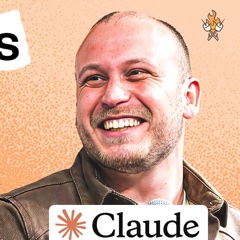
Boris Cherny
Creator and head of Claude Code at Anthropic
Where to hear and read about Boris Cherny1 episode or test

Boris Cherny created Claude Code and leads it at Anthropic; it grew from a terminal experiment into a tool that writes all of his own code. The lesson most worth taking is to build for the model six months out and follow what users and the model already try to do.
If you build for the model 6 months out, when that model comes out, you're just going to hit the ground running, and the product is going to click.
Head of Claude Code: What happens after coding is solved | Boris Cherny
Boris Cherny: the story and the lessons
1Boris Cherny's path to Claude Code
Cherny taught himself to code in middle school as a practical tool. He first coded to put answers on a TI-83 for a math test. He later fell for TypeScript, wrote a book and ran the world's biggest TypeScript meetup.
He still treats code as a means to build things, though teammates like Lena write C++ by hand on weekends for the love of it.
He was a top engineer at Instagram and owned code quality at Meta. At Meta he was responsible for code quality across Facebook, Instagram and WhatsApp. He says he was among the most productive engineers at Instagram and still is at Anthropic.
Before Anthropic he also lived a slow rural life in Japan, the only engineer and English speaker in his town, trading pickles and miso with neighbors. Miso taught him to think on long time scales: white miso takes at least 3 months, red two to four years.
He left Anthropic for Cursor and came back within two weeks. He joined Cursor because he liked the product and the team, then returned because he missed Anthropic's safety mission. He calls it the fastest job change he has ever had.
He says a mission people believe in is something he needs to be happy, and that anyone in an Anthropic hallway will say they are there for safety.
His family's history with programming goes back to punch cards. Cherny was born in Odessa and his family left in 1988. His grandfather was one of the first programmers in the Soviet Union and worked on punch cards.
His mother colored on those punch cards with crayons as a child.
2How Cherny built Claude Code
Claude Code began as an experiment in what a model could do with one tool. With only a bash tool, the early prototype answered what music Cherny was listening to without being told how. That showed the model could work out tool use on its own.
It came from Anthropic's Labs team, alongside MCP and the desktop app, on a path from coding to tool use to computer use.
He learned the model layer first, spending a month on post-training. Cherny spent one month on prototypes and one month on post-training before the tool took shape.
His rule: "you really have to understand the layer under the layer at which you work." Most prototypes never shipped.
The terminal was the easiest thing one person could build. His internal announcement got two likes because nobody expected a terminal coding tool. Internal daily use then went vertical quickly, and the external release came in February.
It was not an instant hit outside, because it felt alien and took months to understand. Growth took off with Opus 4 in May and again in November.
Cowork took about 10 days because Claude Code wrote it. The team explored options for a few months before someone suggested putting Claude Code inside the desktop app. Claude Code then wrote the product, including its virtual machine and guardrails.
It launched early and rough as a research preview, so real use could guide the product and its safety.
3Cherny on latent demand
Cherny calls latent demand the most important principle in product. Watch how people misuse your product and build a purpose-built version of it. The aim is to bring the product to where people already are, not make them learn a new workflow.
He says: "latent demand which I think is just the single most important principle in product."
Facebook Marketplace and Dating both came from user behavior data. Marketplace started because 40% of group posts were buying and selling. Dating started from data that 60% of profile views were between non-friends of the opposite gender.
He heard the Marketplace story from Fiona, the founding manager of that team.
Claude Code users showed demand for Cowork long before it existed. Users grew tomato plants, analyzed their genome, recovered wedding photos and read an MRI. A data scientist, Brendan, installed Node.js and Claude Code just to run SQL, and the next week every data scientist did the same.
Cherny was shocked, since even many engineers avoid the terminal. People jumping through those hoops told the team a purpose-built product would be liked.
He applies latent demand to what the model is trying to do. Most builders box the model into one component. Claude Code inverted that: the product is the model, with minimal scaffolding and a minimal set of tools.
His advice is to "look at what the model is trying to do and make that a little bit easier." Researchers call this staying on distribution.
Cherny fixed feedback within minutes so users felt heard. Early on he fixed each item in the internal feedback channel within a minute or five. In December he began answering bug reports on Twitter, and most get a fix within minutes.
Now Claude reads the channel, proposes fixes and puts up PRs for him to review. "If you make people feel heard, then they want to contribute."
He put the product on every surface where people already work. Claude Code now runs in the terminal, desktop app, iOS and Android apps, web, Slack and GitHub. Designers and other non-engineers mostly use the desktop app's code tab.
It is the same agent everywhere, and the terminal is not required.
4Cherny's rules for building AI products
Cherny builds for the model six months out, not today's. Early on Claude wrote little of his code because the Sonnet 3.5 generation was not good enough. He bet it eventually would, and growth went exponential with Opus 4 and Sonnet 4.
Product-market fit will look weak for the first six months. Claude wrote about 20% of his code in February, about 30% in May and 100% by November.
He gives the model tools and a goal, not a fixed workflow. A fancy orchestrator forcing step one, two and three almost always does worse than letting the model decide. He also avoids loading context up front and gives the model a tool to fetch it.
Scaffolding adds maybe 10 to 20%, and the next model often wipes that out. A year ago much of it was needed, and now it isn't.
He always bets on the more general model. Cherny applies Rich Sutton's bitter lesson that the more general model beats the more specific one. That means avoiding tiny models and fine-tuning unless there is a real reason.
The Claude Code team is expected to read the essay.
He retests old assumptions every time a new model ships. A newer engineer asked Claude Code to find a memory leak while Cherny was reading a heap snapshot by hand. Claude took the same snapshot, wrote itself an analysis tool and opened a PR faster than he could.
His lesson: it's not Sonnet 3.5 anymore, so keep moving your mindset to the current model. New hires and new grads often work in a more AGI-forward way than he does.
He ships AI products early to learn real-world behavior and safety. Claude Code ran inside Anthropic for 4 or 5 months first, because its safety was unclear. Cowork shipped as a research preview until it proves safe in the real world.
Anthropic checks safety on three layers: interpretability, evals, and behavior in the wild. A model can look good on the first two and not on the third.
5How Cherny runs the Claude Code team
Cherny under-resources projects so engineers lean on Claude. Some projects get a single engineer, who ships fast out of intrinsic motivation and automates the rest with Claude. The team rule is that having Claude do something beats doing it yourself.
Anthropic's engineering team grew about 4x while output per engineer rose 200% in pull requests. At Meta, hundreds of engineers working a year gave a few percentage points.
He gives engineers unlimited tokens and optimizes cost later. At the start, throw lots of tokens at an idea to see if it works. Once it scales, move work to Haiku or Sonnet instead of Opus.
One engineer experimenting costs little next to salary. Some Anthropic engineers now spend hundreds of thousands a month on tokens.
He gives people room to fail and cuts bad ideas fast. There is no road map. Cherny says it's okay if 80% of ideas are bad, as long as bad ones are cut quickly instead of fed more investment.
He hacked on Claude Code every night and weekend because it felt like a thread worth pulling.
Everyone on his team codes, and roles overlap about 50%. The PM, engineering manager, designer, finance person and data scientist all code. He expects the software engineer title to start going away in some places.
His advice is to "try to be a generalist more than you have in the past." Strong engineers are often hybrids of product, infrastructure, design or business sense.
He does today what can be done today, and ignores rivals. Early on it was only Cherny, so speed was the only edge in a crowded coding market. The best way to go faster is to have Claude do more.
He has barely used Codex, which looked a lot like Claude Code, and the team builds from user feedback instead of studying competitors.
6How Cherny works with Claude and what he expects next
Claude writes all of Cherny's code and he ships 10 to 30 PRs a day. He has edited no line by hand since November. Humans still review: Claude reviews 100% of pull requests at Anthropic, followed by a human layer.
Only pure throwaway prototype code skips human review. He says it is not yet safe to be fully hands-off when many people run the program.
He runs the strongest model and starts most tasks in plan mode. Cherny runs Opus 4.6 at maximum effort always, since a weaker model like Sonnet takes more correction and often more tokens. About 80% of his tasks start in plan mode, then he auto-accepts edits.
Plan mode injects one sentence: "Please don't write any code yet." With a good plan the model usually gets it right the first time.
He keeps several agents running and codes from a phone. He had five running at the time and starts more as soon as he wakes up. A third of his coding is in the terminal, a third in the desktop app and a third in the iOS app.
He didn't expect to code from his phone, even in 2026.
He sets up Cowork in three steps: one tool, connect more, parallelize. Start with one task like cleaning up the desktop, then connect tools like email and Slack, then run many tasks at once. Each Monday he has it message every engineer who has not filled in the team status spreadsheet.
A PM judged Cowork ready when it handled 48 of the 50 non-technical use cases in Lenny's post.
He compares AI to the printing press and expects painful disruption. Scribes under 1% of the population once did all reading and writing, and within 50 years of Gutenberg more was printed than in the previous thousand years. Literacy lagged about 200 years because it needs schools and free time.
Cherny is optimistic long term and imagines everyone programming, but expects the transition to hurt many people and calls for a shared societal conversation.
His headline figures come from Anthropic's own team and a single report. The 200% PR gain and 4% of public GitHub commits do not measure code quality or value. The talk offers no evidence on the costs of unreviewed AI code or on who bears the job losses.
His claim that coding is solved rests on his own kind of programming. His own motto is "Use common sense."

Head of Claude Code: What happens after coding is solved | Boris Cherny
Boris Cherny explains the product and team principles behind Claude Code: latent demand, building for the model six months out, under-resourcing teams, and giving engineers unlimited tokens. The result is a tool that went from a terminal hack to 4% of public GitHub commits, with 100% of his own code now written by Claude.
Cherny taught himself to code in middle school as a practical tool. He first coded to put answers on a TI-83 for a math test. He later fell for TypeScript, wrote a book and ran the world's biggest TypeScript meetup.
He still treats code as a means to build things, though teammates like Lena write C++ by hand on weekends for the love of it.
He was a top engineer at Instagram and owned code quality at Meta. At Meta he was responsible for code quality across Facebook, Instagram and WhatsApp. He says he was among the most productive engineers at Instagram and still is at Anthropic.
Before Anthropic he also lived a slow rural life in Japan, the only engineer and English speaker in his town, trading pickles and miso with neighbors. Miso taught him to think on long time scales: white miso takes at least 3 months, red two to four years.
He left Anthropic for Cursor and came back within two weeks. He joined Cursor because he liked the product and the team, then returned because he missed Anthropic's safety mission. He calls it the fastest job change he has ever had.
He says a mission people believe in is something he needs to be happy, and that anyone in an Anthropic hallway will say they are there for safety.
His family's history with programming goes back to punch cards. Cherny was born in Odessa and his family left in 1988. His grandfather was one of the first programmers in the Soviet Union and worked on punch cards.
His mother colored on those punch cards with crayons as a child.
Claude Code began as an experiment in what a model could do with one tool. With only a bash tool, the early prototype answered what music Cherny was listening to without being told how. That showed the model could work out tool use on its own.
It came from Anthropic's Labs team, alongside MCP and the desktop app, on a path from coding to tool use to computer use.
He learned the model layer first, spending a month on post-training. Cherny spent one month on prototypes and one month on post-training before the tool took shape.
His rule: "you really have to understand the layer under the layer at which you work." Most prototypes never shipped.
The terminal was the easiest thing one person could build. His internal announcement got two likes because nobody expected a terminal coding tool. Internal daily use then went vertical quickly, and the external release came in February.
It was not an instant hit outside, because it felt alien and took months to understand. Growth took off with Opus 4 in May and again in November.
Cowork took about 10 days because Claude Code wrote it. The team explored options for a few months before someone suggested putting Claude Code inside the desktop app. Claude Code then wrote the product, including its virtual machine and guardrails.
It launched early and rough as a research preview, so real use could guide the product and its safety.
Cherny calls latent demand the most important principle in product. Watch how people misuse your product and build a purpose-built version of it. The aim is to bring the product to where people already are, not make them learn a new workflow.
He says: "latent demand which I think is just the single most important principle in product."
Facebook Marketplace and Dating both came from user behavior data. Marketplace started because 40% of group posts were buying and selling. Dating started from data that 60% of profile views were between non-friends of the opposite gender.
He heard the Marketplace story from Fiona, the founding manager of that team.
Claude Code users showed demand for Cowork long before it existed. Users grew tomato plants, analyzed their genome, recovered wedding photos and read an MRI. A data scientist, Brendan, installed Node.js and Claude Code just to run SQL, and the next week every data scientist did the same.
Cherny was shocked, since even many engineers avoid the terminal. People jumping through those hoops told the team a purpose-built product would be liked.
He applies latent demand to what the model is trying to do. Most builders box the model into one component. Claude Code inverted that: the product is the model, with minimal scaffolding and a minimal set of tools.
His advice is to "look at what the model is trying to do and make that a little bit easier." Researchers call this staying on distribution.
Cherny fixed feedback within minutes so users felt heard. Early on he fixed each item in the internal feedback channel within a minute or five. In December he began answering bug reports on Twitter, and most get a fix within minutes.
Now Claude reads the channel, proposes fixes and puts up PRs for him to review. "If you make people feel heard, then they want to contribute."
He put the product on every surface where people already work. Claude Code now runs in the terminal, desktop app, iOS and Android apps, web, Slack and GitHub. Designers and other non-engineers mostly use the desktop app's code tab.
It is the same agent everywhere, and the terminal is not required.
Cherny builds for the model six months out, not today's. Early on Claude wrote little of his code because the Sonnet 3.5 generation was not good enough. He bet it eventually would, and growth went exponential with Opus 4 and Sonnet 4.
Product-market fit will look weak for the first six months. Claude wrote about 20% of his code in February, about 30% in May and 100% by November.
He gives the model tools and a goal, not a fixed workflow. A fancy orchestrator forcing step one, two and three almost always does worse than letting the model decide. He also avoids loading context up front and gives the model a tool to fetch it.
Scaffolding adds maybe 10 to 20%, and the next model often wipes that out. A year ago much of it was needed, and now it isn't.
He always bets on the more general model. Cherny applies Rich Sutton's bitter lesson that the more general model beats the more specific one. That means avoiding tiny models and fine-tuning unless there is a real reason.
The Claude Code team is expected to read the essay.
He retests old assumptions every time a new model ships. A newer engineer asked Claude Code to find a memory leak while Cherny was reading a heap snapshot by hand. Claude took the same snapshot, wrote itself an analysis tool and opened a PR faster than he could.
His lesson: it's not Sonnet 3.5 anymore, so keep moving your mindset to the current model. New hires and new grads often work in a more AGI-forward way than he does.
He ships AI products early to learn real-world behavior and safety. Claude Code ran inside Anthropic for 4 or 5 months first, because its safety was unclear. Cowork shipped as a research preview until it proves safe in the real world.
Anthropic checks safety on three layers: interpretability, evals, and behavior in the wild. A model can look good on the first two and not on the third.
Cherny under-resources projects so engineers lean on Claude. Some projects get a single engineer, who ships fast out of intrinsic motivation and automates the rest with Claude. The team rule is that having Claude do something beats doing it yourself.
Anthropic's engineering team grew about 4x while output per engineer rose 200% in pull requests. At Meta, hundreds of engineers working a year gave a few percentage points.
He gives engineers unlimited tokens and optimizes cost later. At the start, throw lots of tokens at an idea to see if it works. Once it scales, move work to Haiku or Sonnet instead of Opus.
One engineer experimenting costs little next to salary. Some Anthropic engineers now spend hundreds of thousands a month on tokens.
He gives people room to fail and cuts bad ideas fast. There is no road map. Cherny says it's okay if 80% of ideas are bad, as long as bad ones are cut quickly instead of fed more investment.
He hacked on Claude Code every night and weekend because it felt like a thread worth pulling.
Everyone on his team codes, and roles overlap about 50%. The PM, engineering manager, designer, finance person and data scientist all code. He expects the software engineer title to start going away in some places.
His advice is to "try to be a generalist more than you have in the past." Strong engineers are often hybrids of product, infrastructure, design or business sense.
He does today what can be done today, and ignores rivals. Early on it was only Cherny, so speed was the only edge in a crowded coding market. The best way to go faster is to have Claude do more.
He has barely used Codex, which looked a lot like Claude Code, and the team builds from user feedback instead of studying competitors.
Claude writes all of Cherny's code and he ships 10 to 30 PRs a day. He has edited no line by hand since November. Humans still review: Claude reviews 100% of pull requests at Anthropic, followed by a human layer.
Only pure throwaway prototype code skips human review. He says it is not yet safe to be fully hands-off when many people run the program.
He runs the strongest model and starts most tasks in plan mode. Cherny runs Opus 4.6 at maximum effort always, since a weaker model like Sonnet takes more correction and often more tokens. About 80% of his tasks start in plan mode, then he auto-accepts edits.
Plan mode injects one sentence: "Please don't write any code yet." With a good plan the model usually gets it right the first time.
He keeps several agents running and codes from a phone. He had five running at the time and starts more as soon as he wakes up. A third of his coding is in the terminal, a third in the desktop app and a third in the iOS app.
He didn't expect to code from his phone, even in 2026.
He sets up Cowork in three steps: one tool, connect more, parallelize. Start with one task like cleaning up the desktop, then connect tools like email and Slack, then run many tasks at once. Each Monday he has it message every engineer who has not filled in the team status spreadsheet.
A PM judged Cowork ready when it handled 48 of the 50 non-technical use cases in Lenny's post.
He compares AI to the printing press and expects painful disruption. Scribes under 1% of the population once did all reading and writing, and within 50 years of Gutenberg more was printed than in the previous thousand years. Literacy lagged about 200 years because it needs schools and free time.
Cherny is optimistic long term and imagines everyone programming, but expects the transition to hurt many people and calls for a shared societal conversation.
His headline figures come from Anthropic's own team and a single report. The 200% PR gain and 4% of public GitHub commits do not measure code quality or value. The talk offers no evidence on the costs of unreviewed AI code or on who bears the job losses.
His claim that coding is solved rests on his own kind of programming. His own motto is "Use common sense."