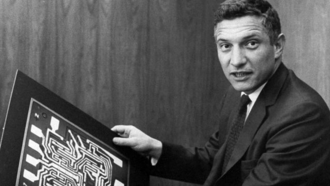
Bob Noyce
Co-inventor of the integrated circuit and founder of Fairchild Semiconductor and Intel
Where to hear and read about Bob Noyce1 episode or test

Bob Noyce co-invented the integrated circuit, co-founded Fairchild Semiconductor and Intel, and is called the grandfather of Silicon Valley. The most useful lesson from him is how a founder's culture of trusting young people with real decisions, paying them in ownership and telling them the truth can outlast the founder and shape a whole industry.
if you think I'm going to make your decision for you you're mistaken, hey it's your ass
How The Sun Rose On Silicon Valley: Bob Noyce (Founder of Intel)
Bob Noyce: the story and the lessons
1Bob Noyce's road from Grinnell, Iowa to the transistor
A curious physics professor put Noyce in front of the first transistors. In 1948 Grinnell professor Grant Gale read a newspaper item about the transistor, wrote to his former classmate John Bardeen at Bell Labs and to Bell Labs president Oliver Buckley, a Grinnell graduate, and got two of the first transistors. Noyce was one of his 18 physics students.
Grinnell was a town of 7,000. Remove any link in that chain, Gale's classmate, Buckley's alumni tie, and Noyce likely never meets the transistor. The lesson drawn is Paul Graham's advice to "make yourself a big target for luck."
Noyce was a star student, a tinkerer and a rebel. Gale let him take freshman physics while still in high school, and at 13 he built a rideable box kite from Popular Science plans that rose about 12 feet behind a car. He also won diving awards, sang in the choir and starred in a radio soap opera.
Later, while running Fairchild and Intel, he kept up hang gliding, scuba diving and skiing.
A stolen pig nearly ended his college career. Noyce took a 25-pound pig for a luau, the farmer called the sheriff, and he faced expulsion and a felony charge. Gale kept him from being expelled.
The suspension cost him little because he had so many extra credits he needed only one more semester. The episode did not dent his confidence.
Noyce chose small, early teams over famous employers. After MIT in 1953 he turned down Bell Labs and IBM for Philco in Philadelphia, which was "starting from near zero in semiconductor research."
He knew Bell Labs did the most important work but judged his chances of rapid advancement better somewhere small. The same instinct took him west in 1956: he landed in San Francisco at 6:00 a.m., signed a house contract by noon and had a job from William Shockley that afternoon.
2How Noyce and the Traitorous Eight left Shockley and started Fairchild
Shockley gathered brilliant engineers and then drove them away. Shockley, a Nobel winner, hired top young PhDs, then made them all take lie detector tests over suspected sabotage. No saboteur was found.
Colleagues called his personality "reverse charisma." He felt threatened by anyone who might seem as smart as he was and never imagined his engineers saw themselves as geniuses too, so they concluded they could run a company no worse than he did.
The defectors chose Noyce to lead because people trusted him. Seven men left first and recruited Noyce, then 29, as their administrator because he was the one with the halo.
He never blinked, answered in a soft voice with a smile, and made people feel like the most important person in the room.
Arthur Rock found funding that came with a buyout option. Rock, then at Hayden Stone, brought in Sherman Fairchild's Fairchild Camera and Instrument, which got the right to buy the startup for $3 million within eight years.
It exercised the option in 1959 right after the integrated circuit appeared, and each of the eight received $250,000 in stock, about 20 times a year's salary. Noyce, 31, stayed on as general manager.
The eight stayed near Palo Alto instead of going back East. Stanford was courting engineering firms, and General Electric, IBM and Hewlett-Packard were already nearby.
3How Bob Noyce made the integrated circuit practical
Hand-wiring transistors was failing, so Noyce removed the wires. Fairchild's PhDs cut silicon with diamond cutters under microscopes and wired transistors by hand, with 50 to 90% coming out defective. Noyce asked "why not put them all on a single piece of silicon without wires."
He made his first notes in January 1959. He was not the only one thinking this way, but he had never heard of Jack Kilby at Texas Instruments.
Noyce's silicon version won because it could be mass produced. Texas Instruments announced Kilby's version first, but Noyce's silicon device was far more practical to manufacture and set the industry standard, making him co-inventor of the chip.
Sputnik in 1957 had made miniaturization urgent, and NASA chose Noyce's circuit for the first astronaut computers, so orders poured in.
Chip density grew from one circuit to 32,000 in under 20 years. One circuit in 1959 became 10 by 1964, then 1,000, then 32,000, each step about six years apart. By 1968 Noyce held a dozen new circuit and transistor patents.
The ENIAC had needed 18,000 vacuum tubes and filled a room; the chip put that power on a panel the size of a playing card.
4How Noyce and Gordon Moore built Intel
Noyce and Moore bet $500,000 of their own money on Intel. They put in $250,000 each, Arthur Rock raised about $2.51 million more, and Grinnell College added $300,000.
Rock backed them at once because of their record. Grinnell's $300,000 grew more than 30 times and doubled its endowment.
Intel avoided Fairchild's market and attacked computer memory. They went after "the most backward area of computer technology," where computers still stored data in ceramic ringlets. Within two years they had the 1103 memory chip, whose 4,000 transistors did the work of 1,000 ringlets, faster.
Sales went from under $3,000 and 42 employees in year one to $66 million and 2,500 employees in year five. Noyce and Moore started out in white coats at lab tables alongside a dozen young engineers.
A young engineer's microprocessor gave Intel its second act. Ted Hoff, about the age Noyce had been when he invented the integrated circuit, created the computer on a chip at Intel.
To Noyce this confirmed that on the electrical frontier "the great flashes came to the young." Intel's sales grew from $64 million in 1973 to almost a billion dollars in 1983.
Noyce, Moore and Grove personally taught the market the microprocessor. Buyers were confused and even frightened, and some engineers called it a gimmick, so Intel ran more seminars and workshops than the local junior college's whole course catalog.
The three became a traveling educational road show. Sony's Akio Morita made the same point with nemawashi, binding a tree's roots bit by bit before transplanting it.
5Bob Noyce's rules for running a company
Noyce gave young engineers real projects and made them decide. With no experienced chip managers in existence, he hired engineers straight from graduate school, gave them guidelines, and refused to make their decisions for them.
Instead of being scared, the engineers felt exhilarated, and the startup spirit survived as Fairchild grew from 12 to 12,000 people in ten years.
He paid in stock options, not profit sharing, to protect research. At Fairchild he learned that profit sharing pulls people toward products that already make money, so at Intel he gave options to all engineers and most office workers.
He wanted avant-garde research that might not pay off in the short run.
Noyce cut management layers so ideas beat hierarchy. Below Noyce and Moore there were only strategic business segments with wide autonomy, and cross-department problems went to councils of people on the line.
Executives sat in one big room, and Noyce kept his old scratched metal desk while newer hires got better ones. In meetings he set the agenda, then a young engineer could challenge him as an equal.
He gave ambitious people honest grades. Intel used five ratings from Superior to does not meet requirements, a system Andy Grove inspired and Noyce loved.
He believed many young hires had never had honest grades because colleges inflated marks to keep students out of Vietnam, and that ambitious people "want to be told how you're doing."
Freedom at Intel came with an obligation to discipline. Grove taught the culture in Socratic sessions everyone attended, Noyce included, under the principle "the greater the freedom the greater the obligation to exercise discipline."
Grove's ball story made the point: owning the ball is not enough, you finish and score more.
6How Noyce's culture spread and how he stepped back
Fairchild alumni started more than 50 companies and built Silicon Valley. Defectors, called the Fairchildren, carried Noyce's approach into new microchip firms, and orchards gave way to offices and factories.
They treated the technology "as if it were a religious mission." Noyce later said several times he did not enjoy running a big company.
His departure forced Fairchild to import a whole management team. Once Noyce left, Fairchild hired Motorola's semiconductor chief Les Hogan along with his engineers and administrators.
Hogan's pay was so large that Valley wealth came to be measured in units called Hogans.
Noyce handed Intel to Moore and Grove in 1974. He became chairman and the voice of Silicon Valley, and the company kept growing under them.
He received the National Medal of Science in 1980, joined the Inventors Hall of Fame in 1983, mentored a young Steve Jobs, and died of a heart attack at 62. Jobs called him "the ultimate inventor, the ultimate Rebel, the ultimate entrepreneur."

How The Sun Rose On Silicon Valley: Bob Noyce (Founder of Intel)
Bob Noyce built two defining semiconductor companies by hiring young talent, giving it real responsibility, and choosing uncrowded ground to compete on. His 1959 silicon integrated circuit and Intel's memory chip and microprocessor show how a founder's confidence, culture and incentives can set the course of a whole industry.
A curious physics professor put Noyce in front of the first transistors. In 1948 Grinnell professor Grant Gale read a newspaper item about the transistor, wrote to his former classmate John Bardeen at Bell Labs and to Bell Labs president Oliver Buckley, a Grinnell graduate, and got two of the first transistors. Noyce was one of his 18 physics students.
Grinnell was a town of 7,000. Remove any link in that chain, Gale's classmate, Buckley's alumni tie, and Noyce likely never meets the transistor. The lesson drawn is Paul Graham's advice to "make yourself a big target for luck."
Noyce was a star student, a tinkerer and a rebel. Gale let him take freshman physics while still in high school, and at 13 he built a rideable box kite from Popular Science plans that rose about 12 feet behind a car. He also won diving awards, sang in the choir and starred in a radio soap opera.
Later, while running Fairchild and Intel, he kept up hang gliding, scuba diving and skiing.
A stolen pig nearly ended his college career. Noyce took a 25-pound pig for a luau, the farmer called the sheriff, and he faced expulsion and a felony charge. Gale kept him from being expelled.
The suspension cost him little because he had so many extra credits he needed only one more semester. The episode did not dent his confidence.
Noyce chose small, early teams over famous employers. After MIT in 1953 he turned down Bell Labs and IBM for Philco in Philadelphia, which was "starting from near zero in semiconductor research."
He knew Bell Labs did the most important work but judged his chances of rapid advancement better somewhere small. The same instinct took him west in 1956: he landed in San Francisco at 6:00 a.m., signed a house contract by noon and had a job from William Shockley that afternoon.
Shockley gathered brilliant engineers and then drove them away. Shockley, a Nobel winner, hired top young PhDs, then made them all take lie detector tests over suspected sabotage. No saboteur was found.
Colleagues called his personality "reverse charisma." He felt threatened by anyone who might seem as smart as he was and never imagined his engineers saw themselves as geniuses too, so they concluded they could run a company no worse than he did.
The defectors chose Noyce to lead because people trusted him. Seven men left first and recruited Noyce, then 29, as their administrator because he was the one with the halo.
He never blinked, answered in a soft voice with a smile, and made people feel like the most important person in the room.
Arthur Rock found funding that came with a buyout option. Rock, then at Hayden Stone, brought in Sherman Fairchild's Fairchild Camera and Instrument, which got the right to buy the startup for $3 million within eight years.
It exercised the option in 1959 right after the integrated circuit appeared, and each of the eight received $250,000 in stock, about 20 times a year's salary. Noyce, 31, stayed on as general manager.
The eight stayed near Palo Alto instead of going back East. Stanford was courting engineering firms, and General Electric, IBM and Hewlett-Packard were already nearby.
Hand-wiring transistors was failing, so Noyce removed the wires. Fairchild's PhDs cut silicon with diamond cutters under microscopes and wired transistors by hand, with 50 to 90% coming out defective. Noyce asked "why not put them all on a single piece of silicon without wires."
He made his first notes in January 1959. He was not the only one thinking this way, but he had never heard of Jack Kilby at Texas Instruments.
Noyce's silicon version won because it could be mass produced. Texas Instruments announced Kilby's version first, but Noyce's silicon device was far more practical to manufacture and set the industry standard, making him co-inventor of the chip.
Sputnik in 1957 had made miniaturization urgent, and NASA chose Noyce's circuit for the first astronaut computers, so orders poured in.
Chip density grew from one circuit to 32,000 in under 20 years. One circuit in 1959 became 10 by 1964, then 1,000, then 32,000, each step about six years apart. By 1968 Noyce held a dozen new circuit and transistor patents.
The ENIAC had needed 18,000 vacuum tubes and filled a room; the chip put that power on a panel the size of a playing card.
Noyce and Moore bet $500,000 of their own money on Intel. They put in $250,000 each, Arthur Rock raised about $2.51 million more, and Grinnell College added $300,000.
Rock backed them at once because of their record. Grinnell's $300,000 grew more than 30 times and doubled its endowment.
Intel avoided Fairchild's market and attacked computer memory. They went after "the most backward area of computer technology," where computers still stored data in ceramic ringlets. Within two years they had the 1103 memory chip, whose 4,000 transistors did the work of 1,000 ringlets, faster.
Sales went from under $3,000 and 42 employees in year one to $66 million and 2,500 employees in year five. Noyce and Moore started out in white coats at lab tables alongside a dozen young engineers.
A young engineer's microprocessor gave Intel its second act. Ted Hoff, about the age Noyce had been when he invented the integrated circuit, created the computer on a chip at Intel.
To Noyce this confirmed that on the electrical frontier "the great flashes came to the young." Intel's sales grew from $64 million in 1973 to almost a billion dollars in 1983.
Noyce, Moore and Grove personally taught the market the microprocessor. Buyers were confused and even frightened, and some engineers called it a gimmick, so Intel ran more seminars and workshops than the local junior college's whole course catalog.
The three became a traveling educational road show. Sony's Akio Morita made the same point with nemawashi, binding a tree's roots bit by bit before transplanting it.
Noyce gave young engineers real projects and made them decide. With no experienced chip managers in existence, he hired engineers straight from graduate school, gave them guidelines, and refused to make their decisions for them.
Instead of being scared, the engineers felt exhilarated, and the startup spirit survived as Fairchild grew from 12 to 12,000 people in ten years.
He paid in stock options, not profit sharing, to protect research. At Fairchild he learned that profit sharing pulls people toward products that already make money, so at Intel he gave options to all engineers and most office workers.
He wanted avant-garde research that might not pay off in the short run.
Noyce cut management layers so ideas beat hierarchy. Below Noyce and Moore there were only strategic business segments with wide autonomy, and cross-department problems went to councils of people on the line.
Executives sat in one big room, and Noyce kept his old scratched metal desk while newer hires got better ones. In meetings he set the agenda, then a young engineer could challenge him as an equal.
He gave ambitious people honest grades. Intel used five ratings from Superior to does not meet requirements, a system Andy Grove inspired and Noyce loved.
He believed many young hires had never had honest grades because colleges inflated marks to keep students out of Vietnam, and that ambitious people "want to be told how you're doing."
Freedom at Intel came with an obligation to discipline. Grove taught the culture in Socratic sessions everyone attended, Noyce included, under the principle "the greater the freedom the greater the obligation to exercise discipline."
Grove's ball story made the point: owning the ball is not enough, you finish and score more.
Fairchild alumni started more than 50 companies and built Silicon Valley. Defectors, called the Fairchildren, carried Noyce's approach into new microchip firms, and orchards gave way to offices and factories.
They treated the technology "as if it were a religious mission." Noyce later said several times he did not enjoy running a big company.
His departure forced Fairchild to import a whole management team. Once Noyce left, Fairchild hired Motorola's semiconductor chief Les Hogan along with his engineers and administrators.
Hogan's pay was so large that Valley wealth came to be measured in units called Hogans.
Noyce handed Intel to Moore and Grove in 1974. He became chairman and the voice of Silicon Valley, and the company kept growing under them.
He received the National Medal of Science in 1980, joined the Inventors Hall of Fame in 1983, mentored a young Steve Jobs, and died of a heart attack at 62. Jobs called him "the ultimate inventor, the ultimate Rebel, the ultimate entrepreneur."