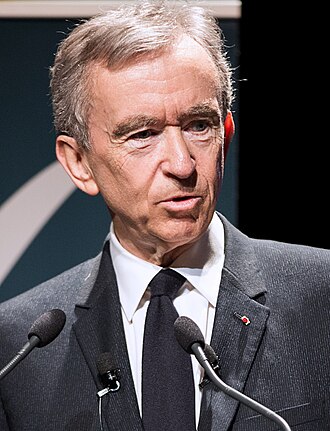
Bernard Arnault
Chairman who built LVMH into the world's largest luxury goods group
Where to hear and read about Bernard Arnault1 episode or test

Bernard Arnault is the chairman who took control of LVMH days before turning 40, assembling Dior, Moët, Hennessy and Louis Vuitton in under five years and setting out to build the world's biggest luxury group. The lesson worth taking from him is how patience with cash, holding structures that keep control, and being underestimated by rivals let an outsider beat an entrenched establishment.
You have to be specially gifted or you have to work hard. I was not gifted enough, I had to work so I worked.
Bernard Arnault (The Richest Man in the World)
Bernard Arnault: the story and the lessons
1Bernard Arnault's path from a builders' family to New York
Arnault grew up in a third-generation building family tied to Boussac. Born in 1949, he joined a firm his grandfather started with a wheelbarrow and a partner who supplied the capital. That firm built a factory for textile king Marcel Boussac, whose group Arnault later bought to get Dior.
He was a serious, competitive child who preferred work to play. He was top of his class in every subject, even PE, and his father never had to tell him to study. In May 1968 his only worry was that lectures would be cancelled.
In his own words: "I'm very competitive, I always want to win."
He wanted to do things, not watch them being taught. At 22 he found a McKinsey training course frustrating: "You watch but you don't do anything."
A close friend said you couldn't compete with him because he grasped things faster, and people either detested him or found him charming.
He sold his father's firm and built a market leader in property. He sold the construction company for 40 million francs and built a property developer that became the leading French builder of private houses within 5 years.
Like Rockefeller, he first learned the trade on site with subcontractors, then stepped back to become a strategist.
In New York he studied a master of leveraged deals. His jogging neighbor turned out to be John Kluge, who had just bid for Metromedia and reportedly made about $5 billion on it. Arnault admired Kluge's audacity and later used similar leveraged techniques.
He came back to France to buy a company and chose Dior for its name: "The president of Dior is better known than the president of France."
2How Bernard Arnault won Dior by waiting out the Boussac owners
Arnault saw the largest bankruptcy in French history as an opening. Marcel Boussac had refused to modernize and sold off everything but declining textile assets and Dior. Arnault wanted only Dior, the jewel.
His view: "companies that are in Ruins hold the greatest surprises and bring the greatest profits" for those who dig deeper than anyone else.
Everyone said he would fail, and he used that as fuel. His father called him "quite mad" and an adviser told him to take the first plane back to the United States. Officials assumed nobody would hand Boussac to a young property developer living in America.
"This consensus of opinion acted as a stimulus."
He toured the ministries to make the takeover politically possible. Arnault and his partner visited the Ministries of Justice, Industry, Finance and Social Affairs, persuading officials the plan was feasible, and won backing from major French financiers and Lazard.
He let time work against sellers losing money every month. The Willot brothers would only sell the whole group, and Boussac was losing 100 million francs a month. They signed on November 14, two days before liquidation was due to be announced.
The principle: "if you are the one with cash time is your friend."
He refused to be a partner and demanded full control. The four Willot brothers offered him a partnership as a fifth brother, and he said no. Talks broke off, and the brothers came back to sign.
He then took the whole group, kept Dior and sold the textile business.
3How Arnault rebuilt Dior around the brand and a designer
He judged that a strong name outweighed Dior's operating mess. Dior had a failed ready-to-wear line, a bad culture, too few boutiques and 260 licenses worldwide hurting its image and quality.
He set out to own distribution through exclusive shops. He followed Chanel and Hermès in building company shops rather than relying on licensees.
He accepted that "a network of shops is not built overnight," saying long-term positioning is the key even though he is impatient by nature and must control it.
He backed Christian Lacroix at once with real money. He launched a fashion house around the designer with 70 million francs and committed another 200 to 250 million over five years.
He saw Lacroix as underappreciated and was certain he must not slip through his fingers.
He learned from how Racamier built Louis Vuitton. Racamier made goods in France and sold them in the Far East through company-owned shops, the reverse of rivals who outsourced production. Vuitton went from two company shops in 1978 to about 200 million a year in profit roughly eight years later.
4Bernard Arnault's financial machine: cascades and other people's money
Lazard banker Antoine Bernheim became his mentor and architect. Bernheim made Arnault a protégé and taught him the financial techniques he used for the rest of his career.
Bernheim's verdict on him: "believe me he is very good."
Stacked holding companies let a small stake control a large target. Hold 51% of a financial company that holds 51% of the operating company, and you control it with far less capital and no costly public bid.
The layers can be repeated, which suited the French market of the time and his appetite for large targets.
He floated subsidiaries to raise cash without giving up control. Turning Dior Couture into a holding company and selling part of it to private investors raised 3.3 billion francs to buy more LVMH shares.
Small shareholders replaced the bankers, making the structure "a veritable Treasure Chest."
He broke free of the banks that first backed him. After Boussac he moved to take almost total control and leave the banking consortium, since otherwise he would stay at the bankers' beck and call.
He also took part in greenmail during the 1980s raiding era, and buying out the Willots earned him standing with the banking establishment.
5How Bernard Arnault took LVMH in the 1987 crash
LVMH's founders could not share power, which left a breach. Henri Racamier of Louis Vuitton and Alain Chevalier of Moët Hennessy merged to avoid a raid, then fought over headquarters, decorators, letterhead and the champagne in a Fortune photo shoot that took three hours.
Chevalier himself had called the merger "a marriage between a carp and a rabbit."
His mentor told him to wait rather than raid. After the crash LVMH fell 50% to 1,200 francs and Arnault wanted to strike. Bernheim told him: "wait until they come looking for you."
Meanwhile he arranged about 1.5 billion francs of credit in under a month from Crédit Lyonnais, JP Morgan and eight international banks, for around 6 billion in battle funds.
He met both founders in secret, and each thought him an ally. Racamier sought him out to oust Chevalier, and Arnault also met Chevalier privately. Neither suspected he wanted the whole company.
"Everyone believed that they owed him something."
Racamier underestimated him as too young to be a rival. At 76, Racamier saw Arnault as a possible successor, not a threat. Within about a year and a half it cost him his company.
Racamier later said a limp handshake in June 1988 told him he had been wrong, and he rationalized it away.
He kept buying at record prices while rivals sold. The price rose from about 1,250 to 4,720 francs. Racamier sold 80,000 shares at the peak, and Arnault bought 800,000, or 8% of LVMH, on January 5 and 6, 1989.
Chevalier told him in the corridor, "I played, I lost, I'm resigning," and Arnault was sworn in as chairman on January 13, 1989.
He took the chair with no gesture to the old guard. His first words: "I am the boss, I should be here on Monday morning and I should be running the company in person."
He struck praise of the previous management from his press release and added "elected unanimously" beside his name.
6Bernard Arnault's view of luxury as an industry
He saw luxury as a true industry when others saw craft. In the 1980s nobody treated luxury as a real industry. Arnault saw it as one area where French products could not be out-competed.
"My relationship to luxury goods is really very rational. It is the only area in which it is possible to make luxury profit margins."
He buys timeless brands because time is the best filter. He targeted brands that had survived economic cycles and shifts in taste, some hundreds of years old, predicting fewer brands would keep a worldwide presence and his would be among them.
He paired that ten-year aim with a six-month plan to meet every business manager and share his goals.
He set the goal of the world's biggest luxury group at 40. On taking office he declared one person would run LVMH and make it the biggest luxury goods group in the world.
First he had to carry about 11 billion francs of investment, cut debt and rebuild his war chest.
Rivals first mocked his multi-brand model, then copied it. People said combining so many brands made no sense. He later noted every competitor had spent 10 years trying to imitate it.
"First they criticize you, then they copy you."
7How Bernard Arnault works and leads
He plans where the group should stand in 10 or 20 years. He believes business leaders hold longer lasting power than politicians, and admired Gianni Agnelli's view that companies last while politics is ephemeral.
He pushed every executive relentlessly for speed and follow-through. He ignored an executive's complaint of overwork and later asked, "You do agree to do what we talked about, don't you?" He once left a property file on a desk at midday and phoned at 2 p.m. to ask how much had sold.
He keeps extreme discretion and trusts almost no one. He wore no wedding ring, and when his daughter was born not even his secretary knew. He trusted only his father and kept loyal followers rather than friends.
He attacks like Napoleon and never coasts on a win. Pick the right target, attack at its weakest spot at the right time, leave nothing to chance. After a hard tennis win: "I may lose once but I never lose twice."
Racamier was called an iron fist in a velvet glove; Arnault an iron fist in an iron glove.
Even his parties were work. Dior's lavish 40th anniversary celebrations were about winning people over: "you had to make people like you."

Bernard Arnault (The Richest Man in the World)
Bernard Arnault took control of LVMH by age 40 through patience with cash, financial structuring, and by being underestimated by every rival. The decision that makes it worth hearing is how he waited out Boussac to win Dior, then bought LVMH shares in the 1987 crash and kept buying at record prices.
Arnault grew up in a third-generation building family tied to Boussac. Born in 1949, he joined a firm his grandfather started with a wheelbarrow and a partner who supplied the capital. That firm built a factory for textile king Marcel Boussac, whose group Arnault later bought to get Dior.
He was a serious, competitive child who preferred work to play. He was top of his class in every subject, even PE, and his father never had to tell him to study. In May 1968 his only worry was that lectures would be cancelled.
In his own words: "I'm very competitive, I always want to win."
He wanted to do things, not watch them being taught. At 22 he found a McKinsey training course frustrating: "You watch but you don't do anything."
A close friend said you couldn't compete with him because he grasped things faster, and people either detested him or found him charming.
He sold his father's firm and built a market leader in property. He sold the construction company for 40 million francs and built a property developer that became the leading French builder of private houses within 5 years.
Like Rockefeller, he first learned the trade on site with subcontractors, then stepped back to become a strategist.
In New York he studied a master of leveraged deals. His jogging neighbor turned out to be John Kluge, who had just bid for Metromedia and reportedly made about $5 billion on it. Arnault admired Kluge's audacity and later used similar leveraged techniques.
He came back to France to buy a company and chose Dior for its name: "The president of Dior is better known than the president of France."
Arnault saw the largest bankruptcy in French history as an opening. Marcel Boussac had refused to modernize and sold off everything but declining textile assets and Dior. Arnault wanted only Dior, the jewel.
His view: "companies that are in Ruins hold the greatest surprises and bring the greatest profits" for those who dig deeper than anyone else.
Everyone said he would fail, and he used that as fuel. His father called him "quite mad" and an adviser told him to take the first plane back to the United States. Officials assumed nobody would hand Boussac to a young property developer living in America.
"This consensus of opinion acted as a stimulus."
He toured the ministries to make the takeover politically possible. Arnault and his partner visited the Ministries of Justice, Industry, Finance and Social Affairs, persuading officials the plan was feasible, and won backing from major French financiers and Lazard.
He let time work against sellers losing money every month. The Willot brothers would only sell the whole group, and Boussac was losing 100 million francs a month. They signed on November 14, two days before liquidation was due to be announced.
The principle: "if you are the one with cash time is your friend."
He refused to be a partner and demanded full control. The four Willot brothers offered him a partnership as a fifth brother, and he said no. Talks broke off, and the brothers came back to sign.
He then took the whole group, kept Dior and sold the textile business.
He judged that a strong name outweighed Dior's operating mess. Dior had a failed ready-to-wear line, a bad culture, too few boutiques and 260 licenses worldwide hurting its image and quality.
He set out to own distribution through exclusive shops. He followed Chanel and Hermès in building company shops rather than relying on licensees.
He accepted that "a network of shops is not built overnight," saying long-term positioning is the key even though he is impatient by nature and must control it.
He backed Christian Lacroix at once with real money. He launched a fashion house around the designer with 70 million francs and committed another 200 to 250 million over five years.
He saw Lacroix as underappreciated and was certain he must not slip through his fingers.
He learned from how Racamier built Louis Vuitton. Racamier made goods in France and sold them in the Far East through company-owned shops, the reverse of rivals who outsourced production. Vuitton went from two company shops in 1978 to about 200 million a year in profit roughly eight years later.
Lazard banker Antoine Bernheim became his mentor and architect. Bernheim made Arnault a protégé and taught him the financial techniques he used for the rest of his career.
Bernheim's verdict on him: "believe me he is very good."
Stacked holding companies let a small stake control a large target. Hold 51% of a financial company that holds 51% of the operating company, and you control it with far less capital and no costly public bid.
The layers can be repeated, which suited the French market of the time and his appetite for large targets.
He floated subsidiaries to raise cash without giving up control. Turning Dior Couture into a holding company and selling part of it to private investors raised 3.3 billion francs to buy more LVMH shares.
Small shareholders replaced the bankers, making the structure "a veritable Treasure Chest."
He broke free of the banks that first backed him. After Boussac he moved to take almost total control and leave the banking consortium, since otherwise he would stay at the bankers' beck and call.
He also took part in greenmail during the 1980s raiding era, and buying out the Willots earned him standing with the banking establishment.
LVMH's founders could not share power, which left a breach. Henri Racamier of Louis Vuitton and Alain Chevalier of Moët Hennessy merged to avoid a raid, then fought over headquarters, decorators, letterhead and the champagne in a Fortune photo shoot that took three hours.
Chevalier himself had called the merger "a marriage between a carp and a rabbit."
His mentor told him to wait rather than raid. After the crash LVMH fell 50% to 1,200 francs and Arnault wanted to strike. Bernheim told him: "wait until they come looking for you."
Meanwhile he arranged about 1.5 billion francs of credit in under a month from Crédit Lyonnais, JP Morgan and eight international banks, for around 6 billion in battle funds.
He met both founders in secret, and each thought him an ally. Racamier sought him out to oust Chevalier, and Arnault also met Chevalier privately. Neither suspected he wanted the whole company.
"Everyone believed that they owed him something."
Racamier underestimated him as too young to be a rival. At 76, Racamier saw Arnault as a possible successor, not a threat. Within about a year and a half it cost him his company.
Racamier later said a limp handshake in June 1988 told him he had been wrong, and he rationalized it away.
He kept buying at record prices while rivals sold. The price rose from about 1,250 to 4,720 francs. Racamier sold 80,000 shares at the peak, and Arnault bought 800,000, or 8% of LVMH, on January 5 and 6, 1989.
Chevalier told him in the corridor, "I played, I lost, I'm resigning," and Arnault was sworn in as chairman on January 13, 1989.
He took the chair with no gesture to the old guard. His first words: "I am the boss, I should be here on Monday morning and I should be running the company in person."
He struck praise of the previous management from his press release and added "elected unanimously" beside his name.
He saw luxury as a true industry when others saw craft. In the 1980s nobody treated luxury as a real industry. Arnault saw it as one area where French products could not be out-competed.
"My relationship to luxury goods is really very rational. It is the only area in which it is possible to make luxury profit margins."
He buys timeless brands because time is the best filter. He targeted brands that had survived economic cycles and shifts in taste, some hundreds of years old, predicting fewer brands would keep a worldwide presence and his would be among them.
He paired that ten-year aim with a six-month plan to meet every business manager and share his goals.
He set the goal of the world's biggest luxury group at 40. On taking office he declared one person would run LVMH and make it the biggest luxury goods group in the world.
First he had to carry about 11 billion francs of investment, cut debt and rebuild his war chest.
Rivals first mocked his multi-brand model, then copied it. People said combining so many brands made no sense. He later noted every competitor had spent 10 years trying to imitate it.
"First they criticize you, then they copy you."
He plans where the group should stand in 10 or 20 years. He believes business leaders hold longer lasting power than politicians, and admired Gianni Agnelli's view that companies last while politics is ephemeral.
He pushed every executive relentlessly for speed and follow-through. He ignored an executive's complaint of overwork and later asked, "You do agree to do what we talked about, don't you?" He once left a property file on a desk at midday and phoned at 2 p.m. to ask how much had sold.
He keeps extreme discretion and trusts almost no one. He wore no wedding ring, and when his daughter was born not even his secretary knew. He trusted only his father and kept loyal followers rather than friends.
He attacks like Napoleon and never coasts on a win. Pick the right target, attack at its weakest spot at the right time, leave nothing to chance. After a hard tennis win: "I may lose once but I never lose twice."
Racamier was called an iron fist in a velvet glove; Arnault an iron fist in an iron glove.
Even his parties were work. Dior's lavish 40th anniversary celebrations were about winning people over: "you had to make people like you."