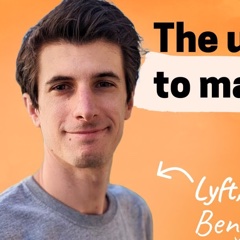
Benjamin Lauzier
Former VP of Product and Growth at Thumbtack, early Lyft leader (employee 30), marketplace advisor and Reforge instructor, founder of Nurra
Where to hear and read about Benjamin Lauzier1 episode or test

Benjamin Lauzier is a marketplace operator who was employee 30 at Lyft, later VP of Product and Growth at Thumbtack, and now advises founders and runs Nurra. The lesson most worth taking from him: before product-market fit a marketplace is just a product problem, and after it you win by fixing the hardest side, usually supply, and turning your best suppliers into your recruiters and coaches.
by renting cars we could essentially manufacture our own supply
How marketplaces win: Liquidity, growth levers, quality, more | Benjamin Lauzier (Lyft, Thumbtack)
Benjamin Lauzier: the story and the lessons
1Benjamin Lauzier's path from Lyft and Thumbtack to Nurra
Lauzier has built and scaled marketplaces for almost 15 years. He was employee number 30 at Lyft and led product and growth for drivers. At Lyft, 1% of U.S. workers were driving for the company every month.
He later became VP of Product and Growth at Thumbtack, where he rebuilt the product team and the revenue model.
He admits to designing marketplaces from an ivory tower. Staring at stats breeds the thought 'if only we could get people to do X.' Lauzier says he made this mistake himself.
His takeaway is that people act in non-deterministic or counterintuitive ways, and marketplaces add a hidden dimension on top of the usual product challenge.
Lauzier started Nurra after his wife's health struggles in the U.S. system. His wife's undiagnosed chronic pain meant a three-month wait for a neurologist, then about eight minutes of the doctor's time. He spent six months talking to hundreds of patients, doctors and experts before building.
Each Nurra patient gets a personal advocate, available 24/7, who finds appointments and explains test results. He calls it his first real company and says going from zero to one felt overwhelming and lonely, but also exciting.
Nurra follows his own advice and starts with the hardest side. Demand, meaning finding patients and shaping the value proposition for them, is the hard side. Health advocates are jumpstarted for now, and a marketplace component may come later.
This matches his closing advice to wait on marketplace dynamics until the core business has product-market fit.
2How Lauzier's team at Lyft matched Uber with a fraction of the resources
Lyft paid its best drivers $35 a session to onboard new drivers. Uber was about 30 times bigger and ran local offices with DMV-style group onboarding. Lyft's mentors checked the car and documents, photographed the license and did a short ride along.
A small team could vet 10 to 20 top drivers, who then onboarded the rest of a new market. Lyft matched most of Uber's footprint with a tenth or a twentieth of the resources. Mentor status also felt like a promotion, which raised retention of top drivers, something Lyft had not expected.
Lyft's brand and driver community made peer onboarding work. A driver on a smaller platform earns less and a rider waits longer, so only the brand made up for it. Pink mustaches and a strong identity gave drivers a reason to join.
Lyft ran Uber-style offices only in its first three to four markets, since offices meant leases, hires and a long lead time before a city could launch.
Lauzier turned drivers into paid recruiters who beat trained salespeople. Many applicants dropped off before activation, and Lyft had hundreds of account executives calling them. Drivers claimed leads from a mini sales dashboard and earned $20 per person converted to activation.
A peer message like 'I'm a fellow driver, do you have questions?' worked better than one from Lyft. Recruiting also gave drivers income during quiet, low-utilization periods.
Lyft built a rental fleet to manufacture its own supply. About 50% of job seekers and welfare recipients in the U.S. have no car. With GM as a backer holding off-lease vehicles, Lyft could dial cars up or down by market and price, and raise average vehicle age where quality was low.
The decision came on a Christmas Eve call between Lyft's CEO and GM's CTO. The fleet became the fourth-largest rental fleet in the U.S. within 18 months, and Lyft would pay for the car if a driver drove 30 hours a week and not for Uber.
Converting riders into drivers failed at Lyft. Lyft had a rider waitlist and showed a pop-up: 'People are making 50 bucks an hour right now, do you want to hop on your car and drive?' It converted a few people but distracted from the experience.
Uber reportedly got meaningful supply this way, and Lauzier is unsure why the audiences differed.
3Lauzier's playbook for building a marketplace
Before product-market fit, Lauzier says to forget marketplace theory. Founders at this stage bring economics papers and supply and demand ratios. He tells them to nail the core exchange of value for one side and use a crutch for the other.
Thumbtack posted a customer's job on Craigslist behind the scenes and pulled the contractors browsing there onto its platform. Airbnb also leaned on Craigslist early.
He tells founders to pick the hardest side first. Supply is the hardest side 80 to 90% of the time. At Thumbtack the hard side was demand, and Rover and TaskRabbit are exceptions where supply was easy.
The tell is 'we can get X, but we struggle to get Y.' Teams in the weeds usually already know which side that is.
He measures product-market fit once per side. He uses the Sean Ellis test of how many users would be significantly disappointed if the product went away, asked of both supply and demand.
Demand often shows fit first, while suppliers find the offer weak, for example because the margins taken are too high.
Lauzier gives teams a market health metric that predicts liquidity. Liquidity is distorted by weather and competitor bids, so he looks for a proxy that plateaus and correlates with both retention and the transaction. At Lyft it was ETA: below about two minutes riders almost always booked.
A supply team can then test whether adding 100 drivers actually reduces ETAs. At Airbnb the equivalent was the share of searches with dates that ended in a booking.
He checks three signs before choosing a marketplace model. The market should be fragmented in a long tail, needs should be uniform enough to commoditize supply, and finding and vetting a match should be hard.
Services are tricky on uniformity, because electricians want only certain jobs on days they are free. With five airlines you don't need a marketplace.
He retains early supply with a basket of value-added services. OpenTable did this with its restaurant services, giving suppliers reasons to stay beyond the lead flow.
4Why marketplaces fail, and how Lauzier protects quality
Lauzier says extra user controls quietly fragment supply. Sidecar let riders filter by car year and drivers set their own prices, which hurt ETAs. A rider sliding to a newer car could unknowingly add ten minutes of wait.
Product teams add toggles because user feedback asks for them, and fragment supply without seeing the effect on marketplace health.
At Thumbtack he turned hard filters into ranking signals. A smoke machine checkbox for wedding DJs excluded the 95% of DJs without one, though users said it was not a dealbreaker.
The fix was to let the preference affect ranking but not filtering. When supply is tight, open the walls.
He warns against building only a demand funnel. Many large marketplaces run ads, clicks and conversions and hope supply stays good enough. Marketplaces lag, so neglected sellers leave before anyone notices.
Then comes a panic and a forced product overhaul. His fix is to treat sellers as users with their own value proposition from the start.
He sets the quality bar in advance and resists lowering it. A marketplace implies curation. The constant push of 'if only we lowered our bar, we could get more supply' ends in shady-looking listings.
Toptal vets heavily up front and keeps quality up with coaching. It advertises a 3% pass rate, though the real rate is allegedly lower because 1% would sound fake.
He sets guardrails and coaching first, then adds control for the gaps. That means a clear quality bar plus tools such as star ratings and thresholds, with hands-on tactics only where gaps remain. Control attempts backfire unpredictably and can raise employment classification risk in the U.S.
Thumbtack's move to direct bookings promised about 20% better ROI for pros, yet pros hated losing the thrill of the sale. Lyft faced the same perception problem when it tried to smooth driver earnings.
5Lauzier's outside views on Lyft's strategy and French startups
He thinks Lyft's narrow vision left it exposed when COVID hit. Lyft stayed anchored on people transportation and shared rides, and skipped food and parcel delivery. During COVID nobody wanted a car with five strangers, but everyone wanted food delivered, so Uber rebounded faster.
He left Lyft in 2019 and calls this a naive outside view. Market caps at the time were about $150 billion for Uber and $5 billion for Lyft.
He wants French startups to teach equity and give teams real ownership. Equity is often under 10% of an exec's pay in France versus over 50% in the U.S. He suggests explaining what equity is worth and the story of the business.
He also recommends teams that own a slice of the business with clear accountability, not feature teams. He says he has not fully cracked how to change this, and believes 80% of U.S. employees also misunderstand their equity.

How marketplaces win: Liquidity, growth levers, quality, more | Benjamin Lauzier (Lyft, Thumbtack)
Marketplace growth is mostly ordinary product-market fit work plus a specific playbook for liquidity, supply growth and quality. Lauzier shows how Lyft matched Uber's footprint with a tenth to a twentieth of the resources by turning its best drivers into mentors and recruiters.
Lauzier has built and scaled marketplaces for almost 15 years. He was employee number 30 at Lyft and led product and growth for drivers. At Lyft, 1% of U.S. workers were driving for the company every month.
He later became VP of Product and Growth at Thumbtack, where he rebuilt the product team and the revenue model.
He admits to designing marketplaces from an ivory tower. Staring at stats breeds the thought 'if only we could get people to do X.' Lauzier says he made this mistake himself.
His takeaway is that people act in non-deterministic or counterintuitive ways, and marketplaces add a hidden dimension on top of the usual product challenge.
Lauzier started Nurra after his wife's health struggles in the U.S. system. His wife's undiagnosed chronic pain meant a three-month wait for a neurologist, then about eight minutes of the doctor's time. He spent six months talking to hundreds of patients, doctors and experts before building.
Each Nurra patient gets a personal advocate, available 24/7, who finds appointments and explains test results. He calls it his first real company and says going from zero to one felt overwhelming and lonely, but also exciting.
Nurra follows his own advice and starts with the hardest side. Demand, meaning finding patients and shaping the value proposition for them, is the hard side. Health advocates are jumpstarted for now, and a marketplace component may come later.
This matches his closing advice to wait on marketplace dynamics until the core business has product-market fit.
Lyft paid its best drivers $35 a session to onboard new drivers. Uber was about 30 times bigger and ran local offices with DMV-style group onboarding. Lyft's mentors checked the car and documents, photographed the license and did a short ride along.
A small team could vet 10 to 20 top drivers, who then onboarded the rest of a new market. Lyft matched most of Uber's footprint with a tenth or a twentieth of the resources. Mentor status also felt like a promotion, which raised retention of top drivers, something Lyft had not expected.
Lyft's brand and driver community made peer onboarding work. A driver on a smaller platform earns less and a rider waits longer, so only the brand made up for it. Pink mustaches and a strong identity gave drivers a reason to join.
Lyft ran Uber-style offices only in its first three to four markets, since offices meant leases, hires and a long lead time before a city could launch.
Lauzier turned drivers into paid recruiters who beat trained salespeople. Many applicants dropped off before activation, and Lyft had hundreds of account executives calling them. Drivers claimed leads from a mini sales dashboard and earned $20 per person converted to activation.
A peer message like 'I'm a fellow driver, do you have questions?' worked better than one from Lyft. Recruiting also gave drivers income during quiet, low-utilization periods.
Lyft built a rental fleet to manufacture its own supply. About 50% of job seekers and welfare recipients in the U.S. have no car. With GM as a backer holding off-lease vehicles, Lyft could dial cars up or down by market and price, and raise average vehicle age where quality was low.
The decision came on a Christmas Eve call between Lyft's CEO and GM's CTO. The fleet became the fourth-largest rental fleet in the U.S. within 18 months, and Lyft would pay for the car if a driver drove 30 hours a week and not for Uber.
Converting riders into drivers failed at Lyft. Lyft had a rider waitlist and showed a pop-up: 'People are making 50 bucks an hour right now, do you want to hop on your car and drive?' It converted a few people but distracted from the experience.
Uber reportedly got meaningful supply this way, and Lauzier is unsure why the audiences differed.
Before product-market fit, Lauzier says to forget marketplace theory. Founders at this stage bring economics papers and supply and demand ratios. He tells them to nail the core exchange of value for one side and use a crutch for the other.
Thumbtack posted a customer's job on Craigslist behind the scenes and pulled the contractors browsing there onto its platform. Airbnb also leaned on Craigslist early.
He tells founders to pick the hardest side first. Supply is the hardest side 80 to 90% of the time. At Thumbtack the hard side was demand, and Rover and TaskRabbit are exceptions where supply was easy.
The tell is 'we can get X, but we struggle to get Y.' Teams in the weeds usually already know which side that is.
He measures product-market fit once per side. He uses the Sean Ellis test of how many users would be significantly disappointed if the product went away, asked of both supply and demand.
Demand often shows fit first, while suppliers find the offer weak, for example because the margins taken are too high.
Lauzier gives teams a market health metric that predicts liquidity. Liquidity is distorted by weather and competitor bids, so he looks for a proxy that plateaus and correlates with both retention and the transaction. At Lyft it was ETA: below about two minutes riders almost always booked.
A supply team can then test whether adding 100 drivers actually reduces ETAs. At Airbnb the equivalent was the share of searches with dates that ended in a booking.
He checks three signs before choosing a marketplace model. The market should be fragmented in a long tail, needs should be uniform enough to commoditize supply, and finding and vetting a match should be hard.
Services are tricky on uniformity, because electricians want only certain jobs on days they are free. With five airlines you don't need a marketplace.
He retains early supply with a basket of value-added services. OpenTable did this with its restaurant services, giving suppliers reasons to stay beyond the lead flow.
Lauzier says extra user controls quietly fragment supply. Sidecar let riders filter by car year and drivers set their own prices, which hurt ETAs. A rider sliding to a newer car could unknowingly add ten minutes of wait.
Product teams add toggles because user feedback asks for them, and fragment supply without seeing the effect on marketplace health.
At Thumbtack he turned hard filters into ranking signals. A smoke machine checkbox for wedding DJs excluded the 95% of DJs without one, though users said it was not a dealbreaker.
The fix was to let the preference affect ranking but not filtering. When supply is tight, open the walls.
He warns against building only a demand funnel. Many large marketplaces run ads, clicks and conversions and hope supply stays good enough. Marketplaces lag, so neglected sellers leave before anyone notices.
Then comes a panic and a forced product overhaul. His fix is to treat sellers as users with their own value proposition from the start.
He sets the quality bar in advance and resists lowering it. A marketplace implies curation. The constant push of 'if only we lowered our bar, we could get more supply' ends in shady-looking listings.
Toptal vets heavily up front and keeps quality up with coaching. It advertises a 3% pass rate, though the real rate is allegedly lower because 1% would sound fake.
He sets guardrails and coaching first, then adds control for the gaps. That means a clear quality bar plus tools such as star ratings and thresholds, with hands-on tactics only where gaps remain. Control attempts backfire unpredictably and can raise employment classification risk in the U.S.
Thumbtack's move to direct bookings promised about 20% better ROI for pros, yet pros hated losing the thrill of the sale. Lyft faced the same perception problem when it tried to smooth driver earnings.
He thinks Lyft's narrow vision left it exposed when COVID hit. Lyft stayed anchored on people transportation and shared rides, and skipped food and parcel delivery. During COVID nobody wanted a car with five strangers, but everyone wanted food delivered, so Uber rebounded faster.
He left Lyft in 2019 and calls this a naive outside view. Market caps at the time were about $150 billion for Uber and $5 billion for Lyft.
He wants French startups to teach equity and give teams real ownership. Equity is often under 10% of an exec's pay in France versus over 50% in the U.S. He suggests explaining what equity is worth and the story of the business.
He also recommends teams that own a slice of the business with clear accountability, not feature teams. He says he has not fully cracked how to change this, and believes 80% of U.S. employees also misunderstand their equity.