Barbara Minto
Author of The Minto Pyramid Principle
Where to hear and read about Barbara Minto1 book
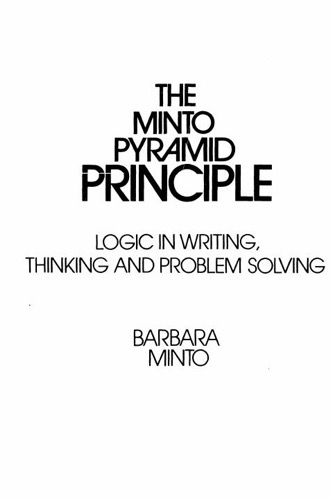
Barbara Minto wrote The Minto Pyramid Principle (1996), a method for clear writing, thinking and problem solving that arranges ideas under one governing thought. The lesson most worth taking is to name the reader's question, put your answer at the top and group the support beneath it, because unclear writing is a failure of structure, not style.
Controlling the sequence in which you present your ideas is the single most important act necessary to clear writing.
The Minto Pyramid Principle: Logic in Writing, Thinking and Problem Solving
Barbara Minto: the story and the lessons
1Barbara Minto's case for fixing structure before style
Minto treats unclear writing as a problem of thinking, not style. In The Minto Pyramid Principle (1996) she argues that most unclear writing comes from the order of ideas. Order is far easier to fix than style.
Changing style after formal education takes repetitive practice that few working writers have time for. Long sentences and abstract language are real problems, but they are the harder ones to change, like learning to type.
Minto puts the summarizing idea before the ideas it summarizes. Readers take in one idea at a time and hold about seven items, so she gives the governing point of every document, section and paragraph first. Ideas are worked out bottom up but delivered top down.
A husband handed nine grocery items one by one came back with only the paper and the grapes. Sorted into dairy, fruit and vegetables, the same nine are easy to recall.
Minto sets a 30-second test for any document. The introduction, main point and Key Line points should make the whole argument clear in the first 30 seconds. The reader can then scan the rest, sure nothing important will surprise him.
"If your entire thinking is not clear to the reader in the first 30 seconds of reading, you should rewrite."
Minto says readers group ideas whether or not the writer helps. Six dots with some gaps smaller than others are seen as two groups of three. Past four or five items the mind sorts them into categories to keep them.
Grouping helps only when the logic of each group is stated before its items. Left to guess, readers guess wrong or not at all.
2How Minto builds a pyramid
Minto starts with the top: subject, question and answer. She has the writer draw a box, write the Subject, state the Question the reader should have answered, and write the Answer. Then state the Situation and Complication, and if the Complication does not raise the Question, change one of them.
A reply memo about Big Chief's offer to cut a five-week billing cycle to one day described the new system but never said whether to accept. Rebuilt around the question, it said yes, for three reasons: needed information, better cash flow, less work.
Minto makes every point raise a question the level below answers. An idea tells the reader something new, so he asks Why? or How?. The line directly below answers that question and nothing else, and raises the next one.
A reader can reject Chesterton's case for keeping pigs as pets and still see exactly why he makes it. Following the reasoning is the most a writer can hope for, since agreement is not guaranteed.
Minto says never answer a question the reader has not asked. The first statement must answer a question already in the reader's mind. A section that answers an unasked question will need repeating or rereading.
Held to this rule, the pyramid "almost magically forces you to present information only as the reader needs it."
Minto tests three rules on the pyramid before drafting. Each idea summarizes the group below it, each group holds one kind of idea, and each group sits in logical order. A broken rule points to flawed thinking, undeveloped ideas or unclear relationships.
Fixing it before drafting avoids heavy rewriting later.
Minto builds from the bottom when the top will not come. List every point, judge the recommendations first, then map cause and effect among the problems and draw a conclusion.
A young consultant, two weeks into a printing company assignment, sent a rambling memo. Listing his points showed his two remedies said the same thing, and mapping cause and effect revealed two separate lines of reasoning. She warns against dictating everything first, since ideas once written look carved in gold.
3Minto's Situation, Complication, Question introductions
Minto opens with a story the reader already accepts. State a noncontroversial Situation anchored in time and place, add the Complication that happened next, name the one Question it raises, then give the Answer. The last thing the reader already knows is the Complication.
A board memo with a purpose line and five topics became clear as a story. A new October organization gave division managers day-to-day authority, the Board was still fixed on short-term problems, so daily matters should go to a broadened Executive Committee.
Minto says a Complication creates tension but need not be a problem. Most take one of four forms: a task is blocked, a known solution needs doing, a proposed solution needs testing, or an action failed.
If the Question will not come, she asks what question the body's points answer.
Minto keeps introductions short and free of proof. Situation and Complication run three or four paragraphs at most, and a close reader may need one sentence. Exhibits in an introduction signal overstating the obvious.
A London Office memo was rewritten four ways (standard, direct, concerned, aggressive). The content stayed the same and only the tone shifted. "Introductions are meant to remind rather than to inform."
Minto wants Key Line points stated as ideas, not topics. A list of topics tells the reader nothing and hides a jumbled argument. Headings like Background and Findings fail for the same reason.
A project-team memo listed six sections, from Background to Prerequisites for success, and none carried a message. "Never write about categories, only about ideas."
Minto sorts most documents into four reader questions. They are what should we do, should we do what we plan, how do we do something, and why did it happen. Consultants usually answer only the first three.
Simmons & Smith expected its NC membrane market to double in 3 years and disliked the 30% dealer commission. The answer was a separate distribution approach for each market.
4How Minto groups, orders and summarizes ideas
Minto names every group with one plural noun. Ideas in a group must be the same kind, such as reasons, steps or recommendations. If no single plural noun covers them, regroup.
A mixed group like apples and chairs can only be summed up as 'things', which says nothing.
Minto replaces blank assertions like 'five problems' with the real point. A writer claimed 'two organization problems' but could find no order. Pressed, he saw four areas needing more delegation, and the real point was the company's inability to delegate authority.
"The act of summarizing the grouping is the act of completing the thinking."
Minto gives every inductive group a time, structural or degree order. The mind forms groups only by finding causes, dividing a whole or classifying. A list with no order is broken, and finding the order exposes missing steps.
A draft called investment evaluation unsound, simplistic and misleading. The third point was the effect of the other two, and the process beneath was concept, technique, application. The draft never addressed application. "You cannot tell that nonsense is being written unless you first impose a structure on it."
Minto keeps groups to four or five and subgroups longer lists. Lists longer than five almost always hide closer links. Eight buyer complaints about a sales report sorted into bad timing, poor data and unhelpful format.
The order of the three groups shifts with the question asked, such as why buyers hate the report versus how to fix it.
Minto words each action as an end product you could hold. Verbs like improve or strengthen give no answer to 'How?'. 'Reduce accounts receivable' became 'Establish a system for following up overdue accounts'.
The concrete wording exposed a missing step: stop calling on chronic nonpayers.
Minto cuts facts that share nothing with their neighbors. Japanese drives into China, Indonesia and Australia support a move into Southeast Asia. Drives into China, Iceland and Peru share nothing and support no point.
"There is no place for news in a document whose purpose is to communicate your thinking."
Minto puts induction on the Key Line and pushes deduction low. A deductive Key Line makes the reader hold every problem and cause before learning what to do. She reserves deduction for answers that will surprise the reader or actions that make no sense without the reasoning.
A client asking how to cut costs can be told 'do A, B and C'. Telling him to sell the business needs the argument first. She limits a deductive chain to four points and two therefores.
5How Minto defines and analyzes problems
Minto defines a problem as the gap between R1 and R2. Sketch the Opening Scene, the Disturbing Event, the undesired result R1 and the desired result R2. A real estate firm that sold the same way for 30 years and grew about 10% a year saw projections fall 10%, so the question became how to ensure continued growth.
R2 should carry a number or a definite end state. If it cannot be stated, finding it becomes the first piece of work, since without it solutions cannot be compared.
Minto asks where the reader stands on a solution. Many histories are layered, with a solution proposed, tried or rejected, and the reader's latest action becomes the Complication. A common error is never settling whether the reader has already acted.
Jackson Foods changed its terms of trade to raise order sizes, which made little difference. That failed fix became the Complication.
Minto structures the analysis before gathering any data. Early consulting firms began every job with a full company and industry study, and one major firm estimated 60% of that effort was wasted. She prefers the scientific method of forming hypotheses and designing tests that rule each in or out.
At Barrows, a consultant planned eight broad data areas to cover by interview. A flow diagram of current operations gave him six yes-no questions instead, on lead times, purchased items, stock availability, capacity, system costs and management reports. "Good problem solving cannot be done in the abstract."
Minto phrases every issue as a yes-no question. Issues come from the structure behind R1, not from the client's question, which only states R2. Open worries should be called concerns.
A Texas distributor with $27 million of central inventory had five wordy issues. A tree cut them to two: does the central system order properly, and does it keep too much obsolete stock.
Minto never raises alternatives just to knock them down. Mention alternatives only when the reader already knows them, and put them in the Complication. Recommend an option because it solves the problem, not because the others fail.
If a reader insists on options, she puts them in an appendix chart with options down the side and criteria across the top.
Minto invents a structure when none exists and tests it. When a result cannot be explained, she draws hypotheses from the situation's structural elements and runs a test that gives a clean yes or no. Charles Sanders Peirce coined the term abduction in 1890.
Galileo guessed force related to time, predicted distances of 1, 4 and 9, and confirmed it by rolling a ball down an inclined plane. Just varying conditions to see what happens is not enough.
6How Minto shapes pages, slides and sentences
Minto uses the lightest visual device that shows the Key Line. With about a paragraph per point, underlining is enough. When each point needs more than a paragraph or two, state the points first and give each its own heading.
An August 25 field sales memo listed three actions with deadlines, then gave each its own heading, starting with SELECTING THE CHAIN.
Minto sets strict rules for headings. Never use a single heading at any level, keep headings in a group parallel, and write so the text reads smoothly with headings removed. Introduce each group of headings first.
"Headings are for the eye more than they are for the mind."
Minto ends only when the ending adds something. A sound pyramid needs no conclusion. Next Steps should hold only actions the reader will not question.
After 30 pages urging a purchase, the Next Steps were three: ask the owner to lunch, confirm the money with the bank, and reconvene the Acquisitions Committee.
Minto lets the speaker carry the message, not the slides. She aims for about 90% exhibits and 10% text slides, with a text slide holding one idea in about 6 lines or 30 words. Each exhibit's title states the answer to the question it addresses.
Gene Zelazny's term for wordy slides read aloud is a visual recitation. "The most interesting thing in the room is always you, not the slides." For type size, divide the farthest viewer's distance in feet by 32 to get letter height in inches.
Minto fixes heavy sentences by finding the nouns and their relationships. Pick out the concrete nouns, sketch how they connect with shapes and arrows, then write one plain sentence stating the link. If a part cannot be pictured, ask the writer.
A long sentence about the cost-effectiveness of sales-force deployment came down to salesman and store. The rewrite said to redeploy the sales force to match the new trading environment.
7Minto's routine for a memo or deck
Minto sorts findings, causes and actions into a worksheet, then turns it. The Recommendation Worksheet has three columns: what is going wrong, what causes it, and what to do. Read down the columns it gives deduction, and turned 90 degrees the recommendations land on the Key Line.
Choosing between the two is a layout decision, not a choice of logic. She says deduction is not the stronger form.
Minto builds a deck from a storyboard, not from the report. Write the introduction in full, put the Key Line and the level below atop the slides, script around them and rehearse. A slide's top line should state its point.
The Jackson Foods storyboard opened with a supply chain costing $12m a year, 14% of NPS. Its steps were to stabilise service, cut obvious costs and build longer-term skills.
Minto says a painful report signals late thinking. A report that takes huge effort and still reads poorly means the thinking needed to write clearly did not happen early enough.
Her fix is to define the gap, structure the analysis, then build the pyramid, so the writing follows from work already done.
The Minto Pyramid Principle: Logic in Writing, Thinking and Problem Solving
Clear business writing comes from arranging ideas as a pyramid under one governing thought, delivered top down, with groupings that are logically ordered and summarized and an introduction that tells a Situation, Complication, Question story. The method also covers defining problems, structuring analysis, laying out pages and slides, and turning ideas into plain prose, so it fixes unclear writing at the level of thinking rather than style.
Minto treats unclear writing as a problem of thinking, not style. In The Minto Pyramid Principle (1996) she argues that most unclear writing comes from the order of ideas. Order is far easier to fix than style.
Changing style after formal education takes repetitive practice that few working writers have time for. Long sentences and abstract language are real problems, but they are the harder ones to change, like learning to type.
Minto puts the summarizing idea before the ideas it summarizes. Readers take in one idea at a time and hold about seven items, so she gives the governing point of every document, section and paragraph first. Ideas are worked out bottom up but delivered top down.
A husband handed nine grocery items one by one came back with only the paper and the grapes. Sorted into dairy, fruit and vegetables, the same nine are easy to recall.
Minto sets a 30-second test for any document. The introduction, main point and Key Line points should make the whole argument clear in the first 30 seconds. The reader can then scan the rest, sure nothing important will surprise him.
"If your entire thinking is not clear to the reader in the first 30 seconds of reading, you should rewrite."
Minto says readers group ideas whether or not the writer helps. Six dots with some gaps smaller than others are seen as two groups of three. Past four or five items the mind sorts them into categories to keep them.
Grouping helps only when the logic of each group is stated before its items. Left to guess, readers guess wrong or not at all.
Minto starts with the top: subject, question and answer. She has the writer draw a box, write the Subject, state the Question the reader should have answered, and write the Answer. Then state the Situation and Complication, and if the Complication does not raise the Question, change one of them.
A reply memo about Big Chief's offer to cut a five-week billing cycle to one day described the new system but never said whether to accept. Rebuilt around the question, it said yes, for three reasons: needed information, better cash flow, less work.
Minto makes every point raise a question the level below answers. An idea tells the reader something new, so he asks Why? or How?. The line directly below answers that question and nothing else, and raises the next one.
A reader can reject Chesterton's case for keeping pigs as pets and still see exactly why he makes it. Following the reasoning is the most a writer can hope for, since agreement is not guaranteed.
Minto says never answer a question the reader has not asked. The first statement must answer a question already in the reader's mind. A section that answers an unasked question will need repeating or rereading.
Held to this rule, the pyramid "almost magically forces you to present information only as the reader needs it."
Minto tests three rules on the pyramid before drafting. Each idea summarizes the group below it, each group holds one kind of idea, and each group sits in logical order. A broken rule points to flawed thinking, undeveloped ideas or unclear relationships.
Fixing it before drafting avoids heavy rewriting later.
Minto builds from the bottom when the top will not come. List every point, judge the recommendations first, then map cause and effect among the problems and draw a conclusion.
A young consultant, two weeks into a printing company assignment, sent a rambling memo. Listing his points showed his two remedies said the same thing, and mapping cause and effect revealed two separate lines of reasoning. She warns against dictating everything first, since ideas once written look carved in gold.
Minto opens with a story the reader already accepts. State a noncontroversial Situation anchored in time and place, add the Complication that happened next, name the one Question it raises, then give the Answer. The last thing the reader already knows is the Complication.
A board memo with a purpose line and five topics became clear as a story. A new October organization gave division managers day-to-day authority, the Board was still fixed on short-term problems, so daily matters should go to a broadened Executive Committee.
Minto says a Complication creates tension but need not be a problem. Most take one of four forms: a task is blocked, a known solution needs doing, a proposed solution needs testing, or an action failed.
If the Question will not come, she asks what question the body's points answer.
Minto keeps introductions short and free of proof. Situation and Complication run three or four paragraphs at most, and a close reader may need one sentence. Exhibits in an introduction signal overstating the obvious.
A London Office memo was rewritten four ways (standard, direct, concerned, aggressive). The content stayed the same and only the tone shifted. "Introductions are meant to remind rather than to inform."
Minto wants Key Line points stated as ideas, not topics. A list of topics tells the reader nothing and hides a jumbled argument. Headings like Background and Findings fail for the same reason.
A project-team memo listed six sections, from Background to Prerequisites for success, and none carried a message. "Never write about categories, only about ideas."
Minto sorts most documents into four reader questions. They are what should we do, should we do what we plan, how do we do something, and why did it happen. Consultants usually answer only the first three.
Simmons & Smith expected its NC membrane market to double in 3 years and disliked the 30% dealer commission. The answer was a separate distribution approach for each market.
Minto names every group with one plural noun. Ideas in a group must be the same kind, such as reasons, steps or recommendations. If no single plural noun covers them, regroup.
A mixed group like apples and chairs can only be summed up as 'things', which says nothing.
Minto replaces blank assertions like 'five problems' with the real point. A writer claimed 'two organization problems' but could find no order. Pressed, he saw four areas needing more delegation, and the real point was the company's inability to delegate authority.
"The act of summarizing the grouping is the act of completing the thinking."
Minto gives every inductive group a time, structural or degree order. The mind forms groups only by finding causes, dividing a whole or classifying. A list with no order is broken, and finding the order exposes missing steps.
A draft called investment evaluation unsound, simplistic and misleading. The third point was the effect of the other two, and the process beneath was concept, technique, application. The draft never addressed application. "You cannot tell that nonsense is being written unless you first impose a structure on it."
Minto keeps groups to four or five and subgroups longer lists. Lists longer than five almost always hide closer links. Eight buyer complaints about a sales report sorted into bad timing, poor data and unhelpful format.
The order of the three groups shifts with the question asked, such as why buyers hate the report versus how to fix it.
Minto words each action as an end product you could hold. Verbs like improve or strengthen give no answer to 'How?'. 'Reduce accounts receivable' became 'Establish a system for following up overdue accounts'.
The concrete wording exposed a missing step: stop calling on chronic nonpayers.
Minto cuts facts that share nothing with their neighbors. Japanese drives into China, Indonesia and Australia support a move into Southeast Asia. Drives into China, Iceland and Peru share nothing and support no point.
"There is no place for news in a document whose purpose is to communicate your thinking."
Minto puts induction on the Key Line and pushes deduction low. A deductive Key Line makes the reader hold every problem and cause before learning what to do. She reserves deduction for answers that will surprise the reader or actions that make no sense without the reasoning.
A client asking how to cut costs can be told 'do A, B and C'. Telling him to sell the business needs the argument first. She limits a deductive chain to four points and two therefores.
Minto defines a problem as the gap between R1 and R2. Sketch the Opening Scene, the Disturbing Event, the undesired result R1 and the desired result R2. A real estate firm that sold the same way for 30 years and grew about 10% a year saw projections fall 10%, so the question became how to ensure continued growth.
R2 should carry a number or a definite end state. If it cannot be stated, finding it becomes the first piece of work, since without it solutions cannot be compared.
Minto asks where the reader stands on a solution. Many histories are layered, with a solution proposed, tried or rejected, and the reader's latest action becomes the Complication. A common error is never settling whether the reader has already acted.
Jackson Foods changed its terms of trade to raise order sizes, which made little difference. That failed fix became the Complication.
Minto structures the analysis before gathering any data. Early consulting firms began every job with a full company and industry study, and one major firm estimated 60% of that effort was wasted. She prefers the scientific method of forming hypotheses and designing tests that rule each in or out.
At Barrows, a consultant planned eight broad data areas to cover by interview. A flow diagram of current operations gave him six yes-no questions instead, on lead times, purchased items, stock availability, capacity, system costs and management reports. "Good problem solving cannot be done in the abstract."
Minto phrases every issue as a yes-no question. Issues come from the structure behind R1, not from the client's question, which only states R2. Open worries should be called concerns.
A Texas distributor with $27 million of central inventory had five wordy issues. A tree cut them to two: does the central system order properly, and does it keep too much obsolete stock.
Minto never raises alternatives just to knock them down. Mention alternatives only when the reader already knows them, and put them in the Complication. Recommend an option because it solves the problem, not because the others fail.
If a reader insists on options, she puts them in an appendix chart with options down the side and criteria across the top.
Minto invents a structure when none exists and tests it. When a result cannot be explained, she draws hypotheses from the situation's structural elements and runs a test that gives a clean yes or no. Charles Sanders Peirce coined the term abduction in 1890.
Galileo guessed force related to time, predicted distances of 1, 4 and 9, and confirmed it by rolling a ball down an inclined plane. Just varying conditions to see what happens is not enough.
Minto uses the lightest visual device that shows the Key Line. With about a paragraph per point, underlining is enough. When each point needs more than a paragraph or two, state the points first and give each its own heading.
An August 25 field sales memo listed three actions with deadlines, then gave each its own heading, starting with SELECTING THE CHAIN.
Minto sets strict rules for headings. Never use a single heading at any level, keep headings in a group parallel, and write so the text reads smoothly with headings removed. Introduce each group of headings first.
"Headings are for the eye more than they are for the mind."
Minto ends only when the ending adds something. A sound pyramid needs no conclusion. Next Steps should hold only actions the reader will not question.
After 30 pages urging a purchase, the Next Steps were three: ask the owner to lunch, confirm the money with the bank, and reconvene the Acquisitions Committee.
Minto lets the speaker carry the message, not the slides. She aims for about 90% exhibits and 10% text slides, with a text slide holding one idea in about 6 lines or 30 words. Each exhibit's title states the answer to the question it addresses.
Gene Zelazny's term for wordy slides read aloud is a visual recitation. "The most interesting thing in the room is always you, not the slides." For type size, divide the farthest viewer's distance in feet by 32 to get letter height in inches.
Minto fixes heavy sentences by finding the nouns and their relationships. Pick out the concrete nouns, sketch how they connect with shapes and arrows, then write one plain sentence stating the link. If a part cannot be pictured, ask the writer.
A long sentence about the cost-effectiveness of sales-force deployment came down to salesman and store. The rewrite said to redeploy the sales force to match the new trading environment.
Minto sorts findings, causes and actions into a worksheet, then turns it. The Recommendation Worksheet has three columns: what is going wrong, what causes it, and what to do. Read down the columns it gives deduction, and turned 90 degrees the recommendations land on the Key Line.
Choosing between the two is a layout decision, not a choice of logic. She says deduction is not the stronger form.
Minto builds a deck from a storyboard, not from the report. Write the introduction in full, put the Key Line and the level below atop the slides, script around them and rehearse. A slide's top line should state its point.
The Jackson Foods storyboard opened with a supply chain costing $12m a year, 14% of NPS. Its steps were to stabilise service, cut obvious costs and build longer-term skills.
Minto says a painful report signals late thinking. A report that takes huge effort and still reads poorly means the thinking needed to write clearly did not happen early enough.
Her fix is to define the gap, structure the analysis, then build the pyramid, so the writing follows from work already done.