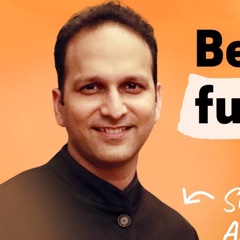
Anuj Rathi
Chief Product and Marketing Officer at Jupiter Money, formerly SVP Revenue and Growth at Swiggy and first PM at Flipkart
Where to hear and read about Anuj Rathi1 episode or test

Anuj Rathi is Chief Product and Marketing Officer at Jupiter Money, previously SVP Revenue and Growth at Swiggy and the first PM at Flipkart. The most useful thing to learn from him is to own the whole outcome: write the future down in concrete form, and treat influence over users and teammates as the core of the PM job.
You're in the business of influence.
The full-stack PM | Anuj Rathi (Swiggy, Jupiter Money, Flipkart)
Anuj Rathi: the story and the lessons
1Anuj Rathi's path through Indian consumer tech
Rathi was Flipkart's first PM and led its buyer experience team. His career in product, growth and marketing at large Indian consumer companies began in 2010. He was later VP of Product at Snapdeal and a senior PM at Walmart Labs.
He was the most requested guest in a call for India-based product leaders. He credits long tenure and well-known work, since few products were built for India in 2010.
He spent seven years at Swiggy and ended as SVP of Revenue and Growth. He is now Chief Product and Marketing Officer at Jupiter Money, whose products are a savings account, credit card, mutual funds, gold and fixed deposits.
Jupiter gives him a new version of the newcomer problem: a user who found value in one service is often not interested in the rest.
Rathi says Indian product management had to be invented. Before 2010 most Indian tech work was back office for American and European customers. No college taught product building and no playbooks existed.
Early leaders came from FMCG and manufacturing and expected predictable output from resources. Repeated cycles taught them that software is not machinery and consumers are not predictable.
He builds for a market where few customers can pay. Per capita income is about $2,000 to $2,500, roughly 30 times lower than in the US, so finding customers who will pay is the hard craft.
An elders' saying holds that language, people and culture change every 15 miles, so a single persona rarely applies. UPI helped by making even a 5 rupee payment digital.
2How Rathi designs for lazy, vain and selfish new users
Rathi assumes customers care far less about the product than the team does. PMs watch minor nuances daily and assume everyone thinks about the product all day. Word of mouth is never as strong as assumed, even for the strongest brands.
Closeness to the product is a built-in bias. The indifferent customers are exactly the ones a company has to win first.
He designs onboarding for users who are lazy, vain and selfish. Lazy means blow my mind or I won't pay attention. Vain means I already have a habit. Selfish means show me what's in it for me. He borrows the framework from Scott Belsky.
At Swiggy, reframing from 'we are a food delivery app' to 'what is in it for you' and carrying the marketing message into onboarding showed results quickly. He says it changes success more than features built for loyal users.
At Swiggy he asked what finally made a user download. The team assumed the user had heard of Swiggy 20 times, then asked what trigger finally led to the download and why they had not downloaded earlier.
The hard part is rejecting your own product through that user's eyes.
He carries one value prop through the whole first journey. A PM should know the category's not-yet-buying consumers as well as the marketer does, pick the message that earns attention, and introduce other products later.
He calls letting a new user try everything at once being 'greedy'. The skill is knowing when to introduce the second feature, after the first has earned attention.
He runs product reviews on one named person, not a persona. The team builds all collateral for one specific person, such as Lenny, 30, with his food delivery history, needs and frustrations. About 50% of Rathi's product reviews go to this.
The questions: what triggered him to open the app at 11:00, and does every pixel, copy line and word serve what he came for? In real-time marketplaces the team also maps his emotional state through the roughly 30 minute delivery wait.
3How Rathi writes the future down before building
Rathi has teams write three divergent press releases and FAQs. Each is fully thought through, such as two tiers versus three, or a membership versus a points program. The PM then recommends one and folds in parts of the others.
People whose ideas were rejected see they were weighed and why they did not add up. It works even with a CXO who asks for a specific build. In his words: "I really truly believe in the power of three."
He uses the PR FAQ to negotiate date, scope and goals. Starting from a launch date, a VP Engineering can say if the date is too aggressive without full PRDs. The customer quote tests whether marketing and pricing can deliver, and the business owner quote sets a goal such as a result within three months.
If anyone disagrees, the date and goals change together.
He makes FAQ questions mandatory so process lives in the document. At Jupiter every FAQ must cover compliance, legal and sign-offs. At Swiggy it asked about effects on restaurant partners and on each segment of delivery partners.
PMs ended up consulting the other sides of the marketplace before shipping, which produced crisp products that work for all sides.
He puts the journey on a shared wall and strategy on a page. Each PM keeps a current version and a new version side by side to explain why a change is being made. Leaders get a strategy on a page, also called growth loops, covering the market, which users, activation budgets and cross-pollination.
He builds three versions so CXOs see why one strategy beat the others. The biggest gain is that the whole company sees the same picture, and weak ideas surface early once they are concrete.
4Rathi's 4BB framework and his views on speed
Rathi splits product focus across four buckets called 4BB. The buckets are Brilliant Basics (tech debt and hygiene), Bread and Butter (backlog), Big Bets and Breaking Bad (redefining the company). The head of product and the CEO decide how to split 100 focus points.
He calls it "a product strategy call", not a tactical PM call. At Swiggy, moving from food delivery into grocery and convenience was a Breaking Bad bet.
He brings leadership three splits and the cost of each. The splits show trade-offs, such as fewer bugs and no differentiators versus more game-changing bets and more downtime. If leaders cut basics to fund a bet, they must accept the downtime and not blame the team later.
If the recommended pick is 80% right, parts of the other two can be folded in. Once leadership aligns, disagree and commit applies and nobody reopens the choice.
He prefers thought experiments to testing obviously weak ideas. When forced to choose, he says think more and ship better. Smart people can see that some experiments will fail, and testing everything wastes company time.
He frames it as a preference, not a rule. Speed and excellence are separate axes, and ideally you are good at both.
He asks PM candidates when they choose speed over excellence. He asks which products need speed and which need excellence, then digs into examples and looks at how they assess risk, market and competition.
A 'ship and find out' answer signals someone who misses that the V in MVP must be viable and differentiated enough to market. Half-baked launches are fine when there is a clear market gap.
5What Rathi learned running a three-sided marketplace at Swiggy
Rathi has seen OKRs fail in a three-sided marketplace. OKRs assume you can divide and conquer by user type, but with consumers, restaurants and delivery partners the goals conflict. Raising the delivery fee, restaurant commission or lowering delivery partner pay each pulls the other sides.
"They're not independent levers in the first place." Modeling it is nearly impossible: change X and Y changes, then Z.
He uses big bets that treat the levers as one story. One example is making delivery profitable through a higher delivery fee without touching earnings per hour or restaurant commissions.
He found this a better way to choose a strategic direction than splitting goals by side.
He does not trust simple A/B tests in marketplaces. Putting half the drivers on A and half on B fails because the groups affect each other through network effects.
Liquidity choices, such as spending a limited pool on riders' first 10 rides versus on drivers, also need different thinking.
Each PM must champion every side, not only their own. The delivery PM must also champion the consumer, and the reverse. Supply often gets squeezed, as with Uber and Lyft drivers or Airbnb hosts.
The delivery executive faces very different scenarios from the user waiting on an order, so empathy has to cover both.
He keeps all sides stable first, then picks a priority side. No side may become so unhappy that it leaves. Then the company's vision decides whom to serve most.
Swiggy's first value read 'customer comes first', which confused people because restaurants are also customers. It was clarified to the end consumer, with restaurants and delivery partners working with Swiggy in service of that consumer.
6How Rathi defines, hires and diagnoses PMs
He says a PM owns the outcome, not just features. Success means the product changed user behavior, delivered a business result and built a capability. A launch that merely worked does not count.
PMs must either be strong across users, competition, other PMs, engineering and marketing, or run ideas past partners who are. He cites the book Range to argue for breadth.
He hires PMs for raw sharpness, drive and influence. Sharpness is problem identification, problem solving and higher-order thinking. Drive covers curiosity, learnability and never giving up. Influence reaches users, engineers and leadership.
About 80% of smartness is achievable, drive is hardest to coach, and he has not seen low-drive people become high-drive. Influence is not optional, and candidates should be excited by it, not scared.
He asks whether a person can't, won't, or wasn't set up. For 'can't', coach, mentor or move the person. For 'won't', find out whether they disagree with the vision or lack time. The third cause is the leader's own failure, in OKRs and org design.
"almost 70%, 80% of problems why things don't happen are a setup issue." He sees org design showing up in the product itself, as in Conway's law.
He thinks many PMs are in the wrong job. Many people enter product without knowing what it takes. Coaching can help, but a wrong fit makes people miserable.
He says this from the PMs he has worked with, not from data.
He pairs AI with human intelligence, UX and behavioral science. He warns against force-fitting AI onto problems it was never chosen for. Swiggy CEO Sriharsha coined 'HI' to say human intelligence matters as much.
"If you're not humanly intelligent, you're not going to be artificially intelligent."
Rathi says to stop externalizing when a product bombs. He asks what he could have done better. As a poker player, he sees results as half luck and half skill.
Repeated failure means looking back at skill.

The full-stack PM | Anuj Rathi (Swiggy, Jupiter Money, Flipkart)
Anuj Rathi shares practical frameworks for product work: designing for lazy, vain and selfish new users, writing three divergent press releases, the 4BB strategy buckets, and why OKRs fail in marketplaces. His lessons come from seven years at Swiggy and a career building products for India since 2010.
Rathi was Flipkart's first PM and led its buyer experience team. His career in product, growth and marketing at large Indian consumer companies began in 2010. He was later VP of Product at Snapdeal and a senior PM at Walmart Labs.
He was the most requested guest in a call for India-based product leaders. He credits long tenure and well-known work, since few products were built for India in 2010.
He spent seven years at Swiggy and ended as SVP of Revenue and Growth. He is now Chief Product and Marketing Officer at Jupiter Money, whose products are a savings account, credit card, mutual funds, gold and fixed deposits.
Jupiter gives him a new version of the newcomer problem: a user who found value in one service is often not interested in the rest.
Rathi says Indian product management had to be invented. Before 2010 most Indian tech work was back office for American and European customers. No college taught product building and no playbooks existed.
Early leaders came from FMCG and manufacturing and expected predictable output from resources. Repeated cycles taught them that software is not machinery and consumers are not predictable.
He builds for a market where few customers can pay. Per capita income is about $2,000 to $2,500, roughly 30 times lower than in the US, so finding customers who will pay is the hard craft.
An elders' saying holds that language, people and culture change every 15 miles, so a single persona rarely applies. UPI helped by making even a 5 rupee payment digital.
Rathi assumes customers care far less about the product than the team does. PMs watch minor nuances daily and assume everyone thinks about the product all day. Word of mouth is never as strong as assumed, even for the strongest brands.
Closeness to the product is a built-in bias. The indifferent customers are exactly the ones a company has to win first.
He designs onboarding for users who are lazy, vain and selfish. Lazy means blow my mind or I won't pay attention. Vain means I already have a habit. Selfish means show me what's in it for me. He borrows the framework from Scott Belsky.
At Swiggy, reframing from 'we are a food delivery app' to 'what is in it for you' and carrying the marketing message into onboarding showed results quickly. He says it changes success more than features built for loyal users.
At Swiggy he asked what finally made a user download. The team assumed the user had heard of Swiggy 20 times, then asked what trigger finally led to the download and why they had not downloaded earlier.
The hard part is rejecting your own product through that user's eyes.
He carries one value prop through the whole first journey. A PM should know the category's not-yet-buying consumers as well as the marketer does, pick the message that earns attention, and introduce other products later.
He calls letting a new user try everything at once being 'greedy'. The skill is knowing when to introduce the second feature, after the first has earned attention.
He runs product reviews on one named person, not a persona. The team builds all collateral for one specific person, such as Lenny, 30, with his food delivery history, needs and frustrations. About 50% of Rathi's product reviews go to this.
The questions: what triggered him to open the app at 11:00, and does every pixel, copy line and word serve what he came for? In real-time marketplaces the team also maps his emotional state through the roughly 30 minute delivery wait.
Rathi has teams write three divergent press releases and FAQs. Each is fully thought through, such as two tiers versus three, or a membership versus a points program. The PM then recommends one and folds in parts of the others.
People whose ideas were rejected see they were weighed and why they did not add up. It works even with a CXO who asks for a specific build. In his words: "I really truly believe in the power of three."
He uses the PR FAQ to negotiate date, scope and goals. Starting from a launch date, a VP Engineering can say if the date is too aggressive without full PRDs. The customer quote tests whether marketing and pricing can deliver, and the business owner quote sets a goal such as a result within three months.
If anyone disagrees, the date and goals change together.
He makes FAQ questions mandatory so process lives in the document. At Jupiter every FAQ must cover compliance, legal and sign-offs. At Swiggy it asked about effects on restaurant partners and on each segment of delivery partners.
PMs ended up consulting the other sides of the marketplace before shipping, which produced crisp products that work for all sides.
He puts the journey on a shared wall and strategy on a page. Each PM keeps a current version and a new version side by side to explain why a change is being made. Leaders get a strategy on a page, also called growth loops, covering the market, which users, activation budgets and cross-pollination.
He builds three versions so CXOs see why one strategy beat the others. The biggest gain is that the whole company sees the same picture, and weak ideas surface early once they are concrete.
Rathi splits product focus across four buckets called 4BB. The buckets are Brilliant Basics (tech debt and hygiene), Bread and Butter (backlog), Big Bets and Breaking Bad (redefining the company). The head of product and the CEO decide how to split 100 focus points.
He calls it "a product strategy call", not a tactical PM call. At Swiggy, moving from food delivery into grocery and convenience was a Breaking Bad bet.
He brings leadership three splits and the cost of each. The splits show trade-offs, such as fewer bugs and no differentiators versus more game-changing bets and more downtime. If leaders cut basics to fund a bet, they must accept the downtime and not blame the team later.
If the recommended pick is 80% right, parts of the other two can be folded in. Once leadership aligns, disagree and commit applies and nobody reopens the choice.
He prefers thought experiments to testing obviously weak ideas. When forced to choose, he says think more and ship better. Smart people can see that some experiments will fail, and testing everything wastes company time.
He frames it as a preference, not a rule. Speed and excellence are separate axes, and ideally you are good at both.
He asks PM candidates when they choose speed over excellence. He asks which products need speed and which need excellence, then digs into examples and looks at how they assess risk, market and competition.
A 'ship and find out' answer signals someone who misses that the V in MVP must be viable and differentiated enough to market. Half-baked launches are fine when there is a clear market gap.
Rathi has seen OKRs fail in a three-sided marketplace. OKRs assume you can divide and conquer by user type, but with consumers, restaurants and delivery partners the goals conflict. Raising the delivery fee, restaurant commission or lowering delivery partner pay each pulls the other sides.
"They're not independent levers in the first place." Modeling it is nearly impossible: change X and Y changes, then Z.
He uses big bets that treat the levers as one story. One example is making delivery profitable through a higher delivery fee without touching earnings per hour or restaurant commissions.
He found this a better way to choose a strategic direction than splitting goals by side.
He does not trust simple A/B tests in marketplaces. Putting half the drivers on A and half on B fails because the groups affect each other through network effects.
Liquidity choices, such as spending a limited pool on riders' first 10 rides versus on drivers, also need different thinking.
Each PM must champion every side, not only their own. The delivery PM must also champion the consumer, and the reverse. Supply often gets squeezed, as with Uber and Lyft drivers or Airbnb hosts.
The delivery executive faces very different scenarios from the user waiting on an order, so empathy has to cover both.
He keeps all sides stable first, then picks a priority side. No side may become so unhappy that it leaves. Then the company's vision decides whom to serve most.
Swiggy's first value read 'customer comes first', which confused people because restaurants are also customers. It was clarified to the end consumer, with restaurants and delivery partners working with Swiggy in service of that consumer.
He says a PM owns the outcome, not just features. Success means the product changed user behavior, delivered a business result and built a capability. A launch that merely worked does not count.
PMs must either be strong across users, competition, other PMs, engineering and marketing, or run ideas past partners who are. He cites the book Range to argue for breadth.
He hires PMs for raw sharpness, drive and influence. Sharpness is problem identification, problem solving and higher-order thinking. Drive covers curiosity, learnability and never giving up. Influence reaches users, engineers and leadership.
About 80% of smartness is achievable, drive is hardest to coach, and he has not seen low-drive people become high-drive. Influence is not optional, and candidates should be excited by it, not scared.
He asks whether a person can't, won't, or wasn't set up. For 'can't', coach, mentor or move the person. For 'won't', find out whether they disagree with the vision or lack time. The third cause is the leader's own failure, in OKRs and org design.
"almost 70%, 80% of problems why things don't happen are a setup issue." He sees org design showing up in the product itself, as in Conway's law.
He thinks many PMs are in the wrong job. Many people enter product without knowing what it takes. Coaching can help, but a wrong fit makes people miserable.
He says this from the PMs he has worked with, not from data.
He pairs AI with human intelligence, UX and behavioral science. He warns against force-fitting AI onto problems it was never chosen for. Swiggy CEO Sriharsha coined 'HI' to say human intelligence matters as much.
"If you're not humanly intelligent, you're not going to be artificially intelligent."
Rathi says to stop externalizing when a product bombs. He asks what he could have done better. As a poker player, he sees results as half luck and half skill.
Repeated failure means looking back at skill.