Anish Acharya
General Partner at Andreessen Horowitz (a16z), consumer investor and former founder
Where to hear and read about Anish Acharya1 episode or test
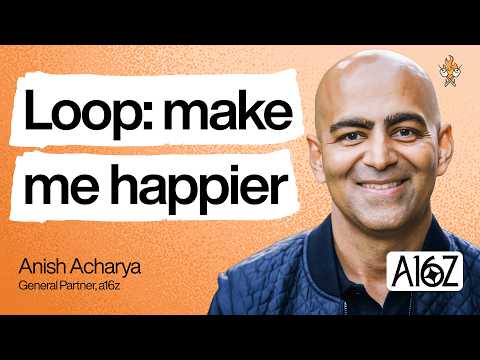
Anish Acharya is a General Partner at a16z who invests in consumer companies after founding and selling two startups. The thing most worth learning from him is to treat AI as a product builder would: ship something small every week, aim bigger than feels comfortable, and let humans choose the next hill for loops of agents to climb.
Nobody has a growth problem these days, they have a product problem.
Why companies are becoming a series of loops | Anish Acharya (a16z)
Anish Acharya: the story and the lessons
1Anish Acharya's path from founder to a16z investor
Acharya built and sold two companies before moving into venture capital. He founded Social Deck and sold it to Google, then led several efforts inside Google. He then founded Snowball and sold it to Credit Karma, where he became VP of product and then GM of the consumer product and credit card business.
He has been at a16z for over 7 years, focused on consumer investing. That operating background is why he judges AI as a product builder and not only as an investor.
His first startup failed to pick between being a product and a platform. Social Deck was a social platform for mobile games that was also a game studio. A wise adviser told him to pick one, and it took years before he saw the adviser was right.
His rule from it: "Don't build a product and a platform at the same time." Being a studio is hard enough alone.
He learns from people a few steps ahead instead of through pain. He compares it to teaching his children not to touch the hot stove. He credits the Social Deck advice as a case where he ignored that shortcut.
2How Acharya thinks companies will run as loops of agents
He turns each business function into an agent loop with human checkpoints. Coding already has a loop of bug report, repro, fix, review and ship, and it can finish in about 5 minutes, even emailing the customer. He says growth, support, sales and legal can be mapped the same way, with a human on high-risk approvals.
A growth loop generates every variant, measures it, merges at stat sig, keeps a long-term holdout and starts the next experiment. The strong form is a loop over all the function loops that tells the CEO when to change strategy.
Humans pick the next hill once a loop plateaus. Loops climb to a local maximum and stall. A person with out-of-distribution thinking has to move the work to the base of the next hill.
Asking an agent to "make me a million dollars, make no mistakes" fails because it needs direction. "You need somebody to actually help you land at the base of the next hill."
Kavak's agents call a human when stuck, then learn from the trace. Kavak, which sells used cars in Mexico, runs an agent per customer. A human coaches the agent through a failure, and the trace is captured so the agent need not call next time.
Kavak's founder frames each failure as a knowledge gap or data gap to close. The company also runs a "Jedi Academy" where everyone, mechanics included, ships an agent in production by the end of six weeks.
He asks founders how they would reorganize around infinitely smart, cheap models. The most ambitious companies redesign around the models, while others only give existing roles access to AI. Electricity took 40 years to go from swapping out coal to rebuilding factories.
He says that is where things are heading, so reorganizing is a matter of when, not if.
He matches model tier to upside, not to verifiability. Frontier tokens are priced irrationally, with one extra IQ point costing 100x more, but the premium pays where upside is unbounded: drug discovery, sales, support, research, engineering. Bounded jobs like closing the books can run on cheaper open-weight models tuned with reinforcement learning.
"You can't close the books 100x better." He expects companies to run both architectures.
He wants PMs to say yes to every idea and build them all. Cheap building lets a PM try every feature and optionally simulate user reactions, so the best idea wins instead of the best-pitched one. A Google executive told him they laid off no one and got through two years of roadmap in three months.
He expects many PMs to find they are better at backing someone else's good idea than their own.
3Why Acharya doubts a fast takeoff or permanent underclass
He sees many players at every layer, not one winner. Every layer of the stack has about 20 relevant players, and Claude Code, Codex, Lovable and Replit all work. Lab insiders describe autocatalytic effects, not true recursive self-improvement, so a lab slightly ahead does not run away.
He calls the permanent underclass fear a dark fantasy the evidence does not support.
He thinks many problems are not bound by intelligence. He doubts a data center of PhDs would transform supply chains at FedEx or pizza at Domino's. Job postings for radiologists and programmers are higher than ever.
After a summer in his small hometown he found people's lives had changed little, so the bottleneck is adoption, not model progress.
He argues AI restores individual agency and raises ambition. AI unbundles skill from desire, so anyone can make music without playing piano or build software. His theory is that people are at their best when stakes are high.
"You ship your bad ideas so you can discover your good ideas."
4What Acharya looks for in consumer AI products
He points consumer AI at feelings, not productivity. More people want to spend time than save time, so entertainment and social are the biggest products. He wants loops like "make me happier" aimed at connection, health, progress and fun.
He calls the gap one of product design, not model capability. Examples from his own home were a screen-time system that his son hacked by recording "I love you, Dad", and a friend's pendant that counts family laughs.
He wants interfaces between chat and TikTok. Chat suits only the highest-agency users, and the average consumer's ideal interface is closer to TikTok. Expensive models, the interface problem and a productivity focus have held consumer AI back.
He compares the moment to iPhone 2010, before Airbnb, WhatsApp and Uber. Brian Chesky has started a lab on next-generation interfaces.
He says moats are discovered by shipping, not designed in advance. Cursor was criticized for having no moat, then captured reasoning traces and trained its own Composer models. Granola was criticized too, yet is beloved and dominant.
Classic moats such as network effects, scale, brand and proprietary data still work because none depend on how hard software is to build. "Moats are most often discovered, not designed."
He treats weak growth as a weak product. Products can now be wildly ambitious and expensive, so the gap is imagination. With platforms closed off, organic word of mouth on X, YouTube and Instagram is the best third-party network effect left.
MSCHF's card versus card mailed 100,000 debit cards and went viral, which he takes as proof that money is social.
He asks founders to design the Birkin bag version of their product. Imagine your software at $1,000 or $10,000 a month and ask what it would have to do. He says price is a measure of product-market fit and that expensive consumer software is new and important.
Buyers already pay $200 a month and sign million-dollar contracts without knowing exactly what they get. He likens it to Christmas 2009 and expects the window to close.
He now passes on ideas that are too small. Three years ago, overly ambitious companies were passed on and a $100 million seed seemed like too much. He cites Atoms as attempting something that would have felt insurmountable 5 to 10 years ago.
He is not recommending a $100 billion raise, only that there is "no ceiling on ambition". He ties this to Andreessen's pitch for a16z's first fund: go to the moon or leave a moon-size crater.
5How Acharya builds AI intuition by shipping every week
He ships something with every new model to learn its character. He argues models differ in shape, not rank. Qwen is creative and strong on long-horizon tasks, while GLM is precise and neurotic with no vision.
Qwen ran 4 or 5 hours on a 5-minute Star Wars documentary, using MiniMax for video and ElevenLabs for audio. People who call models fungible "just haven't actually used the models."
He keeps a low-stakes chassis project and treats the model as a tool. He keeps about two dozen small apps and one or two large ones he iterates on. Silly ideas carry the most alpha, and a project works better if it is not important.
He pauses before any task and asks how AI could do it.
He tells builders to ship one small project every week. One frustrating week, then a fulfilling one, is enough to be as pilled as anyone. With Codex he built a 20-slide Mother's Day deck for his wife from his text messages and photo gallery.
A friend, Nikhil Singh Goel, finds people flip on AI once it creates a moment of joy, so he suggests starting with something that would delight someone else. "Just ship something once a week."

Why companies are becoming a series of loops | Anish Acharya (a16z)
Anish Acharya explains how companies will be built as cascading loops of agents with humans choosing the next hill to climb, and where the consumer AI opportunity sits. He also covers why moats are discovered, why pricing and ambition should go higher, and why building something every week is the best way to build intuition.
Acharya built and sold two companies before moving into venture capital. He founded Social Deck and sold it to Google, then led several efforts inside Google. He then founded Snowball and sold it to Credit Karma, where he became VP of product and then GM of the consumer product and credit card business.
He has been at a16z for over 7 years, focused on consumer investing. That operating background is why he judges AI as a product builder and not only as an investor.
His first startup failed to pick between being a product and a platform. Social Deck was a social platform for mobile games that was also a game studio. A wise adviser told him to pick one, and it took years before he saw the adviser was right.
His rule from it: "Don't build a product and a platform at the same time." Being a studio is hard enough alone.
He learns from people a few steps ahead instead of through pain. He compares it to teaching his children not to touch the hot stove. He credits the Social Deck advice as a case where he ignored that shortcut.
He turns each business function into an agent loop with human checkpoints. Coding already has a loop of bug report, repro, fix, review and ship, and it can finish in about 5 minutes, even emailing the customer. He says growth, support, sales and legal can be mapped the same way, with a human on high-risk approvals.
A growth loop generates every variant, measures it, merges at stat sig, keeps a long-term holdout and starts the next experiment. The strong form is a loop over all the function loops that tells the CEO when to change strategy.
Humans pick the next hill once a loop plateaus. Loops climb to a local maximum and stall. A person with out-of-distribution thinking has to move the work to the base of the next hill.
Asking an agent to "make me a million dollars, make no mistakes" fails because it needs direction. "You need somebody to actually help you land at the base of the next hill."
Kavak's agents call a human when stuck, then learn from the trace. Kavak, which sells used cars in Mexico, runs an agent per customer. A human coaches the agent through a failure, and the trace is captured so the agent need not call next time.
Kavak's founder frames each failure as a knowledge gap or data gap to close. The company also runs a "Jedi Academy" where everyone, mechanics included, ships an agent in production by the end of six weeks.
He asks founders how they would reorganize around infinitely smart, cheap models. The most ambitious companies redesign around the models, while others only give existing roles access to AI. Electricity took 40 years to go from swapping out coal to rebuilding factories.
He says that is where things are heading, so reorganizing is a matter of when, not if.
He matches model tier to upside, not to verifiability. Frontier tokens are priced irrationally, with one extra IQ point costing 100x more, but the premium pays where upside is unbounded: drug discovery, sales, support, research, engineering. Bounded jobs like closing the books can run on cheaper open-weight models tuned with reinforcement learning.
"You can't close the books 100x better." He expects companies to run both architectures.
He wants PMs to say yes to every idea and build them all. Cheap building lets a PM try every feature and optionally simulate user reactions, so the best idea wins instead of the best-pitched one. A Google executive told him they laid off no one and got through two years of roadmap in three months.
He expects many PMs to find they are better at backing someone else's good idea than their own.
He sees many players at every layer, not one winner. Every layer of the stack has about 20 relevant players, and Claude Code, Codex, Lovable and Replit all work. Lab insiders describe autocatalytic effects, not true recursive self-improvement, so a lab slightly ahead does not run away.
He calls the permanent underclass fear a dark fantasy the evidence does not support.
He thinks many problems are not bound by intelligence. He doubts a data center of PhDs would transform supply chains at FedEx or pizza at Domino's. Job postings for radiologists and programmers are higher than ever.
After a summer in his small hometown he found people's lives had changed little, so the bottleneck is adoption, not model progress.
He argues AI restores individual agency and raises ambition. AI unbundles skill from desire, so anyone can make music without playing piano or build software. His theory is that people are at their best when stakes are high.
"You ship your bad ideas so you can discover your good ideas."
He points consumer AI at feelings, not productivity. More people want to spend time than save time, so entertainment and social are the biggest products. He wants loops like "make me happier" aimed at connection, health, progress and fun.
He calls the gap one of product design, not model capability. Examples from his own home were a screen-time system that his son hacked by recording "I love you, Dad", and a friend's pendant that counts family laughs.
He wants interfaces between chat and TikTok. Chat suits only the highest-agency users, and the average consumer's ideal interface is closer to TikTok. Expensive models, the interface problem and a productivity focus have held consumer AI back.
He compares the moment to iPhone 2010, before Airbnb, WhatsApp and Uber. Brian Chesky has started a lab on next-generation interfaces.
He says moats are discovered by shipping, not designed in advance. Cursor was criticized for having no moat, then captured reasoning traces and trained its own Composer models. Granola was criticized too, yet is beloved and dominant.
Classic moats such as network effects, scale, brand and proprietary data still work because none depend on how hard software is to build. "Moats are most often discovered, not designed."
He treats weak growth as a weak product. Products can now be wildly ambitious and expensive, so the gap is imagination. With platforms closed off, organic word of mouth on X, YouTube and Instagram is the best third-party network effect left.
MSCHF's card versus card mailed 100,000 debit cards and went viral, which he takes as proof that money is social.
He asks founders to design the Birkin bag version of their product. Imagine your software at $1,000 or $10,000 a month and ask what it would have to do. He says price is a measure of product-market fit and that expensive consumer software is new and important.
Buyers already pay $200 a month and sign million-dollar contracts without knowing exactly what they get. He likens it to Christmas 2009 and expects the window to close.
He now passes on ideas that are too small. Three years ago, overly ambitious companies were passed on and a $100 million seed seemed like too much. He cites Atoms as attempting something that would have felt insurmountable 5 to 10 years ago.
He is not recommending a $100 billion raise, only that there is "no ceiling on ambition". He ties this to Andreessen's pitch for a16z's first fund: go to the moon or leave a moon-size crater.
He ships something with every new model to learn its character. He argues models differ in shape, not rank. Qwen is creative and strong on long-horizon tasks, while GLM is precise and neurotic with no vision.
Qwen ran 4 or 5 hours on a 5-minute Star Wars documentary, using MiniMax for video and ElevenLabs for audio. People who call models fungible "just haven't actually used the models."
He keeps a low-stakes chassis project and treats the model as a tool. He keeps about two dozen small apps and one or two large ones he iterates on. Silly ideas carry the most alpha, and a project works better if it is not important.
He pauses before any task and asks how AI could do it.
He tells builders to ship one small project every week. One frustrating week, then a fulfilling one, is enough to be as pilled as anyone. With Codex he built a 20-slide Mother's Day deck for his wife from his text messages and photo gallery.
A friend, Nikhil Singh Goel, finds people flip on AI once it creates a moment of joy, so he suggests starting with something that would delight someone else. "Just ship something once a week."