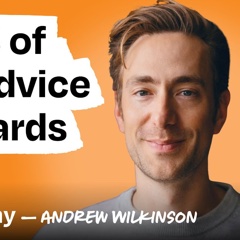
Andrew Wilkinson
Co-founder and CEO of Tiny, a holding company that buys and holds profitable internet and consumer businesses
Where to hear and read about Andrew Wilkinson1 episode or test

Andrew Wilkinson is co-founder and CEO of Tiny, a holding company that buys and keeps profitable internet and consumer businesses, and he has run about 75 projects. The thing most worth learning from him is to fish in small, boring, defensible markets where you have an edge, and to hire people who are already fully formed.
You can't take a brilliant management team and change a bad business model. Ultimately the business model wins.
I’ve run 75+ businesses. Here’s why you’re probably chasing the wrong idea. | Andrew Wilkinson
Andrew Wilkinson: the story and the lessons
1How Andrew Wilkinson picks business ideas
Wilkinson fishes in small, boring ponds instead of crowded, glamorous ones. Competition lowers margins, so he favors niches few people dream of, like form-filling software, pest control and funeral homes, over cafes or productivity apps. One form-filling software business charges about $1,000 on a $20,000 grant it helps people win and makes $30 million a year.
He borrows Charlie Munger's image of a big pond ringed by fishermen with the best lures. His advice is to walk into the forest and find the small hole full of fish.
He starts from his passions, then hunts for the profitable niche inside them. Funding movies loses money 90% of the time, so his love of film led him to Letterboxd, a social network with a network effect that Tiny bought at a fair price. Coffee and DJing led to AeroPress and Serato.
He compares it to a restaurant owner who found that the vendors cleaning grease traps and exhaust vents made much more money than the restaurant. His summary: 'I follow my passions and spend a long time learning different industries and then I find the profitable niche within.'
He points his skill at customers with big budgets. A student earning $1,000 a month on restaurant social media could charge $5,000 to realtors or wealth managers, who earn tens of thousands per deal. Wilkinson moved his web agency toward a San Francisco job board of startups and charged five times the price for five times less work.
His method is to find your passion and skill, zero in, then pivot to the most profitable version. His own superpower was sales.
He began with an easy business that won early. His web agency, which became Metalab, worked at once: build sites, talk to clients, send a $5,000 invoice. That win gave him a story that he was good at business.
It carried him through losses on designer cat furniture, an online DJ school, a skin cream line and a pizzeria. His advice to first-timers: 'You don't want to walk into the gym on day one and try and deadlift 300 pounds.'
Wilkinson lost $10 million on Flow and learned to avoid failed models. He bootstrapped Flow, a productivity tool, against Asana, which had raised hundreds of millions. Bars, a pizzeria and a local newspaper also failed him, each a model where many had failed before.
He says restaurants have a hundred failure points a day. If many competitors have died in a space, find out what keeps killing them before you enter. His gym rule is to attempt a hard business only after 15 years of training and three startups that worked.
He now asks an AI to break down an idea's economics. Before starting a business, he would ask Claude or ChatGPT for the numbers, what is hard about it, the regulatory moat and the payroll. His example prompt is a Botox clinic.
He says his sense of what customers will pay is mostly gut, built from many mental models. Without such a tool he started 'so many incredibly stupid businesses', and he says there is no excuse now.
2How Tiny buys, holds and bootstraps businesses
Wilkinson switched from starting companies to buying them after reading about Buffett. After about 11 starts, the failure rate made the work stressful and he did not like his path. He saw that Buffett owns 260 businesses, reads quietly all day and makes one or two big decisions a year.
He wants a moat so a business survives mistakes. A brand like Coca-Cola or Advil gives pricing power, and a network effect keeps users in a community where their friends are. He finds switching costs, as with Salesforce, a depressing kind of moat.
He points to X keeping its network after a rename and the loss of 80% of its staff. His latest purchase, Serato, is the largest DJ software company, with a passionate user base and deep hardware integration.
Tiny leaves acquired companies alone, except to choose a new CEO. When Tiny buys a company it says nothing changes and tells nobody. Its one usual intervention is a new CEO when the founder leaves, which Wilkinson calls the most important decision it makes.
He wants moats because most businesses fall apart when one person leaves.
Tiny reached almost $300 million in revenue with no venture capital. Its 40+ businesses earn almost $300 million a year, all bootstrapped, built on brands and network effects. He says the only difference from a VC is the tolerance for burning money.
Venture money is for moonshots like satellites. The Things app has stayed a tiny profitable team for 20 years, with no AI, API or Android app by choice. He guesses it earns $5 to $25 million a year, far below the $300 million to $1 billion path a VC needs, so no trawlers come.
He designs work so he avoids the tasks he hates. Wilkinson calls it lazy leadership: get away from the work you hate as fast as possible. He started a pressure washing business with a student and told him that at scale he would never have to touch a pressure washer.
At about 10 leads a day, the founder can hire crews and do only sales or marketing. The difference between a job and a business is scale. In his words: 'How do I be Teflon for tasks?'
Tiny aims to be the buyer founders wish they had. After selling his first business, he disliked the private equity buyers in suits who used words he didn't understand. Tiny looks for high quality businesses with happy customers, happy employees and a lasting competitive advantage.
3How Wilkinson hires, fires and decides
He spends about 20% of his time filtering people. He hires fully formed people for what the job needs today, not for potential. His early mistake was hiring on gut and thinking he could change people, which he compares to marrying someone to fix them.
His test for a superstar is someone you cannot imagine firing. One bad actor makes everything stressful.
He fires anyone he doubts even once. When he kept doubting someone, it almost always failed within six to 12 months. His rule is to act the first time the question comes up.
'If I ever think, should I fire this person even once, I should fire them immediately.'
He hires CEOs whose own plan already matches his. One candidate favored enterprise sales over the organic marketing Wilkinson wanted, and did enterprise sales anyway after being hired. He now hires only when he is nodding along to the plan, then leaves the CEO alone.
'They're an elephant and you're the rider.' An idea pushed in a board meeting gets sandbagged because the CEO wants their own idea to work.
Wilkinson lives by the motto that hard choices make an easy life. He took it from Jerzy Gregorek: 'Easy choices, hard life. Hard choices, easy life.' Shutting down a business, firing someone or dropping a loved project was almost always the right call.
4How Wilkinson uses AI and manages his own mind
Lindy agents run his inbox and calendar. A chain of four or five agents archives mail he need not see, labels anything needing action in 24 hours, and turns simple requests into multiple-choice questions. Replying with a number sends a reply written as him.
It cut his email by about 20% and replaced a full-time email assistant. He calls it the world's most reliable employee, at $200 a month and working 24/7.
An agent briefs him on each person 30 minutes before a meeting. It checks his calendar, researches the person on Perplexity and pulls email context, then texts him a summary. He books meetings months ahead and forgets why.
He uses Perplexity because ChatGPT deep research can't be automated. He says deep research now beats a human researcher paid $400 to $500 per guest.
He builds web projects alone with Replit and style prompts. Replit lets him build websites and Python web apps that once needed a team of five. He prompts in a style, such as Stripe's design or the tone of David Ogilvy.
He finds Lovable and Bolt more basic, with fiddlier deployment.
He wears a recorder so an LLM can answer questions about his day. He clips Limitless in his pocket and asks at night what he promised people. He has also used it as a couples counselor to replay how a fight started.
Often both people are at fault, and his girlfriend has come to appreciate the replay.
He advises getting great with AI tools and building wealth. He does not know whether knowledge jobs will shrink, and thinks prompting may fade like coding. He suggests mastering the tools and putting the proceeds into compute and energy.
He treats Dario Amodei's 2027 prediction with a grain of salt, since he can barely get his own agents to make calendar entries reliably.
Wilkinson found medication helped his anxiety where money never did. Revenue grew from about $15 million to almost $300 million and he felt the same stress. In 2020 he started a tiny SSRI dose, and within three or four days the nasty voice in his head got quieter.
He was so scared that he cut the pill into 10 pieces and waited six months to try one. He picked an SSRI using a DNA test and has taken it for about four and a half years. 'My brain went from Times Square to a quiet library.'
He says entrepreneurs should consider getting tested for ADHD. A baseline cognitive test put his working memory at the 10th percentile, and a five-day assessment confirmed ADHD. He cites about 5% of people having it versus about 30% of entrepreneurs.
The diagnosis ended the feeling that he was broken. He suggests starting by asking ChatGPT to quiz you, and says knowing is better even if you don't medicate.

I’ve run 75+ businesses. Here’s why you’re probably chasing the wrong idea. | Andrew Wilkinson
Andrew Wilkinson explains how to pick business ideas by fishing where the fish are, favoring boring niches, buying businesses with moats, and hiring fully formed people. He bootstrapped Tiny to almost $300 million in revenue across 40+ businesses without venture capital, and he now runs much of his inbox, calendar and research with AI agents.
Wilkinson fishes in small, boring ponds instead of crowded, glamorous ones. Competition lowers margins, so he favors niches few people dream of, like form-filling software, pest control and funeral homes, over cafes or productivity apps. One form-filling software business charges about $1,000 on a $20,000 grant it helps people win and makes $30 million a year.
He borrows Charlie Munger's image of a big pond ringed by fishermen with the best lures. His advice is to walk into the forest and find the small hole full of fish.
He starts from his passions, then hunts for the profitable niche inside them. Funding movies loses money 90% of the time, so his love of film led him to Letterboxd, a social network with a network effect that Tiny bought at a fair price. Coffee and DJing led to AeroPress and Serato.
He compares it to a restaurant owner who found that the vendors cleaning grease traps and exhaust vents made much more money than the restaurant. His summary: 'I follow my passions and spend a long time learning different industries and then I find the profitable niche within.'
He points his skill at customers with big budgets. A student earning $1,000 a month on restaurant social media could charge $5,000 to realtors or wealth managers, who earn tens of thousands per deal. Wilkinson moved his web agency toward a San Francisco job board of startups and charged five times the price for five times less work.
His method is to find your passion and skill, zero in, then pivot to the most profitable version. His own superpower was sales.
He began with an easy business that won early. His web agency, which became Metalab, worked at once: build sites, talk to clients, send a $5,000 invoice. That win gave him a story that he was good at business.
It carried him through losses on designer cat furniture, an online DJ school, a skin cream line and a pizzeria. His advice to first-timers: 'You don't want to walk into the gym on day one and try and deadlift 300 pounds.'
Wilkinson lost $10 million on Flow and learned to avoid failed models. He bootstrapped Flow, a productivity tool, against Asana, which had raised hundreds of millions. Bars, a pizzeria and a local newspaper also failed him, each a model where many had failed before.
He says restaurants have a hundred failure points a day. If many competitors have died in a space, find out what keeps killing them before you enter. His gym rule is to attempt a hard business only after 15 years of training and three startups that worked.
He now asks an AI to break down an idea's economics. Before starting a business, he would ask Claude or ChatGPT for the numbers, what is hard about it, the regulatory moat and the payroll. His example prompt is a Botox clinic.
He says his sense of what customers will pay is mostly gut, built from many mental models. Without such a tool he started 'so many incredibly stupid businesses', and he says there is no excuse now.
Wilkinson switched from starting companies to buying them after reading about Buffett. After about 11 starts, the failure rate made the work stressful and he did not like his path. He saw that Buffett owns 260 businesses, reads quietly all day and makes one or two big decisions a year.
He wants a moat so a business survives mistakes. A brand like Coca-Cola or Advil gives pricing power, and a network effect keeps users in a community where their friends are. He finds switching costs, as with Salesforce, a depressing kind of moat.
He points to X keeping its network after a rename and the loss of 80% of its staff. His latest purchase, Serato, is the largest DJ software company, with a passionate user base and deep hardware integration.
Tiny leaves acquired companies alone, except to choose a new CEO. When Tiny buys a company it says nothing changes and tells nobody. Its one usual intervention is a new CEO when the founder leaves, which Wilkinson calls the most important decision it makes.
He wants moats because most businesses fall apart when one person leaves.
Tiny reached almost $300 million in revenue with no venture capital. Its 40+ businesses earn almost $300 million a year, all bootstrapped, built on brands and network effects. He says the only difference from a VC is the tolerance for burning money.
Venture money is for moonshots like satellites. The Things app has stayed a tiny profitable team for 20 years, with no AI, API or Android app by choice. He guesses it earns $5 to $25 million a year, far below the $300 million to $1 billion path a VC needs, so no trawlers come.
He designs work so he avoids the tasks he hates. Wilkinson calls it lazy leadership: get away from the work you hate as fast as possible. He started a pressure washing business with a student and told him that at scale he would never have to touch a pressure washer.
At about 10 leads a day, the founder can hire crews and do only sales or marketing. The difference between a job and a business is scale. In his words: 'How do I be Teflon for tasks?'
Tiny aims to be the buyer founders wish they had. After selling his first business, he disliked the private equity buyers in suits who used words he didn't understand. Tiny looks for high quality businesses with happy customers, happy employees and a lasting competitive advantage.
He spends about 20% of his time filtering people. He hires fully formed people for what the job needs today, not for potential. His early mistake was hiring on gut and thinking he could change people, which he compares to marrying someone to fix them.
His test for a superstar is someone you cannot imagine firing. One bad actor makes everything stressful.
He fires anyone he doubts even once. When he kept doubting someone, it almost always failed within six to 12 months. His rule is to act the first time the question comes up.
'If I ever think, should I fire this person even once, I should fire them immediately.'
He hires CEOs whose own plan already matches his. One candidate favored enterprise sales over the organic marketing Wilkinson wanted, and did enterprise sales anyway after being hired. He now hires only when he is nodding along to the plan, then leaves the CEO alone.
'They're an elephant and you're the rider.' An idea pushed in a board meeting gets sandbagged because the CEO wants their own idea to work.
Wilkinson lives by the motto that hard choices make an easy life. He took it from Jerzy Gregorek: 'Easy choices, hard life. Hard choices, easy life.' Shutting down a business, firing someone or dropping a loved project was almost always the right call.
Lindy agents run his inbox and calendar. A chain of four or five agents archives mail he need not see, labels anything needing action in 24 hours, and turns simple requests into multiple-choice questions. Replying with a number sends a reply written as him.
It cut his email by about 20% and replaced a full-time email assistant. He calls it the world's most reliable employee, at $200 a month and working 24/7.
An agent briefs him on each person 30 minutes before a meeting. It checks his calendar, researches the person on Perplexity and pulls email context, then texts him a summary. He books meetings months ahead and forgets why.
He uses Perplexity because ChatGPT deep research can't be automated. He says deep research now beats a human researcher paid $400 to $500 per guest.
He builds web projects alone with Replit and style prompts. Replit lets him build websites and Python web apps that once needed a team of five. He prompts in a style, such as Stripe's design or the tone of David Ogilvy.
He finds Lovable and Bolt more basic, with fiddlier deployment.
He wears a recorder so an LLM can answer questions about his day. He clips Limitless in his pocket and asks at night what he promised people. He has also used it as a couples counselor to replay how a fight started.
Often both people are at fault, and his girlfriend has come to appreciate the replay.
He advises getting great with AI tools and building wealth. He does not know whether knowledge jobs will shrink, and thinks prompting may fade like coding. He suggests mastering the tools and putting the proceeds into compute and energy.
He treats Dario Amodei's 2027 prediction with a grain of salt, since he can barely get his own agents to make calendar entries reliably.
Wilkinson found medication helped his anxiety where money never did. Revenue grew from about $15 million to almost $300 million and he felt the same stress. In 2020 he started a tiny SSRI dose, and within three or four days the nasty voice in his head got quieter.
He was so scared that he cut the pill into 10 pieces and waited six months to try one. He picked an SSRI using a DNA test and has taken it for about four and a half years. 'My brain went from Times Square to a quiet library.'
He says entrepreneurs should consider getting tested for ADHD. A baseline cognitive test put his working memory at the 10th percentile, and a five-day assessment confirmed ADHD. He cites about 5% of people having it versus about 30% of entrepreneurs.
The diagnosis ended the feeling that he was broken. He suggests starting by asking ChatGPT to quiz you, and says knowing is better even if you don't medicate.