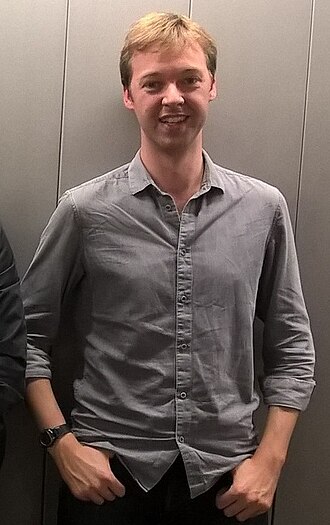
Andrew Hunter Murray
Novelist, comedian and journalist, co-host of No Such Thing as a Fish
Where to hear and read about Andrew Hunter Murray1 episode or test

Andrew Hunter Murray is a novelist, comedian and journalist who co-hosts the podcast No Such Thing as a Fish and has written three novels. The most useful thing to learn from him is his method: a one-sentence premise, a scene-by-scene spreadsheet plot, then drafting for entertainment with a few physically real characters.
You're comparing your flour and eggs with finished cakes.
Learn How to Write Novels in 1 Hour (Andrew Hunter Murray Interview)
Andrew Hunter Murray: the story and the lessons
1Who Andrew Hunter Murray is and how his novels began
Murray writes novels out of love of literature, beside comedy and journalism. He has written three novels: The Last Day, The Sanctuary and A Beginner's Guide to Breaking and Entering. He is also a journalist and comedian who writes for Private Eye.
He co-hosts No Such Thing as a Fish and has done so for 12 years without missing a week. He also spent 10 years in the Austen-based improv show Ostentatious.
The Last Day began with a premise he could say in one sentence. The world stopped turning 30 years ago, half in light and half in darkness. Readers start imagining the consequences at once.
To make it feel real he asked his astrophysicist sister-in-law how the Earth could stop turning, and she sent eight ways.
His third novel started with a character, not a premise. Alex, who lives in empty second homes while the owners are away, 'just arrived in my head'. Murray knows how Alex will react to almost anything, and the book is lighter and funnier than the first two end-of-the-world novels.
With no premise to lean on, the theme grew out of Alex: what it is like to be young in a world that does not open its doors.
Murray threw away his first draft of The Last Day. It was 30,000 words of world guide with no plot, after about six months of research that included what happens to the tide.
He had planned a first half that guided the reader through the world and a second half with a crisp conspiracy plot. It read like Tolkien-style guides to Middle Earth, with ancestors nobody needs to know about.
2How Murray plans and drafts a novel
Murray wants a premise built from concrete nouns. A good premise can be explained in a sentence, which tells the reader what they are getting and tells him what he is writing. The Last Day was easier to write and pitch than the muddier second book.
His advice is to put in 'as many concrete nouns in your premises as you can possibly crowbar in.' If he cannot say it crisply when asked, he is still flailing.
He writes longhand while the book is loose, then types. He stays 'in the soup of what the book could be' by hand for as long as he can, and switches to typing once the idea is clear.
Typing pins things down, but it is too easy to delete a sentence that might have led somewhere. When longhand works he writes a sentence he did not know he had, and feels 'written through'.
Murray keeps a grubby notebook he is free to trash. Each book gets a notebook of loose dialogue, scenes he would love to write, notes from other writers and possible openings. He shows it to no one.
Its scruffiness is the point, because it lets him make a mess. He is using one now for the prequel to his Alex books.
He plots every scene on an Excel spreadsheet. Each row logs the day, the characters, what the reader learns about the plot and where the protagonist is personally. He then asks whether each scene earns its place and pushes into the next, and rewrites stretches that lack pace.
Even a fireworks-factory scene must teach something: 'have we learned enough here?' He calls Excel 'the novelist's most important friend' and will not show the sheet to anyone.
Murray does the plotting first so drafting is the reward. He calls plotting the awful part and writing sentences the treat that follows. Jokes and small observations about character come in the morning writing, not in planning.
Plot is the part he likes least, so he spends the most time on it. The start of a book is the most fun, when it is still a block of marble that could become a thousand statues.
3How Murray makes characters feel real
Murray draws a few characters deeply instead of many thinly. He quotes Edith Wharton: a few characters studied closely beat many half-drawn ones, and no character earns a place unless the story would be poorer without them.
One detail can carry a minor character. He recalls a man his father met who had a special method for folding shirts and told everyone about it.
He makes characters physical through gesture and what is on the table. Gesture, movement and reaction show a person's reality most clearly, and a tiny amount is enough, such as indigestion from the breakfast buffet. The aim is to put the reader in the room.
In the first Breaking and Entering book he found moments where characters failed because he 'treated characters as a vehicle for plot' and had not made them physical enough.
Murray builds scenes around inner struggle, not spectacle. He cites Wharton's line that real drama is soul drama. The thrilling part of a train racing toward two tied-up heroes is what one says to the other when they think it is over.
In Die Hard the writers spent their effort on a wristwatch that carries a failing marriage, not on a taller skyscraper or bigger flames.
He withholds information to make a character more powerful. He admires Mick Herron's Slow Horses, where readers see inside every head but Jackson Lamb's. Readers have bonded with the misfits over nine books and get only hints about why Lamb is the way he is.
'I'm a huge fan of resisting the urge to say everything about a character.'
Murray gives every character with a stake a moment of growth. He dislikes reaching the end of a draft and finding a character never had a moment of achievement or satisfaction. His sheet tracks Alex's state of mind in each scene beside the plot clue.
Only walk-ons, like a kiosk seller handing over a chocolate bar, are exempt. He also notes he keeps writing characters who thaw out, such as Alex and Ellen Hopper in The Last Day, and does not know why.
He borrows Austen's concentric circles of comedy and reality. Austen puts the heroine at the centre with the most real, least comic characters closest to her. The further out a character stands, the more absurd and the less often they appear.
Narrowing the field lets her make even minor characters real. He studied her for a term at university and performed Austen-based improv for 10 years.
4Murray on theme, humour and finding material
Murray entertains first and lets the theme come in sideways. He calls it 'sugarcoated broccoli'. His Breaking and Entering books touch inequality in the UK, but he says his job is to entertain, not to write policy.
The same material could have been a dry book about housing shortages in Greater London.
He keeps research off the page and stays on the path. He borrows Philip Pullman's image of a book as a walk through the woods: look at the scenery, but do not leave the path for a picnic.
Research shows up only where it moves the story. Pages of housing research would have made an unreadable book.
Murray uses the future to look at the present. The Last Day is a climate novel and The Sanctuary is about how extreme wealth warps the minds of everyone exposed to it. A setting at one remove gives him more freedom.
He quotes the idea that 'Science fiction doesn't describe the future. It's a way of looking at the present.'
He pitches each joke at the right distance for the audience. He sees comedy as connection: 'any joke is like a horse jumping across some kind of canyon.' Too near and nobody is impressed, too far and the horse falls in.
In a novel a whole life can be the joke and he can go back and improve it. On the podcast a joke must land second to second.
He reads sentences aloud to find hidden jokes. A page of Austen gets funnier read aloud, because every sentence works hard and she hides jokes a casual reader misses.
Murray says there are funny lines on every page, still funny after 250 years.
Murray finds odd facts by reading widely and asking people about their work. Everyone knows fascinating things about their job or hobby that they no longer notice. He also looks for jewels in news stories, on cereal packets and in non-fiction books.
He has found facts for No Such Thing as a Fish every week for 12 years. Someone once wrote a whole book about cod.
5Why Murray keeps a sign reading 'This is not the cake'
Murray refuses to compare his draft with finished books. A neon sign above his desk reads 'This is not the cake'. His draft is flour and eggs, and comparing it with published books is unfair.
The gap never closes for good, so the mantra applies to book 5 as much as book 1. He forgets how to write a book between projects and starts again each time.
He reminds himself that great writers started weaker. Graham Greene's early books are rarely read, and he found his stride four or five books in. Austen's first, Northanger Abbey, is the weakest of her six.
Murray logs every book he reads and learns from the ones he dislikes. His spreadsheet records the date read, the publication date, the author's sex (so he reads more women) and a one-line impression.
A perfect book is like a stone temple: you cannot get a knife between the blocks. A weak book shows where the author lost him, such as a third act that did not grip.

Learn How to Write Novels in 1 Hour (Andrew Hunter Murray Interview)
Andrew Hunter Murray explains how he builds novels from a premise you can say in one sentence, then plots them on a spreadsheet before the fun of drafting begins. The memorable part is his handling of character: a few vividly drawn people, physical detail instead of backstory, and a neon sign reminding him that his draft is not the finished cake.
Murray writes novels out of love of literature, beside comedy and journalism. He has written three novels: The Last Day, The Sanctuary and A Beginner's Guide to Breaking and Entering. He is also a journalist and comedian who writes for Private Eye.
He co-hosts No Such Thing as a Fish and has done so for 12 years without missing a week. He also spent 10 years in the Austen-based improv show Ostentatious.
The Last Day began with a premise he could say in one sentence. The world stopped turning 30 years ago, half in light and half in darkness. Readers start imagining the consequences at once.
To make it feel real he asked his astrophysicist sister-in-law how the Earth could stop turning, and she sent eight ways.
His third novel started with a character, not a premise. Alex, who lives in empty second homes while the owners are away, 'just arrived in my head'. Murray knows how Alex will react to almost anything, and the book is lighter and funnier than the first two end-of-the-world novels.
With no premise to lean on, the theme grew out of Alex: what it is like to be young in a world that does not open its doors.
Murray threw away his first draft of The Last Day. It was 30,000 words of world guide with no plot, after about six months of research that included what happens to the tide.
He had planned a first half that guided the reader through the world and a second half with a crisp conspiracy plot. It read like Tolkien-style guides to Middle Earth, with ancestors nobody needs to know about.
Murray wants a premise built from concrete nouns. A good premise can be explained in a sentence, which tells the reader what they are getting and tells him what he is writing. The Last Day was easier to write and pitch than the muddier second book.
His advice is to put in 'as many concrete nouns in your premises as you can possibly crowbar in.' If he cannot say it crisply when asked, he is still flailing.
He writes longhand while the book is loose, then types. He stays 'in the soup of what the book could be' by hand for as long as he can, and switches to typing once the idea is clear.
Typing pins things down, but it is too easy to delete a sentence that might have led somewhere. When longhand works he writes a sentence he did not know he had, and feels 'written through'.
Murray keeps a grubby notebook he is free to trash. Each book gets a notebook of loose dialogue, scenes he would love to write, notes from other writers and possible openings. He shows it to no one.
Its scruffiness is the point, because it lets him make a mess. He is using one now for the prequel to his Alex books.
He plots every scene on an Excel spreadsheet. Each row logs the day, the characters, what the reader learns about the plot and where the protagonist is personally. He then asks whether each scene earns its place and pushes into the next, and rewrites stretches that lack pace.
Even a fireworks-factory scene must teach something: 'have we learned enough here?' He calls Excel 'the novelist's most important friend' and will not show the sheet to anyone.
Murray does the plotting first so drafting is the reward. He calls plotting the awful part and writing sentences the treat that follows. Jokes and small observations about character come in the morning writing, not in planning.
Plot is the part he likes least, so he spends the most time on it. The start of a book is the most fun, when it is still a block of marble that could become a thousand statues.
Murray draws a few characters deeply instead of many thinly. He quotes Edith Wharton: a few characters studied closely beat many half-drawn ones, and no character earns a place unless the story would be poorer without them.
One detail can carry a minor character. He recalls a man his father met who had a special method for folding shirts and told everyone about it.
He makes characters physical through gesture and what is on the table. Gesture, movement and reaction show a person's reality most clearly, and a tiny amount is enough, such as indigestion from the breakfast buffet. The aim is to put the reader in the room.
In the first Breaking and Entering book he found moments where characters failed because he 'treated characters as a vehicle for plot' and had not made them physical enough.
Murray builds scenes around inner struggle, not spectacle. He cites Wharton's line that real drama is soul drama. The thrilling part of a train racing toward two tied-up heroes is what one says to the other when they think it is over.
In Die Hard the writers spent their effort on a wristwatch that carries a failing marriage, not on a taller skyscraper or bigger flames.
He withholds information to make a character more powerful. He admires Mick Herron's Slow Horses, where readers see inside every head but Jackson Lamb's. Readers have bonded with the misfits over nine books and get only hints about why Lamb is the way he is.
'I'm a huge fan of resisting the urge to say everything about a character.'
Murray gives every character with a stake a moment of growth. He dislikes reaching the end of a draft and finding a character never had a moment of achievement or satisfaction. His sheet tracks Alex's state of mind in each scene beside the plot clue.
Only walk-ons, like a kiosk seller handing over a chocolate bar, are exempt. He also notes he keeps writing characters who thaw out, such as Alex and Ellen Hopper in The Last Day, and does not know why.
He borrows Austen's concentric circles of comedy and reality. Austen puts the heroine at the centre with the most real, least comic characters closest to her. The further out a character stands, the more absurd and the less often they appear.
Narrowing the field lets her make even minor characters real. He studied her for a term at university and performed Austen-based improv for 10 years.
Murray entertains first and lets the theme come in sideways. He calls it 'sugarcoated broccoli'. His Breaking and Entering books touch inequality in the UK, but he says his job is to entertain, not to write policy.
The same material could have been a dry book about housing shortages in Greater London.
He keeps research off the page and stays on the path. He borrows Philip Pullman's image of a book as a walk through the woods: look at the scenery, but do not leave the path for a picnic.
Research shows up only where it moves the story. Pages of housing research would have made an unreadable book.
Murray uses the future to look at the present. The Last Day is a climate novel and The Sanctuary is about how extreme wealth warps the minds of everyone exposed to it. A setting at one remove gives him more freedom.
He quotes the idea that 'Science fiction doesn't describe the future. It's a way of looking at the present.'
He pitches each joke at the right distance for the audience. He sees comedy as connection: 'any joke is like a horse jumping across some kind of canyon.' Too near and nobody is impressed, too far and the horse falls in.
In a novel a whole life can be the joke and he can go back and improve it. On the podcast a joke must land second to second.
He reads sentences aloud to find hidden jokes. A page of Austen gets funnier read aloud, because every sentence works hard and she hides jokes a casual reader misses.
Murray says there are funny lines on every page, still funny after 250 years.
Murray finds odd facts by reading widely and asking people about their work. Everyone knows fascinating things about their job or hobby that they no longer notice. He also looks for jewels in news stories, on cereal packets and in non-fiction books.
He has found facts for No Such Thing as a Fish every week for 12 years. Someone once wrote a whole book about cod.
Murray refuses to compare his draft with finished books. A neon sign above his desk reads 'This is not the cake'. His draft is flour and eggs, and comparing it with published books is unfair.
The gap never closes for good, so the mantra applies to book 5 as much as book 1. He forgets how to write a book between projects and starts again each time.
He reminds himself that great writers started weaker. Graham Greene's early books are rarely read, and he found his stride four or five books in. Austen's first, Northanger Abbey, is the weakest of her six.
Murray logs every book he reads and learns from the ones he dislikes. His spreadsheet records the date read, the publication date, the author's sex (so he reads more women) and a one-line impression.
A perfect book is like a stone temple: you cannot get a knife between the blocks. A weak book shows where the author lost him, such as a third act that did not grip.