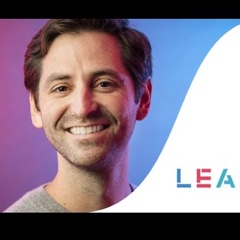
Andrew Grauer
CEO of Learneo and cofounder of Course Hero
Where to hear and read about Andrew Grauer1 episode or test

Andrew Grauer cofounded Course Hero as a Cornell sophomore in 2006 and now runs Learneo, a $3.6 billion family of learning and writing brands. The most useful thing to learn from him is to go deep on one narrow problem first, then keep each team narrow by aggregating focused brands instead of forcing one product to go generic.
allow those companies to continue to really focus on going deep and building amazing quality product for a specific audience
How Learneo Leveraged M&A to Build a $3.6B EdTech Empire
Andrew Grauer: the story and the lessons
1How Andrew Grauer started Course Hero at Cornell
Grauer started Course Hero in 2006 as a Cornell sophomore. He now runs Learneo, which owns QuillBot, CliffsNotes, LitCharts, LanguageTool, Scribbr and Symbolab. Learneo's latest private valuation is $3.6 billion, almost two decades after the start.
Starting felt like an unlock, an entrepreneurial inner voice. It was also a nightmare for his schoolwork.
A guest speaker's 'just do it' pushed him to start small. A speaker in a Cornell entrepreneurship lecture series said big, complex businesses begin as small actions repeated for years. Grauer chose a problem that was underserved, had no real market yet and was nearly universal: helping stressed, anxious students study.
He began with Cornell alone and made content course specific. Course Hero went school by school, with content tied to a specific course rather than a generic Wikipedia-style topic page. That specificity was the differentiator.
He calls it an unscalable solution that only works if you trust that repeating it at more schools will add up.
Grauer worried the first market was too small, and so did investors. He had to ask whether the idea was way too small, and investors questioned how big it could get. Nobody yet knew a niche could lead into other things.
The context was 2006, with Facebook just emerging and Airbnb not yet founded. A narrow start pays off when a second act can follow.
2How Course Hero's growth loop worked
Students could contribute materials for free access or pay a subscription. Uploading your own course materials unlocked the platform, or you paid a Netflix-like fee. Contributions drove distribution, some visitors subscribed, and some contributed, which helped the next user.
It was an early subscription model for digital goods in the US, and it reached cash flow positive around 2010.
Each new contribution made the product better with no extra product work. A user arriving after 1,000 contributions to a course got more value than user one. Grauer compares it to Airbnb's marketplace gaining value with each listing.
Word of mouth and SEO fed each other, so in the host's phrase 1 plus 1 equals 3.
He layered cheap organic channels and early testing onto the loop. Course Hero used local campus marketing and search engine optimization. It added A/B and multivariate testing when Google Website Optimizer was just coming out and testing was not normal.
Grauer treats product/market fit as a cluster of signals, not a moment. In the first half of 2010, traffic, revenue and contributions fed each other. That brought about 1 million sessions a month, over $1 million ARR run rate and the first cash-flow-positive stretch.
He jokes that a sign saying 'you've unlocked product market fit' would have been incredibly gamelike.
The team defined the unit of the business as question, answer and explanation. Quality was built at that level, tied to specific problem sets, courses and schools. The goal was a complete map of great answers for every assessment in a course, major and department.
Being students themselves gave the founders a built-in test of whether the product was good enough. They borrowed from Airbnb, Glassdoor, Shutterstock and YouTube: deep in one place, open everywhere.
3How Grauer built Learneo through acquisitions
Grauer saw narrow subject startups going deeper than Course Hero could. Between 2015 and 2019, many learning startups reached scale by owning one subject such as math, writing, science or medicine. Course Hero went wide across disciplines while they went vertical.
A broad player like Quizlet would struggle to justify that level of detail on its roadmap. He wondered what happens at the limit.
He bought focused brands so each team could stay specific. Learneo acquired by subject: Symbolab for math, LitCharts and CliffsNotes for literature, QuillBot, Scribbr and LanguageTool for writing. Acquisitions ran from 2019 to 2021, and the parent company Learneo was formed in 2022.
A team can spend two-week sprints on a single calculator without fear of missing out on the broader market. Users often have blinders on and want one brand for one use case.
He runs acquisitions like product development and puts people first. Form a hypothesis, act, ship, learn. Mix riskier bets with asymmetric upside and singles and doubles that strengthen the group.
'The most important thing that I can say is that the people matter.' Building with the QuillBot team showed writing was a much larger problem than the student use case.
Grauer places several asymmetric bets so one win can return 100x. He cites Bezos's baseball image: a home run caps at four runs, but on the internet a bet can return 100x or 1000x. Get clear on the upside, make the bet, and avoid relying on a single one.
He reset the thesis after ChatGPT launched in December 2022. The 2020 to 2022 thesis was aggregating durable, content-oriented consumer brands. Afterward the team kept what worked and decided to build on it or cut losses and double down.
The new test is where focus can win 100x or 1000x, like a VC. He says this takes strongly aligned teammates to process and build conviction.
4What Grauer learned from QuillBot and how he runs a team
QuillBot grew from a technical breakthrough and word of mouth, not a growth plan. ARR went from about $4 million in 2021 to over $60 million, and monthly users from a few million to over 30 million. Almost nobody searched for paraphrasing tools before it, and TikTok talk created the market.
The founders were self-taught University of Illinois Urbana-Champaign students who learned transformer models around 2017. SEO, influencers and paid marketing were layered on later.
He lets people use the product immediately with no sign-up. QuillBot's paraphraser worked without authentication, so searching the brand name led straight to using the tool.
Low friction let social word of mouth turn into usage.
Grauer applies a toothbrush test to find big problems. Writing is a pain that comes up often and lasts through life, for professionals as well as students. That made it a massive opportunity beyond a learning niche.
He wants to be a craftsman, not the cheapest provider. Grauer argues accessibility should not mean only affordability. Quality differentiates and is critical to building an iconic brand before you scale.
He designs every plan for growth, treating it like a muscle. Work for the next month, quarter and year should ladder up to growth, even for features users love. Growth is not sexy or natural to think about.
'If you don't do it, it atrophies.'
Grauer role models determination as the value that lasts. He describes it as being a persistent and optimistic problem solver, and says the most important thing he can do is show it in his own thinking and actions.
His team is remote across the US, India and Europe, so the downside is little time in person.
He plans to push QuillBot from text into visual and voice creation. QuillBot completed a writing suite covering grammar, paraphrasing, spellchecking, proofreading, AI detection and humanization, across browsers, desktop and mobile. The goal is to help people create images, charts and video alongside writing.
His stated mission is an explosion in the number of things QuillBot can help people create.

How Learneo Leveraged M&A to Build a $3.6B EdTech Empire
Course Hero grew through a contribute-or-subscribe content loop built school by school, then Learneo aggregated focused edtech brands like QuillBot, Symbolab and CliffsNotes instead of forcing one product to go generic. QuillBot grew from about $4 million ARR in 2021 to over $60 million ARR and over 30 million monthly active users.
Grauer started Course Hero in 2006 as a Cornell sophomore. He now runs Learneo, which owns QuillBot, CliffsNotes, LitCharts, LanguageTool, Scribbr and Symbolab. Learneo's latest private valuation is $3.6 billion, almost two decades after the start.
Starting felt like an unlock, an entrepreneurial inner voice. It was also a nightmare for his schoolwork.
A guest speaker's 'just do it' pushed him to start small. A speaker in a Cornell entrepreneurship lecture series said big, complex businesses begin as small actions repeated for years. Grauer chose a problem that was underserved, had no real market yet and was nearly universal: helping stressed, anxious students study.
He began with Cornell alone and made content course specific. Course Hero went school by school, with content tied to a specific course rather than a generic Wikipedia-style topic page. That specificity was the differentiator.
He calls it an unscalable solution that only works if you trust that repeating it at more schools will add up.
Grauer worried the first market was too small, and so did investors. He had to ask whether the idea was way too small, and investors questioned how big it could get. Nobody yet knew a niche could lead into other things.
The context was 2006, with Facebook just emerging and Airbnb not yet founded. A narrow start pays off when a second act can follow.
Students could contribute materials for free access or pay a subscription. Uploading your own course materials unlocked the platform, or you paid a Netflix-like fee. Contributions drove distribution, some visitors subscribed, and some contributed, which helped the next user.
It was an early subscription model for digital goods in the US, and it reached cash flow positive around 2010.
Each new contribution made the product better with no extra product work. A user arriving after 1,000 contributions to a course got more value than user one. Grauer compares it to Airbnb's marketplace gaining value with each listing.
Word of mouth and SEO fed each other, so in the host's phrase 1 plus 1 equals 3.
He layered cheap organic channels and early testing onto the loop. Course Hero used local campus marketing and search engine optimization. It added A/B and multivariate testing when Google Website Optimizer was just coming out and testing was not normal.
Grauer treats product/market fit as a cluster of signals, not a moment. In the first half of 2010, traffic, revenue and contributions fed each other. That brought about 1 million sessions a month, over $1 million ARR run rate and the first cash-flow-positive stretch.
He jokes that a sign saying 'you've unlocked product market fit' would have been incredibly gamelike.
The team defined the unit of the business as question, answer and explanation. Quality was built at that level, tied to specific problem sets, courses and schools. The goal was a complete map of great answers for every assessment in a course, major and department.
Being students themselves gave the founders a built-in test of whether the product was good enough. They borrowed from Airbnb, Glassdoor, Shutterstock and YouTube: deep in one place, open everywhere.
Grauer saw narrow subject startups going deeper than Course Hero could. Between 2015 and 2019, many learning startups reached scale by owning one subject such as math, writing, science or medicine. Course Hero went wide across disciplines while they went vertical.
A broad player like Quizlet would struggle to justify that level of detail on its roadmap. He wondered what happens at the limit.
He bought focused brands so each team could stay specific. Learneo acquired by subject: Symbolab for math, LitCharts and CliffsNotes for literature, QuillBot, Scribbr and LanguageTool for writing. Acquisitions ran from 2019 to 2021, and the parent company Learneo was formed in 2022.
A team can spend two-week sprints on a single calculator without fear of missing out on the broader market. Users often have blinders on and want one brand for one use case.
He runs acquisitions like product development and puts people first. Form a hypothesis, act, ship, learn. Mix riskier bets with asymmetric upside and singles and doubles that strengthen the group.
'The most important thing that I can say is that the people matter.' Building with the QuillBot team showed writing was a much larger problem than the student use case.
Grauer places several asymmetric bets so one win can return 100x. He cites Bezos's baseball image: a home run caps at four runs, but on the internet a bet can return 100x or 1000x. Get clear on the upside, make the bet, and avoid relying on a single one.
He reset the thesis after ChatGPT launched in December 2022. The 2020 to 2022 thesis was aggregating durable, content-oriented consumer brands. Afterward the team kept what worked and decided to build on it or cut losses and double down.
The new test is where focus can win 100x or 1000x, like a VC. He says this takes strongly aligned teammates to process and build conviction.
QuillBot grew from a technical breakthrough and word of mouth, not a growth plan. ARR went from about $4 million in 2021 to over $60 million, and monthly users from a few million to over 30 million. Almost nobody searched for paraphrasing tools before it, and TikTok talk created the market.
The founders were self-taught University of Illinois Urbana-Champaign students who learned transformer models around 2017. SEO, influencers and paid marketing were layered on later.
He lets people use the product immediately with no sign-up. QuillBot's paraphraser worked without authentication, so searching the brand name led straight to using the tool.
Low friction let social word of mouth turn into usage.
Grauer applies a toothbrush test to find big problems. Writing is a pain that comes up often and lasts through life, for professionals as well as students. That made it a massive opportunity beyond a learning niche.
He wants to be a craftsman, not the cheapest provider. Grauer argues accessibility should not mean only affordability. Quality differentiates and is critical to building an iconic brand before you scale.
He designs every plan for growth, treating it like a muscle. Work for the next month, quarter and year should ladder up to growth, even for features users love. Growth is not sexy or natural to think about.
'If you don't do it, it atrophies.'
Grauer role models determination as the value that lasts. He describes it as being a persistent and optimistic problem solver, and says the most important thing he can do is show it in his own thinking and actions.
His team is remote across the US, India and Europe, so the downside is little time in person.
He plans to push QuillBot from text into visual and voice creation. QuillBot completed a writing suite covering grammar, paraphrasing, spellchecking, proofreading, AI detection and humanization, across browsers, desktop and mobile. The goal is to help people create images, charts and video alongside writing.
His stated mission is an explosion in the number of things QuillBot can help people create.