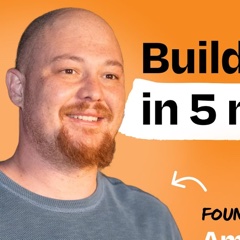
Amjad Masad
Co-founder and CEO, Replit
Where to hear and read about Amjad Masad1 episode or test

Amjad Masad is co-founder and CEO of Replit, which lets people build, run and ship real software by describing it to an AI agent. The most useful lesson from him is to build for the models arriving in six months while keeping your plans loose enough to drop at once.
you become limited by how fast you can generate ideas
Behind the product: Replit | Amjad Masad (co-founder and CEO)
Amjad Masad: the story and the lessons
1What Amjad Masad built at Replit
Masad bet on making everyone a developer, not engineers a bit faster. Many startups sell to engineers on the math of making them slightly more productive and taking a slice of that value. Replit asked what happens if everyone becomes a developer.
Users call the agent a developer in their pocket. Because the activation energy is low, they build ideas they would never have paid a developer to build.
Replit bundles editor, runtime, packages and deployment so beginners never quit at setup. A beginner normally has to download an IDE, install a runtime, configure a package manager, then work out deployment and sharing. Replit puts all of it in one place, including database, storage and hosting on Google Cloud, hidden from the user.
A viral tweet described an 11-year-old girl building and deploying an app on Replit. Masad's point is that the hard part is the nonsense around the code, not the code.
One prompt produced a full-stack app in 5 to 10 minutes. In the demo the agent built a feature-request dashboard with a Postgres database, voting, a planned and in-progress board and admin controls, for roughly 15 cents of compute. A decent engineer would need a few days to a week.
The prompt came from Replit PM Aman Mathur. Masad himself prefers a vague, minimalist prompt and iterates, but says a more descriptive prompt is better.
Replit grew from a learning tool into a place to build real software. It has 34 million users who learn to code, build startups and make personal and company internal tools. A B2B package launched in July and is growing fast.
Masad accepted an opinionated product and skipped the enterprise software pipeline. Replit handles everything from code to deployment, so it is hard to bring into a big company's main pipeline. Masad takes that trade-off to serve PMs, designers, sales ops, HR ops and lawyers.
Many users run Cursor alongside Replit, which covers runtime and deployment. Masad: "we're not going to get into the enterprise main software development pipeline".
2How Masad designs an AI agent product
Replit builds for the models landing in six months, not today's. In 2022 Replit trained and heavily optimized its own autocomplete models, but that turned out to be the wrong modality. When it started the agent, models could not yet do the job, so it built for the ones expected six months out.
Six months later the reasoning arrived and the agent worked. Masad: "we're going to build for the models that are landing in six months."
Masad gave the agent text tools instead of human interfaces. Replit feeds the agent shell output as text at set increments, plus package install, editor and SQL tools that return errors as plain text. Screenshot and video processing is expensive, so it is avoided where possible.
Which view of the code to show, and how many files before the agent hallucinates, is still tuned by experiment. Masad says it is moving from art to science.
Replit combines several models, each with its own job. Claude Sonnet is the main coding model, with OpenAI models, a manager editor model and a critique model around it. Replit also trained its own embedding model for search.
Masad wrote in 2022 that products would become a society of models. He calls it a heavy engineering project that better foundation models made possible.
Replit keeps no explicit roadmap so it can pivot on new capabilities. When Anthropic released computer use, Replit dropped its plans and shipped products around it right away.
Masad: "we slaughtered our roadmap because we don't really have an explicit roadmap."
Masad makes the agent's work visible so users can learn and debug. A progress pane shows what the agent is doing, and users can open and edit files or ask the AI to explain them. Replit writes a Git commit message for every change so users can roll back.
The agent is built as another user in Replit's multiplayer system. Most users never read the code, but it helps when the agent gets stuck.
Replit pairs the autonomous Agent with a faster Assistant. Agent is like handing a developer a PRD and waiting. Assistant is like sitting next to them to nudge a button, responding in milliseconds to seconds.
Agent is still best for setup, the database and debugging. Assistant suits quick, reliable UI iteration.
3What Masad says changes for teams and skills
Masad wants working prototypes to replace mocks and documents between roles. Slack, Zoom and docs are low-bandwidth, so work gets misread and handed off wrong. Replit's Figma extension turns mocks into React that runs on Replit, so engineers receive code, not screenshots.
At Replit a designer became a PM, others moved from designer to engineer, and design engineers sit in design critiques while designers join engineering meetings.
Non-technical founders can now prototype their next concept themselves. Creative founders often have ideas stuck behind engineers busy on the current product. With an AI builder they can make a v1 to touch, then hand it to engineers to improve.
Masad names Andrew Wilkinson of Tiny as a heavy user. A public company's PMs tested a v1 with users before engineers put it on the roadmap.
Masad says ideas, not building, are now the bottleneck. He considers himself quite generative, yet finds he sometimes runs out of ideas now that he can build so fast. For PMs and designers the valuable skills become finding problems and describing them clearly to the AI.
He thinks few people practise being generative, so it is harder to develop than a technical skill.
Masad says learn coding from a real problem, not from tooling. Bootcamps start with Git before the learner has a problem. His co-founder Haya, a designer, spent a whole first day of a course on Git without knowing what it was for.
He suggests building with AI, hitting a problem and fixing it with AI. A school for AI-native coding would teach app structure, prompting and some debugging, and skip most computer science.
Amjad's law says the return on learning to code doubles every six months. A little prompting, reading code and debugging lets you create more and more complete things each period. Others named the law, not Masad.
He says the exact duration may be off but the compounding is the point.
4Where Masad sees the limits of AI building
Masad admits the agent stalls on database migrations after the first version. It is strong at an MVP but weak at large iterations, where a bad schema change can cause an error it cannot recover from. Replit offers Bounties to hire human coders and plans to let the agent call a human.
Fixing migrations is a stated near-term goal.
He expects the next bottleneck to be resilient architecture at scale. AI already runs SQL queries and migrations, so he expects a solo founder to reach thousands of paying users. Sharding databases and using different queue systems still needs a fuller toolset and more reliability.
Masad can imagine a billion-dollar company with zero employees within five years. AI would handle support and development, unless it hits a fundamental limit. He says he is no expert on how far transformers scale, and data limits could surprise people.
His caveat: if software gets cheap, the price you can charge falls, so staying ahead depends on iterating fast and generating new ideas.

Behind the product: Replit | Amjad Masad (co-founder and CEO)
Replit's CEO demos an AI agent that builds and deploys a full-stack app from one prompt, and explains how the product is designed, what it can and cannot do, and how it changes work for PMs, designers and engineers. The demo app took 5 to 10 minutes and about 15 cents of compute for work that would take an engineer a few days to a week.
Masad bet on making everyone a developer, not engineers a bit faster. Many startups sell to engineers on the math of making them slightly more productive and taking a slice of that value. Replit asked what happens if everyone becomes a developer.
Users call the agent a developer in their pocket. Because the activation energy is low, they build ideas they would never have paid a developer to build.
Replit bundles editor, runtime, packages and deployment so beginners never quit at setup. A beginner normally has to download an IDE, install a runtime, configure a package manager, then work out deployment and sharing. Replit puts all of it in one place, including database, storage and hosting on Google Cloud, hidden from the user.
A viral tweet described an 11-year-old girl building and deploying an app on Replit. Masad's point is that the hard part is the nonsense around the code, not the code.
One prompt produced a full-stack app in 5 to 10 minutes. In the demo the agent built a feature-request dashboard with a Postgres database, voting, a planned and in-progress board and admin controls, for roughly 15 cents of compute. A decent engineer would need a few days to a week.
The prompt came from Replit PM Aman Mathur. Masad himself prefers a vague, minimalist prompt and iterates, but says a more descriptive prompt is better.
Replit grew from a learning tool into a place to build real software. It has 34 million users who learn to code, build startups and make personal and company internal tools. A B2B package launched in July and is growing fast.
Masad accepted an opinionated product and skipped the enterprise software pipeline. Replit handles everything from code to deployment, so it is hard to bring into a big company's main pipeline. Masad takes that trade-off to serve PMs, designers, sales ops, HR ops and lawyers.
Many users run Cursor alongside Replit, which covers runtime and deployment. Masad: "we're not going to get into the enterprise main software development pipeline".
Replit builds for the models landing in six months, not today's. In 2022 Replit trained and heavily optimized its own autocomplete models, but that turned out to be the wrong modality. When it started the agent, models could not yet do the job, so it built for the ones expected six months out.
Six months later the reasoning arrived and the agent worked. Masad: "we're going to build for the models that are landing in six months."
Masad gave the agent text tools instead of human interfaces. Replit feeds the agent shell output as text at set increments, plus package install, editor and SQL tools that return errors as plain text. Screenshot and video processing is expensive, so it is avoided where possible.
Which view of the code to show, and how many files before the agent hallucinates, is still tuned by experiment. Masad says it is moving from art to science.
Replit combines several models, each with its own job. Claude Sonnet is the main coding model, with OpenAI models, a manager editor model and a critique model around it. Replit also trained its own embedding model for search.
Masad wrote in 2022 that products would become a society of models. He calls it a heavy engineering project that better foundation models made possible.
Replit keeps no explicit roadmap so it can pivot on new capabilities. When Anthropic released computer use, Replit dropped its plans and shipped products around it right away.
Masad: "we slaughtered our roadmap because we don't really have an explicit roadmap."
Masad makes the agent's work visible so users can learn and debug. A progress pane shows what the agent is doing, and users can open and edit files or ask the AI to explain them. Replit writes a Git commit message for every change so users can roll back.
The agent is built as another user in Replit's multiplayer system. Most users never read the code, but it helps when the agent gets stuck.
Replit pairs the autonomous Agent with a faster Assistant. Agent is like handing a developer a PRD and waiting. Assistant is like sitting next to them to nudge a button, responding in milliseconds to seconds.
Agent is still best for setup, the database and debugging. Assistant suits quick, reliable UI iteration.
Masad wants working prototypes to replace mocks and documents between roles. Slack, Zoom and docs are low-bandwidth, so work gets misread and handed off wrong. Replit's Figma extension turns mocks into React that runs on Replit, so engineers receive code, not screenshots.
At Replit a designer became a PM, others moved from designer to engineer, and design engineers sit in design critiques while designers join engineering meetings.
Non-technical founders can now prototype their next concept themselves. Creative founders often have ideas stuck behind engineers busy on the current product. With an AI builder they can make a v1 to touch, then hand it to engineers to improve.
Masad names Andrew Wilkinson of Tiny as a heavy user. A public company's PMs tested a v1 with users before engineers put it on the roadmap.
Masad says ideas, not building, are now the bottleneck. He considers himself quite generative, yet finds he sometimes runs out of ideas now that he can build so fast. For PMs and designers the valuable skills become finding problems and describing them clearly to the AI.
He thinks few people practise being generative, so it is harder to develop than a technical skill.
Masad says learn coding from a real problem, not from tooling. Bootcamps start with Git before the learner has a problem. His co-founder Haya, a designer, spent a whole first day of a course on Git without knowing what it was for.
He suggests building with AI, hitting a problem and fixing it with AI. A school for AI-native coding would teach app structure, prompting and some debugging, and skip most computer science.
Amjad's law says the return on learning to code doubles every six months. A little prompting, reading code and debugging lets you create more and more complete things each period. Others named the law, not Masad.
He says the exact duration may be off but the compounding is the point.
Masad admits the agent stalls on database migrations after the first version. It is strong at an MVP but weak at large iterations, where a bad schema change can cause an error it cannot recover from. Replit offers Bounties to hire human coders and plans to let the agent call a human.
Fixing migrations is a stated near-term goal.
He expects the next bottleneck to be resilient architecture at scale. AI already runs SQL queries and migrations, so he expects a solo founder to reach thousands of paying users. Sharding databases and using different queue systems still needs a fuller toolset and more reliability.
Masad can imagine a billion-dollar company with zero employees within five years. AI would handle support and development, unless it hits a fundamental limit. He says he is no expert on how far transformers scale, and data limits could surprise people.
His caveat: if software gets cheap, the price you can charge falls, so staying ahead depends on iterating fast and generating new ideas.