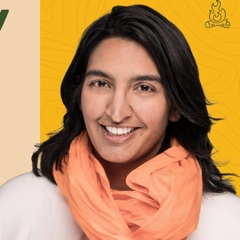
Ami Vora
Product leader at Anthropic
Where to hear and read about Ami Vora2 episodes and tests

 Lenny's PodcastWhy Claude can’t be your PM (yet) | Anthropic CPO Panel
 Lenny's PodcastSimplify To Win | Lenny & Friends Summit 2024
Ami Vora is a product leader at Anthropic who earlier worked on WhatsApp and at Faire. The one thing most worth learning from her is to find what makes a product indispensable, keep it simple and familiar, and stay close to the human problem while the technology changes.
You can't sharpen a knife by adding more to it. That just makes it heavy and unwieldy.
Simplify To Win | Lenny & Friends Summit 2024
Ami Vora: the story and the lessons
1Ami Vora's path from WhatsApp to Faire to Anthropic
Vora started in product when the job had no definition. A PM then just solved problems until hitting a wall. She says AI is bringing that back, with new kinds of scaffolding at each wall.
She calls the shift from 'AI might make PMs obsolete' to 'everyone needs to become a PM' rewinding the clock.
She joined WhatsApp full of shiny features and monetization plans, then held them back. She learned that shipping everything she was excited about would leave users confused, overwhelmed and even ashamed for not understanding. The team slowed other grand ideas, even while envying teams building AI models and photo filters.
She says simplicity is still a fight after 20-plus years. She has built to these principles for more than 20 years. Alignment work, pleasing managers and 2x2s still pull attention from the core problem.
At Anthropic she is learning a new kind of company. She had never worked at a model company. Every couple of months she tries a new approach without knowing she will be good at it.
2How Vora kept WhatsApp simple
She spent the whole roadmap on the one indispensable thing. At WhatsApp, indispensable meant calls and messages going through for free every time. Users never had to ask what the app was for, so they kept using it.
Her test is what cuts through bone or bread: aim for indispensable, not flashy, innovative or fun. Judgment still applies, since a medical device or a plane needs every edge case covered.
She borrowed patterns users already knew from their phones. The team knew only that global users had a phone, so the phone became the reference. They used Android's floating action button at bottom right and asked where the user's thumb naturally lands.
The triangle means a message will send and the arrow means it won't, so you can change your mind.
She gave up newer gestures that users hadn't learned. WhatsApp served global users on low-end devices, so it prioritized the very few most important actions and used only known patterns.
"We couldn't use them because they weren't already accessible to our users."
She built the product story from what customers already said. One user said WhatsApp isn't really an app, it's part of the room. That grew into a metaphor of mirroring face-to-face spaces, which kept the team aligned on how features should feel.
She holds that technologies change but needs like connection, safety and status stay stable.
She settled new features by asking how they work in the physical world. Disappearing messages copied mail: you recycle most of it and keep only what is special. So everything auto-deletes except messages you choose to keep.
The result works like a scrapbook of the most important moments with a friend.
Simple design worked for the whole world, not only emerging markets. WhatsApp reached 2 billion users, 100 billion messages a day and over 100 million users in the US.
Her view is that simple, predictable products reduce cognitive load for everyone.
3How Vora simplified Faire
She cut 50 equal priorities down to the top eight. At Faire the top eight stacked into an indispensable product. Core flows were also simplified from sign up through browsing to checkout.
Growth rate doubled while consumer spending fell and most global marketplaces slowed.
Faire tells the story its customers tell. Customers describe Faire as like a 24/7 trade show, so marketing uses that line.
Faire is also increasingly organizing top priorities and team structure around customer jobs to be done.
Vora warns PMs against adding ideas just to have impact. A PM unsure how to make a difference tends to add features, which she calls a recipe for complexity.
She argues better technology makes simple, familiar products more valuable, because they bring its benefits to everyone.
4Vora's habits for staying close to customers
Vora blocks a weekly calendar slot for customer work. She fills it with using the product, reading reviews, reading support tickets or watching Hotjar recordings.
She says customer empathy has low ROI in the short term and the highest ROI in the long term.
She visits customers in person, which works best for her. At Faire she walks into neighborhood independent shops and asks where they buy and how they feel about Faire.
She calls it retail therapy disguised as customer research.
One real customer becomes the test for every decision. A nursing director runs a gift shop in a labor and delivery ward. Vora asks whether the product is simple enough for her to use in five minutes.
Her goal is a customer who says the product changed their life. When everyone has heard the same customer, debate moves on to tradeoffs.
5Why Vora says the PM role still matters in the AI era
Human problems stay stable while the technology changes every two months. Technology used to change every 5 to 10 years. Vora now throws away what she knew about solutions and tries again, while holding on to the problem.
She no longer values debating where a button goes. She spent years on product and design reviews about button placement and finger reach. Building three versions now answers those questions faster.
She links it to the innovator's dilemma applied to a person: being good at one thing keeps you doing it.
She expects PMs to be even more operationally excellent. With builders heads down in Claude, someone must connect the work. Krieger's example is a PM who caught customer success enablement and safeguards that would have been dropped.
Krieger says Claude is not yet a convenor that brings people and Claudes together.
Vora frames the chaos out loud so change feels safe. She says detailed plans feel like control but lock you out of new things. She talks openly about the emotions and says everyone has to adapt, so it isn't lonely.
"Frame the chaos so it feels safe and it feels plausible to engage with it."
Every exploration needs a clear lead who decides. Krieger says each bet needs one person to decide whether to double down or wind down. Vora backs the idea of a team that is lost together while somebody holds the pen.
6How Vora runs parallel bets at Anthropic
Vora prefers five overlapping products to one over-constrained one. Nobody yet knows what works and people's habits shift with the models. She sees over-constraining a product as the real fail state, then cleans up once something works.
She was raised on simplicity and predictability, which build muscle memory, but says early exploration comes first.
She funds shared foundations so overlapping bets feel complementary. Chat and Cowork had separate memory systems. A foundations team now works so users get their memory wherever they are in Anthropic's products.
She tells teams with overlapping bets that they are all fundamentally on the same team.
She protects the main experience and says no to extra tabs. Instagram's main feed drew about 80% of use, and a better Explore tab might move from 10% to 15%. Half the job is saying no to another sidebar item.
Fold an idea in once proven, but don't kill it too early. She wants shared primitives so the right system already knows the user, rather than handing people a pile of tools.
She parks failed projects and retests them on each new model. Anthropic's 2024 computer use product took about 20 minutes per task and taught the user nothing. It was run in an eval harness, and a later model showed a leap by succeeding more often than not.
Vora says this is why teams must be willing to throw everything away, and people who dismiss a model after one try become capability blind.
She judges early traction with the old product basics. Do people use it, like it, come back, talk about it and get value? The goal of product is unchanged for her: solve a problem people can use easily.
She admits that folding winning experiments back into one product is not fully solved.
Why Claude can’t be your PM (yet) | Anthropic CPO Panel
Anthropic's product leaders explain why the PM role still matters when models change every two months: judgment, relentlessness, convening people and staying close to human problems. They also cover agent-native and malleable software, running parallel bets, and parking projects until a new model makes them work.
Vora started in product when the job had no definition. A PM then just solved problems until hitting a wall. She says AI is bringing that back, with new kinds of scaffolding at each wall.
She calls the shift from 'AI might make PMs obsolete' to 'everyone needs to become a PM' rewinding the clock.
At Anthropic she is learning a new kind of company. She had never worked at a model company. Every couple of months she tries a new approach without knowing she will be good at it.
Human problems stay stable while the technology changes every two months. Technology used to change every 5 to 10 years. Vora now throws away what she knew about solutions and tries again, while holding on to the problem.
She no longer values debating where a button goes. She spent years on product and design reviews about button placement and finger reach. Building three versions now answers those questions faster.
She links it to the innovator's dilemma applied to a person: being good at one thing keeps you doing it.
She expects PMs to be even more operationally excellent. With builders heads down in Claude, someone must connect the work. Krieger's example is a PM who caught customer success enablement and safeguards that would have been dropped.
Krieger says Claude is not yet a convenor that brings people and Claudes together.
Vora frames the chaos out loud so change feels safe. She says detailed plans feel like control but lock you out of new things. She talks openly about the emotions and says everyone has to adapt, so it isn't lonely.
"Frame the chaos so it feels safe and it feels plausible to engage with it."
Every exploration needs a clear lead who decides. Krieger says each bet needs one person to decide whether to double down or wind down. Vora backs the idea of a team that is lost together while somebody holds the pen.
Vora prefers five overlapping products to one over-constrained one. Nobody yet knows what works and people's habits shift with the models. She sees over-constraining a product as the real fail state, then cleans up once something works.
She was raised on simplicity and predictability, which build muscle memory, but says early exploration comes first.
She funds shared foundations so overlapping bets feel complementary. Chat and Cowork had separate memory systems. A foundations team now works so users get their memory wherever they are in Anthropic's products.
She tells teams with overlapping bets that they are all fundamentally on the same team.
She protects the main experience and says no to extra tabs. Instagram's main feed drew about 80% of use, and a better Explore tab might move from 10% to 15%. Half the job is saying no to another sidebar item.
Fold an idea in once proven, but don't kill it too early. She wants shared primitives so the right system already knows the user, rather than handing people a pile of tools.
She parks failed projects and retests them on each new model. Anthropic's 2024 computer use product took about 20 minutes per task and taught the user nothing. It was run in an eval harness, and a later model showed a leap by succeeding more often than not.
Vora says this is why teams must be willing to throw everything away, and people who dismiss a model after one try become capability blind.
She judges early traction with the old product basics. Do people use it, like it, come back, talk about it and get value? The goal of product is unchanged for her: solve a problem people can use easily.
She admits that folding winning experiments back into one product is not fully solved.
Simplify To Win | Lenny & Friends Summit 2024
Simplicity helps teams decide what to build, how to design it and how to tell its story, using WhatsApp and Faire as examples. At Faire, simplifying 50 priorities into 8 and organizing around customer jobs doubled the marketplace's growth rate while other global marketplaces slowed.
She joined WhatsApp full of shiny features and monetization plans, then held them back. She learned that shipping everything she was excited about would leave users confused, overwhelmed and even ashamed for not understanding. The team slowed other grand ideas, even while envying teams building AI models and photo filters.
She says simplicity is still a fight after 20-plus years. She has built to these principles for more than 20 years. Alignment work, pleasing managers and 2x2s still pull attention from the core problem.
She spent the whole roadmap on the one indispensable thing. At WhatsApp, indispensable meant calls and messages going through for free every time. Users never had to ask what the app was for, so they kept using it.
Her test is what cuts through bone or bread: aim for indispensable, not flashy, innovative or fun. Judgment still applies, since a medical device or a plane needs every edge case covered.
She borrowed patterns users already knew from their phones. The team knew only that global users had a phone, so the phone became the reference. They used Android's floating action button at bottom right and asked where the user's thumb naturally lands.
The triangle means a message will send and the arrow means it won't, so you can change your mind.
She gave up newer gestures that users hadn't learned. WhatsApp served global users on low-end devices, so it prioritized the very few most important actions and used only known patterns.
"We couldn't use them because they weren't already accessible to our users."
She built the product story from what customers already said. One user said WhatsApp isn't really an app, it's part of the room. That grew into a metaphor of mirroring face-to-face spaces, which kept the team aligned on how features should feel.
She holds that technologies change but needs like connection, safety and status stay stable.
She settled new features by asking how they work in the physical world. Disappearing messages copied mail: you recycle most of it and keep only what is special. So everything auto-deletes except messages you choose to keep.
The result works like a scrapbook of the most important moments with a friend.
Simple design worked for the whole world, not only emerging markets. WhatsApp reached 2 billion users, 100 billion messages a day and over 100 million users in the US.
Her view is that simple, predictable products reduce cognitive load for everyone.
She cut 50 equal priorities down to the top eight. At Faire the top eight stacked into an indispensable product. Core flows were also simplified from sign up through browsing to checkout.
Growth rate doubled while consumer spending fell and most global marketplaces slowed.
Faire tells the story its customers tell. Customers describe Faire as like a 24/7 trade show, so marketing uses that line.
Faire is also increasingly organizing top priorities and team structure around customer jobs to be done.
Vora warns PMs against adding ideas just to have impact. A PM unsure how to make a difference tends to add features, which she calls a recipe for complexity.
She argues better technology makes simple, familiar products more valuable, because they bring its benefits to everyone.
Vora blocks a weekly calendar slot for customer work. She fills it with using the product, reading reviews, reading support tickets or watching Hotjar recordings.
She says customer empathy has low ROI in the short term and the highest ROI in the long term.
She visits customers in person, which works best for her. At Faire she walks into neighborhood independent shops and asks where they buy and how they feel about Faire.
She calls it retail therapy disguised as customer research.
One real customer becomes the test for every decision. A nursing director runs a gift shop in a labor and delivery ward. Vora asks whether the product is simple enough for her to use in five minutes.
Her goal is a customer who says the product changed their life. When everyone has heard the same customer, debate moves on to tradeoffs.