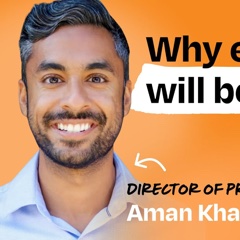
Aman Khan
Director of Product at Arize AI, ex-Spotify, Cruise, Zipline and Apple
Where to hear and read about Aman Khan1 episode or test

Aman Khan is Director of Product at Arize AI, with earlier roles at Spotify, Cruise, Zipline and Apple, and he has stayed an individual contributor on purpose. The thing most worth learning from him is to build prototypes and start from the customer problem rather than copying what everyone else ships with AI.
I actually think the role of a PM is to be that wanderer.
Becoming an AI PM | Aman Khan (Arize AI, ex-Spotify, Apple, Cruise)
Aman Khan: the story and the lessons
1Aman Khan's path into AI product management
Khan chose to stay an individual contributor and build AI products. He is Director of Product at Arize AI, an observability company for AI engineers. Before that he worked on the ML platform team at Spotify, then at Cruise, Zipline and Apple.
At Spotify the work meant enabling hundreds of engineers to build and ship products. When people named their favorite IC product managers on Twitter and LinkedIn, his name came up near the top on both.
He moved into AI without an AI or computer science degree. Khan studied mechanical engineering and taught himself computer science. He has no PhD or master's in machine learning and calls himself a bit of an outsider to the field.
He got hooked helping AI engineers and data scientists with a "simple" problem, a dashboard to see how a model works. The complexity showed up as he went deeper, and he had to push the technology forward.
Khan says falling for the customer problem pulls you toward the right technology. He argues curiosity about a problem gets you into AI faster than technical pedigree. For AI-powered PMs, the method is to picture the ideal experience and the tools will turn up.
His customer support example: ideally a customer reaches you with a problem and you solve it with little friction, yet today it often means a badly routing chatbot or long phone waits.
Khan splits AI product managers into three flavors. AI platform PMs build tools for AI engineers, such as observability and evaluation at Arize. AI product PMs own products where the model is the core, like ChatGPT or NotebookLM. AI-powered PMs use models to build a better experience without building the model.
He expects most PMs in the near future to be one flavor of AI product manager, and compares AI to the database in SaaS apps.
2How Khan says to get hired as an AI PM
Khan says a portfolio of built prototypes beats any credential. No degree exists for AI product management. Hiring comes down to three questions: can you do the job, are you excited by the work, and do I like working with you.
A portfolio answers the first two before the phone interview, leaving only culture fit. He built a working newsletter signup page on his phone in about five minutes with the Replit agent, which was not possible a year earlier.
He tells newcomers to learn the foundations, then apply them to an industry. Start with what machine learning and AI are and where their limits lie. Khan points to Andrej Karpathy's roughly hour-long video on LLM foundations.
You can run that video through NotebookLM for a shorter version. Then use the tools yourself in the industry you care about to see how far they go.
Khan shows up to design meetings with prototypes instead of a PRD. Using Cursor, Replit and v0, he says a PM can arrive with clickable mockups or a landing page and admit the ideas are probably wrong but the starting point is higher resolution.
Prototypes also communicate ideas to engineers and executives, which he says maxes out a PM's influence. He now shows tools rather than explaining them because it works better.
Khan calls AI PM the highest-leverage seat in the company. AI tools build what they are told, so the hard parts are knowing what to build, articulating it and having taste. He sees that as the PM's job as the customer's representative.
Executives tend to repeat what has worked so far, and the PM can use a prototype to show how to use the tools at their highest leverage. In his words: "being an AI product manager feels like the highest leverage position you could be in at the company right now".
3How Khan builds AI products without copying chatbots
Khan asks what interface the problem needs before building a chatbot. After ChatGPT launched, many companies built a chatbot on their own data, and it is unclear how much it was used. At Arize the interface that worked automated internal data analysis, which looks nothing like a chatbot.
Arize shipped only a small chatbot, to learn how the technology worked. His rule: "don't do what everyone else is doing."
He leaves knobs and levers so users keep some control. Khan calls this the Ikea effect applied to AI: people feel more empowered when they shape the result. Betty Crocker's water-only cake mix tanked until the instructions asked for eggs, and then sales skyrocketed.
A fully self-driving Waymo still lets riders set the air conditioning and music.
Khan uses AI to lower the barrier to creation, not remove the person. He asks what problem the product actually solves. Blue Apron sells the feeling of cooking, otherwise it would look like DoorDash, where food just shows up.
"AI makes your product easier to use and it brings the barrier to creation down."
He questions AI agent pitches that describe the solution, not the problem. Khan asks whether foundation model companies will build the agent layer, and suggests making that experience so seamless in your product that it does not feel like AI.
Few product teams have researchers who can build a model from scratch, so he sees the PM's edge as applying the technology well.
Khan runs hackathons with a list of problems and counts the shots taken. He brings about ten real problems and expects nine to fail, because the failures build intuition for where AI sticks. He wants a metric for how many shots a team takes, since AI work often does not move revenue.
At Arize, a Slackbot meant to ping the right on-call person from a support post failed because it lacked context on who had moved projects.
He walks and chews gum: delivers customer value while protecting room to experiment. Prototyping, hackathons and teardowns do not move a KPI, but he keeps space for them alongside business metrics. Arize live-streamed a NotebookLM teardown and plans one every week or two.
He accepts that some bets will miss, comparing it to a great chef occasionally serving a bad meal. The phrase comes from Kevin Yien's advice that the job is solving customer problems, not shipping AI products.
4How Khan lasts as an IC product manager
Khan brings energy to meetings to cut friction when direction is unclear. He learned this from his CEO a little over a year ago, who shows up energized even when tired. People pick up on subtle signals, so a PM who arrives engaged lifts the room.
Energy looks different per person: visible enthusiasm, asking how someone is doing, or keeping the tone positive. The PM does not set top-down values but does set how the room feels, since everyone looks to the PM for the decision.
He gets into the details himself to earn the team's trust. When Arize faced an existential choice between investing in LLMs and staying with its existing customers, Khan worked like an outbound salesperson. He messaged people with AI in their LinkedIn titles and maxed out his five LinkedIn messages a day.
He also sat with the sales team to learn how. It taught him how to message the product and, as he put it, "demonstrated to the team that I was willing to get into the details with them."
Khan wanders ahead while the company waits. Companies lean toward waiting, for example for the next OpenAI model. He says the PM's role is to be the scout who wanders to find signal and push what the company thinks is possible.
It is lonely: an engineering manager once told him morale was high and sprints were planned three weeks out while the product side was unsure. Arize's chief product officer Aparna told him that not knowing the direction is what zero to one feels like.
He uses long-context LLMs to find signal in customer calls. One PM cannot sit in 100 meetings a week. His team fed Gong transcripts of prospects, mostly engineers, into a large language model and asked for the most common problems.
The output can even become a NotebookLM audio episode. He calls this almost a superpower, because you are in many places at once.
Khan treats having fun as working advice, not decoration. A serial entrepreneur on the board, who has taken companies public, told him the best advice for an early PM was to just have fun. Khan says learning while having fun makes you iterate faster.
He applies it even to wandering periods with no direction. His personal motto is Steve Jobs's line about not wasting your limited time living someone else's life.

Becoming an AI PM | Aman Khan (Arize AI, ex-Spotify, Apple, Cruise)
Explains the three flavors of AI product manager, how to break into the role with a portfolio of built prototypes, and how to avoid copying chatbot-style AI products. Also covers how to last as an individual contributor PM through energy, comfort with wandering, and using AI to find signal in customer data.
Khan chose to stay an individual contributor and build AI products. He is Director of Product at Arize AI, an observability company for AI engineers. Before that he worked on the ML platform team at Spotify, then at Cruise, Zipline and Apple.
At Spotify the work meant enabling hundreds of engineers to build and ship products. When people named their favorite IC product managers on Twitter and LinkedIn, his name came up near the top on both.
He moved into AI without an AI or computer science degree. Khan studied mechanical engineering and taught himself computer science. He has no PhD or master's in machine learning and calls himself a bit of an outsider to the field.
He got hooked helping AI engineers and data scientists with a "simple" problem, a dashboard to see how a model works. The complexity showed up as he went deeper, and he had to push the technology forward.
Khan says falling for the customer problem pulls you toward the right technology. He argues curiosity about a problem gets you into AI faster than technical pedigree. For AI-powered PMs, the method is to picture the ideal experience and the tools will turn up.
His customer support example: ideally a customer reaches you with a problem and you solve it with little friction, yet today it often means a badly routing chatbot or long phone waits.
Khan splits AI product managers into three flavors. AI platform PMs build tools for AI engineers, such as observability and evaluation at Arize. AI product PMs own products where the model is the core, like ChatGPT or NotebookLM. AI-powered PMs use models to build a better experience without building the model.
He expects most PMs in the near future to be one flavor of AI product manager, and compares AI to the database in SaaS apps.
Khan says a portfolio of built prototypes beats any credential. No degree exists for AI product management. Hiring comes down to three questions: can you do the job, are you excited by the work, and do I like working with you.
A portfolio answers the first two before the phone interview, leaving only culture fit. He built a working newsletter signup page on his phone in about five minutes with the Replit agent, which was not possible a year earlier.
He tells newcomers to learn the foundations, then apply them to an industry. Start with what machine learning and AI are and where their limits lie. Khan points to Andrej Karpathy's roughly hour-long video on LLM foundations.
You can run that video through NotebookLM for a shorter version. Then use the tools yourself in the industry you care about to see how far they go.
Khan shows up to design meetings with prototypes instead of a PRD. Using Cursor, Replit and v0, he says a PM can arrive with clickable mockups or a landing page and admit the ideas are probably wrong but the starting point is higher resolution.
Prototypes also communicate ideas to engineers and executives, which he says maxes out a PM's influence. He now shows tools rather than explaining them because it works better.
Khan calls AI PM the highest-leverage seat in the company. AI tools build what they are told, so the hard parts are knowing what to build, articulating it and having taste. He sees that as the PM's job as the customer's representative.
Executives tend to repeat what has worked so far, and the PM can use a prototype to show how to use the tools at their highest leverage. In his words: "being an AI product manager feels like the highest leverage position you could be in at the company right now".
Khan asks what interface the problem needs before building a chatbot. After ChatGPT launched, many companies built a chatbot on their own data, and it is unclear how much it was used. At Arize the interface that worked automated internal data analysis, which looks nothing like a chatbot.
Arize shipped only a small chatbot, to learn how the technology worked. His rule: "don't do what everyone else is doing."
He leaves knobs and levers so users keep some control. Khan calls this the Ikea effect applied to AI: people feel more empowered when they shape the result. Betty Crocker's water-only cake mix tanked until the instructions asked for eggs, and then sales skyrocketed.
A fully self-driving Waymo still lets riders set the air conditioning and music.
Khan uses AI to lower the barrier to creation, not remove the person. He asks what problem the product actually solves. Blue Apron sells the feeling of cooking, otherwise it would look like DoorDash, where food just shows up.
"AI makes your product easier to use and it brings the barrier to creation down."
He questions AI agent pitches that describe the solution, not the problem. Khan asks whether foundation model companies will build the agent layer, and suggests making that experience so seamless in your product that it does not feel like AI.
Few product teams have researchers who can build a model from scratch, so he sees the PM's edge as applying the technology well.
Khan runs hackathons with a list of problems and counts the shots taken. He brings about ten real problems and expects nine to fail, because the failures build intuition for where AI sticks. He wants a metric for how many shots a team takes, since AI work often does not move revenue.
At Arize, a Slackbot meant to ping the right on-call person from a support post failed because it lacked context on who had moved projects.
He walks and chews gum: delivers customer value while protecting room to experiment. Prototyping, hackathons and teardowns do not move a KPI, but he keeps space for them alongside business metrics. Arize live-streamed a NotebookLM teardown and plans one every week or two.
He accepts that some bets will miss, comparing it to a great chef occasionally serving a bad meal. The phrase comes from Kevin Yien's advice that the job is solving customer problems, not shipping AI products.
Khan brings energy to meetings to cut friction when direction is unclear. He learned this from his CEO a little over a year ago, who shows up energized even when tired. People pick up on subtle signals, so a PM who arrives engaged lifts the room.
Energy looks different per person: visible enthusiasm, asking how someone is doing, or keeping the tone positive. The PM does not set top-down values but does set how the room feels, since everyone looks to the PM for the decision.
He gets into the details himself to earn the team's trust. When Arize faced an existential choice between investing in LLMs and staying with its existing customers, Khan worked like an outbound salesperson. He messaged people with AI in their LinkedIn titles and maxed out his five LinkedIn messages a day.
He also sat with the sales team to learn how. It taught him how to message the product and, as he put it, "demonstrated to the team that I was willing to get into the details with them."
Khan wanders ahead while the company waits. Companies lean toward waiting, for example for the next OpenAI model. He says the PM's role is to be the scout who wanders to find signal and push what the company thinks is possible.
It is lonely: an engineering manager once told him morale was high and sprints were planned three weeks out while the product side was unsure. Arize's chief product officer Aparna told him that not knowing the direction is what zero to one feels like.
He uses long-context LLMs to find signal in customer calls. One PM cannot sit in 100 meetings a week. His team fed Gong transcripts of prospects, mostly engineers, into a large language model and asked for the most common problems.
The output can even become a NotebookLM audio episode. He calls this almost a superpower, because you are in many places at once.
Khan treats having fun as working advice, not decoration. A serial entrepreneur on the board, who has taken companies public, told him the best advice for an early PM was to just have fun. Khan says learning while having fun makes you iterate faster.
He applies it even to wandering periods with no direction. His personal motto is Steve Jobs's line about not wasting your limited time living someone else's life.