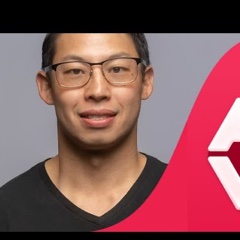
Allen Chen
Cofounder and CEO of Fitbod
Where to hear and read about Allen Chen1 episode or test

Allen Chen is cofounder and CEO of Fitbod, a strength training app he built for himself after a career in quant trading, now at $38M in ARR. The most useful thing to learn from him is how to grow a consumer subscription app on its own revenue, with ROI-positive ads, a habit loop and word of mouth, instead of large funding rounds.
Build a great product people want to talk about and they'll talk about it.
How Fitbod Uses AI to Hyperpersonalize Strength Workouts
Allen Chen: the story and the lessons
1Allen Chen's path from quant trading to Fitbod
Chen paired a quant trading career with a lifetime of training. He studied computer science at UCLA, then wrote portfolio trading algorithms in high frequency trading in New York. He graduated in 2008, a hard time to start in finance, and played rugby in college, then CrossFit.
In his words, automated programming meeting the training world was a nice fit.
He built Fitbod in the gap before a planned hedge fund job. Chen was in grad school for mathematics of finance and between jobs, with a hedge fund role lined up later that year. He wanted his phone to say which muscles were sore and which were fresh, and his cofounder Jesse, a designer, turned his ugly prototype into a polished app.
Jesse and Chen met at UCLA as freshmen and were roommates the next year.
The founders had no plan to build a venture business. Both had day jobs. Jesse worked at a tech company in San Francisco and Chen planned to return to his old job. Making a little money was the natural next step, then maybe making it their job.
They did not know what the venture landscape looked like.
Building for themselves gave Fitbod product-market fit almost at once. The app launched free in late 2015 and ranked high in App Store search for strength training. Other people turned out to want the same thing.
As two people, Chen answered every email and sorted feedback by how he and Jesse would use it in the gym. That filter lets you hear 100 ideas and keep the 10 that fit, and it acts as a de facto roadmap.
2How Fitbod went from free app to paying subscribers
Chen launched free, then charged only the top users. The free app delighted users with exact personalized workouts and sent back feedback that shaped the product. In mid 2016 Fitbod added a premium subscription for ancillary features, aimed at its most engaged users.
Subscriptions were new on Apple then, so charging was an experiment.
A $25k accelerator check turned a strong funnel into growth. By the end of 2016 the founders went all in and joined Jason Calacanis's Launch Accelerator. The check went to ads and the first outside hires, and they closed a pre-seed round at the end of 2017.
Strong retention, referrals and conversions were, in Chen's phrase, fuel on the fire. Calacanis remains the biggest investor.
Chen ran the first paid ads himself, hunting for arbitrage. Apple Search Ads and Facebook ads began around 2017. Chen handled media buying and account structure, and Jesse made the creatives.
He told his team he was looking for "arbitrage", which at first meant being methodical about the numbers at each funnel step. That setup carried paid ads for roughly the first two to four years.
3Why Chen kept Fitbod lean and self-funded
Chen requires paid ads to pay for themselves within a set payback period. Acquisition should be ROI positive: bring in more than you spend within the payback window, then reinvest the revenue. Raising money to pour into ads never made sense to him.
"They should pay for themselves essentially like with a certain period of payback you should be taking in more than you're putting into the paid ads engine."
Fitbod stayed small-round and in founder control. It has been cash flow positive for its whole life, has earned over $150M cumulatively and reinvested it after Apple fees, and grows about 40% a year. It is nearing 50 employees.
The founders did try to raise, but the rounds stayed small and diluted them little. Chen says ten years had ups and downs yet ended where they needed to be.
Chen steers ad spend by LTV to CAC, payback and budget. CAC is per subscriber and compared with subscriber LTV, with trial starts, day-seven retention and onboarding completions feeding into it. Payback sets the working capital available to fund the ad machine.
Once LTV to CAC is strong, the open question is how much addressable market can be reached at that CAC. The host notes a ratio of at least 3x is typical.
Each paid channel does a different job as spend scales. Apple Search Ads performs well but search queries are finite, and Google is also intent-based. TikTok brings a different type of user, and Meta is now the biggest channel and where the next scale is likely to come from.
Paid acquisition has grown into a full team that shares what it learns on account structure, creative testing and campaign breakouts.
4How Fitbod builds habit and word of mouth
Chen built Fitbod's loop on the body's recovery cycle. The app tracks how long since each muscle group was trained and when it is recovered, so the app tells users when to train again. Users open it to check when the next workout is due, even on rest days.
The founders built this from Hooked and The Power of Habit, and Nir Eyal later featured Fitbod as a chapter in Hooked. Chen adds the caveat that it is hard work: the loop is natural, but the workout is still effort.
Chen says a plan removes the fear and guesswork of starting. He knew the gym but still guessed or used whatever equipment was open. One user sat crying in her car, afraid to go in, downloaded Fitbod, and got the confidence to walk in.
Hearing how the app changes people's lives is the best part of the work for him.
Chen works on retention and lets word of mouth follow. Fitbod's word of mouth is large but hard to measure, and it comes from the product itself, not from sharing features. Gifting subscriptions and extended trials only help at the margins.
The host's point is that longer retention gives users more chances to tell friends.
Fitbod keeps a simple surface with depth underneath. Beginners get a quick start, while power users find multiple gym profiles, plate calculators, self-filmed instruction videos and an estimated one rep max chart for every exercise.
Chen still trains with Fitbod after 10 years and checks the one rep max chart every workout.
5How Fitbod chooses what to measure and where to invest
Fitbod tracks weekly workout retention as its engagement metric. It asks whether a user who trained last week trained again this week. The metric is borrowed from Duolingo and is A/B tested.
Topline KPIs stay constant: retention, conversion, acquisition, total subscribers and ARR. Proxy metrics shift to the biggest bottleneck.
Chen wants KPIs a team can act on, and warns of Goodhart's law. Moving one funnel metric shifts the others, so teams work on a piece only in the context of the whole funnel.
He cites Goodhart's law: once a metric becomes the target, it stops being a good measure.
Fitbod sorts projects into defense and offense. Using Elena Verna's framework, defense is what must be done well enough to keep the business running, and offense is where extra investment brings upside. The team talks about it constantly and tests new projects against it.
Chen runs on one or two growth loops until scale. Following Reforge's idea, he says every company has one or two major loops until it reaches a certain size. Fitbod's are word of mouth and paid ads.
6How Chen uses AI to personalize Fitbod workouts
Hand-written rules could not cover a diverse user base. Early Fitbod was an optimization problem with random forest models, and every new user need meant another rule. His own plan suited him, but one user may own only kettlebells and have 15 minutes a day.
Fitbod now runs its own LLM trained on 100 million workouts. The in-house model has run for a few years. It predicts the next best workout from profile, equipment, preferences, workout pattern and user edits, and a custom neural network sets how much weight to lift per exercise.
Training data includes sets, reps and weight compared against what Fitbod recommended. That comparison shows each user's preferences and works as verifiable rewards.
Chen grounds the AI in ten years of domain knowledge. AI is built with tight controls first, and supervision is reduced gradually until it can mostly run on its own. Domain knowledge, such as whether to superset barbells with dumbbells, keeps recommendations right.
The host describes a data network effect, where more users give more data, which improves the algorithm and draws more users.
Fitbod treats every user edit as training signal. When users replace, add or remove exercises, that feeds the algorithm for future workouts. A variability setting gives a consistent routine or more rotation, and gym profiles adapt plans to where people train.
Chen adds LLM features only where they solve a real need. He warns that a chatbot alone is not a solution and starts from the user need. Ideas he names include chat about an injury that adjusts the workout, audio cues, video form correction, and a gym photo that reveals the equipment.
He also expects data beyond workouts to strengthen the models.

How Fitbod Uses AI to Hyperpersonalize Strength Workouts
Allen Chen explains how Fitbod grew a strength training app from a build-for-yourself prototype to $38M in ARR with small funding rounds, built on habit loops, word of mouth, ROI-positive paid ads and now in-house LLM personalization. The result is over 100 million workouts and about 40% yearly growth while staying cash flow positive and in founder control.
Chen paired a quant trading career with a lifetime of training. He studied computer science at UCLA, then wrote portfolio trading algorithms in high frequency trading in New York. He graduated in 2008, a hard time to start in finance, and played rugby in college, then CrossFit.
In his words, automated programming meeting the training world was a nice fit.
He built Fitbod in the gap before a planned hedge fund job. Chen was in grad school for mathematics of finance and between jobs, with a hedge fund role lined up later that year. He wanted his phone to say which muscles were sore and which were fresh, and his cofounder Jesse, a designer, turned his ugly prototype into a polished app.
Jesse and Chen met at UCLA as freshmen and were roommates the next year.
The founders had no plan to build a venture business. Both had day jobs. Jesse worked at a tech company in San Francisco and Chen planned to return to his old job. Making a little money was the natural next step, then maybe making it their job.
They did not know what the venture landscape looked like.
Building for themselves gave Fitbod product-market fit almost at once. The app launched free in late 2015 and ranked high in App Store search for strength training. Other people turned out to want the same thing.
As two people, Chen answered every email and sorted feedback by how he and Jesse would use it in the gym. That filter lets you hear 100 ideas and keep the 10 that fit, and it acts as a de facto roadmap.
Chen launched free, then charged only the top users. The free app delighted users with exact personalized workouts and sent back feedback that shaped the product. In mid 2016 Fitbod added a premium subscription for ancillary features, aimed at its most engaged users.
Subscriptions were new on Apple then, so charging was an experiment.
A $25k accelerator check turned a strong funnel into growth. By the end of 2016 the founders went all in and joined Jason Calacanis's Launch Accelerator. The check went to ads and the first outside hires, and they closed a pre-seed round at the end of 2017.
Strong retention, referrals and conversions were, in Chen's phrase, fuel on the fire. Calacanis remains the biggest investor.
Chen ran the first paid ads himself, hunting for arbitrage. Apple Search Ads and Facebook ads began around 2017. Chen handled media buying and account structure, and Jesse made the creatives.
He told his team he was looking for "arbitrage", which at first meant being methodical about the numbers at each funnel step. That setup carried paid ads for roughly the first two to four years.
Chen requires paid ads to pay for themselves within a set payback period. Acquisition should be ROI positive: bring in more than you spend within the payback window, then reinvest the revenue. Raising money to pour into ads never made sense to him.
"They should pay for themselves essentially like with a certain period of payback you should be taking in more than you're putting into the paid ads engine."
Fitbod stayed small-round and in founder control. It has been cash flow positive for its whole life, has earned over $150M cumulatively and reinvested it after Apple fees, and grows about 40% a year. It is nearing 50 employees.
The founders did try to raise, but the rounds stayed small and diluted them little. Chen says ten years had ups and downs yet ended where they needed to be.
Chen steers ad spend by LTV to CAC, payback and budget. CAC is per subscriber and compared with subscriber LTV, with trial starts, day-seven retention and onboarding completions feeding into it. Payback sets the working capital available to fund the ad machine.
Once LTV to CAC is strong, the open question is how much addressable market can be reached at that CAC. The host notes a ratio of at least 3x is typical.
Each paid channel does a different job as spend scales. Apple Search Ads performs well but search queries are finite, and Google is also intent-based. TikTok brings a different type of user, and Meta is now the biggest channel and where the next scale is likely to come from.
Paid acquisition has grown into a full team that shares what it learns on account structure, creative testing and campaign breakouts.
Chen built Fitbod's loop on the body's recovery cycle. The app tracks how long since each muscle group was trained and when it is recovered, so the app tells users when to train again. Users open it to check when the next workout is due, even on rest days.
The founders built this from Hooked and The Power of Habit, and Nir Eyal later featured Fitbod as a chapter in Hooked. Chen adds the caveat that it is hard work: the loop is natural, but the workout is still effort.
Chen says a plan removes the fear and guesswork of starting. He knew the gym but still guessed or used whatever equipment was open. One user sat crying in her car, afraid to go in, downloaded Fitbod, and got the confidence to walk in.
Hearing how the app changes people's lives is the best part of the work for him.
Chen works on retention and lets word of mouth follow. Fitbod's word of mouth is large but hard to measure, and it comes from the product itself, not from sharing features. Gifting subscriptions and extended trials only help at the margins.
The host's point is that longer retention gives users more chances to tell friends.
Fitbod keeps a simple surface with depth underneath. Beginners get a quick start, while power users find multiple gym profiles, plate calculators, self-filmed instruction videos and an estimated one rep max chart for every exercise.
Chen still trains with Fitbod after 10 years and checks the one rep max chart every workout.
Fitbod tracks weekly workout retention as its engagement metric. It asks whether a user who trained last week trained again this week. The metric is borrowed from Duolingo and is A/B tested.
Topline KPIs stay constant: retention, conversion, acquisition, total subscribers and ARR. Proxy metrics shift to the biggest bottleneck.
Chen wants KPIs a team can act on, and warns of Goodhart's law. Moving one funnel metric shifts the others, so teams work on a piece only in the context of the whole funnel.
He cites Goodhart's law: once a metric becomes the target, it stops being a good measure.
Fitbod sorts projects into defense and offense. Using Elena Verna's framework, defense is what must be done well enough to keep the business running, and offense is where extra investment brings upside. The team talks about it constantly and tests new projects against it.
Chen runs on one or two growth loops until scale. Following Reforge's idea, he says every company has one or two major loops until it reaches a certain size. Fitbod's are word of mouth and paid ads.
Hand-written rules could not cover a diverse user base. Early Fitbod was an optimization problem with random forest models, and every new user need meant another rule. His own plan suited him, but one user may own only kettlebells and have 15 minutes a day.
Fitbod now runs its own LLM trained on 100 million workouts. The in-house model has run for a few years. It predicts the next best workout from profile, equipment, preferences, workout pattern and user edits, and a custom neural network sets how much weight to lift per exercise.
Training data includes sets, reps and weight compared against what Fitbod recommended. That comparison shows each user's preferences and works as verifiable rewards.
Chen grounds the AI in ten years of domain knowledge. AI is built with tight controls first, and supervision is reduced gradually until it can mostly run on its own. Domain knowledge, such as whether to superset barbells with dumbbells, keeps recommendations right.
The host describes a data network effect, where more users give more data, which improves the algorithm and draws more users.
Fitbod treats every user edit as training signal. When users replace, add or remove exercises, that feeds the algorithm for future workouts. A variability setting gives a consistent routine or more rotation, and gym profiles adapt plans to where people train.
Chen adds LLM features only where they solve a real need. He warns that a chatbot alone is not a solution and starts from the user need. Ideas he names include chat about an injury that adjusts the workout, audio cues, video form correction, and a gym photo that reveals the equipment.
He also expects data beyond workouts to strengthen the models.