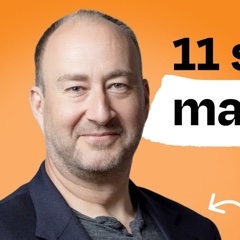
Alistair Croll
Co-author of Lean Analytics and Just Evil Enough, startup advisor and conference chair
Where to hear and read about Alistair Croll1 episode or test

Alistair Croll is a startup advisor, conference chair and co-author of Lean Analytics and Just Evil Enough. The thing most worth learning from him is to find a zero-day marketing exploit, a go-to-market move specific to your market that bends the system in a way its creators never intended, while staying ethical.
I'm not saying be evil. I'm saying be just evil enough.
Just evil enough: Subversive marketing strategies for startups | Alistair Croll
Alistair Croll: the story and the lessons
1Alistair Croll and the road to Just Evil Enough
Croll is a lifelong product manager who writes, advises and runs conferences. He co-wrote Lean Analytics and runs conferences on data, AI and government. He has been a product manager all his life, even while running events.
His Lean Analytics work gave him a close view of many startups. Just Evil Enough, written with Emily Ross, is a study of loopholes for getting people to notice what you built.
The phrase 'just evil enough' began as advice to LocalMind's founders. LocalMind let strangers answer questions about a place. In a geofenced tweet test about 95% answered, but nobody was asking, so Croll suggested the team ask the questions itself.
When Lenny said he wasn't evil, Croll replied that he should be just evil enough. This was at Year One Labs, which ran for a year instead of the usual 90 days to apply Lean Startup ideas.
Croll solves the cold start by seeding the platform yourself. Behance's founder Scott Belsky was turned down by top designers when he asked them to join. He then asked to interview them for his blog and use their design work, and they agreed.
That gave social proof and showed new users how famous designers built their templates. Asking the questions yourself, as LocalMind did, likewise shows users what to ask and yields passive data about what is happening in a bar or restaurant.
Croll used a weekend hackathon instead of an application form to judge founders. Year One Labs picked startups by hackathon. One team built a Foursquare check-in tool showing restaurants where customers had been before and after, so they could advertise there.
The thinking was that even if it was a bad idea, the founder could make 51 more and one wouldn't suck.
Croll chose what is interesting over fame, safety or wealth. His one-person company is called Solve for Interesting. He says solving for fame, safety or wealth went worse for him than following what's interesting.
His working motto: "It's amazing what can get done when nobody cares who gets credit."
2Croll's idea of the zero-day marketing exploit
Croll says distribution is now harder than building, and most founders ignore it. Most startups fail because they treat distribution as an afterthought, and product managers focus on the next feature. Without an unfair advantage that turns attention into profitable demand, he says, you will probably fail.
He treats the go-to-market move as seriously as a product feature.
A zero-day exploit is specific to your market, unlike a generic growth hack. Growth hacks like the exit-intent popup or Dropbox's two-sided storage reward work on any product and fade once everyone knows them. A zero-day exploit uses the dynamics of one industry.
Invite lists and storage rewards were cool the first time. As Croll puts it: "If it works, it just becomes marketing." His advice is to use what works but go find your own.
Croll defines subversion as using a system in ways its creators never intended. It is not the same as doing harm. The mindset has three parts: system awareness, novelty and disagreeability, and he says it can be learned like any skill.
The authors studied it with neuroscientists and through historical examples. System awareness plus a novel approach gets you two-thirds of the way there.
Croll uses Tina Seelig's $5 class to show what seeing the real system means. Each team got $5, five days to plan, two hours to act and three minutes to present. Most stayed in the obvious box, with lottery tickets or lemonade stands. One team turned $5 into about $200 testing bike tire pressure for donations, and another made about $250 selling places in line at fancy restaurants.
The winners made around $650 by selling their three-minute presentation slot to a recruiter. They saw the system they were really in.
Croll prizes people who notice when the scoring quietly changes. In Zachary Hambrick's Navy test, sailors monitored four consoles with a scoreboard in the middle. Halfway through, one quadrant became worth 75% of the points without notice. Some sailors saw it and scored very well, while others kept following instructions and fell behind.
He contrasts people playing the game right with people questioning whether they're playing the right game. Rules decide who may play, but bluffing and reading tells decide who wins, as in poker.
Croll says lasting exploits change how the business works, not just one campaign. Traffic spikes from a single stunt are turbo boosts that disappear. IKEA moved one stage of furniture's chain, assembly, to the customer and changed the industry.
The questions to ask: how do you differentiate, how could you reframe, how is the product delivered, and who provides each step. Any of these can be the lever.
Croll scans product, medium and market with the 18-square Recon Canvas. Rows are objective, collective and subjective. Columns are product (features, messages), medium (platforms, norms) and market (attention captured, actions created). In each square, ask what normal behavior is and where something unorthodox could work.
The book has about 160 case studies spread across the squares. The authors reviewed 300 to 400 cases, including Genghis Khan and Billy Butlin's holiday camps. His method is to take the mindset, scan the market, apply a tactic, then prune candidates with rules.
Croll says the medium is the part of fit most founders overlook. When two companies sell the same product to the same market and only one wins, the cause is often medium strategy. Burger King's free Whopper required ordering in the new app from a McDonald's parking lot, which drove installs and location sharing.
Burger King also liked influencers' 10-year-old posts to guarantee a notification, said nothing while curiosity built, then revealed that funnel cake fries were returning. The result was millions of free impressions.
3Croll's tactics for bending a market
Croll suggests checking whether you are selling to the wrong buyer. Bridge-inspection drones sold poorly to city councils, who see inspection as a cost. Insurers can refuse to sign off on bridges without the drone, and selling to them gave a 100% close rate.
At Coradiant, Croll moved the pitch from operations to marketing: "Analytics shows you what people did. We show you if they could do it." Fidelity, Salesforce and LinkedIn bought within three months.
Croll turns a product's weakness into an asset for an ignored segment. Salesforce was low on features, but rivals Vantive, Clarify and Remedy cost millions and took years to install. Salesforce installed with a URL, and its logo said No Software.
Often the weakness is already a benefit to a segment you have overlooked, such as prosumers who white label.
Croll tells founders to combine the product with the adjacent step. If customers are not buying, the product may be only half a solution. Kraft's powdered cheese only sold once bound to macaroni as a ready-made dinner. 1-800-Mattress won New Yorkers by including old-mattress removal.
The mattress line: "I don't want a new mattress. I want a replaced mattress." Look at the value chain and slide it over one block.
Croll sees Netflix as a lesson in repurposing someone else's infrastructure. Blockbuster had streaming first, but US broadband was too thin. Netflix mailed DVDs through the US Postal Service, a slow but very high-bandwidth network, with a website to order the next disc.
The real question was whether it could get a video to all of North America in two days, not whether it could stream video.
Croll shows how aggregating scattered data can win search traffic and partners. Busbud generated millions of structured bus-schedule pages that search engines favored, with a Buy my ticket button sending users to bus companies. It then showed the companies that had ignored it that 20% of their traffic came from Busbud.
Get Satisfaction crawled complaints about Sony and then pressured Sony to pay. Croll calls that too evil, since it assumed consent.
Croll reframes a market by drawing a new grid. Colgate competed on sex appeal and Crest on clinical proof. Tom's of Maine offered natural-minded buyers a different dimension, and Tesla raced Bugattis to make acceleration the dimension instead of range.
His line: "Positioning is simply where you are on a grid. Reframing is drawing the grid." The dimension only matters if a reachable, lucrative segment treats it as the dominant buying criterion.
Croll points out that defaults and regulation can swamp any growth hack. Austria, where organ donation is opt-out, has about 99.6% donors against Germany's 12% on opt-in. Startups often overlook regulatory change or loopholes as a strategy.
In his words, "All your growth hacks ain't going to get you from 12% to 99.6%."
Croll treats personal access as a legitimate edge, if you are honest about it. Getaround's founder borrowed a VC friend's early Tesla Roadster and let people drive it at CES. Whitney Wolfe Herd pitched sororities on Bumble, then told the fraternity across the street the women were on the app.
People are often ashamed to admit their access, though it is often what gives someone an advantage.
Croll allows bait and switch only when the bait is free or delivered. Energage sells HR software, which is hard to get excited about, so it ran local Best Workplaces surveys with newspapers, then offered companies the data on their employees. Tupperware sold dinner parties, then the chance to run a business.
To avoid being a con man, make the bait free, deliver what you promised, or delight people so few complain.
Croll staged his own Lean Analytics launch as a competition among allies. About 15 well-known supporters each got a scheduled click-to-tweet with a unique tag, posting about every 12 hours over seven days. Seeing who drove more clicks and pre-orders made them compete.
The authors then wrote a blog post explaining how they hacked their own launch, which proved their analytics credibility.
Croll checks incentives so they do not punish the behavior he wants. A survey offering one random respondent a free consulting session discouraged sharing, since each extra respondent lowered the odds. He and Ross made Team Orange and Team Black, with the prize going to the team with the most responses.
People immediately began recruiting others for their team.
Croll favors messages that polarize, and measures it. Liquid Death reportedly won't run an ad unless 50% of people dislike it. Coinbase's bouncing QR code Super Bowl ad ranked worst of 64 but drew 20 million hits and crashed its servers.
The Blair Witch Project listed its actors as missing and played scary noises outside their tent.
4Where Croll draws the line, and how to practice
Croll holds subversion to rules: never assume consent, punch down or break the law. The rules also forbid acting without permission, lying, dark patterns, breaking a law's intent and ruining your reputation. The book has a chapter called Don't Actually Be Evil.
Afterlife crawled obituaries to sell flowers to the grieving, and its founders were charged in criminal court.
Croll says legal is not the same as acceptable. Chrysler's PT Cruiser technically counts as a truck. Selling it pulled the truck line's average fuel consumption under the federal limit, so Chrysler could keep selling trucks that were terrible on fuel.
Croll asks if it is illegal, and answers no. Is it too evil for the authors? Absolutely.
Croll says thinking like a super villain is a trainable muscle. Practice being disagreeable and understanding your system. Then ignore the guardrails, embrace absurdity and don't pull punches on wording. Wes Kao calls the bold version a spiky point of view.
He also points to TRIZ, which combines unrelated fields, and construal level theory, which brings distant ideas closer.
Croll tests candidate exploits with pre-mortems and counterfactuals. Ask whether the opposite is true, whether it would have been better a year ago or a year from now, and what would convince you that you're wrong. Four startups he worked with using this method each found a go-to-market strategy.
He wants product meetings where people allude to their zero-day exploit instead of their feature, since the exploit is the thing you tell no one.
Croll says AI shifts the risk from building to getting to market. Mass production puts easily changed work first and risky work last. With an LLM and Figma, a team can build 10 prototypes, test them on citizens, then document the winner, and documentation is now the risky step.
A feature changes in a day in the spec, a week in code and a month in production, if at all. "That's how big companies fail and small companies win": by not asking what technology has made hard or easy.

Just evil enough: Subversive marketing strategies for startups | Alistair Croll
Startups win by finding a subversive, unprecedented go-to-market move (a zero-day marketing exploit) that makes the system behave in a way its creators did not intend. Croll lays out a scanning framework and 11 recurring tactics, backed by case studies like Netflix, Busbud, Burger King and Tesla.
Croll is a lifelong product manager who writes, advises and runs conferences. He co-wrote Lean Analytics and runs conferences on data, AI and government. He has been a product manager all his life, even while running events.
His Lean Analytics work gave him a close view of many startups. Just Evil Enough, written with Emily Ross, is a study of loopholes for getting people to notice what you built.
The phrase 'just evil enough' began as advice to LocalMind's founders. LocalMind let strangers answer questions about a place. In a geofenced tweet test about 95% answered, but nobody was asking, so Croll suggested the team ask the questions itself.
When Lenny said he wasn't evil, Croll replied that he should be just evil enough. This was at Year One Labs, which ran for a year instead of the usual 90 days to apply Lean Startup ideas.
Croll solves the cold start by seeding the platform yourself. Behance's founder Scott Belsky was turned down by top designers when he asked them to join. He then asked to interview them for his blog and use their design work, and they agreed.
That gave social proof and showed new users how famous designers built their templates. Asking the questions yourself, as LocalMind did, likewise shows users what to ask and yields passive data about what is happening in a bar or restaurant.
Croll used a weekend hackathon instead of an application form to judge founders. Year One Labs picked startups by hackathon. One team built a Foursquare check-in tool showing restaurants where customers had been before and after, so they could advertise there.
The thinking was that even if it was a bad idea, the founder could make 51 more and one wouldn't suck.
Croll chose what is interesting over fame, safety or wealth. His one-person company is called Solve for Interesting. He says solving for fame, safety or wealth went worse for him than following what's interesting.
His working motto: "It's amazing what can get done when nobody cares who gets credit."
Croll says distribution is now harder than building, and most founders ignore it. Most startups fail because they treat distribution as an afterthought, and product managers focus on the next feature. Without an unfair advantage that turns attention into profitable demand, he says, you will probably fail.
He treats the go-to-market move as seriously as a product feature.
A zero-day exploit is specific to your market, unlike a generic growth hack. Growth hacks like the exit-intent popup or Dropbox's two-sided storage reward work on any product and fade once everyone knows them. A zero-day exploit uses the dynamics of one industry.
Invite lists and storage rewards were cool the first time. As Croll puts it: "If it works, it just becomes marketing." His advice is to use what works but go find your own.
Croll defines subversion as using a system in ways its creators never intended. It is not the same as doing harm. The mindset has three parts: system awareness, novelty and disagreeability, and he says it can be learned like any skill.
The authors studied it with neuroscientists and through historical examples. System awareness plus a novel approach gets you two-thirds of the way there.
Croll uses Tina Seelig's $5 class to show what seeing the real system means. Each team got $5, five days to plan, two hours to act and three minutes to present. Most stayed in the obvious box, with lottery tickets or lemonade stands. One team turned $5 into about $200 testing bike tire pressure for donations, and another made about $250 selling places in line at fancy restaurants.
The winners made around $650 by selling their three-minute presentation slot to a recruiter. They saw the system they were really in.
Croll prizes people who notice when the scoring quietly changes. In Zachary Hambrick's Navy test, sailors monitored four consoles with a scoreboard in the middle. Halfway through, one quadrant became worth 75% of the points without notice. Some sailors saw it and scored very well, while others kept following instructions and fell behind.
He contrasts people playing the game right with people questioning whether they're playing the right game. Rules decide who may play, but bluffing and reading tells decide who wins, as in poker.
Croll says lasting exploits change how the business works, not just one campaign. Traffic spikes from a single stunt are turbo boosts that disappear. IKEA moved one stage of furniture's chain, assembly, to the customer and changed the industry.
The questions to ask: how do you differentiate, how could you reframe, how is the product delivered, and who provides each step. Any of these can be the lever.
Croll scans product, medium and market with the 18-square Recon Canvas. Rows are objective, collective and subjective. Columns are product (features, messages), medium (platforms, norms) and market (attention captured, actions created). In each square, ask what normal behavior is and where something unorthodox could work.
The book has about 160 case studies spread across the squares. The authors reviewed 300 to 400 cases, including Genghis Khan and Billy Butlin's holiday camps. His method is to take the mindset, scan the market, apply a tactic, then prune candidates with rules.
Croll says the medium is the part of fit most founders overlook. When two companies sell the same product to the same market and only one wins, the cause is often medium strategy. Burger King's free Whopper required ordering in the new app from a McDonald's parking lot, which drove installs and location sharing.
Burger King also liked influencers' 10-year-old posts to guarantee a notification, said nothing while curiosity built, then revealed that funnel cake fries were returning. The result was millions of free impressions.
Croll suggests checking whether you are selling to the wrong buyer. Bridge-inspection drones sold poorly to city councils, who see inspection as a cost. Insurers can refuse to sign off on bridges without the drone, and selling to them gave a 100% close rate.
At Coradiant, Croll moved the pitch from operations to marketing: "Analytics shows you what people did. We show you if they could do it." Fidelity, Salesforce and LinkedIn bought within three months.
Croll turns a product's weakness into an asset for an ignored segment. Salesforce was low on features, but rivals Vantive, Clarify and Remedy cost millions and took years to install. Salesforce installed with a URL, and its logo said No Software.
Often the weakness is already a benefit to a segment you have overlooked, such as prosumers who white label.
Croll tells founders to combine the product with the adjacent step. If customers are not buying, the product may be only half a solution. Kraft's powdered cheese only sold once bound to macaroni as a ready-made dinner. 1-800-Mattress won New Yorkers by including old-mattress removal.
The mattress line: "I don't want a new mattress. I want a replaced mattress." Look at the value chain and slide it over one block.
Croll sees Netflix as a lesson in repurposing someone else's infrastructure. Blockbuster had streaming first, but US broadband was too thin. Netflix mailed DVDs through the US Postal Service, a slow but very high-bandwidth network, with a website to order the next disc.
The real question was whether it could get a video to all of North America in two days, not whether it could stream video.
Croll shows how aggregating scattered data can win search traffic and partners. Busbud generated millions of structured bus-schedule pages that search engines favored, with a Buy my ticket button sending users to bus companies. It then showed the companies that had ignored it that 20% of their traffic came from Busbud.
Get Satisfaction crawled complaints about Sony and then pressured Sony to pay. Croll calls that too evil, since it assumed consent.
Croll reframes a market by drawing a new grid. Colgate competed on sex appeal and Crest on clinical proof. Tom's of Maine offered natural-minded buyers a different dimension, and Tesla raced Bugattis to make acceleration the dimension instead of range.
His line: "Positioning is simply where you are on a grid. Reframing is drawing the grid." The dimension only matters if a reachable, lucrative segment treats it as the dominant buying criterion.
Croll points out that defaults and regulation can swamp any growth hack. Austria, where organ donation is opt-out, has about 99.6% donors against Germany's 12% on opt-in. Startups often overlook regulatory change or loopholes as a strategy.
In his words, "All your growth hacks ain't going to get you from 12% to 99.6%."
Croll treats personal access as a legitimate edge, if you are honest about it. Getaround's founder borrowed a VC friend's early Tesla Roadster and let people drive it at CES. Whitney Wolfe Herd pitched sororities on Bumble, then told the fraternity across the street the women were on the app.
People are often ashamed to admit their access, though it is often what gives someone an advantage.
Croll allows bait and switch only when the bait is free or delivered. Energage sells HR software, which is hard to get excited about, so it ran local Best Workplaces surveys with newspapers, then offered companies the data on their employees. Tupperware sold dinner parties, then the chance to run a business.
To avoid being a con man, make the bait free, deliver what you promised, or delight people so few complain.
Croll staged his own Lean Analytics launch as a competition among allies. About 15 well-known supporters each got a scheduled click-to-tweet with a unique tag, posting about every 12 hours over seven days. Seeing who drove more clicks and pre-orders made them compete.
The authors then wrote a blog post explaining how they hacked their own launch, which proved their analytics credibility.
Croll checks incentives so they do not punish the behavior he wants. A survey offering one random respondent a free consulting session discouraged sharing, since each extra respondent lowered the odds. He and Ross made Team Orange and Team Black, with the prize going to the team with the most responses.
People immediately began recruiting others for their team.
Croll favors messages that polarize, and measures it. Liquid Death reportedly won't run an ad unless 50% of people dislike it. Coinbase's bouncing QR code Super Bowl ad ranked worst of 64 but drew 20 million hits and crashed its servers.
The Blair Witch Project listed its actors as missing and played scary noises outside their tent.
Croll holds subversion to rules: never assume consent, punch down or break the law. The rules also forbid acting without permission, lying, dark patterns, breaking a law's intent and ruining your reputation. The book has a chapter called Don't Actually Be Evil.
Afterlife crawled obituaries to sell flowers to the grieving, and its founders were charged in criminal court.
Croll says legal is not the same as acceptable. Chrysler's PT Cruiser technically counts as a truck. Selling it pulled the truck line's average fuel consumption under the federal limit, so Chrysler could keep selling trucks that were terrible on fuel.
Croll asks if it is illegal, and answers no. Is it too evil for the authors? Absolutely.
Croll says thinking like a super villain is a trainable muscle. Practice being disagreeable and understanding your system. Then ignore the guardrails, embrace absurdity and don't pull punches on wording. Wes Kao calls the bold version a spiky point of view.
He also points to TRIZ, which combines unrelated fields, and construal level theory, which brings distant ideas closer.
Croll tests candidate exploits with pre-mortems and counterfactuals. Ask whether the opposite is true, whether it would have been better a year ago or a year from now, and what would convince you that you're wrong. Four startups he worked with using this method each found a go-to-market strategy.
He wants product meetings where people allude to their zero-day exploit instead of their feature, since the exploit is the thing you tell no one.
Croll says AI shifts the risk from building to getting to market. Mass production puts easily changed work first and risky work last. With an LLM and Figma, a team can build 10 prototypes, test them on citizens, then document the winner, and documentation is now the risky step.
A feature changes in a day in the spec, a week in code and a month in production, if at all. "That's how big companies fail and small companies win": by not asking what technology has made hard or easy.