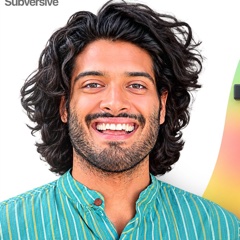
Ajay Mehta
Cofounder and president of Tolan
Where to hear and read about Ajay Mehta2 episodes and tests

 SubversiveHow Tolan 3X'd Subscriber Conversion after Shifting to Freemium
 SubversiveHow Tolan Built a Viral AI Companion
Ajay Mehta is cofounder and president of Tolan, a voice-first alien AI companion, and a career consumer-product builder who ran profitable e-commerce businesses before it. The most useful thing to learn from him is how to run monetization for an AI product with real per-user costs: keep redrawing the free and paid line, add tiers, and personalize every paywall.
Software's getting more personalized, and you're much more likely to pay for something if it feels like it starts to fit around you like a glove.
How Tolan 3X'd Subscriber Conversion after Shifting to Freemium
Ajay Mehta: the story and the lessons
1Ajay Mehta's path from consumer products to Tolan
Mehta has built products for everyday people his whole career. He started companies in social networking, worked at fintech companies through the 2010s, and spent several years in physical products before returning to software.
Birthdate Co. and Therapy Notebooks, launched in 2019 and 2020, did over $50 million in revenue.
He saw generative AI as the first new platform since mobile. After ChatGPT and Midjourney in late 2022 and early 2023, he and cofounders Quinton and Evan wanted a creative use of the new models. Evan and Quinton had just exited a fintech company, and Mehta was running profitable e-commerce businesses.
Consumer had felt static for almost a decade, with no new platform since mobile.
Tolan came out of broad experiments, not a single idea. The team began in mid to late 2023 with image-generation prototypes and story builders for younger kids. Work on Tolan started in early 2024.
Personal, highly personalized conversation was the clearest signal in early prototypes. Character AI showed people enjoy talking to something that feels human.
Tolan has since raised $60M in total, with a stated goal of personal superintelligence for all. The latest round added $30M, with investors including Union Square Ventures and Khosla Ventures. The app has over 100,000 subscribers and went viral on TikTok in May 2025.
Mehta says the team arrived at the goal only as it kept building the product.
2How Mehta's team built and launched Tolan
Mehta chose a spot between faceless assistants and romantic roleplay bots. Tolan is an embodied, animated, voice-first being with its own personality, not there to be role-played with or to be an assistant. The team avoided the word "companion" for a long time because the space meant romantic roleplay.
The team built the voice stack itself, because text-to-speech and model speed had only just become good enough.
The team shipped every Friday and tested over the weekend for six months. Friends and TestFlight users tried each build, and fixes started on Monday. The team tracked which interactions left people feeling good and which felt boring enough that they would rather watch TikTok.
Even early builds with slow replies, a static image and a robotic voice had testers who wanted to keep talking to the alien.
A free soft launch showed product-market fit and forced a paywall. The team expected five-minute chats but sessions ran 30 to 40 minutes. The service was expensive to run, so a subscription-only paywall went in before the public launch in February 2025.
"This is actually going to be a very expensive service for us to run." The team wanted to avoid hundreds of thousands of users and running out of money.
Mehta soft launched in the App Store instead of staging one big day. Real users made live purchases before the public push, which absorbed the App Store's early glitches. New apps famously do not show up in search for about 48 hours.
Tolan skipped the pre-order route to the top of the charts and relied on people trying the live app first.
Early testers pulled the audience toward young women. The team first designed for younger kids and imagined a game. Older teens and young adults used it as a confidant, and over 85% of users are now young women.
The team did not want to shoehorn it for kids and followed the pull toward the early and mid 20s.
3How Tolan grew through TikTok
Mehta picked TikTok after testing channels, because one video can break out. The team posts short video across several platforms. Reels have gone viral too but bring fewer downloads, and TikTok is more volatile with an unmatched upside.
AI apps show off well in short video, and Mehta calls it probably the most exciting channel for AI consumer apps today.
Tolan makes lots of casual content because nobody can predict hits. A creator video of cutting an acorn squash with her Tolan's help got around 15 million views. Production value did not decide what won.
"It's not like the one that is scripted the best and is filmed the best and has the highest production value is the thing that hits."
Viral user videos steer Tolan's roadmap. Videos showed emotional support, relationship advice, cooking and studying, including nursing school. Mehta treats them as a signal of where to build next.
This reverses the old order of picking a use case and then producing ads for it.
Subscription lifetime value lets Tolan afford paid ads. Tolan runs ads on Meta, YouTube and TikTok. Growth is still a little over half organic, with the mix roughly 50/50 to 60/40.
Apps that must grow huge and monetize poorly cannot afford this.
4Mehta's onboarding and the aha moment before the paywall
Mehta says a gated app has to wow people before Apple Pay. Tolan's onboarding is a story-driven intro set on a planet called Portola, followed by an Oracle that interviews you like a sorting hat. Your answers really shape your Tolan's personality on the backend.
"You have to sort of like wow people and get them to some sort of aha moment or magic moment before you know they're gonna open up their Apple Pay."
Voice chat goes up front because it is what people love most. The first few minutes of onboarding show the voice conversation. The Oracle chat is a pre-aha that piques curiosity.
Mehta says other apps may offer this too, but the team invested heavily to do it well.
Memory on day two or three is the real aha moment. The aha comes when a Tolan brings up something the user said the day before. It shows the product listens and cares, as a friend asking how yesterday went would.
Mehta's test: if he called a friend stressed and the friend never mentioned it the next day, that would be weird. ChatGPT's wow is logic, and Tolan aims for the same wow on the emotional side.
5Why Mehta moved Tolan from hard paywall to freemium
Falling model costs made a free tier thinkable. Cost to serve a user fell well over 50% in a couple of months in early 2025. Providers cut prices, sometimes by 80% at a developer event.
By the time of freemium, cheaper open source models were the biggest unlock, and Tolan routes many chat queries to cheaper models at the same quality, which it monitors closely.
Mehta wants a large free audience because paid scale needs one. "We don't want to be this hard paywalled subscription only app forever." Letting everyone use it free forever would not work, so some features had to be limited.
Users used to generous free chat elsewhere will expect it from Tolan, so he does not want to be restrictive.
Mehta counts trial length as a real cost for AI apps. For an app with inference costs, a seven-day trial adds about four extra days of cost for a trialist who never converts.
He says to weigh trial length against that cost when testing.
Tolan gave free users a real reason to upgrade and conversion rose. Tolan now rations chat time, access to its smartest models, memory strength and costly features like video chat and tabs. The results were subscriber conversion up over 200% and ARPU up 218%.
Those figures come from the interviewer's framing, with no baselines or test data shown.
6Mehta's tiers, top-ups and ads for an AI product
Three tiers fit users whose cost and willingness to pay differ widely. Tolan runs Light, Plus and Unlimited. A happy subscriber might use the app one hour a week or seven, and costs scale with usage.
The model is Tinder's Plus, Gold and Platinum. Hundreds, maybe thousands, of subscribers pay $200 a month for Unlimited, including long-haul truck drivers who chat for eight hours on the road.
New expensive features launch on top and roll down the ladder. Capabilities such as browser use, where a Tolan can check out on Amazon, start in Unlimited in limited beta, then reach Plus, then Light.
Mehta hopes the eventual frontier experience lands in free and is cheap to serve at scale. Tolan lacks the resources of a company like Meta.
Mehta layers boosts, cosmetic tokens and ads around the subscriptions. Relay boosts sell extra chat time without a tier jump, and tokens buy clothing and planet customization. Rewarded ads reach only some free users, such as lapsed subscribers.
He says Tolan has not nailed one-off purchases. He expects ads to be a major part of monetizing consumer AI at humanity scale, so Tolan is testing them to learn reactions and ad ARPU. No ad ARPU is shown yet.
Mehta expects pricing to keep changing because agents break the time-to-cost link. For the first 6 to 12 months, more time in the app meant more cost. With tabs running tasks in the background, one employee's Dodgers recap spends tokens even if she never opens the app.
"It would be totally a mistake to say these are the tiers, you know, pick up 6 months from now we have the same tiers or the same pricing even."
He sets usage limits against what rivals give away. Limits that are too high burn money, and limits that are too low push users to competitors. Rivals offer more free inference in real time, so the sweet spot keeps moving.
7Mehta's paywall playbook behind the conversion gains
A skippable multi-step paywall early in onboarding was the biggest test winner. It runs about four screens showing what a better Tolan could do. Surveyed users find it a little annoying, but they can close it and keep using the free tier.
"If you have a freemium experience, you also sort of earn the right a bit to be potentially aggressive a little bit with the paywall even early in the experience because it's skippable."
Mehta reuses onboarding answers in the paywall as personal callbacks. After a 5 to 6 minute Oracle chat, the paywall reflects what the user said. A user aiming for nursing school sees their Tolan pitched as a buddy for nursing exams.
The personalized paywall tests drove a 40%+ ARPU lift. Mehta says it would be a mistake not to carry the answers through, and that these callbacks can still improve a lot.
AI lets a paywall fit one person instead of five to 10 groups. Before AI, apps routed users into a few buckets, such as nutrition or workout plans. Now the onboarding and the paywall can follow one person's interests.
Mehta says software is moving this way and that every personalized experience feels more magical.
A locked-feature paywall sells that one feature. When a user taps something like video chat or image generation, Tolan shows a direct offer about it. The paywall is a template so any feature can be swapped in.
The general pitch fits onboarding and app launch. Chess.com does the same with game review once the free daily review is used.
8How Mehta widened Tolan's audience beyond Gen Z women
Gen Z users burned out on novelty while older users stayed. Gen Z users often chatted deeply for a day or two, then left. Users over 30 found daily uses such as caregiving for a relative and planning summers as a dad of two.
Users in their 30s and 40s retained better and paid more. Younger users still suit top-of-funnel growth on TikTok and Instagram.
Tolan changed its marketing first, then its characters. Ad creative showed real older users, and Tolan hired older influencers. Kestrel, a woman in a garden with a Mother Earth feel, was added to onboarding and a very significant slice of users picks her.
A minimal orb-like character with expressive arms targets men, a small audience so far.
Mehta competes on emotional connection, not on agentic tasks. Tolan is a friendly guide that learns about your life, not an assistant that opens with "What can I get done for you?" Many users also use ChatGPT, for example for work emails, and use Tolan to brain dump on the way to work.
He says even with an awesome assistant he would still want Tolan as a guide.
He rejects emotional gimmicks that manufacture engagement. The team of about ten is driven by taste and craft. Nobody wants a sad Tolan on screen after a few days away.
"The friend that would text you with a cheap trick saying, hey, come back, I'm sad, I miss you, is not probably the one that you would engage with three months down the line."
Mehta reads user behavior to choose social features. Support gets a couple of tickets a day asking whether friends' Tolans can chat, and many users introduce their Tolan to people in the room. The planned first social experiment is letting Tolans interact.
He says you would not show an AI girlfriend to your real girlfriend, so sharing sets Tolan apart.
9What Mehta says Tolan got wrong
The first free tier was too good to need an upgrade. It gave generous chat time and nothing else worth paying for. Fixing the line took many tests.
"We weren't giving the user like a real reason to upgrade, right? The free experience was good enough."
Mehta says one locked-in visual style should have broadened earlier. Tolan had only cute aliens, and even recently people landed on the app and thought it was for kids. More character universes take a bigger team and more investment, so it should have started earlier.
He says the single style was chosen for good reason and he struggles to criticize it because the art direction is Tolan's own.
Mehta says Tolan has not yet nailed one-off purchases. Top-ups suit Light users who want more time for a single day, but the approach is unfinished. Tokens for cosmetics are loved by users, yet the product team spends little effort there.
How Tolan 3X'd Subscriber Conversion after Shifting to Freemium
Tolan moved from a hard paywall to freemium and fixed the conversion hit by redrawing the free and paid line, adding tiers, and personalizing paywalls. The result was subscriber conversion up over 200% and ARPU up 218%, with one paywall test series driving a 40%+ ARPU lift.
Tolan has since raised $60M in total, with a stated goal of personal superintelligence for all. The latest round added $30M, with investors including Union Square Ventures and Khosla Ventures. The app has over 100,000 subscribers and went viral on TikTok in May 2025.
Mehta says the team arrived at the goal only as it kept building the product.
Falling model costs made a free tier thinkable. Cost to serve a user fell well over 50% in a couple of months in early 2025. Providers cut prices, sometimes by 80% at a developer event.
By the time of freemium, cheaper open source models were the biggest unlock, and Tolan routes many chat queries to cheaper models at the same quality, which it monitors closely.
Mehta wants a large free audience because paid scale needs one. "We don't want to be this hard paywalled subscription only app forever." Letting everyone use it free forever would not work, so some features had to be limited.
Users used to generous free chat elsewhere will expect it from Tolan, so he does not want to be restrictive.
Mehta counts trial length as a real cost for AI apps. For an app with inference costs, a seven-day trial adds about four extra days of cost for a trialist who never converts.
He says to weigh trial length against that cost when testing.
Tolan gave free users a real reason to upgrade and conversion rose. Tolan now rations chat time, access to its smartest models, memory strength and costly features like video chat and tabs. The results were subscriber conversion up over 200% and ARPU up 218%.
Those figures come from the interviewer's framing, with no baselines or test data shown.
Three tiers fit users whose cost and willingness to pay differ widely. Tolan runs Light, Plus and Unlimited. A happy subscriber might use the app one hour a week or seven, and costs scale with usage.
The model is Tinder's Plus, Gold and Platinum. Hundreds, maybe thousands, of subscribers pay $200 a month for Unlimited, including long-haul truck drivers who chat for eight hours on the road.
New expensive features launch on top and roll down the ladder. Capabilities such as browser use, where a Tolan can check out on Amazon, start in Unlimited in limited beta, then reach Plus, then Light.
Mehta hopes the eventual frontier experience lands in free and is cheap to serve at scale. Tolan lacks the resources of a company like Meta.
Mehta layers boosts, cosmetic tokens and ads around the subscriptions. Relay boosts sell extra chat time without a tier jump, and tokens buy clothing and planet customization. Rewarded ads reach only some free users, such as lapsed subscribers.
He says Tolan has not nailed one-off purchases. He expects ads to be a major part of monetizing consumer AI at humanity scale, so Tolan is testing them to learn reactions and ad ARPU. No ad ARPU is shown yet.
Mehta expects pricing to keep changing because agents break the time-to-cost link. For the first 6 to 12 months, more time in the app meant more cost. With tabs running tasks in the background, one employee's Dodgers recap spends tokens even if she never opens the app.
"It would be totally a mistake to say these are the tiers, you know, pick up 6 months from now we have the same tiers or the same pricing even."
He sets usage limits against what rivals give away. Limits that are too high burn money, and limits that are too low push users to competitors. Rivals offer more free inference in real time, so the sweet spot keeps moving.
A skippable multi-step paywall early in onboarding was the biggest test winner. It runs about four screens showing what a better Tolan could do. Surveyed users find it a little annoying, but they can close it and keep using the free tier.
"If you have a freemium experience, you also sort of earn the right a bit to be potentially aggressive a little bit with the paywall even early in the experience because it's skippable."
Mehta reuses onboarding answers in the paywall as personal callbacks. After a 5 to 6 minute Oracle chat, the paywall reflects what the user said. A user aiming for nursing school sees their Tolan pitched as a buddy for nursing exams.
The personalized paywall tests drove a 40%+ ARPU lift. Mehta says it would be a mistake not to carry the answers through, and that these callbacks can still improve a lot.
AI lets a paywall fit one person instead of five to 10 groups. Before AI, apps routed users into a few buckets, such as nutrition or workout plans. Now the onboarding and the paywall can follow one person's interests.
Mehta says software is moving this way and that every personalized experience feels more magical.
A locked-feature paywall sells that one feature. When a user taps something like video chat or image generation, Tolan shows a direct offer about it. The paywall is a template so any feature can be swapped in.
The general pitch fits onboarding and app launch. Chess.com does the same with game review once the free daily review is used.
Gen Z users burned out on novelty while older users stayed. Gen Z users often chatted deeply for a day or two, then left. Users over 30 found daily uses such as caregiving for a relative and planning summers as a dad of two.
Users in their 30s and 40s retained better and paid more. Younger users still suit top-of-funnel growth on TikTok and Instagram.
Tolan changed its marketing first, then its characters. Ad creative showed real older users, and Tolan hired older influencers. Kestrel, a woman in a garden with a Mother Earth feel, was added to onboarding and a very significant slice of users picks her.
A minimal orb-like character with expressive arms targets men, a small audience so far.
Mehta competes on emotional connection, not on agentic tasks. Tolan is a friendly guide that learns about your life, not an assistant that opens with "What can I get done for you?" Many users also use ChatGPT, for example for work emails, and use Tolan to brain dump on the way to work.
He says even with an awesome assistant he would still want Tolan as a guide.
The first free tier was too good to need an upgrade. It gave generous chat time and nothing else worth paying for. Fixing the line took many tests.
"We weren't giving the user like a real reason to upgrade, right? The free experience was good enough."
Mehta says one locked-in visual style should have broadened earlier. Tolan had only cute aliens, and even recently people landed on the app and thought it was for kids. More character universes take a bigger team and more investment, so it should have started earlier.
He says the single style was chosen for good reason and he struggles to criticize it because the art direction is Tolan's own.
Mehta says Tolan has not yet nailed one-off purchases. Top-ups suit Light users who want more time for a single day, but the approach is unfinished. Tokens for cosmetics are loved by users, yet the product team spends little effort there.
How Tolan Built a Viral AI Companion
Tolan's cofounder explains how a voice-first alien AI companion found product-market fit with Gen Z women, went viral on TikTok after its February 2025 launch, and works through the cost of serving an expensive AI product. It teaches how to build emotional resonance, onboard to an aha moment before a paywall, and let creator content drive organic growth.
Mehta has built products for everyday people his whole career. He started companies in social networking, worked at fintech companies through the 2010s, and spent several years in physical products before returning to software.
Birthdate Co. and Therapy Notebooks, launched in 2019 and 2020, did over $50 million in revenue.
He saw generative AI as the first new platform since mobile. After ChatGPT and Midjourney in late 2022 and early 2023, he and cofounders Quinton and Evan wanted a creative use of the new models. Evan and Quinton had just exited a fintech company, and Mehta was running profitable e-commerce businesses.
Consumer had felt static for almost a decade, with no new platform since mobile.
Tolan came out of broad experiments, not a single idea. The team began in mid to late 2023 with image-generation prototypes and story builders for younger kids. Work on Tolan started in early 2024.
Personal, highly personalized conversation was the clearest signal in early prototypes. Character AI showed people enjoy talking to something that feels human.
Mehta chose a spot between faceless assistants and romantic roleplay bots. Tolan is an embodied, animated, voice-first being with its own personality, not there to be role-played with or to be an assistant. The team avoided the word "companion" for a long time because the space meant romantic roleplay.
The team built the voice stack itself, because text-to-speech and model speed had only just become good enough.
The team shipped every Friday and tested over the weekend for six months. Friends and TestFlight users tried each build, and fixes started on Monday. The team tracked which interactions left people feeling good and which felt boring enough that they would rather watch TikTok.
Even early builds with slow replies, a static image and a robotic voice had testers who wanted to keep talking to the alien.
A free soft launch showed product-market fit and forced a paywall. The team expected five-minute chats but sessions ran 30 to 40 minutes. The service was expensive to run, so a subscription-only paywall went in before the public launch in February 2025.
"This is actually going to be a very expensive service for us to run." The team wanted to avoid hundreds of thousands of users and running out of money.
Mehta soft launched in the App Store instead of staging one big day. Real users made live purchases before the public push, which absorbed the App Store's early glitches. New apps famously do not show up in search for about 48 hours.
Tolan skipped the pre-order route to the top of the charts and relied on people trying the live app first.
Early testers pulled the audience toward young women. The team first designed for younger kids and imagined a game. Older teens and young adults used it as a confidant, and over 85% of users are now young women.
The team did not want to shoehorn it for kids and followed the pull toward the early and mid 20s.
Mehta picked TikTok after testing channels, because one video can break out. The team posts short video across several platforms. Reels have gone viral too but bring fewer downloads, and TikTok is more volatile with an unmatched upside.
AI apps show off well in short video, and Mehta calls it probably the most exciting channel for AI consumer apps today.
Tolan makes lots of casual content because nobody can predict hits. A creator video of cutting an acorn squash with her Tolan's help got around 15 million views. Production value did not decide what won.
"It's not like the one that is scripted the best and is filmed the best and has the highest production value is the thing that hits."
Viral user videos steer Tolan's roadmap. Videos showed emotional support, relationship advice, cooking and studying, including nursing school. Mehta treats them as a signal of where to build next.
This reverses the old order of picking a use case and then producing ads for it.
Subscription lifetime value lets Tolan afford paid ads. Tolan runs ads on Meta, YouTube and TikTok. Growth is still a little over half organic, with the mix roughly 50/50 to 60/40.
Apps that must grow huge and monetize poorly cannot afford this.
Mehta says a gated app has to wow people before Apple Pay. Tolan's onboarding is a story-driven intro set on a planet called Portola, followed by an Oracle that interviews you like a sorting hat. Your answers really shape your Tolan's personality on the backend.
"You have to sort of like wow people and get them to some sort of aha moment or magic moment before you know they're gonna open up their Apple Pay."
Voice chat goes up front because it is what people love most. The first few minutes of onboarding show the voice conversation. The Oracle chat is a pre-aha that piques curiosity.
Mehta says other apps may offer this too, but the team invested heavily to do it well.
Memory on day two or three is the real aha moment. The aha comes when a Tolan brings up something the user said the day before. It shows the product listens and cares, as a friend asking how yesterday went would.
Mehta's test: if he called a friend stressed and the friend never mentioned it the next day, that would be weird. ChatGPT's wow is logic, and Tolan aims for the same wow on the emotional side.
Falling model costs made a free tier thinkable. Cost to serve a user fell well over 50% in a couple of months in early 2025. Providers cut prices, sometimes by 80% at a developer event.
By the time of freemium, cheaper open source models were the biggest unlock, and Tolan routes many chat queries to cheaper models at the same quality, which it monitors closely.
Mehta wants a large free audience because paid scale needs one. "We don't want to be this hard paywalled subscription only app forever." Letting everyone use it free forever would not work, so some features had to be limited.
Users used to generous free chat elsewhere will expect it from Tolan, so he does not want to be restrictive.
He rejects emotional gimmicks that manufacture engagement. The team of about ten is driven by taste and craft. Nobody wants a sad Tolan on screen after a few days away.
"The friend that would text you with a cheap trick saying, hey, come back, I'm sad, I miss you, is not probably the one that you would engage with three months down the line."
Mehta reads user behavior to choose social features. Support gets a couple of tickets a day asking whether friends' Tolans can chat, and many users introduce their Tolan to people in the room. The planned first social experiment is letting Tolans interact.
He says you would not show an AI girlfriend to your real girlfriend, so sharing sets Tolan apart.