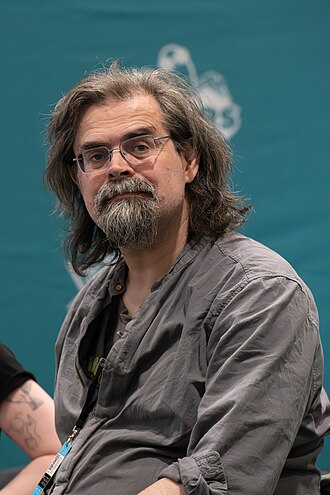
Adrian Tchaikovsky
Fantasy and science fiction author, winner of the Arthur C. Clarke Award
Where to hear and read about Adrian Tchaikovsky1 episode or test

Adrian Tchaikovsky is a fantasy and science fiction author who has written more than 60 books and novellas and won the Arthur C. Clarke Award for Children of Time. The thing most worth learning from him is to build a logically complete world from one what if, so the plot, the characters and even the ending grow out of it instead of being forced.
in order to support your one big lie, everything else needs to be true
Why Most Writing Advice Is Wrong (Adrian Tchaikovsky Interview)
Adrian Tchaikovsky: the story and the lessons
1How Adrian Tchaikovsky builds a book from one what if
Tchaikovsky starts each book with a single what if. Children of Time began with one premise: a small jumping spider becomes a sentient civilization. He asks what must be true because of that, then what must be true because of that, until the world fits together.
He describes it as "you're dropping a stone into a pool" and following each ripple outward.
He builds the world first and lets it tell him the plot. He treats the world as a moment just before the book starts, with factions that hate each other and pressures about to fracture. Those flash points supply the plot and the characters.
The formal world stage takes about two weeks, after months or years of ideas simmering. The habit comes from running role-playing games, where a game master never knows what players will break, so the world has to be robust.
He waits for two half ideas to click into one book. In Children of Ruin, uplifted octopuses were only a novella's worth. Paired with an alien creature that interfaces with human neurology, they became a full novel.
He keeps a stock of half ideas and can't define "solid enough", but he knows it when he sees it.
He avoids crowded idea spaces unless he has a fresh spin. Before committing, he checks where earlier writers have gone. Despite writing many fantasy books, he has never done a dragon.
He calls dragons "such a crowded idea space" that only a really interesting take would justify one.
2Tchaikovsky on plot, characters and endings
He outlines in order but breaks the outline when its logic fails. The outline is a plain Word document of chapters and beats, and he says getting information to the right place is 90% of planning. He leaves it when a detail or a flaw demands it.
In one book, three quarters of the way in, he saw the ending made the whole story pointless and had to rethink it and rewrite chapters.
Tchaikovsky never plans the final scene. He outlines chapter by chapter and fixes the penultimate scene, then lets the book's momentum decide how it ends. A planned finale tends to become a stock showdown with the big bad.
Writers who always know their ending react with horror when he says this, but it has worked well for him.
He wants an ending that is both a surprise and inevitable. He calls the ending the most important part of a book, because it is what readers carry away. Everything the book set up must lead inextricably to it, without that being obvious along the way.
He names unearned endings, needlessly depressing ones and cliffhangers as common failures, and says a cliffhanger is worse when the next book is 7 years away.
He grows characters out of the world so their ties come built in. In City of Lost Chances, the pawnbroker is an immigrant from a nation the occupiers once invaded. That gives him links to the occupiers, the resistance and the university before he does anything.
A magical pawnbroker, an academic collector and a crooked occupier form a web whose petty acts end in a citywide revolution. Characters start as a few adjectives and gain depth he didn't plan.
He sets stories in one city so characters face their consequences. In a travelogue, characters walk away from their messes, as the hobbits never deal with what happened in Bree. A city resident has a lifetime of ties and must stay.
It is harder and needs far more prep, since he must know who hates and likes whom, like a detective's board with red strings. He finds it commensurately more rewarding.
He plays the author's, characters' and reader's knowledge against each other. In Dogs of War, Rex, a bioengineered military dog, thinks he is a good dog while the reader sees him committing war crimes. In City of Lost Chances, he didn't know who held the missing item, so he wrote every suspect as agnostic.
He holds every writing rule loosely, including his own. For any always or never rule he can think of a case where the opposite works. Children of Time is about 60% exposition, yet it is his most successful book.
He calls handing rules to beginners like commandments irresponsible, and says the hero's journey forces scenes into stages that aren't happening, such as a false "descent into the underworld". His view: "every writer does it differently".
3How Tchaikovsky researches so a world holds up
Tchaikovsky treats what science allows as a left wall. For realistic science fiction, research means working out the contours of that wall before writing. The danger is unknown unknowns, things he assumes he understands and gets wrong.
In fantasy he builds his own wall by deciding what magic can do, what it cannot and what it costs. The same idea applies to historical fiction, where the wall is how things were actually done.
He allows one big lie and makes everything else true. In Children of Time the lie is a nanovirus that compresses hundreds of millions of years of evolution into tens of thousands. The spiders themselves are built on real research into jumping spiders.
The starting species is Portia labiata, thumbnail-sized and intelligent. He rules out a 40-ft spider on physics grounds, so the reader feels it could be.
He asks experts to walk him through the gaps. A submarine designer explained the inertia and momentum problems of a water-filled spaceship for Children of Ruin. A contact at London's Natural History Museum gave him a full day with the entomology department for the spiders.
He says experts are usually happy to share and catch problems he would never have thought to ask about.
He learns everything, then puts almost none of it on the page. Research shows up in a few precise details. Stabbing a foe through the armpit, where armor can't cover, satisfies readers who know swords, while a broken blade through a breastplate makes them throw the book.
Dumping research to prove effort wrecks pacing: "nobody wants to read a fencing manual".
He gives magic a price so the story has something to push against. If magic is free, nobody has a problem and everyone solves everything with it. Readers like wicked magic that takes a terrible price.
Michael Moorcock's The Dancers at the End of Time shows the opposite case: near-gods with free magic whose whole story is their boredom.
4How Tchaikovsky writes fight scenes
He writes fights from years of hands-on experience. He did several years of stage fighting, over a decade of live-action roleplay and three or four years of historical broadsword training at the Leeds Armouries. Many epic fantasy readers have done one or more of these things.
He picks a perspective to suit each kind of fight. Abercrombie's battle in The Heroes is seen through a visor slot, as panicky chaos. A big battle can instead cut to a general reading the wings and siege artillery.
In a duel of two people the technique is the narrative. A skirmish of a dozen people is mobile, with opponents trading off.
He blocked a complicated skirmish with his son's toy insects. When many people trade opponents, he marks out where each one goes so the logistics hold up on the page.
He uses fights to show character and reveal the world. In a Shadows of the Apt duel, a skilled fighter who likes his weaker foe spares him once, and that mercy gets him killed. In Echoes of the Fall, fighters flip between human, wolf, bear and snake forms.
He calls a fight "a vehicle for advancing the narrative" and a sneaky way to showcase the world. The shape-changing fights were very hard to think through.
He puts what a fight feels like on the page. In festival LARP, up to a thousand people with rubber weapons meet on a battlefield. Standing in the second rank with a spear while people charge screaming down a hill, part of you reacts as if it were real.
That sense, more than tactics, is what he writes. Reaching readers works the same way: every character, even a minor one, must be real to themselves.

Why Most Writing Advice Is Wrong (Adrian Tchaikovsky Interview)
Tchaikovsky shows how to build a story from the world outward, so that setting, characters and plot all grow from one starting what if, and he warns against treating any writing rule as law. The technique worth hearing is his left wall for research, together with his habit of leaving the ending unplanned so the book's momentum decides it.
Tchaikovsky starts each book with a single what if. Children of Time began with one premise: a small jumping spider becomes a sentient civilization. He asks what must be true because of that, then what must be true because of that, until the world fits together.
He describes it as "you're dropping a stone into a pool" and following each ripple outward.
He builds the world first and lets it tell him the plot. He treats the world as a moment just before the book starts, with factions that hate each other and pressures about to fracture. Those flash points supply the plot and the characters.
The formal world stage takes about two weeks, after months or years of ideas simmering. The habit comes from running role-playing games, where a game master never knows what players will break, so the world has to be robust.
He waits for two half ideas to click into one book. In Children of Ruin, uplifted octopuses were only a novella's worth. Paired with an alien creature that interfaces with human neurology, they became a full novel.
He keeps a stock of half ideas and can't define "solid enough", but he knows it when he sees it.
He avoids crowded idea spaces unless he has a fresh spin. Before committing, he checks where earlier writers have gone. Despite writing many fantasy books, he has never done a dragon.
He calls dragons "such a crowded idea space" that only a really interesting take would justify one.
He outlines in order but breaks the outline when its logic fails. The outline is a plain Word document of chapters and beats, and he says getting information to the right place is 90% of planning. He leaves it when a detail or a flaw demands it.
In one book, three quarters of the way in, he saw the ending made the whole story pointless and had to rethink it and rewrite chapters.
Tchaikovsky never plans the final scene. He outlines chapter by chapter and fixes the penultimate scene, then lets the book's momentum decide how it ends. A planned finale tends to become a stock showdown with the big bad.
Writers who always know their ending react with horror when he says this, but it has worked well for him.
He wants an ending that is both a surprise and inevitable. He calls the ending the most important part of a book, because it is what readers carry away. Everything the book set up must lead inextricably to it, without that being obvious along the way.
He names unearned endings, needlessly depressing ones and cliffhangers as common failures, and says a cliffhanger is worse when the next book is 7 years away.
He grows characters out of the world so their ties come built in. In City of Lost Chances, the pawnbroker is an immigrant from a nation the occupiers once invaded. That gives him links to the occupiers, the resistance and the university before he does anything.
A magical pawnbroker, an academic collector and a crooked occupier form a web whose petty acts end in a citywide revolution. Characters start as a few adjectives and gain depth he didn't plan.
He sets stories in one city so characters face their consequences. In a travelogue, characters walk away from their messes, as the hobbits never deal with what happened in Bree. A city resident has a lifetime of ties and must stay.
It is harder and needs far more prep, since he must know who hates and likes whom, like a detective's board with red strings. He finds it commensurately more rewarding.
He plays the author's, characters' and reader's knowledge against each other. In Dogs of War, Rex, a bioengineered military dog, thinks he is a good dog while the reader sees him committing war crimes. In City of Lost Chances, he didn't know who held the missing item, so he wrote every suspect as agnostic.
He holds every writing rule loosely, including his own. For any always or never rule he can think of a case where the opposite works. Children of Time is about 60% exposition, yet it is his most successful book.
He calls handing rules to beginners like commandments irresponsible, and says the hero's journey forces scenes into stages that aren't happening, such as a false "descent into the underworld". His view: "every writer does it differently".
Tchaikovsky treats what science allows as a left wall. For realistic science fiction, research means working out the contours of that wall before writing. The danger is unknown unknowns, things he assumes he understands and gets wrong.
In fantasy he builds his own wall by deciding what magic can do, what it cannot and what it costs. The same idea applies to historical fiction, where the wall is how things were actually done.
He allows one big lie and makes everything else true. In Children of Time the lie is a nanovirus that compresses hundreds of millions of years of evolution into tens of thousands. The spiders themselves are built on real research into jumping spiders.
The starting species is Portia labiata, thumbnail-sized and intelligent. He rules out a 40-ft spider on physics grounds, so the reader feels it could be.
He asks experts to walk him through the gaps. A submarine designer explained the inertia and momentum problems of a water-filled spaceship for Children of Ruin. A contact at London's Natural History Museum gave him a full day with the entomology department for the spiders.
He says experts are usually happy to share and catch problems he would never have thought to ask about.
He learns everything, then puts almost none of it on the page. Research shows up in a few precise details. Stabbing a foe through the armpit, where armor can't cover, satisfies readers who know swords, while a broken blade through a breastplate makes them throw the book.
Dumping research to prove effort wrecks pacing: "nobody wants to read a fencing manual".
He gives magic a price so the story has something to push against. If magic is free, nobody has a problem and everyone solves everything with it. Readers like wicked magic that takes a terrible price.
Michael Moorcock's The Dancers at the End of Time shows the opposite case: near-gods with free magic whose whole story is their boredom.
He writes fights from years of hands-on experience. He did several years of stage fighting, over a decade of live-action roleplay and three or four years of historical broadsword training at the Leeds Armouries. Many epic fantasy readers have done one or more of these things.
He picks a perspective to suit each kind of fight. Abercrombie's battle in The Heroes is seen through a visor slot, as panicky chaos. A big battle can instead cut to a general reading the wings and siege artillery.
In a duel of two people the technique is the narrative. A skirmish of a dozen people is mobile, with opponents trading off.
He blocked a complicated skirmish with his son's toy insects. When many people trade opponents, he marks out where each one goes so the logistics hold up on the page.
He uses fights to show character and reveal the world. In a Shadows of the Apt duel, a skilled fighter who likes his weaker foe spares him once, and that mercy gets him killed. In Echoes of the Fall, fighters flip between human, wolf, bear and snake forms.
He calls a fight "a vehicle for advancing the narrative" and a sneaky way to showcase the world. The shape-changing fights were very hard to think through.
He puts what a fight feels like on the page. In festival LARP, up to a thousand people with rubber weapons meet on a battlefield. Standing in the second rank with a spear while people charge screaming down a hill, part of you reacts as if it were real.
That sense, more than tactics, is what he writes. Reaching readers works the same way: every character, even a minor one, must be real to themselves.