Adam Foroughi
Co-founder and CEO of AppLovin
Where to hear and read about Adam Foroughi1 episode or test
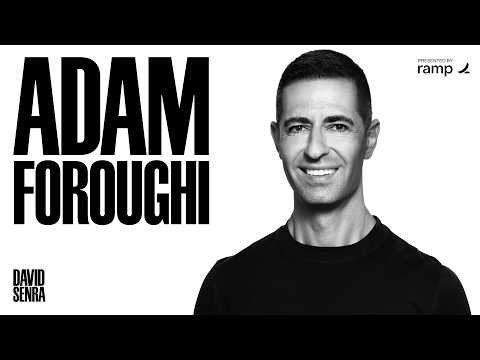
Adam Foroughi is the co-founder and CEO of AppLovin, which he bootstrapped into a mobile ad platform after every top VC passed and grew to roughly $140 billion in market value with a core team of about 400 people. The lesson most worth taking from him is how a product that makes every customer measurably profitable, run by a tiny team of A players, can sell itself and fund bold moves like borrowing to buy back stock at the bottom.
I never believed in saving cash for a rainy day.
Bootstrapping a Business to $5 Billion in Free Cash Flow | AppLovin’s Adam Foroughi
Adam Foroughi: the story and the lessons
1Adam Foroughi's path from Iran to a failed consumer app
Foroughi's drive comes from his family losing everything when he was four. His family was uprooted from Iran when he was four, and his father, a successful real estate developer, lost nearly everything.
He still wakes at the same time each day and checks the same stats, wary of whether the lights are on.
Two earlier ad businesses showed him mobile traffic before others noticed. His social media advertising businesses showed traffic moving to the new app store before anyone talked about it. After selling them in 2010, he moved to Palo Alto and bet on mobile without a plan.
He had also worked as a derivatives trader, which later shaped how he saw deals as arbitrage.
His dating and fashion apps failed because he wanted to own the consumer. In 2011 he launched a dating app and a fashion app, and both were terrible.
He says he had zero fashion sense and was married at the time, so neither team was right for the job.
He turned a failed app's recommendation algorithm into an ad platform. The first AppLovin told you when a friend was playing a game, and while nobody used the app, its push recommendations converted at a very high rate. He scrapped the app and shipped the technology as an SDK ad platform in March 2012.
In his words: "This app stinks, but this recommendation algo is really cool." Developers were desperate for money, and his pitch to a calendar app with a million users was ten thousand dollars a day.
He funded the pivots through an LLC until product market fit was clear. He bootstrapped for about a year and a half, using an LLC so losses could be written off against other earnings. Losing $1 million returned $500,000.
He did not want to sell investors an idea he was not confident in: "I didn't go to VCs until I knew we were going to be an advertising business."
Every top VC passed on him, then funded his rivals. In spring 2012 he asked for $1 million for a quarter of the company, a $4 million valuation, and every top VC said no. They could not see how a small company could beat Google, Facebook and Amazon.
It was his third advertising business after two successes, so he says they failed to bet on the person. Those VCs later invested heavily in competitors, which motivated him to put them out of business; one competitor is public and the others sold for little or are gone.
2How Foroughi beat Google's AdMob with performance marketing
Foroughi built for app developers, not brand advertisers. Google bought AdMob in 2008 for nearly a billion dollars and built it for brands. Foroughi gave the brand route a one-week consideration and rejected it.
Proving brand spend worked was hand-wavy, and budgets went to whoever wined and dined clients most. "I wanted to be in the business of no sales, high-value product."
The goal is to make every advertiser an arbitrageur. A developer who spends $1,000 should know from reporting that it returns more than $1,000, on whatever payback schedule fits the business. Then the only limit on spend is their bank account.
Payback can break even in 30 days or in a year with $5,000 earned by year five. Every model upgrade is judged on whether it drives more spend at the advertiser's return goal: "They get wealthier, we get wealthier."
The network hit $1 million a month within eight months. Launched in March 2012, AppLovin reached a $1 million monthly run rate and profitability within eight months.
In November 2012 he raised a small angel round as a convertible note at a $25 million valuation and added his own money, with the business at a $12 million run rate and barely profitable.
Being turned down by VCs kept the company profitable and lean. Investors push founders to hire after a round, but AppLovin aimed for profit instead.
3Foroughi's six years without a board: the $600 million offer and the China deal
Foroughi made every decision himself until 2018. Until KKR invested in 2018, every share certificate carried his signature as president and vice president.
Total control let him decide fast, but he says it cost him in capital markets, where a board would have prevented mistakes.
He walked away from a $600 million all-cash offer in 2015. The business was heading to about $50 million of EBITDA and growing 100% a year. He would have sold at about a billion.
A deal takes time and the business grows a lot before it closes. "I would've had a number I would've done the deal at, but it was not that number." Today the market cap is about $140 billion.
He chased Chinese capital as an arbitrage and walked into CFIUS. In late 2015 Chinese investors were buying US tech firms to relist in China. Orient Hontai Capital, a four-person team, agreed to put in $1 billion at a valuation over $1.4 billion for 70% control, with a plan to list in China.
He had not understood that a data platform with a Chinese controlling investor would face a national security review. The CFIUS panel included the NSA, CIA, FTC and DOJ, and the review dragged on for over a year.
The business doubled even while options and hiring were frozen. During the review, EBITDA grew to well over $100 million in 2017.
By then the company was worth more than $1.4 billion. "Had I had a board, I probably wouldn't have made this mistake."
He stayed loyal to his investors and restructured instead of quitting. He turned the money into a convertible note that kept the Chinese investors below 10% with no control, and paid $1 billion out as a dividend to shareholders as a pre-IPO liquidity round.
"If anyone bets on me and takes an investment in our business, got to be loyal the other way."
KKR refinanced the note and formed his first board in 2018. KKR's Herald Chen would not have invested on the name alone, but his team dug in and refinanced the note in summer 2018. The first board was Foroughi, Eduardo Vivas and Chen.
4Why Foroughi bought game studios to build the Axon model
A rules-based algorithm could not keep up with Facebook. The early algorithm pushed games to people who played similar games, so a solitaire player saw poker. By 2018 Foroughi saw that Facebook's machine learning was far more potent.
With a strong model, ads feel like content and help people discover products.
He bought 14 or 15 studios for their spending data. Advertisers would not share in-game purchase data with a small startup, so after KKR invested he bought studios, starting with People Fun, to train the first Axon model.
What you buy predicts what you buy next. He hates games and does not play them: "I cared about the data, and I cared about the distribution platform."
Not explaining the strategy cost him developers' trust. Developers learned on their own that AppLovin owned competing studios and feared their data would be used to clone their games. Some larger clients left.
He had been transparent one-on-one but never told the community directly. After lunches and dinners with him, developers came back: "trust comes back really quickly when you realize it's a communication error, not a desire to deceive."
Once the models were fed, he sold the studios as one package. The studios needed over 1,500 people against a core ad team of about 400. After roughly five years, AppLovin sold the whole group to Tripledot.
Today over 50% of mobile gaming marketing dollars may go through the platform.
Axon 2 turned a manual product into plug-and-play profit. Axon 1 was traditional machine learning that needed heavy spend and manual work. The Axon 2 deep learning model, launched in April 2023, let any advertiser plug in and earn a spread.
The stock went from about $9 to a $750 peak. Foroughi says market cap could only rise like that because fundamentals grew alongside it.
5How Foroughi borrowed to buy back AppLovin stock after a 92% crash
The IPO sold too little float, which made the stock volatile. The April 2021 IPO raised about $2 billion at a $28 billion valuation, selling only 7% to 8% of the company.
He now thinks a 10% to 15% float at a lower valuation would have drawn longer-term investors. "Too low a float makes you more volatile."
The stock fell from $115 to $9 while profit kept rising. EBITDA was $700 million in 2021 and passed $1 billion in 2022, yet the company was worth about $3.8 billion.
Too many COVID-era IPOs landed at once, so big funds skipped the research, and early private holders sold into a market with no big buyers.
At five times cash flow, he saw buying back as simple math. He used company cash plus debt to buy back stock over about 18 months, and the board backed it quickly because "it's not rocket science."
Friends and advisers found it scary to borrow while everyone trashed the company, but conviction was high, so they "hit it as hard as we could."
He negotiated with known sellers instead of buying anonymously. Private equity holders and departed founders owned about 50% and were certain to sell, so AppLovin bought directly from them over time.
This removed the overhang on the stock. On the open market, "you don't know who's on the other side of that trade." About $6 billion of buybacks produced roughly $50 to $60 billion in value.
He gave equity only to about 100 critical builders after the crash. Staff asked to be trued up when the stock fell, and he refused, since they would not hand shares back on the way up. Most people could take cash pay instead.
A 90% drop turns $150,000 pay with $50,000 in equity into about $105,000, which may not cover bills, while a $1 million earner can ride it out. Choosing forced the question: "Who are the people that matter?"
6Adam Foroughi's rules for a lean team of A players
Foroughi cut about 40% of staff while revenue nearly doubled. In 2024 the business grew nearly 100% while headcount fell about 40%, leaving roughly 350 to 400 people in ads.
New CTO Giovanni, who joined in November 2022 and led Axon 2, kept asking why each person, team and process existed. Foroughi's test became what he would start with if he started the business today, and roles LLMs would automate were cut, even for long-tenured people, with good severance.
He approves every hire and ended automatic backfills. Every departure used to trigger a job posting, so headcount only rose. He took over HR and told managers: "Convince me that you need the person."
A new hire takes 6 to 12 months to pay off, and teams can often survive the gap. Requests fell from hundreds a year to tens, and the C-suite is just CEO, CFO, CTO and general counsel.
He believes B players eventually drive out the A players. A players do not like working with B, C and D players, and bloat contaminates the best people. Cutting half of a mediocre workforce still leaves it half mediocre.
He cites Steve Jobs saying Pixar, at 400 people, was the only all-A company he had seen. Hired executives tend to empire build, and good early people leave disillusioned.
The best person holds each key seat, whatever their tenure. In 2016 he moved Basil Shikin into the CTO role over co-founder John Krystynak, and the swap has happened again as one of Shikin's hires takes over.
If tenured people keep seats they have outgrown, stronger people below leave. "You owe it to every single person, and you owe it to your company, to make sure the best person is in the right role."
He hires people with a chip on their shoulder. Raff started working for him at 16 as a high school dropout, lived in the office for six months, and became AppLovin's first business hire.
Raff is now a billionaire who still asks advertisers for an extra $5,000 a day.
He refuses to hire a sales force ahead of the opportunity. Investors ask why he is not building sales for the push beyond gaming, but he believes one strong person with AI can do the work of 10 to 100.
Over 80% of the code was LLM-written a year and a half before the interview, and the share is higher now. Companies that "hire into opportunity, dilute their IQ" end up stuck with a mess.
He voices big targets only when he believes them. He predicted a billion-dollar company in 2014, $10 billion after the China round, and $100 billion after a 15% IPO-day drop. Pay triggers for key people now top out at a $1 trillion market cap.
"I got to believe it to voice it." His team follows because past claims were backed by his own hard work.
7Where Foroughi takes AppLovin beyond gaming
Every advance in LLMs makes AppLovin's model more predictive. Engineers who understand the math pair with LLMs that process all open research in the field to design new experiments.
"Your 1X engineer might be 2X more efficient. But your 10X engineer might be 100X more efficient."
Gamers are a huge, attentive audience for long ads. Over a billion people play games daily, including over 150 million US adults, and the average ad runs over 35 seconds.
The power user is a middle-aged person relaxing with Candy Crush for two to three hours a day, not a 21-year-old on Instagram.
He targets small businesses because there is no sales force. Product ads for e-commerce, and later any business down to a local laundromat, make ads more varied and useful.
A Turkish studio of 10 to 15 people sold for about $1 billion within a year of launch, built on the platform. He expects large enterprises to come on their own.

Bootstrapping a Business to $5 Billion in Free Cash Flow | AppLovin’s Adam Foroughi
Foroughi bootstrapped an ad network after VCs passed, bought game studios to get training data, and kept a tiny team of A players, then borrowed to buy back stock when it fell 92%. The result is a company with roughly 400 core employees producing over a billion dollars of cash flow a quarter.
Foroughi's drive comes from his family losing everything when he was four. His family was uprooted from Iran when he was four, and his father, a successful real estate developer, lost nearly everything.
He still wakes at the same time each day and checks the same stats, wary of whether the lights are on.
Two earlier ad businesses showed him mobile traffic before others noticed. His social media advertising businesses showed traffic moving to the new app store before anyone talked about it. After selling them in 2010, he moved to Palo Alto and bet on mobile without a plan.
He had also worked as a derivatives trader, which later shaped how he saw deals as arbitrage.
His dating and fashion apps failed because he wanted to own the consumer. In 2011 he launched a dating app and a fashion app, and both were terrible.
He says he had zero fashion sense and was married at the time, so neither team was right for the job.
He turned a failed app's recommendation algorithm into an ad platform. The first AppLovin told you when a friend was playing a game, and while nobody used the app, its push recommendations converted at a very high rate. He scrapped the app and shipped the technology as an SDK ad platform in March 2012.
In his words: "This app stinks, but this recommendation algo is really cool." Developers were desperate for money, and his pitch to a calendar app with a million users was ten thousand dollars a day.
He funded the pivots through an LLC until product market fit was clear. He bootstrapped for about a year and a half, using an LLC so losses could be written off against other earnings. Losing $1 million returned $500,000.
He did not want to sell investors an idea he was not confident in: "I didn't go to VCs until I knew we were going to be an advertising business."
Every top VC passed on him, then funded his rivals. In spring 2012 he asked for $1 million for a quarter of the company, a $4 million valuation, and every top VC said no. They could not see how a small company could beat Google, Facebook and Amazon.
It was his third advertising business after two successes, so he says they failed to bet on the person. Those VCs later invested heavily in competitors, which motivated him to put them out of business; one competitor is public and the others sold for little or are gone.
Foroughi built for app developers, not brand advertisers. Google bought AdMob in 2008 for nearly a billion dollars and built it for brands. Foroughi gave the brand route a one-week consideration and rejected it.
Proving brand spend worked was hand-wavy, and budgets went to whoever wined and dined clients most. "I wanted to be in the business of no sales, high-value product."
The goal is to make every advertiser an arbitrageur. A developer who spends $1,000 should know from reporting that it returns more than $1,000, on whatever payback schedule fits the business. Then the only limit on spend is their bank account.
Payback can break even in 30 days or in a year with $5,000 earned by year five. Every model upgrade is judged on whether it drives more spend at the advertiser's return goal: "They get wealthier, we get wealthier."
The network hit $1 million a month within eight months. Launched in March 2012, AppLovin reached a $1 million monthly run rate and profitability within eight months.
In November 2012 he raised a small angel round as a convertible note at a $25 million valuation and added his own money, with the business at a $12 million run rate and barely profitable.
Being turned down by VCs kept the company profitable and lean. Investors push founders to hire after a round, but AppLovin aimed for profit instead.
Foroughi made every decision himself until 2018. Until KKR invested in 2018, every share certificate carried his signature as president and vice president.
Total control let him decide fast, but he says it cost him in capital markets, where a board would have prevented mistakes.
He walked away from a $600 million all-cash offer in 2015. The business was heading to about $50 million of EBITDA and growing 100% a year. He would have sold at about a billion.
A deal takes time and the business grows a lot before it closes. "I would've had a number I would've done the deal at, but it was not that number." Today the market cap is about $140 billion.
He chased Chinese capital as an arbitrage and walked into CFIUS. In late 2015 Chinese investors were buying US tech firms to relist in China. Orient Hontai Capital, a four-person team, agreed to put in $1 billion at a valuation over $1.4 billion for 70% control, with a plan to list in China.
He had not understood that a data platform with a Chinese controlling investor would face a national security review. The CFIUS panel included the NSA, CIA, FTC and DOJ, and the review dragged on for over a year.
The business doubled even while options and hiring were frozen. During the review, EBITDA grew to well over $100 million in 2017.
By then the company was worth more than $1.4 billion. "Had I had a board, I probably wouldn't have made this mistake."
He stayed loyal to his investors and restructured instead of quitting. He turned the money into a convertible note that kept the Chinese investors below 10% with no control, and paid $1 billion out as a dividend to shareholders as a pre-IPO liquidity round.
"If anyone bets on me and takes an investment in our business, got to be loyal the other way."
KKR refinanced the note and formed his first board in 2018. KKR's Herald Chen would not have invested on the name alone, but his team dug in and refinanced the note in summer 2018. The first board was Foroughi, Eduardo Vivas and Chen.
A rules-based algorithm could not keep up with Facebook. The early algorithm pushed games to people who played similar games, so a solitaire player saw poker. By 2018 Foroughi saw that Facebook's machine learning was far more potent.
With a strong model, ads feel like content and help people discover products.
He bought 14 or 15 studios for their spending data. Advertisers would not share in-game purchase data with a small startup, so after KKR invested he bought studios, starting with People Fun, to train the first Axon model.
What you buy predicts what you buy next. He hates games and does not play them: "I cared about the data, and I cared about the distribution platform."
Not explaining the strategy cost him developers' trust. Developers learned on their own that AppLovin owned competing studios and feared their data would be used to clone their games. Some larger clients left.
He had been transparent one-on-one but never told the community directly. After lunches and dinners with him, developers came back: "trust comes back really quickly when you realize it's a communication error, not a desire to deceive."
Once the models were fed, he sold the studios as one package. The studios needed over 1,500 people against a core ad team of about 400. After roughly five years, AppLovin sold the whole group to Tripledot.
Today over 50% of mobile gaming marketing dollars may go through the platform.
Axon 2 turned a manual product into plug-and-play profit. Axon 1 was traditional machine learning that needed heavy spend and manual work. The Axon 2 deep learning model, launched in April 2023, let any advertiser plug in and earn a spread.
The stock went from about $9 to a $750 peak. Foroughi says market cap could only rise like that because fundamentals grew alongside it.
The IPO sold too little float, which made the stock volatile. The April 2021 IPO raised about $2 billion at a $28 billion valuation, selling only 7% to 8% of the company.
He now thinks a 10% to 15% float at a lower valuation would have drawn longer-term investors. "Too low a float makes you more volatile."
The stock fell from $115 to $9 while profit kept rising. EBITDA was $700 million in 2021 and passed $1 billion in 2022, yet the company was worth about $3.8 billion.
Too many COVID-era IPOs landed at once, so big funds skipped the research, and early private holders sold into a market with no big buyers.
At five times cash flow, he saw buying back as simple math. He used company cash plus debt to buy back stock over about 18 months, and the board backed it quickly because "it's not rocket science."
Friends and advisers found it scary to borrow while everyone trashed the company, but conviction was high, so they "hit it as hard as we could."
He negotiated with known sellers instead of buying anonymously. Private equity holders and departed founders owned about 50% and were certain to sell, so AppLovin bought directly from them over time.
This removed the overhang on the stock. On the open market, "you don't know who's on the other side of that trade." About $6 billion of buybacks produced roughly $50 to $60 billion in value.
He gave equity only to about 100 critical builders after the crash. Staff asked to be trued up when the stock fell, and he refused, since they would not hand shares back on the way up. Most people could take cash pay instead.
A 90% drop turns $150,000 pay with $50,000 in equity into about $105,000, which may not cover bills, while a $1 million earner can ride it out. Choosing forced the question: "Who are the people that matter?"
Foroughi cut about 40% of staff while revenue nearly doubled. In 2024 the business grew nearly 100% while headcount fell about 40%, leaving roughly 350 to 400 people in ads.
New CTO Giovanni, who joined in November 2022 and led Axon 2, kept asking why each person, team and process existed. Foroughi's test became what he would start with if he started the business today, and roles LLMs would automate were cut, even for long-tenured people, with good severance.
He approves every hire and ended automatic backfills. Every departure used to trigger a job posting, so headcount only rose. He took over HR and told managers: "Convince me that you need the person."
A new hire takes 6 to 12 months to pay off, and teams can often survive the gap. Requests fell from hundreds a year to tens, and the C-suite is just CEO, CFO, CTO and general counsel.
He believes B players eventually drive out the A players. A players do not like working with B, C and D players, and bloat contaminates the best people. Cutting half of a mediocre workforce still leaves it half mediocre.
He cites Steve Jobs saying Pixar, at 400 people, was the only all-A company he had seen. Hired executives tend to empire build, and good early people leave disillusioned.
The best person holds each key seat, whatever their tenure. In 2016 he moved Basil Shikin into the CTO role over co-founder John Krystynak, and the swap has happened again as one of Shikin's hires takes over.
If tenured people keep seats they have outgrown, stronger people below leave. "You owe it to every single person, and you owe it to your company, to make sure the best person is in the right role."
He hires people with a chip on their shoulder. Raff started working for him at 16 as a high school dropout, lived in the office for six months, and became AppLovin's first business hire.
Raff is now a billionaire who still asks advertisers for an extra $5,000 a day.
He refuses to hire a sales force ahead of the opportunity. Investors ask why he is not building sales for the push beyond gaming, but he believes one strong person with AI can do the work of 10 to 100.
Over 80% of the code was LLM-written a year and a half before the interview, and the share is higher now. Companies that "hire into opportunity, dilute their IQ" end up stuck with a mess.
He voices big targets only when he believes them. He predicted a billion-dollar company in 2014, $10 billion after the China round, and $100 billion after a 15% IPO-day drop. Pay triggers for key people now top out at a $1 trillion market cap.
"I got to believe it to voice it." His team follows because past claims were backed by his own hard work.
Every advance in LLMs makes AppLovin's model more predictive. Engineers who understand the math pair with LLMs that process all open research in the field to design new experiments.
"Your 1X engineer might be 2X more efficient. But your 10X engineer might be 100X more efficient."
Gamers are a huge, attentive audience for long ads. Over a billion people play games daily, including over 150 million US adults, and the average ad runs over 35 seconds.
The power user is a middle-aged person relaxing with Candy Crush for two to three hours a day, not a 21-year-old on Instagram.
He targets small businesses because there is no sales force. Product ads for e-commerce, and later any business down to a local laundromat, make ads more varied and useful.
A Turkish studio of 10 to 15 people sold for about $1 billion within a year of launch, built on the platform. He expects large enterprises to come on their own.