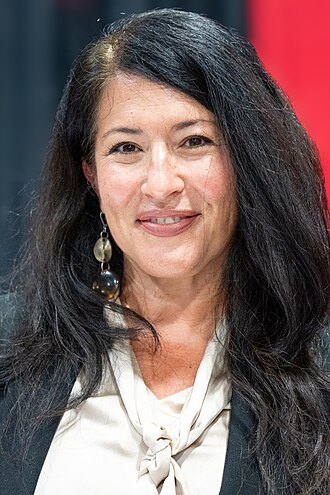
Ada Limón
Where to hear and read about Ada Limón1 episode or test

Ada Limón is a poet who treats writing as listening: she hears sound, rhythm and silence first and sets them down in plain words. The most useful thing to learn from her is to receive before you write and to make every pause and line break do the work of music.
I think so much of writing is receiving.
Learn To Write Poetry (in 47 Minutes) — Ada Limón & Joy Harjo
Ada Limón: the story and the lessons
1How Ada Limón listens before she writes
Limón treats writing as receiving the world, not putting something into it. She says much of making art is looking and listening with all the senses alive. Her best poems come from what the world offers, not from turning everything into her own experience.
Her co-guest Joy Harjo adds that you translate what you hear using craft, and that when a line simply comes through, you say thank you.
Limón often hears a poem before she writes it. A phrase or rhythm signals a kind of music that feels true, and she follows it to find out why.
She can't always tell whether she translated a rhythm she heard or the poem made one that she then teased out and amplified.
Limón cannot write with music on, because it carries her away. She listens to her own music or to whatever is present in the room. Harjo points out that novelist Leslie Silko does the opposite and plays loud music as a wall of sound, so each writer has to test what suits them.
Limón once came back from making tea and wondered what podcast was playing. It was her own poem, so loud in her body that it seemed to come from outside.
Limón's sensitivity to sound pushed her toward solitude from the age of 15. At 15 she wore earplugs in school to dampen the loudness of teenagers, and she ties that to being attuned to the music of the world.
She loves that poetry, unlike making music with others, can be done alone.
Limón finds what is hers by sitting alone and noting the first words. After a stretch of quiet she watches which words come up. Sometimes it is I'm sorry, sometimes thank you, sometimes a wish to sing.
Those first words show what sits under the polite, appropriate self, so she doesn't censor them. After long solitude, songs she doesn't know sometimes come back, ones that exist somewhere in her.
Limón says silence is not empty, it is what is already happening. People think they are looking for silence, but she says you are looking to hear what is already happening and moving in the world.
Silence can feel like whitewashing, yet it is full of music. Sit long enough and the quiet turns loud.
2Ada Limón's craft: sound, line and plain words
Limón treats line breaks and punctuation as instructions for how to read. The line break, the clause and the punctuation tell the reader where to pause and breathe. In a poem all the music has to be on the page.
She compares a poem to a song that cannot wait for percussion to join it, so periods, ellipses and caesuras do the job of the rhythm section. Her line: "The line break tells you how to read the poem."
Limón starts revising at the smallest units, not the sentence. A poet's order runs from sound, even before the syllable, to word, clause, line break and finally the sentence.
Prose starts from the sentence, so a poet's relationship to syntax is different. A phrase works like four bars of a song: an open last syllable leads on, a percussive one stops.
Limón says a poem needs no fancy vocabulary, only careful arrangement. Plain words change when you control syntax, rhythm, cadence and image, and the result can be very clear or deeply mysterious.
Her example is Blake's grain of sand and wildflower lines, where every word is common and only the arrangement is new.
Limón wants poems heard aloud, because the body completes them. Her favorite part of poetry is the reading, and she says people who like poems but have never heard one aloud need to.
Harjo describes a doctor who never understood poetry until he heard both poets read, then said he got it.
Limón agrees that poetry often resists copy editing and sound should be defended. Harjo told a magazine editor that an odd word order around a deer in her poem Shape Shifter was sound sense. The grammatical order would have flattened the line, and the editors accepted it.
Limón agrees with the principle: explain why the odd order is doing work.
Limón warns against writing that only gets a literal message across. Texts and emails are often abbreviated and unpunctuated, written to say meet me here. Harjo calls it clock time writing, and both poets see it as keeping language a blunt tool.
It is useful for logistics, but it leaves little room for metaphor.
3How Limón reads, feels and keeps learning
Limón rereads hard poems and lets her own growth open them. She disliked John Ashbery for years. In the last decade she revisited his work and loved it, partly because she finally had the patience for its abundance.
She says a poem shifts with your mood and body the way a song does, so reading it again lets you wonder more deeply.
Limón reads poems for music and experience, not literal meaning. She says you don't read poetry to get the meaning of the sentence but for the music and for the many meanings a line break offers.
Harjo's example is Hotel California: who knows what it means, and who cares. School's question of what a poem means misses the experience.
Limón keeps a rotating stack of poetry books on her desk. She pulls out the poet she needs that day, puts a book back if it isn't right, and cycles books in when she has moved on.
She compares it to choosing music by mood. She still prefers the physical book to the phone and also devours new work from contemporary poets.
Limón describes writing as a trust fall into an emotion. You keep falling, experience the feeling at its depth, then try to put it into words so others can feel that depth.
Sometimes you don't fall in but realize you are already in it, such as a grief you've been carrying. The aim is awareness that it is there, not switching it on or letting it go.
Limón calls losing track of time a gift that phones eat up. She says it is now hard to find. As a reader, a first pass on a phone gives "I don't get it", and only returning gives more.
Harjo went further: her long, poem-like dreams turned into fast flips like Reels, and she took it as a sign to step back.

Learn To Write Poetry (in 47 Minutes) — Ada Limón & Joy Harjo
Two poets argue that writing begins with receiving, listening to sound, rhythm and silence before you try to say anything. The most useful habits are writing without music, treating line breaks and sound as instructions to the reader, and defending sound against editors who want grammar.
Limón treats writing as receiving the world, not putting something into it. She says much of making art is looking and listening with all the senses alive. Her best poems come from what the world offers, not from turning everything into her own experience.
Her co-guest Joy Harjo adds that you translate what you hear using craft, and that when a line simply comes through, you say thank you.
Limón often hears a poem before she writes it. A phrase or rhythm signals a kind of music that feels true, and she follows it to find out why.
She can't always tell whether she translated a rhythm she heard or the poem made one that she then teased out and amplified.
Limón cannot write with music on, because it carries her away. She listens to her own music or to whatever is present in the room. Harjo points out that novelist Leslie Silko does the opposite and plays loud music as a wall of sound, so each writer has to test what suits them.
Limón once came back from making tea and wondered what podcast was playing. It was her own poem, so loud in her body that it seemed to come from outside.
Limón's sensitivity to sound pushed her toward solitude from the age of 15. At 15 she wore earplugs in school to dampen the loudness of teenagers, and she ties that to being attuned to the music of the world.
She loves that poetry, unlike making music with others, can be done alone.
Limón finds what is hers by sitting alone and noting the first words. After a stretch of quiet she watches which words come up. Sometimes it is I'm sorry, sometimes thank you, sometimes a wish to sing.
Those first words show what sits under the polite, appropriate self, so she doesn't censor them. After long solitude, songs she doesn't know sometimes come back, ones that exist somewhere in her.
Limón says silence is not empty, it is what is already happening. People think they are looking for silence, but she says you are looking to hear what is already happening and moving in the world.
Silence can feel like whitewashing, yet it is full of music. Sit long enough and the quiet turns loud.
Limón treats line breaks and punctuation as instructions for how to read. The line break, the clause and the punctuation tell the reader where to pause and breathe. In a poem all the music has to be on the page.
She compares a poem to a song that cannot wait for percussion to join it, so periods, ellipses and caesuras do the job of the rhythm section. Her line: "The line break tells you how to read the poem."
Limón starts revising at the smallest units, not the sentence. A poet's order runs from sound, even before the syllable, to word, clause, line break and finally the sentence.
Prose starts from the sentence, so a poet's relationship to syntax is different. A phrase works like four bars of a song: an open last syllable leads on, a percussive one stops.
Limón says a poem needs no fancy vocabulary, only careful arrangement. Plain words change when you control syntax, rhythm, cadence and image, and the result can be very clear or deeply mysterious.
Her example is Blake's grain of sand and wildflower lines, where every word is common and only the arrangement is new.
Limón wants poems heard aloud, because the body completes them. Her favorite part of poetry is the reading, and she says people who like poems but have never heard one aloud need to.
Harjo describes a doctor who never understood poetry until he heard both poets read, then said he got it.
Limón agrees that poetry often resists copy editing and sound should be defended. Harjo told a magazine editor that an odd word order around a deer in her poem Shape Shifter was sound sense. The grammatical order would have flattened the line, and the editors accepted it.
Limón agrees with the principle: explain why the odd order is doing work.
Limón warns against writing that only gets a literal message across. Texts and emails are often abbreviated and unpunctuated, written to say meet me here. Harjo calls it clock time writing, and both poets see it as keeping language a blunt tool.
It is useful for logistics, but it leaves little room for metaphor.
Limón rereads hard poems and lets her own growth open them. She disliked John Ashbery for years. In the last decade she revisited his work and loved it, partly because she finally had the patience for its abundance.
She says a poem shifts with your mood and body the way a song does, so reading it again lets you wonder more deeply.
Limón reads poems for music and experience, not literal meaning. She says you don't read poetry to get the meaning of the sentence but for the music and for the many meanings a line break offers.
Harjo's example is Hotel California: who knows what it means, and who cares. School's question of what a poem means misses the experience.
Limón keeps a rotating stack of poetry books on her desk. She pulls out the poet she needs that day, puts a book back if it isn't right, and cycles books in when she has moved on.
She compares it to choosing music by mood. She still prefers the physical book to the phone and also devours new work from contemporary poets.
Limón describes writing as a trust fall into an emotion. You keep falling, experience the feeling at its depth, then try to put it into words so others can feel that depth.
Sometimes you don't fall in but realize you are already in it, such as a grief you've been carrying. The aim is awareness that it is there, not switching it on or letting it go.
Limón calls losing track of time a gift that phones eat up. She says it is now hard to find. As a reader, a first pass on a phone gives "I don't get it", and only returning gives more.
Harjo went further: her long, poem-like dreams turned into fast flips like Reels, and she took it as a sign to step back.