Seinfeld
The hit sitcom co-created by Jerry Seinfeld and Larry David that ran for nine seasons.
Where Seinfeld comes up2 episodes and tests

 How I WriteSeinfeld’s Timeless Lessons on Creativity and Consistency
 How I WriteThe 11 Tricks Behind Funny Storytelling (Scott Dikkers Interview)
Seinfeld stayed tightly controlled: Jerry Seinfeld and Larry David co-wrote without a traditional writers' room and micromanaged every word, take, edit and casting, accepting 14 to 16 hour days. They ended after nine seasons, refusing $110 million for a tenth, and the show earned over $3 billion plus $500 million from Netflix. Lesson: guard your craft and quit while quality is high.
From Jerry Seinfeld interviews
What was said about Seinfeld
1How Seinfeld and Larry David made the show
Seinfeld controlled every word, line, take, edit and casting choice. Jerry Seinfeld credits the show's success to micromanaging every detail, and he accepted 14 to 16 hour days and burnout as the price. The show won 10 Emmys and 3 Golden Globes and earned over $3 billion in revenue, plus $500 million from Netflix for streaming rights.
When Harvard Business Review asked whether a consultant like McKinsey could have found a less burnout-prone model, he asked only whether they were funny, heard no, and said he did not need them. Quote: "the show was successful because I micromanaged it every word every line every take every edit"
Two writers with the door closed beat a political writers' room. Seinfeld says most TV writers spend about half their time on people, personalities and political drama. He and Larry David co-wrote the show without a traditional writers' room and spent about 99% of their time writing.
Success brings parties, speaking gigs, admin and schmoozing, and many people stop doing the work that made them successful. Staying free means saying no to those.
Ending at the peak protected how people felt about the show. Seinfeld ended the show after nine seasons and turned down $110 million for a tenth. It is the only long-running show whose last season landed in the top 20% of IMDB ratings.
He calls this dosage: a comedian who thrills an audience at 70 minutes can get a shrug at 90. The question is the right amount for this piece, not being short. Quote: "a small amount of too much changes the whole feeling about it"
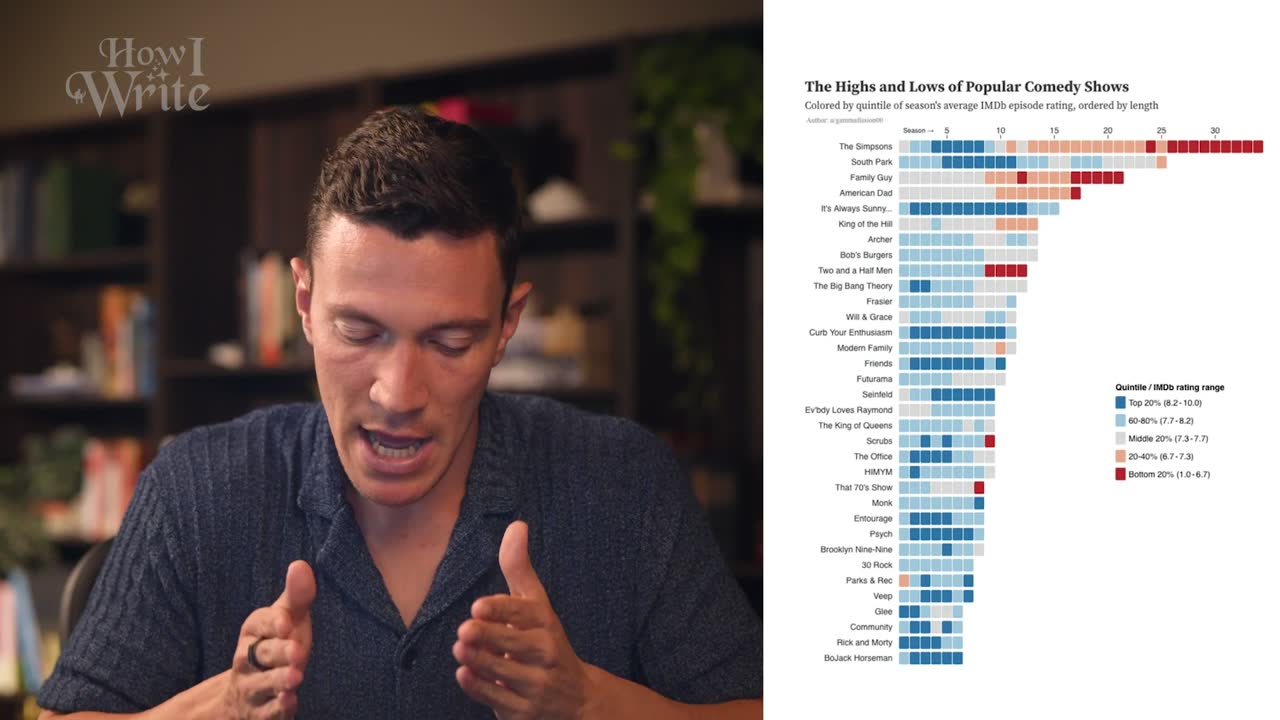
Season-by-season IMDb ratings: The Simpsons and Family Guy end in red, Seinfeld's final season stays top 20%. Fail doing exactly what you want, because that failure is livable. Dave Letterman gave Seinfeld this advice at a year-end party when he was nervous about a big new project. Seinfeld says failure is hard to live with when it was someone else's idea.
Accepting failure up front makes the fear fade: the chance of failure may rise, but the chance of regret falls. Seinfeld also reads his bad reviews and finds them funny.
2Jerry Seinfeld's daily writing process
- 1Write a short session30 or 15 minutes, no distractions
- 2Mark a red XOn a one-page year calendar
- 3Watch the chain growAfter weeks you like seeing it
- 4Don't break the chainConsistency makes the jokes better
From Seinfeld's advice to comic Brad Isaac
Expect writing to stay hard and do it anyway. Seinfeld says writing is harder than weight training because you start from a blank page, and that even the greatest people cannot do it with ease. Asked what he would put on a billboard, he chose a flag reading "just work."
He told his daughter, a writer, "of course it is, get over it." His view: if the difficulty turns you off, you don't want it badly enough. "If you're efficient, you're doing it the wrong way. The right way is the hard way."
Mark a red X for each writing day and don't break the chain. When young comic Brad Isaac asked for tips, Seinfeld told him to hang a one-page year calendar on a prominent wall and mark a big red X for every day he wrote. He gave no advice about words or results, only about keeping the chain going.
After a few weeks you start to like seeing the chain, and that consistency is what makes the jokes better.
A short fixed session removes writer's block. Seinfeld uses a time box of 30 or even 15 minutes, with full focus and no distractions: you don't have to write, but you can't do anything else. He says you can be lazy, scared or a crummy writer, but there is no writer's block.
Open-ended work on one problem breeds resistance, while a known end point makes starting easy. His process has barely changed in five decades: a yellow legal pad, shaving letters and counting syllables, every page saved in an accordion folder, and cookies and milk as the reward.
Keep the phone two rooms away to stop the checking loop. Checking email, texts and feeds breaks a writing session because each app offers a small chance of something new, so the circle never ends. Putting the phone two rooms away fixes much of it.
Make lots of material and let reactions pick the winners. Comedy is made in daily writing and only collected on stage: comedians test jokes and keep what gets laughs. Writers get the same signal in conversation, so double down on what interests people, rewrite what confuses them and cut what bores them.
When a bit lands, switch from intuitive to analytical mode at once; a comedian friend of Seinfeld's pulled out a notebook at a symphony and drew a two-by-two grid to break down a joke. Seinfeld treats every moment as material, finding his Chinese restaurant chopsticks bit ("they've seen the fork") while sitting at dinner.
3Comedy techniques tied to Seinfeld
The barber episode maps an affair onto switching barbers, never naming it. Switching to a younger barber is played as an affair, down to a stray hair on the shoulder and someone sneaking out a window. Each association the audience makes on its own is a laugh beat.
Scott Dikkers describes the method as hiding one thing and borrowing its tropes for another. Quote: "you take the one thing and you hide it from the audience"
"Did you ever notice how" shakes everyday oddities loose. Dikkers lists the Seinfeld prompt alongside starters like "I remember when" and "Why is it that" to trigger small observations.
He warns that some arenas, like airplane material, are clichéd, so check what has been done before using the prompt.
Seinfeld's op-ed opener flips emotion every clause. His New York Times piece opens on a first Manhattan apartment in summer 1976, drops to dog crap on the streets, lifts with signing the lease, drops with a towed car, and ends on "the greatest place I've ever been." The two-sentence intro gets two laughs by breaking the serious newspaper frame.
A whole article built this way would be exhausting, but it works for an opener.
The 11 Tricks Behind Funny Storytelling (Scott Dikkers Interview)
The barber episode maps switching to a younger barber onto an affair, down to a stray hair and someone sneaking out a window. Each unnamed association is a joke beat.
The barber episode maps an affair onto switching barbers, never naming it. Switching to a younger barber is played as an affair, down to a stray hair on the shoulder and someone sneaking out a window. Each association the audience makes on its own is a laugh beat.
Scott Dikkers describes the method as hiding one thing and borrowing its tropes for another. Quote: "you take the one thing and you hide it from the audience"
"Did you ever notice how" shakes everyday oddities loose. Dikkers lists the Seinfeld prompt alongside starters like "I remember when" and "Why is it that" to trigger small observations.
He warns that some arenas, like airplane material, are clichéd, so check what has been done before using the prompt.
Seinfeld’s Timeless Lessons on Creativity and Consistency
Seinfeld micromanaged every word, line, take, edit and casting, and ended the show after nine seasons, turning down $110 million for a tenth. Its last season landed in the top 20% of IMDB ratings, and it earned over $3 billion in revenue plus $500 million from Netflix for streaming rights.
Seinfeld controlled every word, line, take, edit and casting choice. Jerry Seinfeld credits the show's success to micromanaging every detail, and he accepted 14 to 16 hour days and burnout as the price. The show won 10 Emmys and 3 Golden Globes and earned over $3 billion in revenue, plus $500 million from Netflix for streaming rights.
When Harvard Business Review asked whether a consultant like McKinsey could have found a less burnout-prone model, he asked only whether they were funny, heard no, and said he did not need them. Quote: "the show was successful because I micromanaged it every word every line every take every edit"
Two writers with the door closed beat a political writers' room. Seinfeld says most TV writers spend about half their time on people, personalities and political drama. He and Larry David co-wrote the show without a traditional writers' room and spent about 99% of their time writing.
Success brings parties, speaking gigs, admin and schmoozing, and many people stop doing the work that made them successful. Staying free means saying no to those.
Ending at the peak protected how people felt about the show. Seinfeld ended the show after nine seasons and turned down $110 million for a tenth. It is the only long-running show whose last season landed in the top 20% of IMDB ratings.
He calls this dosage: a comedian who thrills an audience at 70 minutes can get a shrug at 90. The question is the right amount for this piece, not being short. Quote: "a small amount of too much changes the whole feeling about it"
Season-by-season IMDb ratings: The Simpsons and Family Guy end in red, Seinfeld's final season stays top 20%. Fail doing exactly what you want, because that failure is livable. Dave Letterman gave Seinfeld this advice at a year-end party when he was nervous about a big new project. Seinfeld says failure is hard to live with when it was someone else's idea.
Accepting failure up front makes the fear fade: the chance of failure may rise, but the chance of regret falls. Seinfeld also reads his bad reviews and finds them funny.
Expect writing to stay hard and do it anyway. Seinfeld says writing is harder than weight training because you start from a blank page, and that even the greatest people cannot do it with ease. Asked what he would put on a billboard, he chose a flag reading "just work."
He told his daughter, a writer, "of course it is, get over it." His view: if the difficulty turns you off, you don't want it badly enough. "If you're efficient, you're doing it the wrong way. The right way is the hard way."
Mark a red X for each writing day and don't break the chain. When young comic Brad Isaac asked for tips, Seinfeld told him to hang a one-page year calendar on a prominent wall and mark a big red X for every day he wrote. He gave no advice about words or results, only about keeping the chain going.
After a few weeks you start to like seeing the chain, and that consistency is what makes the jokes better.
A short fixed session removes writer's block. Seinfeld uses a time box of 30 or even 15 minutes, with full focus and no distractions: you don't have to write, but you can't do anything else. He says you can be lazy, scared or a crummy writer, but there is no writer's block.
Open-ended work on one problem breeds resistance, while a known end point makes starting easy. His process has barely changed in five decades: a yellow legal pad, shaving letters and counting syllables, every page saved in an accordion folder, and cookies and milk as the reward.
Keep the phone two rooms away to stop the checking loop. Checking email, texts and feeds breaks a writing session because each app offers a small chance of something new, so the circle never ends. Putting the phone two rooms away fixes much of it.
Make lots of material and let reactions pick the winners. Comedy is made in daily writing and only collected on stage: comedians test jokes and keep what gets laughs. Writers get the same signal in conversation, so double down on what interests people, rewrite what confuses them and cut what bores them.
When a bit lands, switch from intuitive to analytical mode at once; a comedian friend of Seinfeld's pulled out a notebook at a symphony and drew a two-by-two grid to break down a joke. Seinfeld treats every moment as material, finding his Chinese restaurant chopsticks bit ("they've seen the fork") while sitting at dinner.
Seinfeld's op-ed opener flips emotion every clause. His New York Times piece opens on a first Manhattan apartment in summer 1976, drops to dog crap on the streets, lifts with signing the lease, drops with a towed car, and ends on "the greatest place I've ever been." The two-sentence intro gets two laughs by breaking the serious newspaper frame.
A whole article built this way would be exhausting, but it works for an opener.
More in Entertainment
 Entertainment
Pixar
An animation studio behind Toy Story, Finding Nemo and WALL-E.


 10 sources · 53 tips
 Entertainment
YouTube
A video platform for user-generated and professional video, owned by Google.

 17 sources · 27 tips
 Entertainment
Netflix
A streaming service for films and series that began as DVD by mail.
31 sources · 25 tips Entertainment
Disney
A media and entertainment empire built on animated characters, theme parks, studios, ESPN and streaming.
8 sources · 40 tips Entertainment
UFC
A mixed martial arts league run by Dana White and owned by TKO.
2 sources · 24 tipsSony
A Japanese electronics maker founded after WWII, known for the Walkman, transistor radios and tape recorders.
3 sources · 17 tips Entertainment
Wabi
A platform to discover, remix and use small personal mini apps that share context and work together.
 2 sources · 10 tips
Airplane!
A 1980 spoof disaster comedy co-created by David Zucker, Jim Abrahams and Jerry Zucker.
1 source · 10 tips