
Ladder
A strength training app with human coaches, a workout journal and a nutrition feature.
Ladder built retention around results: a target of three workouts a week, a journal that about 70 to 75% of users log each workout, and a widget about a third have installed. A 7,500+ response survey led to nutrition, where hybrid users convert and retain better. Lesson: turn your retention goal into one weekly behavior, then build logging and progress history that make switching costly.
- 1Mine five-star reviewsCommon theme: users getting results
- 2Name the resultIn fitness, results mean consistency
- 3Set one weekly targetRatcheted from four to three workouts
- 4Ladder features up to itJournal, check marks, streaks, widget
From Ben Gammon, Ladder VP of Product
What was said about Ladder
1Fixing price and funnel before paying for growth
Facebook ads failed because the funnel couldn't activate low-context users. After its 2021 seed round Ladder spent about three months on Facebook ads through an agency, during iOS 14 and heavy pandemic bidding by big fitness brands. The math did not work, so it stopped and spent the rest of the year rebuilding monetization and onboarding.
Early users came from coaches with 5,000 to 15,000 Instagram followers and already knew the coach, but ad users arrived with no context. Organic coach launches brought a flood of sign-ups that faded, which Stewart calls "the opposite of an engine." He says they picked the wrong agency and should never have hired one; he now runs TikTok Ads Manager himself and says "you have to be black belt at growth and product."
Research why a price is too high before cutting it. Ladder launched at $60 a month, priced around a chat-with-coach feature. Van Westendorp and conjoint research, segmented by how much context users had, showed people compared it to Spotify or Netflix at $9.99 to $15 and did not value the chat, so Ladder cut the chat and moved to one $30 plan.
The chat was the costliest feature to maintain and helped neither retention nor conversion. The whole team paused growth work for the overhaul, and onboarding was rebuilt to reach a first workout fast. Phil Carter notes copying competitors' prices is only a jumping-off point.
Skip the credit card on trials and get users through first workouts. No Ladder competitor skips the credit card, but Ladder takes none for its trial, reasoning that a better product benefits from more people trying it. Product effort goes into getting users through their first couple of workouts.
Ladder hides its paywall for 7 days, so it earns nothing unless it brings users back.
2Coach-led organic TikTok, then paid
Prove creative with organic content before spending a dollar on ads. With finite runway, the team stopped building features, mapped growth loops, ruled out SEO as too small, and launched a TikTok handle with one coach that went from zero to 250,000 followers in about 50 days. Paid started at about $50 a day, replicating winning organic videos, sometimes with identical creative.
No money went to TikTok until organic showed creators could win, reach the right consumer, move them through the link in bio, and scale. The team also read comments to check persona fit: "are the comments men talking about her outfit or are they women talking about the workout." Stewart calls creative arguably the most important skill to master.
Coaches whose physiques prove the result make strong short-form creative. Ladder's coaches are full-time teammates and creators, and their physiques show the result of hard strength workouts, an example of product/channel fit in fitness.
Stewart calls in-house coach-creators a superpower for the creative loop. Brett Bauman cites Ladder as a wow app where the coach's voice makes it feel like the user's own app.
Fix the funnel one step at a time, not every metric at once. On Facebook the team chased clicks, first workouts and paid conversion together and could not go deep on any. On TikTok they mapped the funnel and went in order: creative, click, homepage, then quiz.
Build the short-form video motion so it doesn't depend on TikTok. When a TikTok ban first passed, Ladder reused the same creators and strategy on Instagram Reels. Meta now drives more leads than TikTok on roughly every other day.
Ladder is also adding PR and brand campaigns to reach people outside its audience. "We are not just a TikTok business."
3The web onboarding quiz
A web quiz reveals who each ad reaches within minutes. Sending users straight into the app gave no visibility, so Ladder built a web quiz that identifies the persona and recommends a program. Certain answers define the "white hot persona," and about 10 minutes after launching an ad the team can read how well it reaches that person.
The team spent about four months on the quiz alone, with every question printed on an office wall next to live metrics, and marketing screens between questions reinforce value based on answers. Because it runs on the web, data flows back to ad networks, unlike an app install after ATT. It targets strength-focused enthusiasts, not casual cardio users who are expensive to acquire.
Longer onboarding builds sunk cost and richer ad signals. Phil Carter cites Ladder as an example of heavy onboarding investment: more questions allow better personalization, and time invested makes users more likely to start a trial.
George, an app maker, studied Ladder's onboarding while spending about six hours buying and going through competitors' apps. Quote: "they've invested enough time already that they're more inclined to at least start a trial."
4Retention built around getting results
Ladder worked back from five-star reviews to a three-workouts-a-week target. Its five-star reviews shared one theme, getting results, which in fitness means consistency. The target went from four workouts a week to three, backed by science, and became the north star every retention feature ladders up to.
The ethos is "don't make me think": the user presses play and does the workout. Gammon says the result must be named in words that work for users and the team.
Every feature is judged by whether it adds completed workouts. Ladder's north star for anything it builds is workout completions. It checks whether features like cheers correlate with long-term retention; members average eight or nine cheers per workout, and cheers received correlated with retention.
Badges and streaks were each built only with insight that they could add workouts.
Small coach-led teams turn the app into a community. Users join coach-led teams with in-app group chats of people on the same persona and workout, plus topic chats and geo chat rooms for major metros. In surveys, the top unexpected benefit is making friends in real life.
5The workout journal
Logged weights come back as personalized recommendations next session. Users log reps, weights and cardio in the workout player, and the next session opens with a recommended weight; a post-workout summary shows gains since starting. About 70 to 75% of users log in the journal each workout.
Logging feels like a reward to users while feeding a flywheel for the business. Phil Carter cites this adaptation as one-of-one personalization that helped Ladder win a crowded category. The journal itself came from users seen tracking in spreadsheets and Apple Notes.
Accumulated history makes the product sticky. Data builds from one lift to every lift to the profile, and users grow proud of it. Someone with a year of workouts, streaks and progress does not want to lose it by switching.
Quote: "as you build state, it becomes sticky."
Teach a feature while users are doing it. Coaches mention the journal in workout voiceovers ("pop open that journal, swipe up, input those weights") and explain why, starting in a welcome workout. Gammon says this is 10x more effective than FAQs.
Push and email come only after the in-product loop exists. Coaches also remind users to set weights and, after nutrition launched, prompt meal logging tied to goals. The evidence is correlation, not a before-and-after test.
6Check marks, streaks and the home screen widget
A simple game of check marks extends outside the app via a widget. Each workout earns a check mark, three make a weekly streak, and a home screen widget shows it. About a third of users have the widget.
The widget acts as a billboard others may ask about, which can drive referrals. Gammon says benchmarks are tough so he can't say whether a third is good.
Ask for the widget only after earning trust, with instructions. The widget prompt can't be the first thing shown, and adding a widget is not intuitive, so Ladder positions it later with step-by-step instructions.
Quote: "it can't be the first thing that you show you know you haven't earned that trust."
7Choosing and vetting coaches
Launch coaches where quiz data shows unmet demand. Millions of quiz responses show users' goals, styles and equipment and where the roster has holes; a surge of women wanting bodybuilding led to that team. Ladder launched only three coaches last year and still grew more than 2.5x.
Ladder also sized user pockets by home or gym and gender, then picked coaches to attract each.
Vet coaches with a paid test week, not follower counts. After several meetings, each coach programs a paid week of workouts in Ladder's tools, which the team does and rates, plus simulated intro videos, voiceovers and chat. Most pass because filtering happens earlier.
Ladder found audience size a poor measure of programming quality or team fit, and the biggest followings are typically not on its roster.
8Surveys and the nutrition launch
Large recurring surveys beat a handful of interviews for the roadmap. Ladder's year-end survey has 80 to 90 questions, takes over 45 minutes, and drew 7,500+ responses, parsed with AI. Five or ten interviews are only an N of five or ten in a diverse consumer base.
Feedback comes in three buckets: acute pain via Slack and in-app forms, surveys, and dogfooding. In-app chat also enabled a survey with 5,000 replies; member requests led to an apparel store, held until demand was clear. Questions must not be biased or leading.
Nutrition came from survey demand and became a second retention lever. The end-of-2024 survey showed clear demand for nutrition as a multiplier on results, and Ladder built and launched it within about a year. Hybrid users of workouts and nutrition convert at a much higher rate and retain better.
The team worked from first principles: which methods work and what people use today. Results cover only 100 days, and Gammon says it is tough to map them to retention that early.
Judge a new feature on early logging and week 2 to 4 retention. Because "people say stuff that doesn't map to reality," Ladder checks whether users log on day one and day two and looks at week 2, 3 and 4 retention before long-term data exists.
9Brand, identity and other notes
Ladder ties to an identity and a repeated habit. Ladder is cited as an app people use because "I am fit, so I use Ladder." Fitness apps like Ladder and Gravl differ mostly in opinion and brand, like Coca-Cola versus Pepsi.
Andrew Maguire: "Your quality of your product will drive down your cost of acquisition."
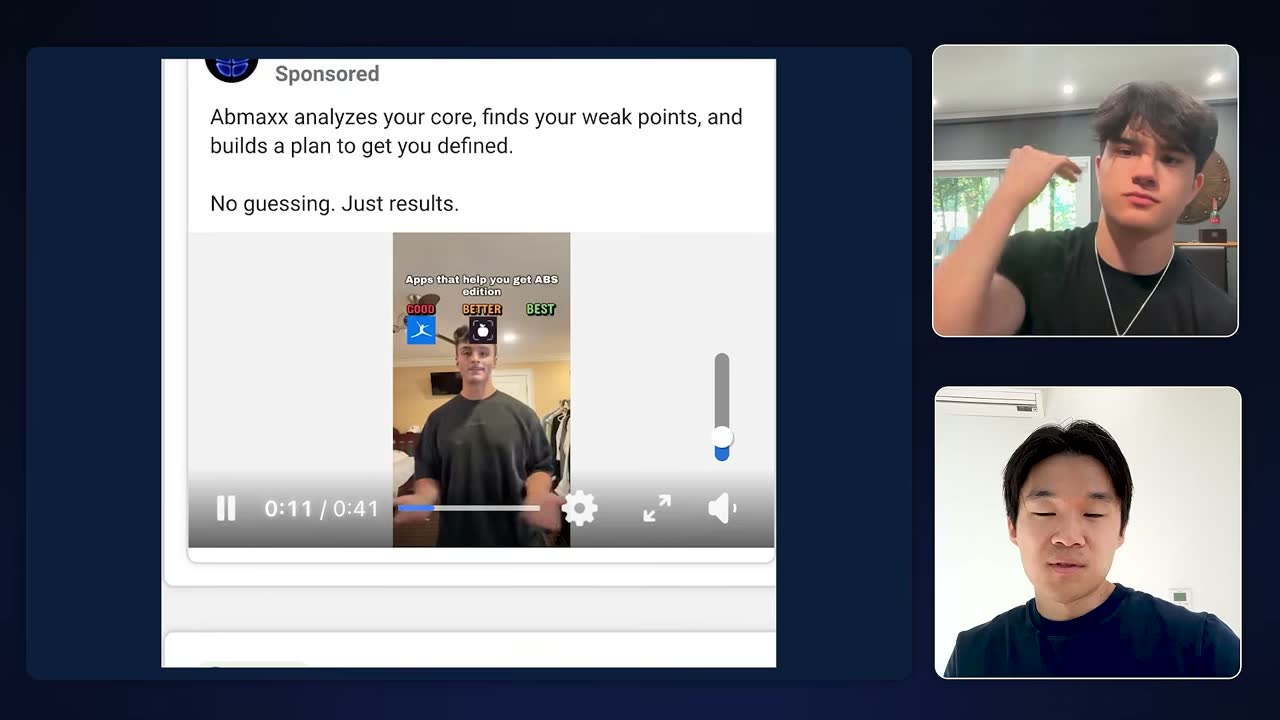
Abmaxx sponsored video ad ranking ab apps "good, better, best," which promotes Cal AI. AI keeps the team at about 20 people. Ladder has nearly 200,000 members and 18 programs with about 20 staff, no full-time managers, and one person working only on AI. Its workout modifications feature swaps movements while keeping the coach's programming intact.
Ladder used cohort-based UA financing and accepts HSA payments. It used General Catalyst's financing, which covers up to 80% of a monthly cohort's acquisition spend at roughly 10% annualized interest, repaid from that cohort. Few apps accepted HSA before Ladder; one user saves about 30 to 40% by switching billing to it.
Its Hilary Duff partnership is brand marketing that cannot yet show ROI but brought a sizable influx almost immediately.

The Art of Driving Retention Through Product – Ben Gammon, Ladder
Built retention around getting results, set a target of three workouts a week, and added a journal that about 70 to 75% of users log in each workout. About a third of users have the widget, and a year-end survey with 7,500+ responses led to the nutrition launch, where hybrid users convert and retain better.
Skip the credit card on trials and get users through first workouts. No Ladder competitor skips the credit card, but Ladder takes none for its trial, reasoning that a better product benefits from more people trying it. Product effort goes into getting users through their first couple of workouts.
Ladder hides its paywall for 7 days, so it earns nothing unless it brings users back.
Longer onboarding builds sunk cost and richer ad signals. Phil Carter cites Ladder as an example of heavy onboarding investment: more questions allow better personalization, and time invested makes users more likely to start a trial.
George, an app maker, studied Ladder's onboarding while spending about six hours buying and going through competitors' apps. Quote: "they've invested enough time already that they're more inclined to at least start a trial."

How Ladder Nailed Product/Channel Fit on TikTok and Meta to Grow 2,000%
Grew subscribers 2,000% after fixing its price and funnel and using coach-led organic TikTok content plus a persona quiz. Cut its $60 plan to one $30 plan, skips the credit card for trials, and has nearly 200,000 members, 18 programs and about 20 staff.
Ladder used cohort-based UA financing and accepts HSA payments. It used General Catalyst's financing, which covers up to 80% of a monthly cohort's acquisition spend at roughly 10% annualized interest, repaid from that cohort. Few apps accepted HSA before Ladder; one user saves about 30 to 40% by switching billing to it.
Its Hilary Duff partnership is brand marketing that cannot yet show ROI but brought a sizable influx almost immediately.

Meet the ex-wrestler making $41k/mo with AI apps
Hides its paywall for 7 days, so it must bring users back to earn anything. George studied its onboarding.
Ladder ties to an identity and a repeated habit. Ladder is cited as an app people use because "I am fit, so I use Ladder." Fitness apps like Ladder and Gravl differ mostly in opinion and brand, like Coca-Cola versus Pepsi.
Andrew Maguire: "Your quality of your product will drive down your cost of acquisition."
Abmaxx sponsored video ad ranking ab apps "good, better, best," which promotes Cal AI. Ladder used cohort-based UA financing and accepts HSA payments. It used General Catalyst's financing, which covers up to 80% of a monthly cohort's acquisition spend at roughly 10% annualized interest, repaid from that cohort. Few apps accepted HSA before Ladder; one user saves about 30 to 40% by switching billing to it.
Its Hilary Duff partnership is brand marketing that cannot yet show ROI but brought a sizable influx almost immediately.
Make Ugly Ads to Grow Your App – Yuliya Lennox (Solid Starts)
Its CEO planned to figure out marketing and then hand it off. Its Hilary Duff partnership is brand marketing that cannot yet show ROI but brought a sizable influx almost immediately.
Ladder used cohort-based UA financing and accepts HSA payments. It used General Catalyst's financing, which covers up to 80% of a monthly cohort's acquisition spend at roughly 10% annualized interest, repaid from that cohort. Few apps accepted HSA before Ladder; one user saves about 30 to 40% by switching billing to it.
Its Hilary Duff partnership is brand marketing that cannot yet show ROI but brought a sizable influx almost immediately.
The Bootstrapper's Path to $10M ARR Without Venture Capital – Andrew Maguire, Volo Ventures
It differs from Gravl in structure and opinion, which people like. It used General Catalyst's cohort-based user acquisition financing.
Coaches whose physiques prove the result make strong short-form creative. Ladder's coaches are full-time teammates and creators, and their physiques show the result of hard strength workouts, an example of product/channel fit in fitness.
Stewart calls in-house coach-creators a superpower for the creative loop. Brett Bauman cites Ladder as a wow app where the coach's voice makes it feel like the user's own app.
How Removing the Free Trial Grew Monthly Subs 2000% – Nancy Anderson, Natal
Few apps accepted HSA before Ladder. One Ladder user switched billing to HSA and saves about 30 to 40% on a subscription he already paid for.
Teach a feature while users are doing it. Coaches mention the journal in workout voiceovers ("pop open that journal, swipe up, input those weights") and explain why, starting in a welcome workout. Gammon says this is 10x more effective than FAQs.
Push and email come only after the in-product loop exists. Coaches also remind users to set weights and, after nutrition launched, prompt meal logging tied to goals. The evidence is correlation, not a before-and-after test.
How Cal AI Hit $50M ARR in 2 Years by Nailing Product/Channel Fit on TikTok
Uses influencer coaches whose physiques prove the result of hard strength workouts, an example of product/channel fit in fitness.
Logged weights come back as personalized recommendations next session. Users log reps, weights and cardio in the workout player, and the next session opens with a recommended weight; a post-workout summary shows gains since starting. About 70 to 75% of users log in the journal each workout.
Logging feels like a reward to users while feeding a flywheel for the business. Phil Carter cites this adaptation as one-of-one personalization that helped Ladder win a crowded category. The journal itself came from users seen tracking in spreadsheets and Apple Notes.
Launch coaches where quiz data shows unmet demand. Millions of quiz responses show users' goals, styles and equipment and where the roster has holes; a surge of women wanting bodybuilding led to that team. Ladder launched only three coaches last year and still grew more than 2.5x.
Ladder also sized user pockets by home or gym and gender, then picked coaches to attract each.
Protecting Freemium at 100M Users AND Driving $500M Revenue – Giordano Contestabile, Life360
Its coaches remind users to set their weights and explain why, and after nutrition was added they began prompting meal logging tied to goals. It is cited as an example of contextual feature education.
Coaches whose physiques prove the result make strong short-form creative. Ladder's coaches are full-time teammates and creators, and their physiques show the result of hard strength workouts, an example of product/channel fit in fitness.
Stewart calls in-house coach-creators a superpower for the creative loop. Brett Bauman cites Ladder as a wow app where the coach's voice makes it feel like the user's own app.
Ladder ties to an identity and a repeated habit. Ladder is cited as an app people use because "I am fit, so I use Ladder." Fitness apps like Ladder and Gravl differ mostly in opinion and brand, like Coca-Cola versus Pepsi.
Andrew Maguire: "Your quality of your product will drive down your cost of acquisition."
Abmaxx sponsored video ad ranking ab apps "good, better, best," which promotes Cal AI.
The AI Growth Playbook for Subscription Apps – Phil Carter, Elemental Growth
Adapts weights from each logged workout. It sized user pockets by home or gym and gender, then picked coaches to attract each one.
Longer onboarding builds sunk cost and richer ad signals. Phil Carter cites Ladder as an example of heavy onboarding investment: more questions allow better personalization, and time invested makes users more likely to start a trial.
George, an app maker, studied Ladder's onboarding while spending about six hours buying and going through competitors' apps. Quote: "they've invested enough time already that they're more inclined to at least start a trial."
COPY this ai app's $6.7m/yr marketing strategy
Brett's example of a wow app: a repeatable use case tied to identity, with a coach's voice that makes it feel like his own app.
Ladder ties to an identity and a repeated habit. Ladder is cited as an app people use because "I am fit, so I use Ladder." Fitness apps like Ladder and Gravl differ mostly in opinion and brand, like Coca-Cola versus Pepsi.
Andrew Maguire: "Your quality of your product will drive down your cost of acquisition."
Abmaxx sponsored video ad ranking ab apps "good, better, best," which promotes Cal AI.
Insights from RevenueCat’s 2026 State of Subscription Apps Report
Cited as an example of heavy investment in onboarding.
Ladder worked back from five-star reviews to a three-workouts-a-week target. Its five-star reviews shared one theme, getting results, which in fitness means consistency. The target went from four workouts a week to three, backed by science, and became the north star every retention feature ladders up to.
The ethos is "don't make me think": the user presses play and does the workout. Gammon says the result must be named in words that work for users and the team.
Logged weights come back as personalized recommendations next session. Users log reps, weights and cardio in the workout player, and the next session opens with a recommended weight; a post-workout summary shows gains since starting. About 70 to 75% of users log in the journal each workout.
Logging feels like a reward to users while feeding a flywheel for the business. Phil Carter cites this adaptation as one-of-one personalization that helped Ladder win a crowded category. The journal itself came from users seen tracking in spreadsheets and Apple Notes.
Accumulated history makes the product sticky. Data builds from one lift to every lift to the profile, and users grow proud of it. Someone with a year of workouts, streaks and progress does not want to lose it by switching.
Quote: "as you build state, it becomes sticky."
Teach a feature while users are doing it. Coaches mention the journal in workout voiceovers ("pop open that journal, swipe up, input those weights") and explain why, starting in a welcome workout. Gammon says this is 10x more effective than FAQs.
Push and email come only after the in-product loop exists. Coaches also remind users to set weights and, after nutrition launched, prompt meal logging tied to goals. The evidence is correlation, not a before-and-after test.
A simple game of check marks extends outside the app via a widget. Each workout earns a check mark, three make a weekly streak, and a home screen widget shows it. About a third of users have the widget.
The widget acts as a billboard others may ask about, which can drive referrals. Gammon says benchmarks are tough so he can't say whether a third is good.
Ask for the widget only after earning trust, with instructions. The widget prompt can't be the first thing shown, and adding a widget is not intuitive, so Ladder positions it later with step-by-step instructions.
Quote: "it can't be the first thing that you show you know you haven't earned that trust."
Large recurring surveys beat a handful of interviews for the roadmap. Ladder's year-end survey has 80 to 90 questions, takes over 45 minutes, and drew 7,500+ responses, parsed with AI. Five or ten interviews are only an N of five or ten in a diverse consumer base.
Feedback comes in three buckets: acute pain via Slack and in-app forms, surveys, and dogfooding. In-app chat also enabled a survey with 5,000 replies; member requests led to an apparel store, held until demand was clear. Questions must not be biased or leading.
Nutrition came from survey demand and became a second retention lever. The end-of-2024 survey showed clear demand for nutrition as a multiplier on results, and Ladder built and launched it within about a year. Hybrid users of workouts and nutrition convert at a much higher rate and retain better.
The team worked from first principles: which methods work and what people use today. Results cover only 100 days, and Gammon says it is tough to map them to retention that early.
Judge a new feature on early logging and week 2 to 4 retention. Because "people say stuff that doesn't map to reality," Ladder checks whether users log on day one and day two and looks at week 2, 3 and 4 retention before long-term data exists.
$6.7M ARR, No Paid Ads, and an Exit to Quizlet in 2 Years – Brett Bauman & Zack Hargett, Coconote
Cited as an example of an app tied to identity and repeated action, where people think 'I am fit, so I use Ladder'.
Facebook ads failed because the funnel couldn't activate low-context users. After its 2021 seed round Ladder spent about three months on Facebook ads through an agency, during iOS 14 and heavy pandemic bidding by big fitness brands. The math did not work, so it stopped and spent the rest of the year rebuilding monetization and onboarding.
Early users came from coaches with 5,000 to 15,000 Instagram followers and already knew the coach, but ad users arrived with no context. Organic coach launches brought a flood of sign-ups that faded, which Stewart calls "the opposite of an engine." He says they picked the wrong agency and should never have hired one; he now runs TikTok Ads Manager himself and says "you have to be black belt at growth and product."
Research why a price is too high before cutting it. Ladder launched at $60 a month, priced around a chat-with-coach feature. Van Westendorp and conjoint research, segmented by how much context users had, showed people compared it to Spotify or Netflix at $9.99 to $15 and did not value the chat, so Ladder cut the chat and moved to one $30 plan.
The chat was the costliest feature to maintain and helped neither retention nor conversion. The whole team paused growth work for the overhaul, and onboarding was rebuilt to reach a first workout fast. Phil Carter notes copying competitors' prices is only a jumping-off point.
Skip the credit card on trials and get users through first workouts. No Ladder competitor skips the credit card, but Ladder takes none for its trial, reasoning that a better product benefits from more people trying it. Product effort goes into getting users through their first couple of workouts.
Ladder hides its paywall for 7 days, so it earns nothing unless it brings users back.
Prove creative with organic content before spending a dollar on ads. With finite runway, the team stopped building features, mapped growth loops, ruled out SEO as too small, and launched a TikTok handle with one coach that went from zero to 250,000 followers in about 50 days. Paid started at about $50 a day, replicating winning organic videos, sometimes with identical creative.
No money went to TikTok until organic showed creators could win, reach the right consumer, move them through the link in bio, and scale. The team also read comments to check persona fit: "are the comments men talking about her outfit or are they women talking about the workout." Stewart calls creative arguably the most important skill to master.
Coaches whose physiques prove the result make strong short-form creative. Ladder's coaches are full-time teammates and creators, and their physiques show the result of hard strength workouts, an example of product/channel fit in fitness.
Stewart calls in-house coach-creators a superpower for the creative loop. Brett Bauman cites Ladder as a wow app where the coach's voice makes it feel like the user's own app.
Fix the funnel one step at a time, not every metric at once. On Facebook the team chased clicks, first workouts and paid conversion together and could not go deep on any. On TikTok they mapped the funnel and went in order: creative, click, homepage, then quiz.
Build the short-form video motion so it doesn't depend on TikTok. When a TikTok ban first passed, Ladder reused the same creators and strategy on Instagram Reels. Meta now drives more leads than TikTok on roughly every other day.
Ladder is also adding PR and brand campaigns to reach people outside its audience. "We are not just a TikTok business."
A web quiz reveals who each ad reaches within minutes. Sending users straight into the app gave no visibility, so Ladder built a web quiz that identifies the persona and recommends a program. Certain answers define the "white hot persona," and about 10 minutes after launching an ad the team can read how well it reaches that person.
The team spent about four months on the quiz alone, with every question printed on an office wall next to live metrics, and marketing screens between questions reinforce value based on answers. Because it runs on the web, data flows back to ad networks, unlike an app install after ATT. It targets strength-focused enthusiasts, not casual cardio users who are expensive to acquire.
Every feature is judged by whether it adds completed workouts. Ladder's north star for anything it builds is workout completions. It checks whether features like cheers correlate with long-term retention; members average eight or nine cheers per workout, and cheers received correlated with retention.
Badges and streaks were each built only with insight that they could add workouts.
Small coach-led teams turn the app into a community. Users join coach-led teams with in-app group chats of people on the same persona and workout, plus topic chats and geo chat rooms for major metros. In surveys, the top unexpected benefit is making friends in real life.
Logged weights come back as personalized recommendations next session. Users log reps, weights and cardio in the workout player, and the next session opens with a recommended weight; a post-workout summary shows gains since starting. About 70 to 75% of users log in the journal each workout.
Logging feels like a reward to users while feeding a flywheel for the business. Phil Carter cites this adaptation as one-of-one personalization that helped Ladder win a crowded category. The journal itself came from users seen tracking in spreadsheets and Apple Notes.
Launch coaches where quiz data shows unmet demand. Millions of quiz responses show users' goals, styles and equipment and where the roster has holes; a surge of women wanting bodybuilding led to that team. Ladder launched only three coaches last year and still grew more than 2.5x.
Ladder also sized user pockets by home or gym and gender, then picked coaches to attract each.
Vet coaches with a paid test week, not follower counts. After several meetings, each coach programs a paid week of workouts in Ladder's tools, which the team does and rates, plus simulated intro videos, voiceovers and chat. Most pass because filtering happens earlier.
Ladder found audience size a poor measure of programming quality or team fit, and the biggest followings are typically not on its roster.
Large recurring surveys beat a handful of interviews for the roadmap. Ladder's year-end survey has 80 to 90 questions, takes over 45 minutes, and drew 7,500+ responses, parsed with AI. Five or ten interviews are only an N of five or ten in a diverse consumer base.
Feedback comes in three buckets: acute pain via Slack and in-app forms, surveys, and dogfooding. In-app chat also enabled a survey with 5,000 replies; member requests led to an apparel store, held until demand was clear. Questions must not be biased or leading.
AI keeps the team at about 20 people. Ladder has nearly 200,000 members and 18 programs with about 20 staff, no full-time managers, and one person working only on AI. Its workout modifications feature swaps movements while keeping the coach's programming intact.
More in Health & Fitness
 Health & Fitness
Calm
A meditation and sleep app with guided sessions and celebrity-narrated Sleep Stories.
 45 sources · 102 tips
 Health & Fitness
Cal AI
A calorie tracking app that logs meals from photos, grown largely through influencer and UGC videos.
28 sources · 104 tips Health & Fitness
Headspace
A meditation and mental wellness app with guided sessions and subscriptions.
 27 sources · 50 tips
 Health & Fitness
Flo
A data tool that combines app analytics into one view and is adding AI agents.
 10 sources · 31 tips
 Health & Fitness
Zero
An intermittent fasting tracker app that teaches fasting and builds habits toward metabolic health.
6 sources · 21 tips Health & Fitness
Rise
A sleep and energy app that helps people track and pay down their sleep debt.
3 sources · 29 tips Health & Fitness
Runna
A personalized running coach app that builds adaptive training plans around a runner's race goals.
6 sources · 28 tips Health & Fitness
Strava
A fitness social platform for runners and cyclists.
13 sources · 13 tips